GCSE English Literature Extra Reading: How Much?
GCSE English Literature extra reading explained: what helps, what wastes time, and how to balance set texts with focused maths exam revision each week.
The uncomfortable part of GCSE revision is not always the work itself. It is wondering whether you are doing enough. One student is rereading Macbeth. Another claims to be working through Victorian novels for context. Meanwhile, your maths paper still contains topics you cannot confidently start.
Here is the short answer: GCSE English Literature extra reading can help, but reading more books is rarely the best first use of revision time. You will usually gain more from knowing your prescribed texts deeply, practising analytical writing and preparing for unseen material. Once those foundations are secure, a modest amount of carefully chosen reading can broaden your vocabulary and interpretations.
There is no official weekly reading quota. For most students balancing English with maths and other GCSEs, roughly 303030 to 606060 minutes of purposeful extra reading per week is plenty. If you have gaps in your set-text knowledge, that time is better spent closing them first.
The practical answer at a glance
Before opening another novel, ask whether you can already:
- explain the plot, characters and central themes of every prescribed text;
- locate short, flexible quotations for major ideas;
- analyse language, form and structure;
- connect relevant context to the writer's choices;
- compare poems without simply listing similarities;
- respond to unseen poetry under timed conditions;
- plan and write an argument that answers the exact question.
If several answers are no, extra reading should wait. Rereading a difficult act, chapter or poem is not glamorous, but it is closer to what the examination rewards.
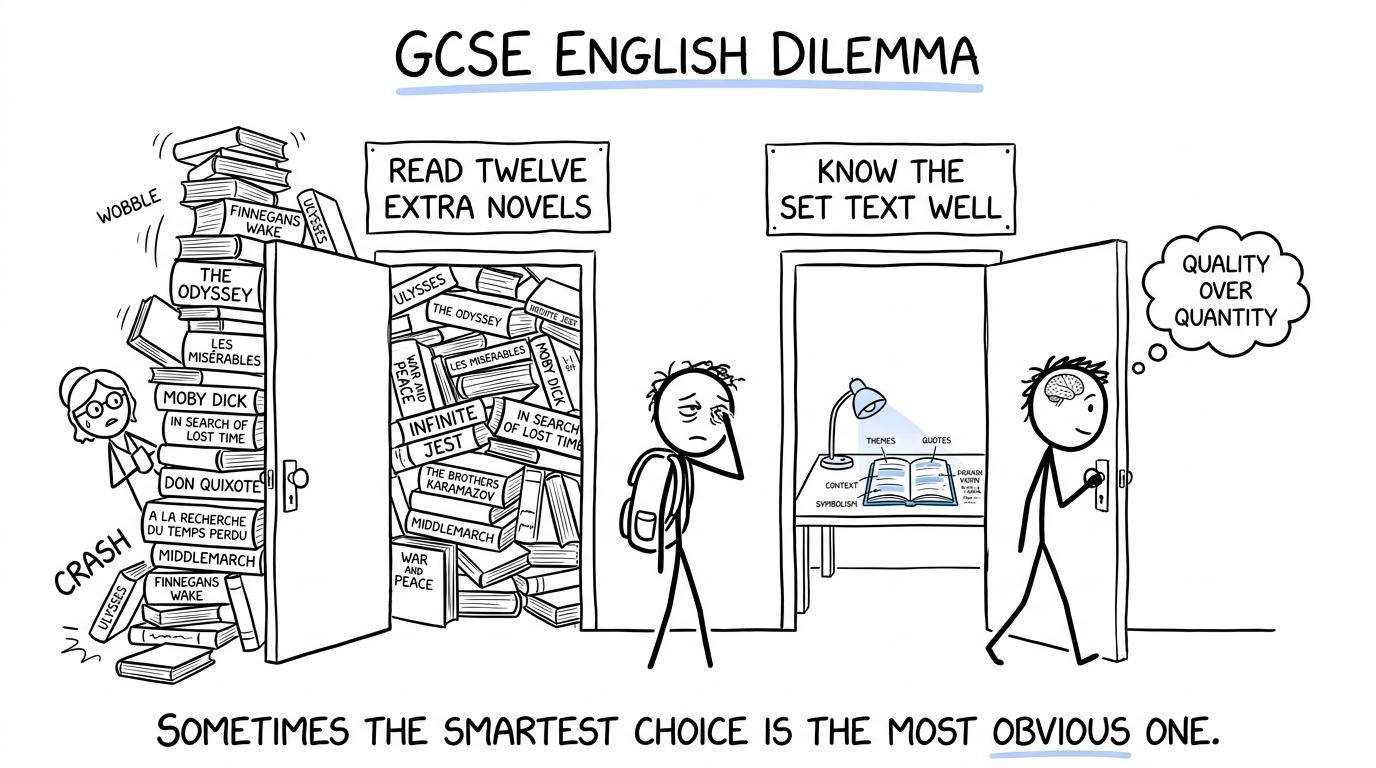 A student choosing knowledge of the set text over a wobbling mountain of extra books
What GCSE English Literature actually assesses
Official GCSE subject content encourages students to read widely and often. That is a valuable long-term aim. Yet the examination does not generally award marks because you completed a separate reading list.
Across AQA, Edexcel, OCR and Eduqas, the exact paper structures and prescribed texts differ. However, specifications broadly assess your ability to:
- read, understand and respond to literary texts;
- develop an informed, critical interpretation;
- support ideas with textual references;
- analyse language, form and structure;
- understand relevant relationships between texts and contexts;
- write clearly and accurately;
- compare writing where the question requires it.
The courses involve prescribed whole texts, such as a Shakespeare play, nineteenth-century prose, modern prose or drama, and poetry. Unseen material also matters, although its placement and format depend on the exam board. Current specifications for Edexcel, OCR and Eduqas describe closed-text examinations, and students should always confirm the precise arrangements for their own board with their teacher and current specification.
The key distinction is simple: broad reading may improve the skills behind your answers, but marks come from applying those skills to the task in front of you.
When extra reading genuinely helps
It develops confidence with unfamiliar language
Regular reading makes complex sentences feel less hostile. This can be useful when you encounter Shakespeare, nineteenth-century prose or an unseen poem. You become more accustomed to using context clues, noticing tone and tolerating the temporary uncertainty of not understanding every word.
That benefit develops gradually. It is closer to physical fitness than last-minute memorisation. Reading one large classic a fortnight before the examination is unlikely to transform your analysis.
It gives you more points of comparison
A short related poem, speech or story can sharpen your understanding of a theme such as power, conflict, responsibility or identity. The purpose is not to force the extra text into your examination answer. It is to notice that writers can approach similar ideas in different ways.
This can support a more informed personal response, provided your argument remains anchored in the prescribed text.
It strengthens vocabulary through context
Reading exposes you to words as they are actually used. That is more useful than collecting impressive adjectives with uncertain meanings. Precise words such as ambivalent, idealised or oppressive can improve an argument, but only when they express what you genuinely mean.
It supports unseen poetry preparation
Unseen poetry is the clearest case for reading beyond your anthology. You do not need to consume entire collections. Reading one unfamiliar poem and briefly considering its speaker, tone, structure and central tension is focused preparation.
The important step is responding, not merely reading. Ask what changes across the poem and which choices create that change.
What to read if your time is limited
Think in layers. Move to the next layer only when the earlier one is reasonably secure.
Your prescribed texts
A second reading of the actual play, novel or anthology is usually more valuable than a first reading of something unrelated. You notice patterns that were invisible when you were still trying to follow the plot.
You do not always need to reread from the first page. Target the sections you understand least, then reconnect them to the work as a whole.
Short related material
Choose material that can be completed in one sitting: a poem from the same period, a short speech, a relevant letter by the author or a brief piece of literary non-fiction. Keep the purpose narrow. You might be investigating how another writer presents social class, not attempting to become an expert on an entire century.
Reliable contextual reading
Context is useful when it changes your interpretation of the writing. A short explanation of social attitudes, theatrical conventions or the author's concerns may help. Pages of dates that never enter your argument probably will not.
Context should illuminate the text rather than sit beside it as a rehearsed paragraph.
Reading for pleasure
Pleasure reading still matters. It can build fluency, attention and vocabulary without turning every page into another test. During an intense examination period, however, it is reasonable to treat this as recreation rather than compulsory revision.
A sensible weekly time budget
Extra reading has an opportunity cost. An hour spent on an unrelated novel is an hour unavailable for algebra, geometry, science recall or a timed English response.
A practical weekly structure might be:
- one short session of 151515 to 202020 minutes reading an unfamiliar poem or related passage;
- one session of 202020 to 303030 minutes revisiting part of a set text;
- a few minutes recording one useful observation, rather than producing pages of notes.
This is guidance, not an exam-board rule. If you cannot explain a major character or theme, transfer the optional-reading session to your prescribed text. If your English knowledge is secure but your maths remains uneven, direct more time towards GCSE Maths revision lessons and practice.
A revision timetable is really a statement about priorities. The MathsGenie guide to building a GCSE revision timetable can help you distribute limited time according to weaknesses rather than anxiety.
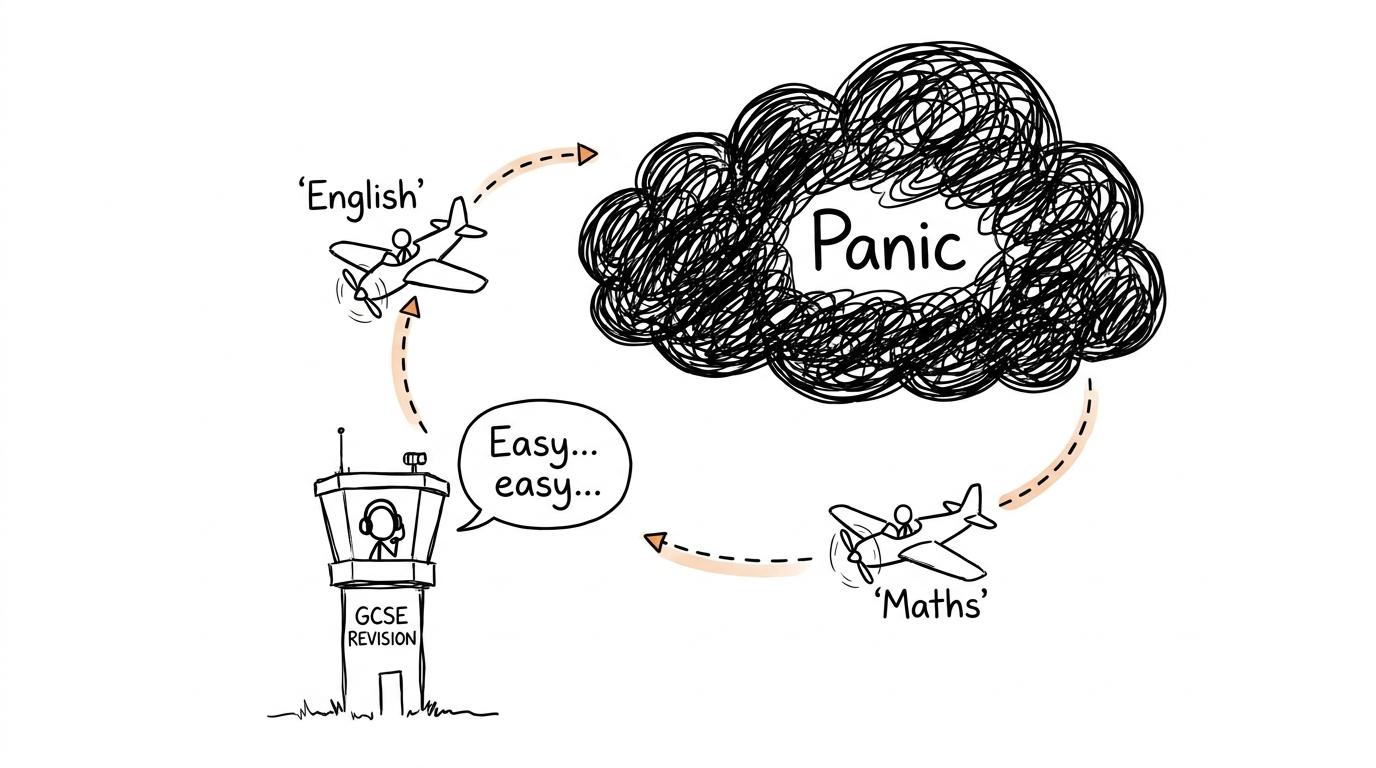 A tiny revision control tower keeping English and maths away from the cloud of panic
Where your time is often better spent
Active recall of the set texts
Close the book and reconstruct the plot, character development or sequence of important moments. Then check what you missed. This reveals gaps more honestly than repeatedly reading highlighted pages.
For quotations, prioritise short, accurate fragments that can support several themes. You need enough textual knowledge to make a precise argument, not a memorised script for every possible question.
Planning arguments
Take a question and decide your central answer before collecting evidence. Each paragraph should advance that answer. This is more useful than writing generic essays about a character and hoping the right question appears.
Timed analytical writing
Knowing a text and writing about it under pressure are different skills. Timed paragraphs and essays teach you to select evidence, develop analysis and move on. Mark schemes and teacher feedback then show where the answer became descriptive or lost focus.
Unseen practice
A student can read poetry every week yet still struggle to organise an examination response. Practise the complete process: read, identify a developing idea, select evidence, analyse methods and manage the available time.
Targeted maths revision
English Literature is untiered, whereas GCSE Maths has foundation and higher tiers. Your revision allocation should reflect the papers you will actually sit and the marks you currently lose.
If maths feels difficult, the answer is rarely to avoid it with a more comfortable subject. The guide to making GCSE Maths feel more manageable explains how topic practice turns unfamiliar questions into recognisable patterns. Students working around the pass boundary can also use the focused pass-grade revision strategy to prioritise methods and reduce blank answers.
Common mistakes with GCSE English Literature extra reading
Reading summaries instead of the text
A summary can repair confusion, but it cannot reproduce the writer's language, structure or dramatic choices. Use it as support, not substitution.
Choosing impressive but irrelevant books
A difficult novel is not automatically useful. Ask what the reading will improve and whether a shorter source could do the same job.
Collecting context without making connections
Historical information earns its place only when it helps explain an interpretation. Avoid attaching a memorised fact to every paragraph regardless of the question.
Memorising excessively long quotations
Long quotations consume revision time and are easier to recall inaccurately. Short textual references are often more flexible and leave space for analysis.
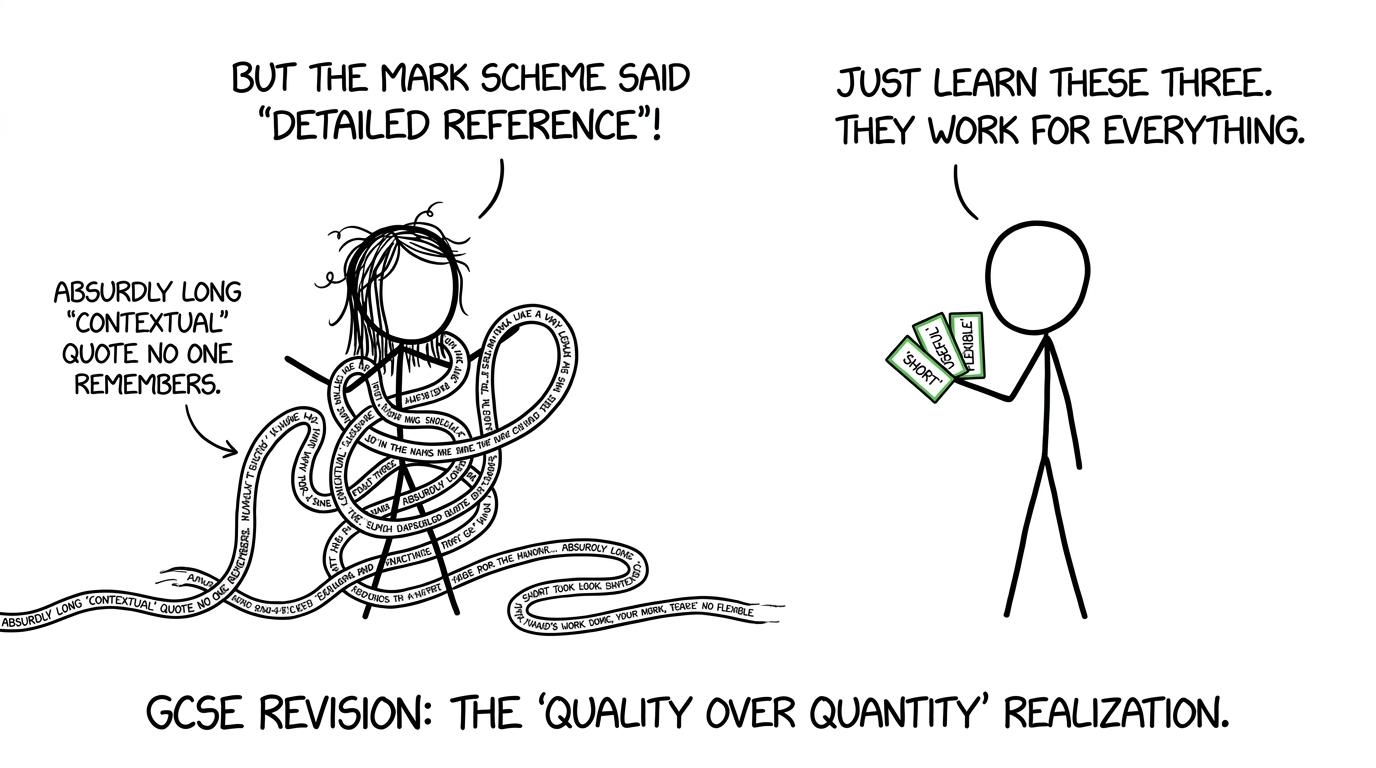 One student tangled in a giant quotation while another holds three short flexible quotation cards
Allowing English to replace weak-subject revision
Reading can feel productive and calm. A difficult maths topic may not. That emotional difference is not evidence that reading deserves more time. A good plan gives priority to the work most likely to recover marks.
Read with a purpose, then practise what earns marks
Extra reading is useful when it is modest, relevant and built on secure knowledge of the prescribed texts. It should broaden your thinking, not become a new syllabus you feel guilty about completing.
Start with the book, play and poems you will be examined on. Practise turning knowledge into a focused argument. Use occasional unfamiliar texts to strengthen reading confidence and unseen analysis. Then protect enough time for every other subject demanding attention.
For maths, make MathsGenie your free revision base. Use revision lessons to relearn a method, practice questions and mini tests to build fluency, then past papers, predicted papers, mark schemes and video solutions to sharpen examination technique. The goal is not to fill every available hour. It is to spend each hour on work that has a clear reason behind it.