GCSE English Literature Careers: What It Helps With
GCSE English Literature careers explained: discover where the grade gets noticed, which apprenticeships value it and what skills employers see.
A GCSE student can spend months learning quotations, analysing motives and comparing poems, then leave the exam wondering: When will any employer care about this?
The honest answer is that GCSE English Literature careers are not confined to becoming an author or English teacher. The qualification can support routes into publishing, journalism, marketing, law, public relations, education, heritage and the Civil Service. It may also satisfy the English requirement for some apprenticeships in England.
But there is an important distinction. GCSE English Literature rarely qualifies you for a career by itself. Its value lies in the doors the grade may help keep open and the skills behind it: analysing evidence, constructing arguments, interpreting unfamiliar material and communicating clearly.
The short answer: where does English Literature help?
A good GCSE English Literature grade can be useful when you apply for:
- sixth-form or college courses involving English, history, politics, media or humanities
- apprenticeships that accept a GCSE with English in the title
- junior roles involving writing, research, customers or communication
- future degree routes such as English, journalism, law, publishing and marketing
- competitive applications where strong overall GCSE results matter
It is especially relevant to careers in publishing, journalism, content, advertising, public relations, education, law, heritage, libraries, theatre and government communications.
Its usefulness is broader than that list suggests. A software company needs clear instructions. An engineering business needs persuasive bids. A charity needs funding applications. A financial firm needs reports that people can understand. Literature does not provide the specialist knowledge for these jobs, but it helps develop the communication and reasoning that sit alongside it.
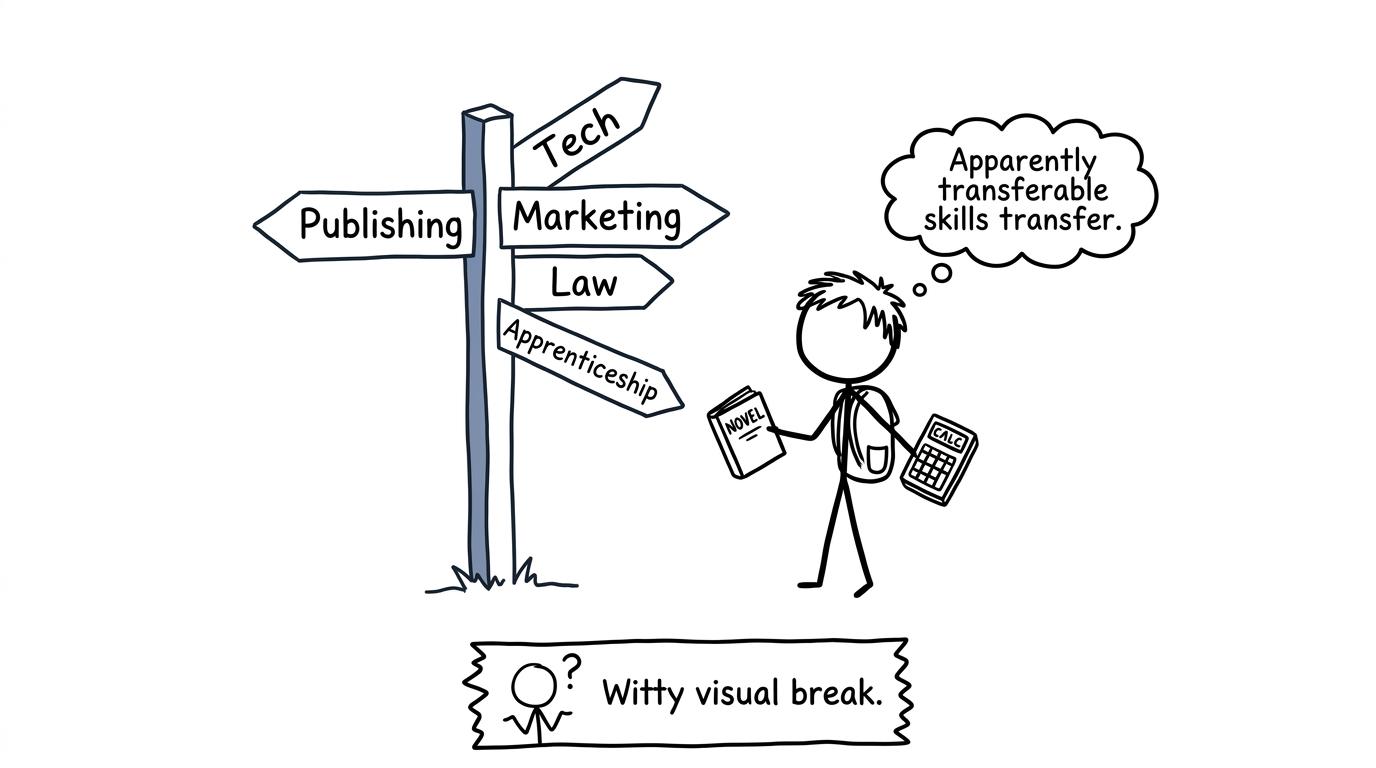 A student holding a novel and calculator at a career crossroads
English Literature and English Language are not interchangeable everywhere
This is the detail students should check before making career decisions.
Employers and course providers often write “GCSE English” in their requirements. Sometimes they accept either English Language or English Literature. Sometimes they specifically require English Language. Teacher training providers, universities and individual employers may apply their own criteria, so you should never assume that one automatically replaces the other.
For apprenticeships in England, current Department for Education guidance lists any regulated GCSE with English in the title as an acceptable English qualification, subject to the required level and grade. A GCSE grade 4 can therefore count as a level 2 English qualification under that framework, including English Literature.
That does not mean every vacancy must accept it. Apprenticeship entry requirements vary by employer, occupation and level. If an advert says “English Language at grade 4”, treat that wording literally and ask the employer or training provider if you are unsure.
Rules and qualification systems also differ across England, Wales, Scotland and Northern Ireland. Always check the current vacancy rather than relying on a general careers list.
Careers where the grade is most relevant
Publishing, editing and books
English Literature has an obvious connection with publishing. Editorial assistants, proofreaders, publishing executives and literary agents work closely with written material, although these careers normally require further qualifications, experience or a strong portfolio.
Literature practice develops useful habits: noticing how a sentence changes meaning, identifying inconsistencies and explaining why a piece of writing succeeds or fails. The GCSE grade is an early signal of interest and ability rather than a complete professional qualification.
Journalism, media and content
Journalists and content creators must research information, assess sources, find the important point and adapt their writing for an audience. Those actions closely resemble the thinking behind a strong literature response.
Possible later roles include reporter, editorial assistant, copywriter, scriptwriter, web content editor and media researcher. Routes vary. Some involve A Levels and university, while others begin through media, content or broadcast apprenticeships.
Marketing, advertising and public relations
Marketing is partly about understanding why people pay attention. Public relations is partly about choosing words carefully when those words may shape how an organisation is perceived.
English Literature can therefore support future work in copywriting, social media, campaign planning, brand communications and public relations. Employers will usually care about practical evidence too, such as a portfolio, work experience or a successful campaign for a school club.
Law, government and the Civil Service
A literature GCSE does not make somebody a solicitor or barrister. Those careers require substantial further education and professional training. The connection is the underlying reasoning.
Legal and government work can involve reading dense documents, distinguishing evidence from assertion, recognising alternative interpretations and presenting a structured case. English Literature gives students an early opportunity to practise those habits under exam conditions.
Teaching, libraries and heritage
English teaching is a direct route, but it requires later qualifications. A good literature result can support progression to A Level English and then an appropriate degree or teacher-training route.
Related possibilities include library work, archives, museums, heritage organisations, theatre administration and arts education. Entry requirements vary considerably: some roles offer apprenticeships, while specialist careers such as librarianship or archiving may require higher education or postgraduate training.
Technical and digital communication
One of the less obvious English Literature career paths is technical communication. Technology businesses need people who can turn complicated ideas into instructions, help pages and accessible explanations.
This is where English and maths can form a powerful combination. Maths teaches precision, modelling and logical structure. Literature develops interpretation, argument and sensitivity to audience. Neither subject replaces technical training, but together they can support careers involving data, analysis, user experience, finance or technology.
Apprenticeships where English Literature may get noticed
Relevant apprenticeship areas can include:
- publishing assistant
- content creator
- broadcast production
- public relations and communications
- marketing
- journalism
- library, information or archive services
- business administration
- legal services
- cultural heritage roles
Availability changes by location and employer. The title of an apprenticeship is not a guarantee that English Literature will be preferred, and a good grade does not guarantee selection.
Where the grade can help is in two different ways. First, it may satisfy a stated English entry requirement if the employer accepts Literature. Second, it can support your evidence for skills such as research, written communication and interpreting information.
Before applying, check:
- the exact English qualification named
- the minimum grade
- the apprenticeship level
- whether maths is also required
- any portfolio, experience or subject requirements
- whether the employer accepts equivalent qualifications
This final check matters to MathsGenie students. Many apprenticeships ask for English and maths, so protecting both grades gives you more options. Use the GCSE Maths revision hub to select your exam board and work at the correct foundation or higher tier.
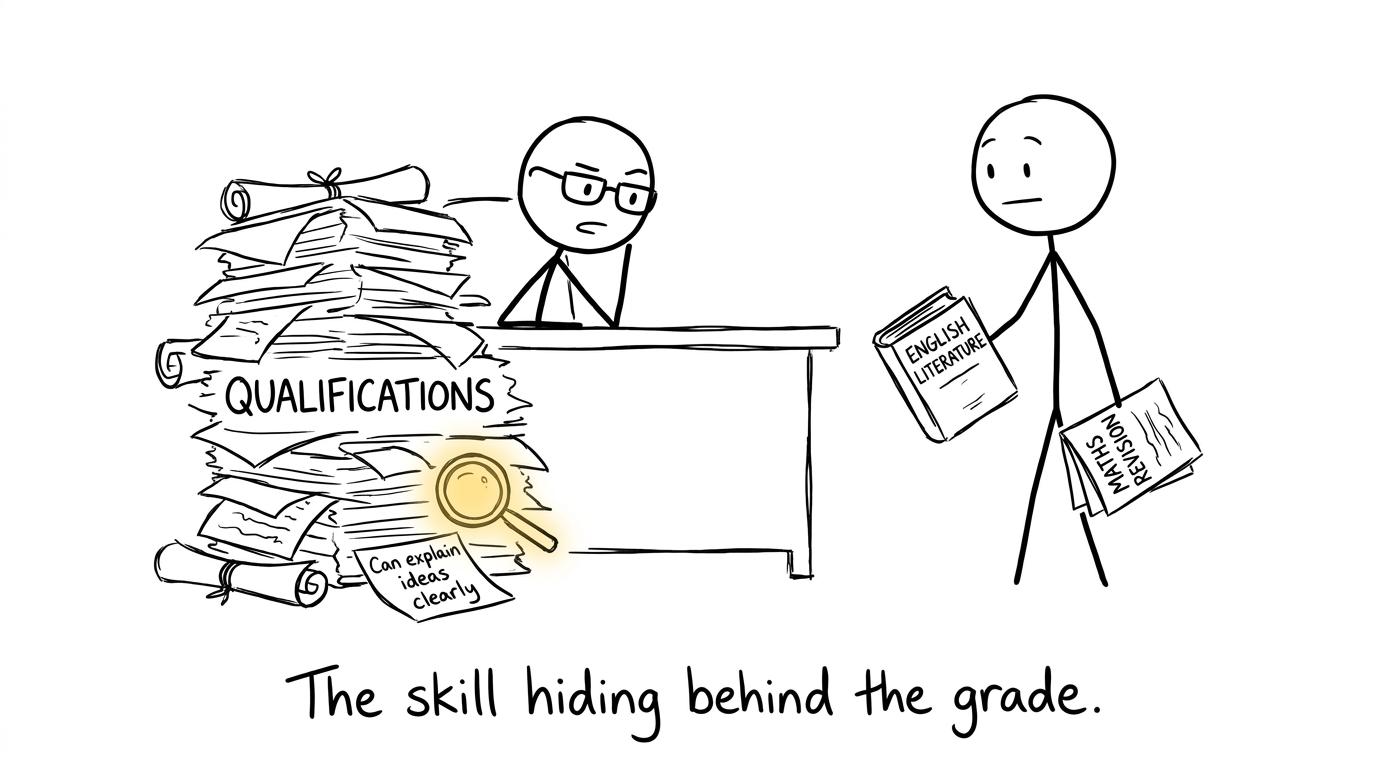 An interviewer finding the communication skill hidden behind qualifications
What employers actually notice behind the grade
A qualification becomes more convincing when you can name the skill it represents.
Evidence-based reasoning
A literature essay is not simply an opinion. You make an interpretation, select evidence and explain how that evidence supports your argument. That pattern appears in reports, recommendations, legal reasoning and business proposals.
Reading beyond the surface
Literature trains you to notice tone, implication, context and conflicting perspectives. In employment, that can help when reading customer feedback, policy documents, research or sensitive communications.
Clear written communication
Strong responses require structure. The reader must be able to follow the argument without guessing what the writer meant. That same discipline matters in emails, applications, reports and instructions.
Working under pressure
GCSE English Literature examinations require students to retrieve knowledge, interpret a question and produce sustained writing within a time limit. The result is not a perfect measure of workplace performance, but preparation builds planning and time-management habits.
How to make the qualification more useful
A grade gets you further when it is paired with evidence.
If publishing interests you, contribute to a school magazine or practise editing. If marketing appeals, help a club communicate an event and record what you produced. If law interests you, try debating, research or relevant work experience. Keep examples of writing, projects and responsibilities so that future applications are specific.
Do the same with maths. Instead of vaguely saying that you are “good with numbers”, build evidence through exam results, projects and confident problem-solving. Start with a diagnostic set from the GCSE predicted papers, then use revision lessons to repair the topics costing you marks.
The MathsGenie guide to finding weak topics explains how to turn lost marks into focused actions. If you need a sustainable schedule across several subjects, adapt the GCSE maths revision timetable rather than trying to revise everything every evening.
Common mistakes when thinking about English Literature careers
Assuming Literature is accepted wherever “English” appears
It often is, particularly within the current English apprenticeship framework in England, but some employers and courses specifically request English Language. Read the exact requirement.
Believing the GCSE directly qualifies you for a profession
Careers such as teaching, law, journalism and librarianship usually need further training, qualifications or experience. The GCSE is a foundation, not the complete route.
Listing a grade without explaining the skill
In an application, connect English Literature to evidence: analysing sources, meeting deadlines, writing clearly or presenting a reasoned conclusion.
Neglecting maths because the career sounds creative
Marketing uses data. Journalism can involve statistics. Publishing has budgets. Apprenticeships commonly include maths requirements. Keep both subjects moving by using MathsGenie past papers with their mark schemes and available worked solutions.
Mistaking passive reading for revision
Rereading feels productive because the material becomes familiar. Familiarity is not the same as retrieval. Test yourself, answer questions and review mistakes. The same principle powers effective maths revision: use past papers properly, then return to targeted practice.
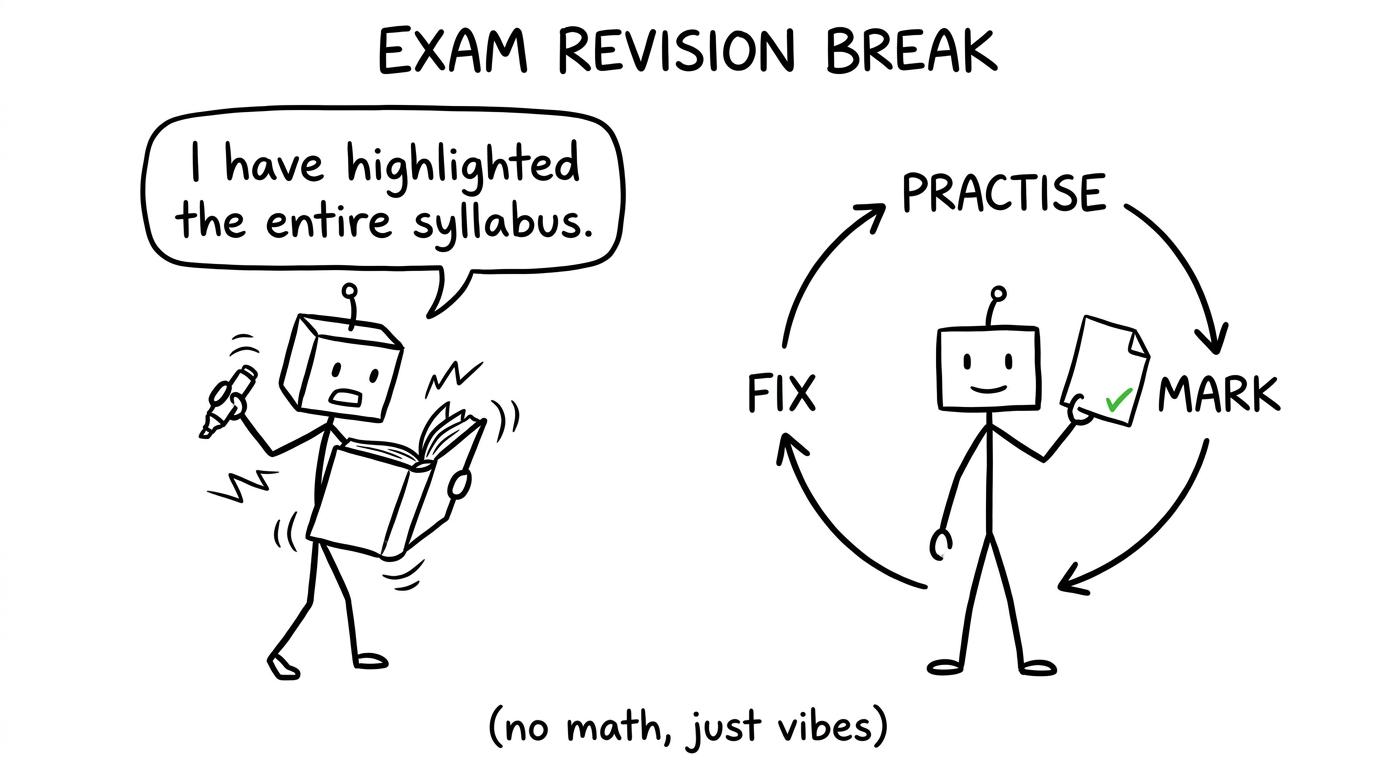 Two revision robots comparing highlighting with practise, mark and fix
Your next step
GCSE English Literature does not lock you into one career. It gives you an early set of tools: close reading, clear writing, evidence-based argument and the ability to consider more than one interpretation. Those tools can support apprenticeships and later careers across communication, law, education, media, heritage, business and technology.
The sensible strategy is to protect your options. Check whether each opportunity asks for English Language, English Literature or either qualification. Build practical evidence around the careers that interest you. And keep strengthening the other core subject employers repeatedly mention: maths.
Open the MathsGenie GCSE revision area, choose Edexcel, AQA, OCR or Eduqas, and begin with one weak topic. Use the free revision lessons and practice questions, check your work with mark schemes and video solutions, then build towards mini tests, past papers and predicted papers. Careers rarely depend on one dramatic revision session. They are shaped by the small doors you keep open.