GCSE English Literature 5 to 8: What Changes?
GCSE English Literature 5 to 8: learn the changes in argument, analysis, evidence, context and timed practice that can lift your exam responses higher.
A grade 555 essay often knows the text, answers the question and includes sensible analysis. A grade 888 response does something more demanding: it sustains a convincing interpretation and examines the writer’s choices with precision. That is the central lesson when moving from GCSE English Literature 5 to 8. You do not simply need more quotations, longer essays or fancier vocabulary. You need to make better decisions with the knowledge you already have.
The shift is from explaining what a text means to building an argument about how and why that meaning is created. This guide shows you the specific changes that can move your writing towards a higher grade band while keeping your maths revision under control.
The grade 555 to grade 888 checklist
Focus your revision on these changes:
- replace a sequence of reasonable points with one sustained argument
- explore implicit meanings rather than stopping at the obvious interpretation
- analyse exact language, form and structure choices
- integrate short, well-selected references into your reasoning
- use context to develop an interpretation, not as detached background
- compare ideas and methods throughout comparative responses
- practise planning and writing under your exam board’s time conditions
- use mark schemes and teacher feedback to identify recurring weaknesses
The difference is not perfection. It is control.
What separates a grade 555 from a grade 888?
Official grade descriptors offer the clearest broad distinction. At grade 555, a student typically develops a generally coherent, engaged response, shows clear understanding of writers’ methods, uses apt references and makes credible comparisons. At grade 888, the response becomes sustained, convincing and perceptive. Analysis is more critical, references are judiciously integrated, contextual understanding is sharper and comparisons can become illuminating.
These descriptors indicate the standard of performance across a qualification. They are not a mechanical checklist or a fixed mark boundary. Grade boundaries change between exam series and specifications, so avoid assuming that a particular raw mark will always equal a particular grade.
| A developing grade 555 habit | A stronger grade 888 habit |
|---|---|
| Answers the question in each paragraph | Sustains one interpretation across the essay |
| Identifies a technique and explains its effect | Examines how language, form or structure shapes meaning |
| Uses relevant quotations | Selects concise evidence that advances the argument |
| Gives a sensible interpretation | Explores implications, tensions or alternative readings |
| Adds contextual information | Uses context to clarify why the text presents an idea in that way |
| Compares obvious similarities | Compares differences in viewpoint, method and effect |
A grade 888 response is usually not distinguished by the number of techniques it names. It is distinguished by the quality of thought connecting evidence to the question.
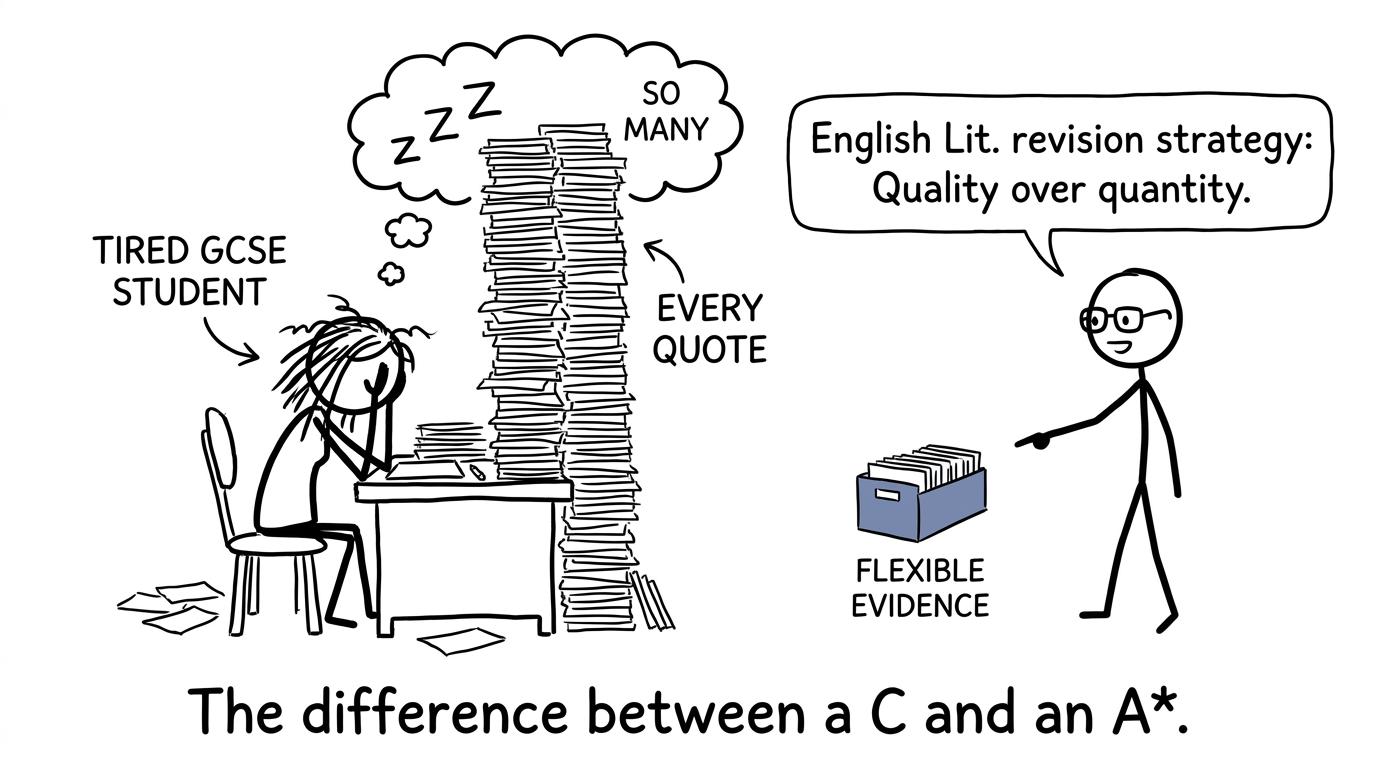 A student choosing flexible evidence over an impossible tower of quotation cards
Build an argument instead of collecting paragraphs
A common grade 555 structure is a set of individually valid paragraphs. One discusses language, another mentions context and another introduces a new idea. Each part may be correct, yet the essay can feel assembled rather than argued.
For a higher-level response, decide your overall interpretation before writing. Your introduction should give a direct answer to the question and establish the line of argument you will develop. Each paragraph should then deepen, complicate or qualify that position.
Before writing, ask:
- What is the writer presenting about this character, relationship or theme?
- Does that presentation change across the text?
- What tension or contradiction could I explore?
- Why might the writer shape the reader’s response in this way?
Your conclusion should not merely repeat the introduction. It should show what your analysis has established about the text as a whole.
Make analysis more precise
AO2 rewards analysis of language, form and structure. Across GCSE English Literature specifications, this is a major part of the assessment. National subject requirements allocate approximately 40%40\%40% to 45%45\%45% of the qualification to AO2, although the way assessment objectives apply to individual questions varies.
The weaker habit is to identify a device and attach a generic effect: a metaphor “creates an image”, or a short sentence “makes the reader want to continue”. Those statements are not always wrong, but they rarely reveal enough about the text.
Instead, slow down around the evidence. Consider:
- the associations of one carefully chosen word
- how imagery develops an idea or relationship
- the effect of contrast, repetition or patterns across the text
- who controls the voice and whose perspective is restricted
- where a scene, revelation or shift occurs in the whole work
- how dramatic form, narrative viewpoint, rhythm or stanza shape matters
Relevant terminology helps you express an insight efficiently. It does not replace the insight. “The writer uses a metaphor” is identification; explaining why that metaphor presents power as unstable is analysis.
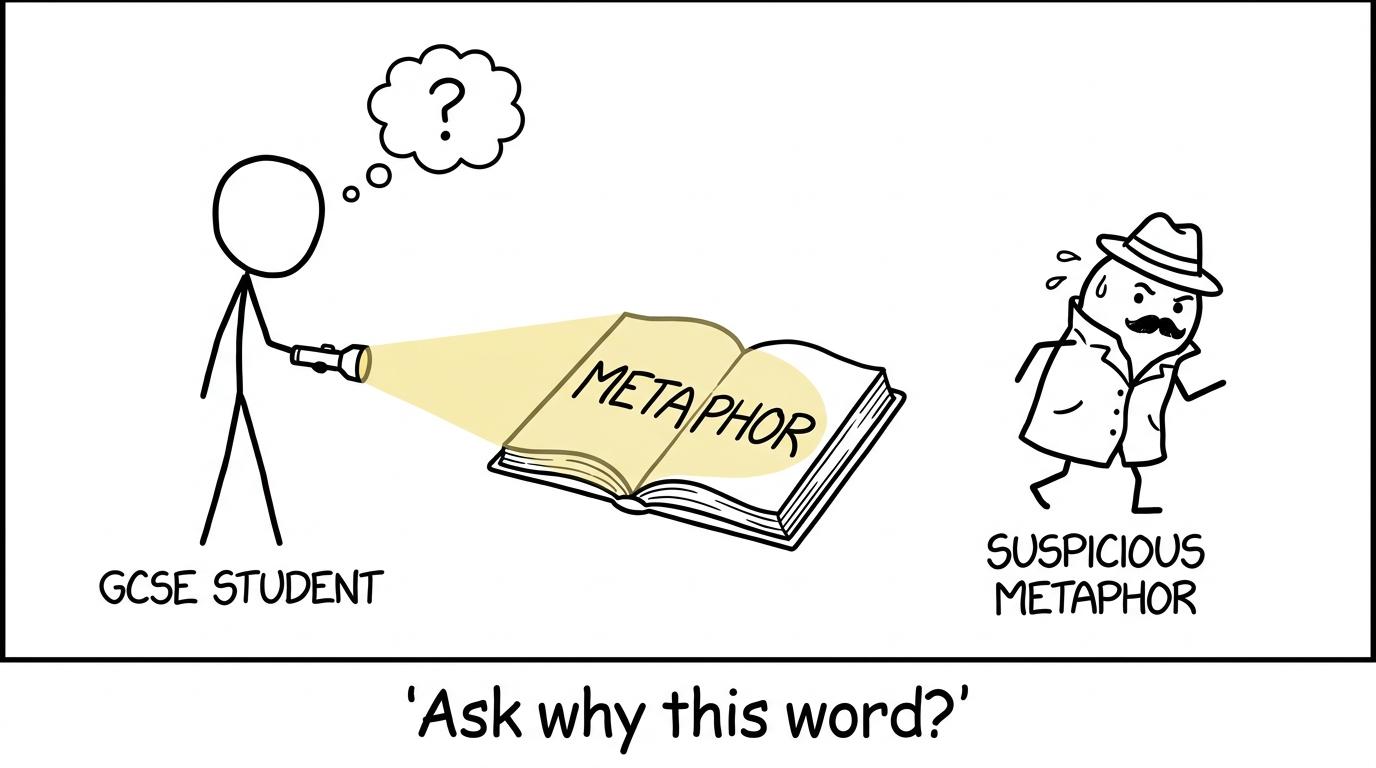 A literary detective investigating one suspicious word
Choose evidence for flexibility, not quantity
Knowing the text matters, particularly where an examination is closed book. For example, AQA’s current GCSE English Literature specification uses closed-book assessments and supplies any required stimulus material in the paper. Check your own Edexcel, AQA, OCR or Eduqas specification because question formats, texts and timings differ.
Do not try to memorise every sentence. Build a compact evidence bank for each text containing:
- short references connected to several themes
- moments from the beginning, middle and end
- evidence of change or conflict
- structural moments you can discuss without a long quotation
- details that connect character, theme and context
Learn each reference with possible interpretations rather than in isolation. A quotation is valuable because of what you can do with it.
Retrieval practice is more useful than repeatedly reading a quotation sheet. Cover the evidence, recall it, check it and revisit what you missed. The same active approach works across subjects. MathsGenie’s GCSE one-month revision plan explains how short retrieval sessions and regular checking can create a manageable routine.
Use context to deepen the answer
Context is assessed through AO3, but context dumping often interrupts otherwise strong analysis. A memorised paragraph about an author’s life or historical period earns little if it does not illuminate the question.
Start with the text. Then connect the writer’s choice to a relevant social, historical or literary idea. Finally, explain how that connection changes your interpretation.
Useful context may include:
- beliefs or power structures represented by the text
- literary conventions the writer follows or challenges
- differences between original and later audiences
- the circumstances of production or reception
- ideas visible within the text itself
Context should feel like a lens, not luggage. Carry only what helps you see the passage more clearly.
Make comparisons analytical
In poetry or other comparative tasks, a grade 555 response may discuss one text and then the other before adding a similarity. A stronger answer compares the writers’ ideas and methods as the argument develops.
Choose the second text because it creates a productive comparison. It might share a theme but reach a different conclusion, use a contrasting voice or structure the reader’s response differently.
Plan around comparative claims rather than separate summaries. Keep returning to what each writer suggests, how each creates that suggestion and why the difference matters. Comparison is not an extra sentence at the end of a paragraph. It is a way of thinking.
Turn practice into evidence about your writing
Reading model notes can improve knowledge, but writing improves when you produce, review and revise responses. Use a weekly cycle:
- plan one answer without notes
- write one paragraph with close AO2 analysis
- complete one timed response
- assess it against the question and relevant mark scheme
- identify one change for the next attempt
- rewrite the weakest paragraph rather than abandoning the whole essay
Mark schemes describe levels holistically, so do not treat them as word-count formulas. Your teacher’s feedback is particularly valuable because they can see whether your main limitation is knowledge, interpretation, analysis, organisation or timing.
Keep an error log containing specific observations such as “context was detached” or “analysis did not return to the question”. This is similar to reviewing a maths paper by topic rather than recording only the total mark. Maths students can apply that process through the GCSE Maths revision hub, GCSE mini tests and shorter 454545-minute tests.
Balance English Literature with maths revision
The student preparing for English Literature is often preparing for several maths papers too. The danger is allowing the nearest exam to consume every revision session.
Use separate, repeatable blocks. An English session might combine quotation retrieval, a short plan and one analytical paragraph. A maths session can combine a revision lesson, practice questions and marking. The MathsGenie GCSE revision timetable offers a structure you can adapt around your examination calendar.
Near the maths exams, use predicted papers and revision resources alongside past papers. Predicted papers are practice tools, not guarantees of future content. Review every paper using its mark scheme and video solutions rather than chasing a score and immediately moving on.
For the English exam week itself, the GCSE English Literature exam-week checklist can help you organise quotation recall, timed writing and your continuing maths routine.
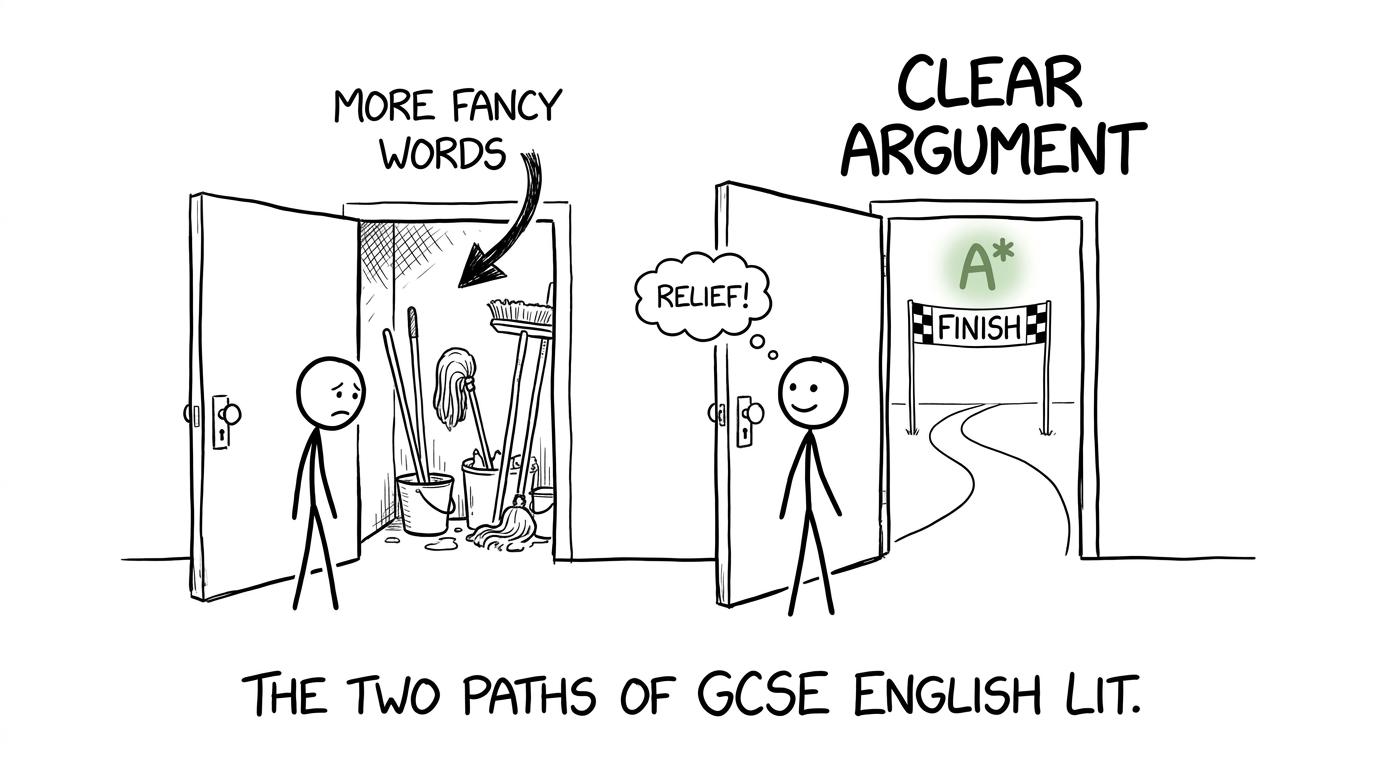 The clear argument door leads somewhere more useful than fancy vocabulary
Common mistakes when aiming for grade 888
Forcing sophisticated vocabulary
Complex words do not create complex thought. Choose precise vocabulary and vary sentence structures, but never sacrifice clarity. A direct analytical verb is more useful than an impressive word used inaccurately.
Offering several undeveloped interpretations
Alternative readings can demonstrate perceptive thinking, but listing possibilities is not evaluation. Develop the interpretation best supported by the text, then use another reading to qualify or challenge it.
Treating terminology as analysis
Naming personification, enjambment or dramatic irony earns limited credit without an explanation of meaning and effect. Ask why that choice matters at that moment.
Memorising complete essays
A rehearsed essay may not answer the question actually set. Memorise flexible evidence and arguments, then adapt them carefully to the wording of the task.
Ignoring the whole text
Extract-based questions still require awareness of the wider play or novel where specified. Track how the idea develops and choose references from purposeful moments elsewhere.
Writing beyond the time limit
An unfinished final response can cost more than an extra paragraph improves the first. Practise using the exact timings and question structure for your board. Leave enough time to address every required section.
Your next move from grade 555 towards grade 888
The journey is not about turning every sentence into something elaborate. It is about making the whole response more deliberate: a clear interpretation, precise evidence, thoughtful analysis, relevant context and controlled timing.
Choose one past response today. Find the paragraph that explains the text without fully analysing the writer’s choices. Rewrite it so that every sentence advances the argument. That small revision reveals the larger principle: higher grades often come from improving the quality of decisions, not simply increasing the volume of work.
Then protect the rest of your revision plan. Use MathsGenie for free GCSE maths revision, practice questions, mini tests, past papers, predicted papers, mark schemes and video solutions. Let each resource answer one question: what should you change before the next exam?