GCSE English Language Revision Timetable: Worth It?
GCSE English Language revision timetable worth it? See when a written plan helps, when flexible revision works, and how to balance English with GCSE maths.
The timetable is often the most reassuring part of revision. Everything has a colour. Every evening has a purpose. For a moment, the uncertainty of GCSEs seems neatly contained inside a grid.
Then Tuesday arrives, homework takes longer than expected, and the whole plan begins to slide.
So, is a GCSE English Language revision timetable worth it? Usually, yes, but only if it is short, flexible and built around actual exam practice. A timetable does not improve your grade by itself. Its value is that it helps you begin, revisit skills over time and protect enough space for English without quietly neglecting maths.
A flexible weekly plan is therefore often more useful than a rigid daily schedule. Plan the work that matters, but leave room to respond to what your practice reveals.
The short answer: when a timetable is worth making
A written English Language revision timetable is useful when it does the following:
- gives each session one precise purpose;
- includes reading and writing practice rather than only note-making;
- revisits skills across several days or weeks;
- uses timed questions and mark-scheme feedback;
- includes catch-up space when life interrupts the plan;
- protects time for other subjects, especially GCSE maths;
- changes when evidence shows that your priorities have changed.
It is probably not useful if designing it takes longer than the first revision session, or if missing one block makes the entire week feel ruined.
The distinction matters. A timetable is a tool for directing attention. It is not evidence that learning has happened.
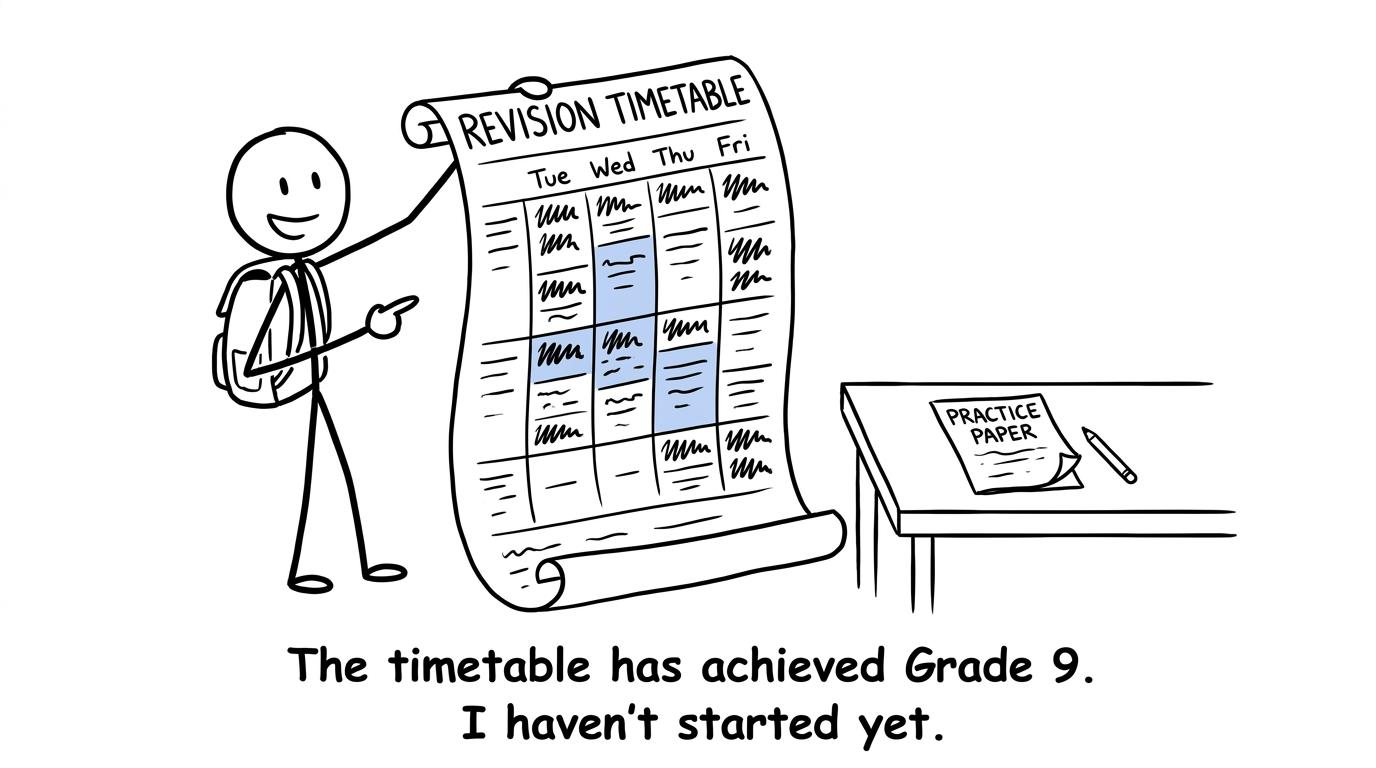 A student presents an impressive revision timetable while the practice paper waits
What a revision timetable can actually change
There is no sensible reason to claim that merely writing a timetable guarantees a better GCSE result. Outcomes depend on many connected factors: existing knowledge, teaching, attendance, the quality of practice, feedback, exam technique and what a student does during the scheduled time.
The stronger argument is indirect. A good timetable supports behaviours associated with effective independent learning.
Education Endowment Foundation guidance describes self-regulated learning through planning, monitoring and evaluating. In revision terms, that means deciding what to practise, checking whether the practice is working and changing the next session accordingly. Crucially, these strategies should be connected to specific subject content rather than treated as a separate lesson in “how to learn”.
A timetable helps with the planning stage. It can also create spacing by bringing a skill back on another day. But it cannot monitor or evaluate your learning unless you add questions, feedback and reflection.
That is why “English revision” is too vague for a useful timetable entry. Better entries might include:
- complete one timed language-analysis response;
- plan a narrative opening for a particular audience;
- compare two unseen viewpoints;
- mark a previous response against the relevant assessment objective;
- rewrite one paragraph using feedback.
The same principle applies to maths. “Revise algebra” creates uncertainty, while a defined set of questions creates a starting point. MathsGenie’s guide to finding your weakest GCSE topics explains how evidence from questions can turn a broad subject into manageable tasks.
Why English Language needs a different kind of plan
GCSE English Language is not mainly a memory test built around a fixed collection of texts. Students must apply reading and writing skills to material presented in the examination.
Across specifications, the core assessment objectives reward skills including interpreting information, analysing language and structure, comparing perspectives, evaluating texts, communicating effectively and writing accurately. Ofqual sets the shared assessment objectives, while question structures and paper arrangements differ between AQA, Pearson Edexcel, OCR and Eduqas.
For example, the current AQA specification uses two written papers, each containing reading and writing sections. Its unseen material means that memorising a perfect response cannot replace practising how to interpret a new text. Other boards organise their questions differently, so always use resources that match your specification.
English Language is also untiered. Unlike GCSE maths, there is no foundation or higher English Language paper. Your timetable should therefore be based on the skills costing you marks, not on a tier.
Plan by assessment skill, not by chapter
A useful timetable rotates between four broad types of work:
- Reading analysis: selecting evidence and explaining effects precisely.
- Comparison and evaluation: building a judgement and supporting it from the text.
- Writing: adapting ideas, structure, tone and register to the task.
- Exam performance: making decisions under timed conditions.
Include technical accuracy within writing sessions rather than leaving it until the end. Across GCSE English Language specifications, accurate spelling, punctuation, vocabulary and sentence control form a meaningful part of the assessment.
The exact balance should come from teacher feedback, marked responses and your exam board’s assessment materials. If comparisons are secure but timed creative writing repeatedly remains unfinished, equal time for both would look fair while being strategically unhelpful.
A timetable that bends without breaking
A rigid timetable assumes that every week will behave. School weeks rarely do.
A more resilient approach is to write a weekly menu containing essential sessions, optional sessions and one empty catch-up block. Decide when to complete each task, but allow unfinished work to move without treating that movement as failure.
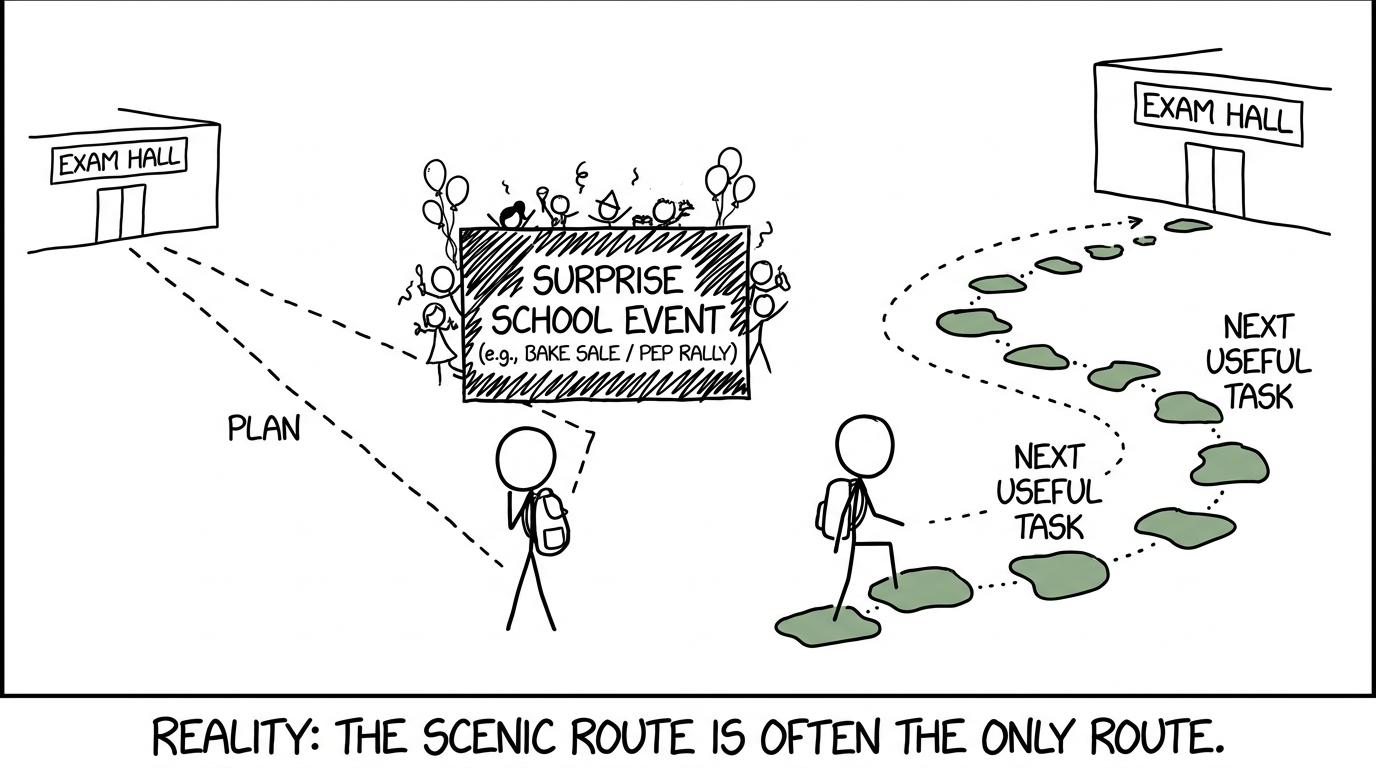 A flexible revision route bends around an unexpected obstacle
Use anchors rather than filling every evening
Choose a small number of dependable revision anchors. These could be one short English session early in the week, one writing session later and one timed task at the weekend. Add other work around them only when your available time is clear.
This approach reduces daily decision-making without pretending that every hour can be predicted. Students with crowded school days may find the same idea useful for maths through the twenty-minute GCSE maths revision routine.
Give every session a minimum version
On a difficult day, the choice should not be between completing a heroic session and doing nothing. Give each block a smaller version.
A full English block might involve a timed response, self-marking and a rewrite. Its minimum version might be planning the response and writing one developed paragraph. A longer maths block might become one GCSE mini test followed by careful marking.
The minimum protects continuity. It should not become the permanent standard, but it makes one disrupted evening less likely to turn into an abandoned week.
Review the plan once a week
At the end of the week, ask:
- What did I complete?
- Which practice exposed a weakness?
- Which task produced no useful evidence?
- What should return next week?
- Is the balance between English, maths and other subjects still sensible?
This is the evaluation stage that a decorative timetable lacks. Cross out tasks that no longer matter. Add tasks revealed by marking. A changing timetable is not an unsuccessful one; it is a plan responding to information.
Flexible revision versus a written timetable
Flexible revision can work just as well as a formal grid when “flexible” means responsive rather than random.
A student may keep a prioritised task list, choose the highest-value task when a revision window opens and record what needs to happen next. That system still contains planning and evaluation, even though it does not assign every task to a fixed hour.
Flexible revision is likely to suit you if you:
- already revise consistently without repeated reminders;
- have an unpredictable weekly routine;
- can choose difficult tasks instead of comfortable ones;
- record completed work and use feedback to choose the next step.
A written timetable is more valuable if you tend to postpone English because its tasks feel less definite than maths questions, spend too long deciding where to begin, or discover too late that one subject has received almost no attention.
The best compromise is often a weekly skeleton with flexible content. Reserve a few recurring blocks, then choose the exact skill from your latest feedback.
How to balance English Language with GCSE maths
English and maths both improve through active practice, but the practice looks different. English may involve annotating an unseen extract, planning a response and revising a paragraph. Maths usually requires solving questions, checking methods and repeating weak topics.
Do not divide time equally simply because the subjects are equally important. Allocate it according to need, upcoming examinations and the quality of available evidence.
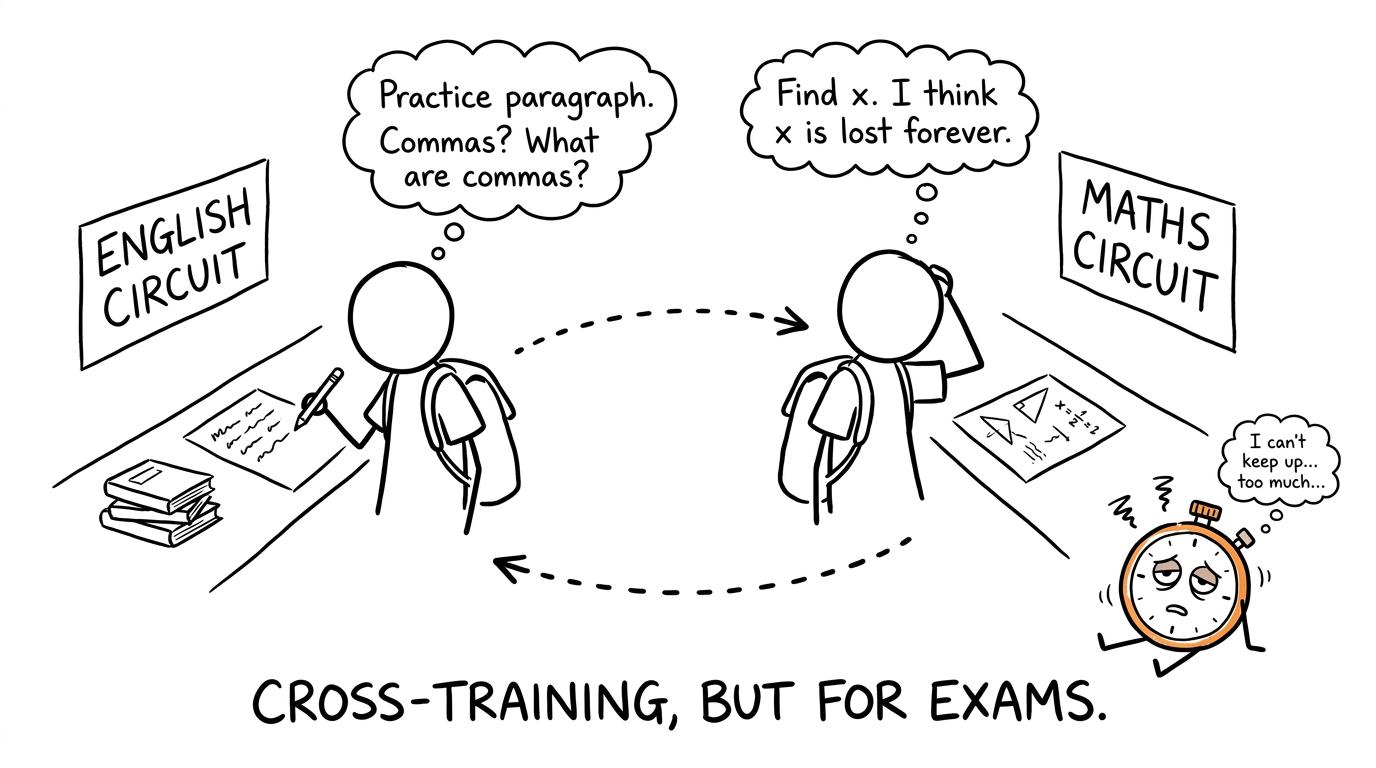 A student switches between English and maths in an exam revision circuit
For maths, begin with the GCSE maths revision hub, choose your board and confirm whether you are sitting foundation or higher tier. Use the GCSE maths revision timetable guide if you need a broader weekly structure.
Your maths blocks should move through a simple cycle: identify a gap, use a revision lesson, answer practice questions, mark them and retest. When you are ready for mixed work, use the correct board-specific collection, such as Edexcel GCSE maths past papers, AQA GCSE maths past papers or OCR GCSE maths past papers.
Alternating subjects can also protect concentration. A precise maths set followed by an English planning task may feel more manageable than two long blocks of the same kind of thinking. What matters is that both blocks produce something you can check.
Common revision timetable mistakes
Making the timetable the main project
A polished grid can create the feeling of progress before any difficult practice has happened. Limit planning time, write the first few tasks and begin one immediately.
Scheduling subjects instead of actions
“English” and “maths” are labels, not instructions. Write the paper, skill, resource, duration and intended result clearly enough that you can start without another decision.
Copying someone else’s priorities
Another student’s timetable reflects different strengths, feedback and commitments. Use your own marked work to decide what deserves time.
Filling every available space
A plan with no spare capacity is fragile. Leave catch-up room and protect rest. If every interruption creates revision debt, the timetable will soon become a source of avoidance.
Revising passively inside an active-looking plan
Reading notes during a scheduled hour may still be passive. English needs written responses and reflection; maths needs attempted questions and checked working. The schedule matters less than the cognitive work inside it.
Ignoring the mark scheme after practice
Completion is not the same as improvement. Compare responses with assessment criteria, identify the next change and revisit it. MathsGenie’s guide to using GCSE mark schemes for English Language shows how marking can shape the next session.
Make the plan useful, not impressive
A GCSE English Language revision timetable is worth making when it converts good intentions into repeated, examinable practice. It is not worth preserving when it becomes too rigid to reflect feedback or too elaborate to follow.
Start with a light weekly structure. Give each English session a specific reading, writing or exam-performance goal. Leave catch-up space. Review the plan every week, and let marked work decide what comes next.
Then apply the same discipline to maths. Open MathsGenie’s free GCSE resources, choose your exam board and tier, and move from revision lessons to practice questions, mini tests, past papers and predicted papers. Use the mark schemes and video solutions to turn every lost mark into a clear next action.
The timetable does not earn the marks. The work it helps you repeat does.