GCSE English Language and Literature Harder Than Before?
GCSE English Language and Literature harder than before? See what reforms changed, how grading stays fair, and how maths students can revise both calmly.
A student can leave a maths lesson knowing exactly which formula went wrong, then open an English paper and feel that the rules have vanished. Essays are less predictable than equations, quotations must be remembered and the clock seems unusually fast. It is natural to ask: is GCSE English Language and Literature harder than before?
The short answer is yes, in some important ways. The reformed GCSEs introduced in England were deliberately designed with more demanding content and greater reliance on final examinations. Literature became closed book, while Language placed substantial emphasis on challenging unseen texts. However, that does not mean grades become harder to earn every year. Ofqual maintains grading standards over time and adjusts grade boundaries to reflect the difficulty of each paper.
This article focuses mainly on GCSEs in England. Qualifications and grading arrangements differ in Wales and Northern Ireland, so always check the specification used by your school.
The answer at a glance
Here is the balanced version:
- The current English GCSEs are genuinely more demanding than many pre-reform versions.
- English Literature requires broader, more challenging reading and closed-book assessment.
- English Language tests reading across unseen texts from different periods alongside purposeful writing.
- Both qualifications are linear, so final examinations carry far more responsibility than coursework once did.
- English Language and Literature are untiered, unlike foundation and higher tier maths.
- Grade boundaries can rise or fall, but that does not by itself make a grade easier or harder to achieve.
- The present format has been broadly stable since the reformed qualifications were first examined in summer 2017.
So there are really two questions. Has the qualification become harder compared with older GCSEs? In several respects, yes. Is it quietly becoming harder every year? There is much less evidence for that claim.
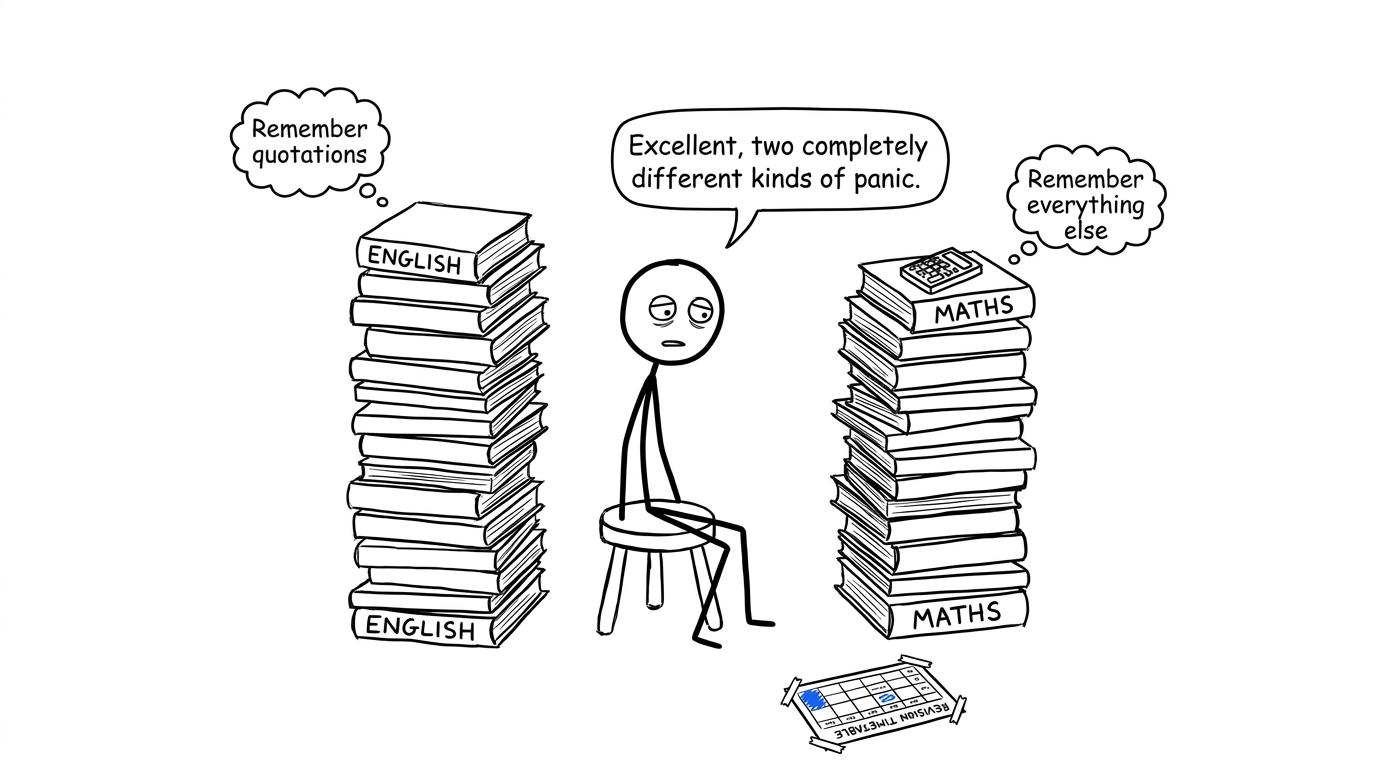 A GCSE student balancing two different kinds of exam pressure
What changed when GCSE English was reformed?
The reformed English Language, English Literature and maths GCSEs were first taught in England from 2015 and first examined in 2017. They introduced the grades 9-1, replaced modular assessment with linear qualifications and increased dependence on examinations.
The Department for Education set more demanding subject content. Ofqual’s research into the reforms identifies several major changes to Literature: students study a broader range of challenging texts, sit closed-book examinations and respond to unseen material. Language is also based on high-quality texts that make substantial demands in vocabulary, structure and meaning.
Older GCSE arrangements were not identical across every year or exam board, so sweeping comparisons can be misleading. Nevertheless, the direction of reform was clear: less reliance on controlled assessment, more assessment at the end of the course and greater academic challenge.
That concentrates pressure. A student can no longer bank a large portion of the final result through coursework completed earlier in the course. Performance on examination day matters more.
Why GCSE English Literature can feel harder
Closed-book assessment changes the memory burden
Students cannot take clean copies of their studied texts into Literature examinations. The paper may provide an extract or other stimulus where the specification requires it, but students still need secure knowledge of the work as a whole.
This does not mean memorising every line of a play or novel. It means remembering a flexible bank of short quotations, where they appear and what they reveal about character, theme, language or context.
That is a different challenge from maths. In maths, remembering a method usually helps you reconstruct the next line. In Literature, a remembered quotation only becomes useful when it is connected to a thoughtful interpretation and the question being asked.
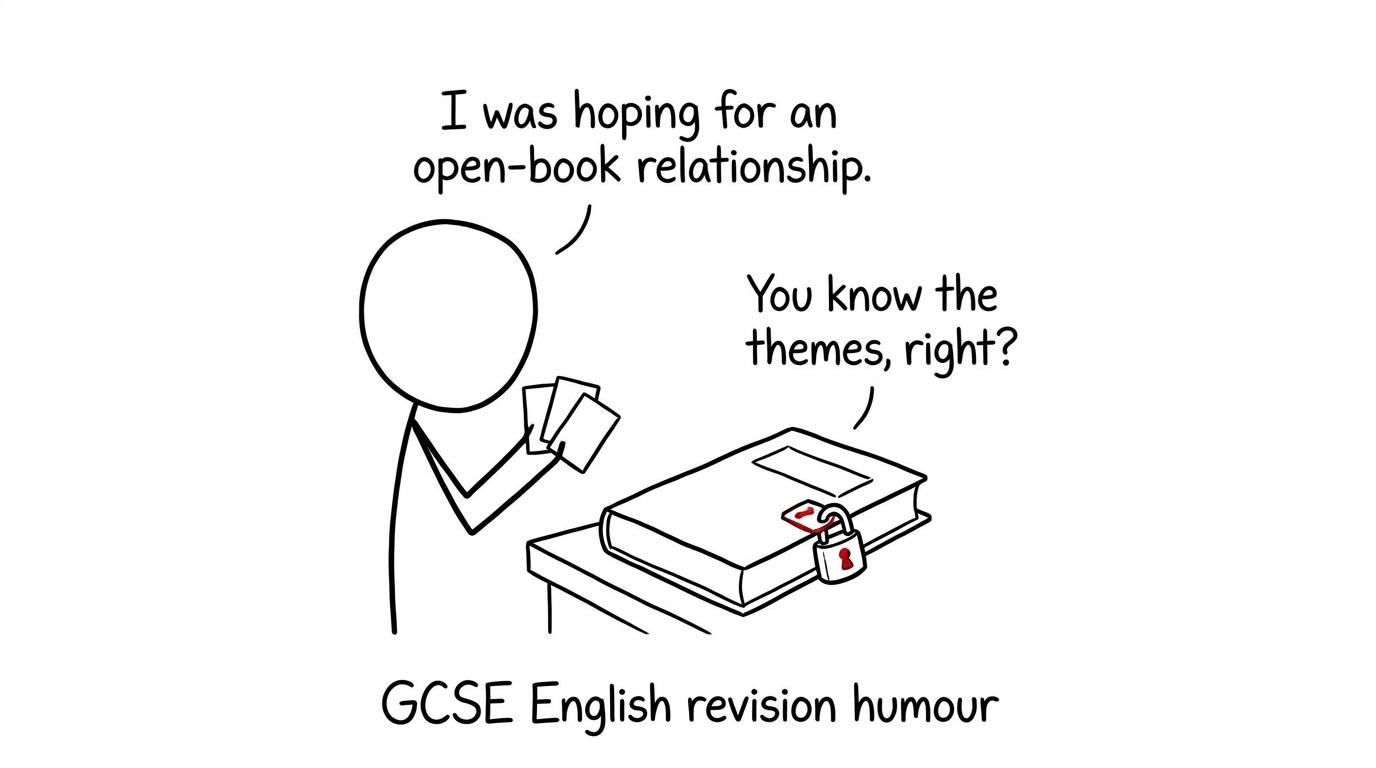 A student negotiates with a locked GCSE Literature book
The range of literature is demanding
The national subject content requires substantial whole texts, including Shakespeare, a nineteenth-century novel, poetry and modern literature. Students must also respond to unseen material.
The exact books, anthology and paper structure depend on whether your school follows AQA, Edexcel, OCR or Eduqas. These specifications are not interchangeable. For instance, the balance between extract questions, whole-text essays and comparison tasks varies by board.
What remains consistent is the depth expected. Plot knowledge alone is not enough. Strong responses develop an argument, select relevant textual references and analyse how language, form and structure shape meaning.
Comparison adds another layer
Literature assessment includes comparison across texts, particularly in poetry. Comparison is difficult because students must keep two ideas active at once: what each writer communicates and how their methods are similar or different.
This resembles a multi-step maths problem. The individual skills may be familiar, but holding them together under time pressure raises the cognitive load.
Why GCSE English Language can feel harder
English Language does not ask students to revise a set novel. That can sound easier until the paper presents an unfamiliar nineteenth-century passage with demanding vocabulary and syntax.
Current subject requirements assess reading through unseen texts from the nineteenth, twentieth and twenty-first centuries. Across the qualification, students encounter literary fiction, literary non-fiction and other forms such as journalism, reviews or essays. They must retrieve information, infer meaning, analyse writers’ methods, evaluate viewpoints and compare texts.
Writing is equally important. Students have to adapt vocabulary, tone, structure and form to a particular purpose and audience while maintaining accurate spelling, punctuation and grammar.
The spoken language endorsement is reported separately and does not contribute to the numerical GCSE grade. The final Language grade comes from written examinations.
Language can therefore feel hard because revision cannot predict the exact passage. You are preparing a process rather than memorising an answer: read carefully, identify what the question requires, select precise evidence and explain its effect.
Has it become harder to achieve the same grade?
This is where the answer becomes more nuanced.
The 9-1 scale created more differentiation at the top. Grade 9 was designed to recognise exceptional performance beyond the old grade structure, while the lower boundaries of grade 7 and grade 4 were broadly aligned with the old grade A and grade C respectively when the new qualifications were introduced.
But raw mark boundaries are not fixed. Exam boards set them after papers have been marked, using statistical evidence and expert judgement. If a paper is unusually difficult, boundaries may be lower. If it is more accessible, they may be higher. Ofqual monitors this process to maintain the standard of work required for each grade over time.
This means a higher boundary does not automatically prove that the qualification has become easier. Nor does a lower boundary prove that it has become harder. Boundaries respond to the paper.
The fairest conclusion is that the reform increased the demands of the course compared with many legacy GCSEs, while the grading system aims to prevent one recent cohort from being disadvantaged simply because its paper was harder.
Why it may feel harder during maths revision season
Picture the final months of Year 11. Maths asks for repeated problem-solving practice. Literature asks for retrieval of quotations and themes. Language asks for timed reading and writing. Each subject draws on a different kind of concentration.
The problem is often not English alone. It is the collision of several linear GCSEs being examined within a short period.
A practical solution is to give each subject a clear job:
- Use short retrieval sessions for quotations and themes.
- Complete timed paragraphs or paper sections for English.
- Use topic practice to repair specific maths weaknesses.
- Reserve full papers for building timing and stamina.
- Mark work promptly so the next session responds to evidence rather than mood.
For maths, the free GCSE Maths revision hub brings together exam-board resources, lessons and practice. If school days are crowded, the 20-minute GCSE maths revision routine shows how a small session can still have a precise purpose.
Use the same feedback loop in both subjects
English and maths look different, but effective revision follows a similar cycle:
- retrieve what you know without notes;
- attempt an examination task;
- compare your work with the assessment guidance;
- identify one specific weakness;
- practise that weakness again;
- return later and retest it.
In English, the weakness might be vague analysis, weak quotation knowledge or poor timing. In maths, it might be an insecure method, a misread question or missing working.
MathsGenie makes this cycle straightforward on the maths side. Use revision lessons and practice questions to strengthen a topic, then test it through past papers, mini tests and video solutions. The one-month maths revision plan can help you fit that work around English and your other subjects without turning every evening into a full mock-exam session.
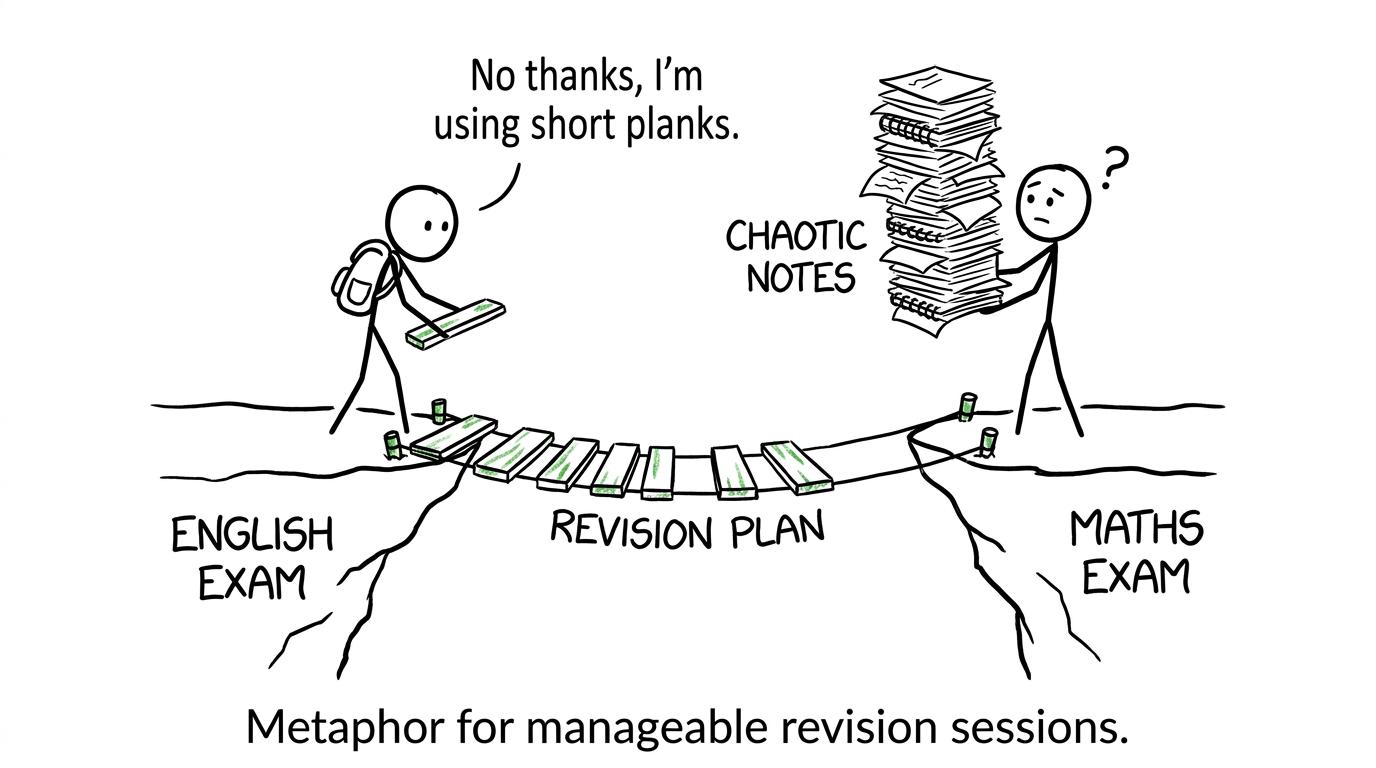 A student builds a manageable bridge between English and maths exams
Common mistakes when judging difficulty
Comparing memories rather than specifications
Adults may remember a different exam board, qualification structure or combination of coursework and examinations. Their experience can be sincere without being directly comparable to yours.
Treating closed book as a memory competition
Quotation knowledge matters, but an essay containing many quotations is not automatically analytical. A smaller collection of flexible references, understood in depth, is more useful than a long list learned without context.
Assuming every exam board has the same paper
AQA, Edexcel, OCR and Eduqas meet national requirements in England, but their paper structures, set texts and mark schemes differ. Revise from the specification and materials used by your school.
Reading too much into grade boundaries
A boundary is partly a response to paper difficulty. Compare the quality of answers required, not just raw marks from different years.
Letting English anxiety consume maths time
English may feel less predictable, encouraging endless rereading. Give it planned, active sessions rather than unlimited time. Then protect regular maths practice through a revision planner and focused tasks.
When beginning paper practice, use the guidance on when to start GCSE past papers. One carefully reviewed paper is more valuable than several rushed attempts, as the advice on how many GCSE past papers to complete explains.
A harder exam does not require a harsher revision plan
GCSE English Language and Literature are more demanding than many earlier versions in identifiable ways. The courses are linear, Literature is closed book and unfamiliar texts play a significant role. Yet the feeling that they become harder every year confuses changing papers with changing standards. Grade boundaries are adjusted so that the required standard remains comparable.
Your task is not to defeat the history of GCSE reform. It is to understand the paper in front of you and prepare deliberately.
Keep English revision active and specification-specific. Keep maths revision equally focused: learn a method, practise it, mark it and retest it. Use MathsGenie’s Edexcel predicted papers alongside official past papers, not instead of them, and use the guidance on redoing GCSE past papers to turn mistakes into future marks.
Start with the free MathsGenie revision lessons today. Build confidence through practice questions and mini tests, then move towards past papers, predicted papers, mark schemes and video solutions. Harder does not have to mean unmanageable. It simply means your revision needs a clearer system.