GCSE English Language and Literature Gender Gap Results
GCSE English language and literature gender gap results reveal a clear female lead. Explore the 2025 national data and what students can learn.
A national result can feel strangely personal. If a chart says one group tends to perform better than another, it is easy to read it as a prediction about your own grade. It is not.
The latest GCSE English language and literature gender gap results show a clear pattern in England: in summer 2025, female candidates achieved higher results than male candidates at key grade thresholds in both subjects. The gap was particularly wide at grade 777 and above in English Literature. Yet these figures describe hundreds of thousands of entries, not the ability or future result of any individual student.
For GCSE maths students, the data also offers a useful lesson in statistics. Percentages need context, percentage-point gaps are not percentage changes, and an association does not establish its cause.
The national picture at a glance
Using JCQ's summer 2025 full-course results for England, the main findings are:
- Female candidates had higher outcomes at grade 444 and above and grade 777 and above in both English subjects.
- In English Language, the female advantage was about 8.08.08.0 percentage points at grade 444 and above.
- In English Literature, the largest gap shown below was about 9.99.99.9 percentage points at grade 777 and above.
- English Language had approximately 801,800801{,}800801,800 entries, while English Literature had approximately 608,100608{,}100608,100.
- Ofqual reported that the gender gap across GCSEs overall narrowed in 2025, although girls remained ahead across overall attainment measures.
- None of these averages determines what a particular boy or girl can achieve.
| Subject and threshold | Male candidates | Female candidates | Female advantage |
|---|---|---|---|
| English Language, grade 4+4+4+ | 79.6%79.6\%79.6% | 87.6%87.6\%87.6% | 8.08.08.0 percentage points |
| English Language, grade 7+7+7+ | 12.0%12.0\%12.0% | 19.3%19.3\%19.3% | 7.37.37.3 percentage points |
| English Literature, grade 4+4+4+ | 82.7%82.7\%82.7% | 89.9%89.9\%89.9% | 7.37.37.3 percentage points |
| English Literature, grade 7+7+7+ | 15.3%15.3\%15.3% | 25.1%25.1\%25.1% | 9.99.99.9 percentage points |
Figures are rounded to one decimal place and cover GCSE full-course results in England for candidates of all ages. The published categories record sex as male or female, so that is the terminology used when reporting the dataset.
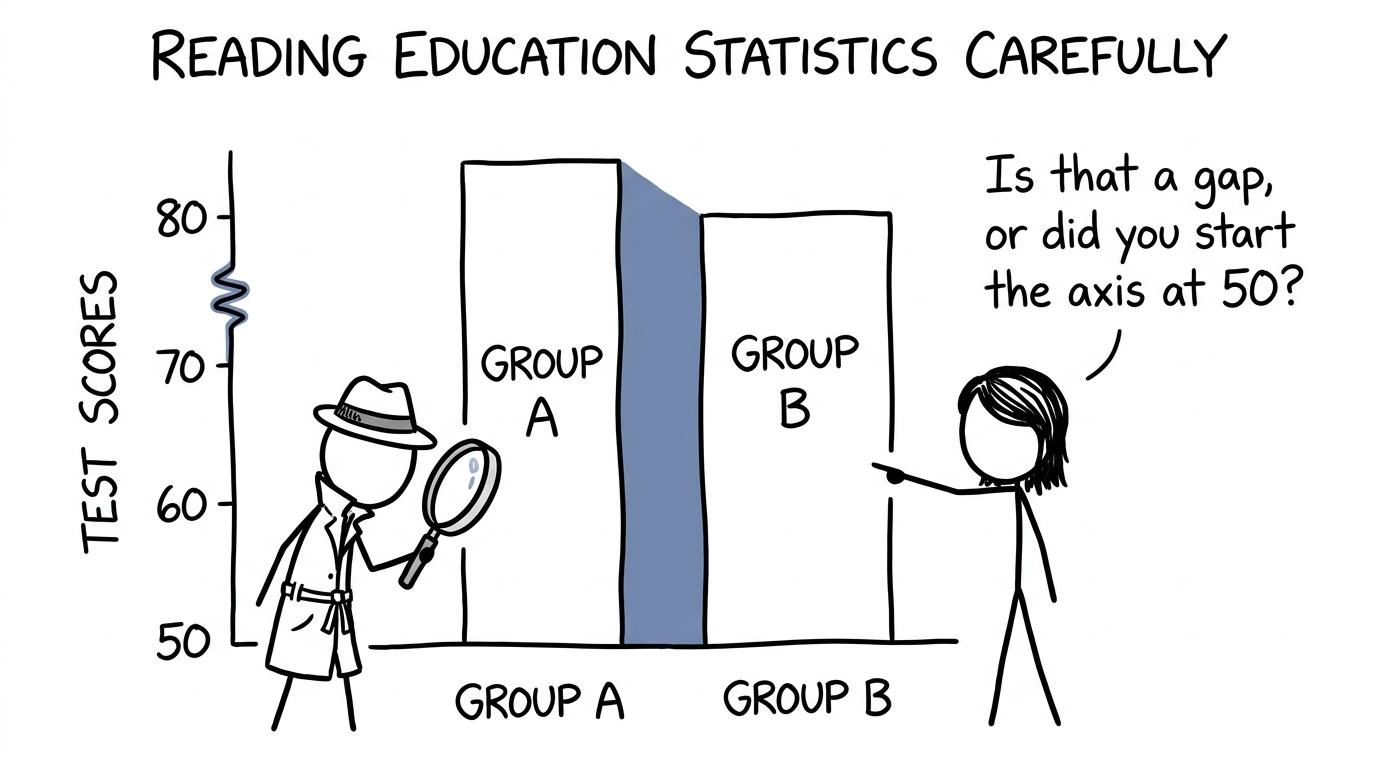 A stick-figure detective checks whether a dramatic chart uses a misleading axis
What the 2025 English Language results show
JCQ recorded about 419,800419{,}800419,800 male and 382,000382{,}000382,000 female English Language entries in England. At grade 444 and above, outcomes were 79.6%79.6\%79.6% for male candidates and 87.6%87.6\%87.6% for female candidates.
The percentage-point gap is therefore:
87.6−79.6=8.087.6 - 79.6 = 8.087.6−79.6=8.0At grade 777 and above, the figures were 12.0%12.0\%12.0% and 19.3%19.3\%19.3% respectively, producing a gap of approximately:
19.3−12.0=7.319.3 - 12.0 = 7.319.3−12.0=7.3The same direction appears at grade 999: about 1.6%1.6\%1.6% of male entries and 3.1%3.1\%3.1% of female entries achieved the highest grade.
These are entry-level outcomes, not the percentage of all teenagers receiving each grade. They also include candidates of different ages, including students resitting English Language after Year 111111. That matters because the composition of the entry group can affect the overall percentages.
What the 2025 English Literature results show
The difference is also visible in English Literature. At grade 444 and above, 82.7%82.7\%82.7% of male entries and 89.9%89.9\%89.9% of female entries reached the threshold. At grade 777 and above, the figures were 15.3%15.3\%15.3% and 25.1%25.1\%25.1%.
That higher-grade difference is approximately:
25.1−15.3=9.825.1 - 15.3 = 9.825.1−15.3=9.8Using JCQ's unrounded values gives a gap of about 9.99.99.9 percentage points. This small distinction is a reminder that calculations from rounded table values may not reproduce a published result exactly.
At grade 999, approximately 2.3%2.3\%2.3% of male entries and 4.9%4.9\%4.9% of female entries achieved the grade. The pattern is therefore not confined to the grade 444 threshold.
English Literature and English Language should not be treated as interchangeable datasets. Literature had fewer entries, and the qualifications assess different combinations of knowledge and skills. Language focuses on reading unseen material, analysing writers' choices and producing effective writing. Literature assesses responses to studied texts, interpretation, comparison and the use of evidence. Exact paper structures vary between AQA, Edexcel, OCR and Eduqas.
Is the gender gap getting smaller?
There are two answers, depending on the question being asked.
Across GCSE subjects overall, Ofqual reported that the gender attainment gap narrowed in 2025. For 161616-year-olds across all subjects, 67.5%67.5\%67.5% of male entries and 73.6%73.6\%73.6% of female entries achieved grade 444 or above. At grade 777 and above, the corresponding figures were 20.5%20.5\%20.5% and 25.5%25.5\%25.5%. Boys' results improved slightly while girls' results were broadly stable or fell marginally, depending on the measure.
English, however, continues to display a notable female advantage. A narrowing overall gap does not mean every subject gap has disappeared. A combined GCSE measure mixes subjects in which the size and even direction of differences may vary.
Department for Education data for state-funded schools provides another perspective. In 2024/25, girls remained ahead on headline measures, but the gap for achieving grade 555 or above in both English and maths narrowed to 3.13.13.1 percentage points. The average Attainment 888 gap also narrowed to 4.04.04.0 marks. These measures combine subjects, so they do not replace the subject-specific JCQ figures.
What the statistics can and cannot tell us
A result gap is a description. It is not, by itself, an explanation.
The data tells us that different proportions of male and female entries reached particular grade thresholds. It does not isolate why. National results alone cannot separate the possible influence of prior attainment, attendance, reading experience, subject engagement, school context, disadvantage, revision habits or many other overlapping factors.
Nor does the data support the claim that one gender is naturally better at English. Group distributions overlap heavily. Hundreds of thousands of candidates sit these qualifications, and each group contains students across the complete grade range.
This is closely related to a GCSE maths principle: correlation does not prove causation. If two variables are associated, further evidence is needed before deciding that one causes the other. Students can develop this judgement through GCSE Statistics revision, where interpreting evidence matters as much as performing calculations.
Why percentage points matter
Suppose one result is 87.6%87.6\%87.6% and another is 79.6%79.6\%79.6%. Their difference is 8.08.08.0 percentage points, not 8.0%8.0\%8.0%.
A relative percentage difference would use a division calculation:
87.6−79.679.6×100≈10.1%\frac{87.6-79.6}{79.6}\times 100 \approx 10.1\%79.687.6−79.6×100≈10.1%That answers a different question. Education reporting usually uses percentage points when comparing attainment rates because it states the direct distance between two percentages.
The denominator matters too. A percentage is always a proportion of a defined group:
percentage achieving threshold=entries achieving thresholdtotal entries in group×100\text{percentage achieving threshold} = \frac{\text{entries achieving threshold}}{\text{total entries in group}}\times 100percentage achieving threshold=total entries in groupentries achieving threshold×100If the groups have different numbers of entries, comparing raw numbers can mislead. This is why percentages are useful, and why they must still be read carefully. If data handling is a weak area in your own revision, the GCSE maths revision hub and averages from frequency tables guide offer structured ways to rebuild the underlying skills.
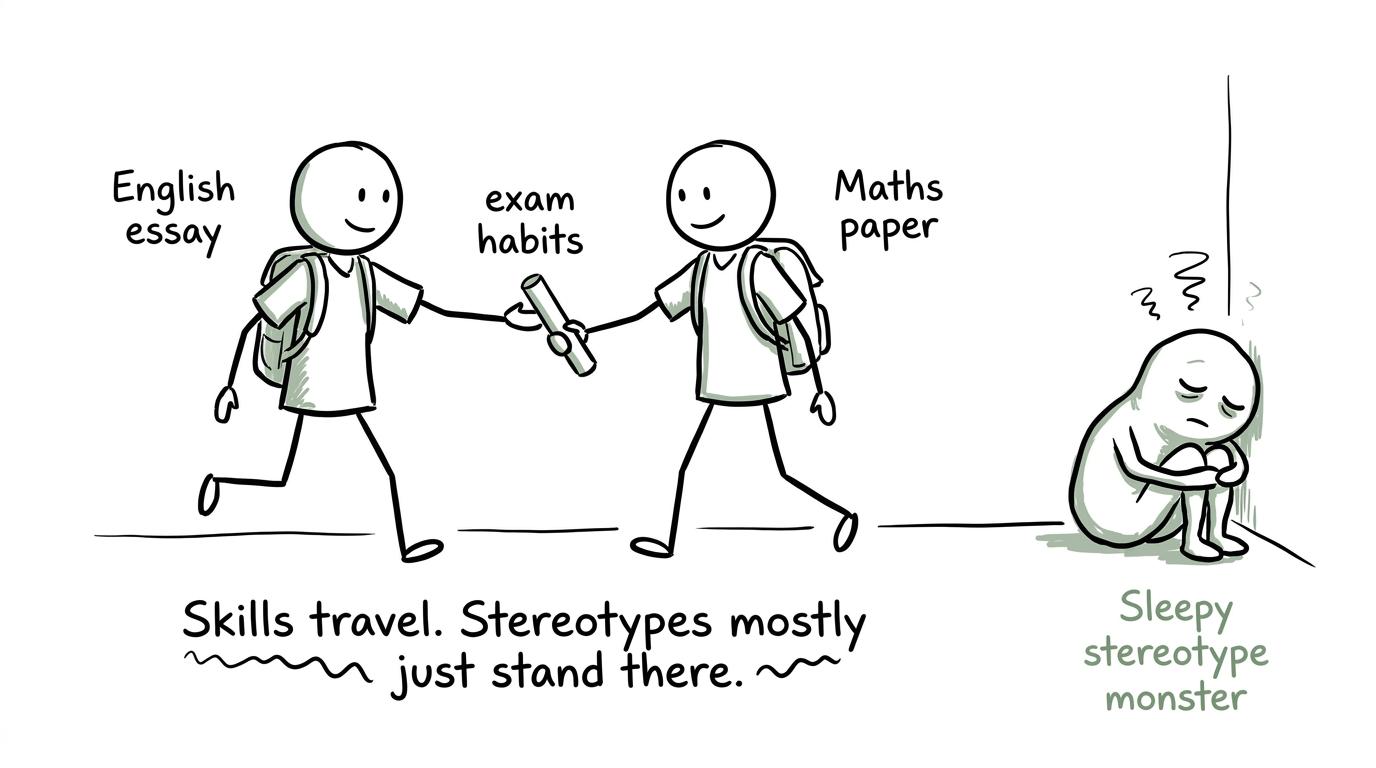 English and maths students pass an exam-habits baton while ignoring a stereotype monster
What maths students should take from the results
The most useful response is not to compare yourself with a national average. It is to notice the habits that work across subjects.
English answers need relevant evidence and clear reasoning. Maths answers need correct methods and enough working to communicate them. Both reward accurate reading of the question. Both punish untested assumptions. Both improve when practice is followed by feedback rather than merely repeated.
A practical revision loop is:
- attempt an exam-style task without notes;
- mark it against the mark scheme;
- identify whether the lost marks came from knowledge, execution or interpretation;
- repair one specific weakness;
- test the same skill again after a short interval.
MathsGenie's guide to using past papers properly explains how to turn mistakes into targeted revision. If you need a wider plan, the GCSE one-week revision plan shows how short, marked sessions can be organised without turning revision into an exhausting marathon.
National averages are interesting, but your marked work is more actionable. It tells you which topic, question type or habit should change next.
Common mistakes when interpreting gender-gap results
Treating a group average as an individual forecast
A male student is not assigned the male average, and a female student is not guaranteed the female average. National patterns describe groups, not personal limits.
Confusing percentage points with percentage change
The difference between 80%80\%80% and 88%88\%88% is 888 percentage points. Calling it an 8%8\%8% increase answers a different statistical question.
Comparing figures with different populations
England-only results, UK results, all-age entries and results for 161616-year-olds are not identical datasets. Check the population before comparing numbers.
Combining Language and Literature carelessly
They are separate qualifications with different entry totals and assessment demands. A headline about “English” may refer to Language, Literature or a combined school-performance measure.
Assuming the results reveal a cause
An observed gap does not prove that gender itself caused the difference. Explaining attainment requires more detailed evidence than a results table provides.
Letting statistics become a stereotype
Stereotypes can lower expectations and distract from useful action. Your next practice paper contains better information about your revision needs than a national label does.
From national patterns to personal progress
The 2025 evidence gives a clear answer: female candidates achieved higher GCSE English Language and English Literature outcomes than male candidates at the principal grade thresholds in England. The female advantage ranged from about 7.37.37.3 to 9.99.99.9 percentage points across the grade 4+4+4+ and grade 7+7+7+ comparisons above.
But data has two jobs. It helps us see a pattern, and it reminds us not to confuse that pattern with destiny.
Your own result is shaped by what you can do next: practise deliberately, mark honestly and revisit the skills that cost marks. Start with the full GCSE maths topic list by board and tier, then use MathsGenie's free revision lessons, practice questions, mini tests and video solutions. Build exam stamina with past papers and, nearer the exam, use GCSE predicted papers alongside their mark schemes.
National statistics describe last summer. Your revision choices are about the result still available to you.