GCSE English Language and Literature Paper Guide
GCSE English Language and Literature exam paper guide covering AQA, Edexcel, OCR and Eduqas formats, timings, sections and revision priorities.
The hardest part of an English exam is not always the analysis or writing. Sometimes it is simply turning the page and meeting a section you did not expect.
This GCSE English Language and Literature exam paper guide explains the current structure used by AQA, Pearson Edexcel, OCR and Eduqas. You will see what each paper covers, how long it lasts and where the marks come from. Find your exam board first, then use the relevant breakdown as your map.
Although MathsGenie is built for free maths revision, many students preparing for English are also balancing three GCSE maths papers. Knowing the shape of every exam reduces that mental load. One subject stops competing with another for your attention.
Your exam paper checklist
Before revising, confirm these details with your teacher or current specification:
- your exam board and specification;
- the set texts your school has chosen;
- which poetry anthology or cluster you study;
- the sections and questions you must answer;
- the duration and marks for each paper;
- whether extracts are supplied;
- which exams are closed book;
- any specification changes affecting your examination year.
English Language and English Literature are separate GCSE qualifications. They are also untiered, so there are no foundation and higher papers. English Language includes a compulsory Spoken Language endorsement, reported separately from the grade 999 for the 111 qualification.
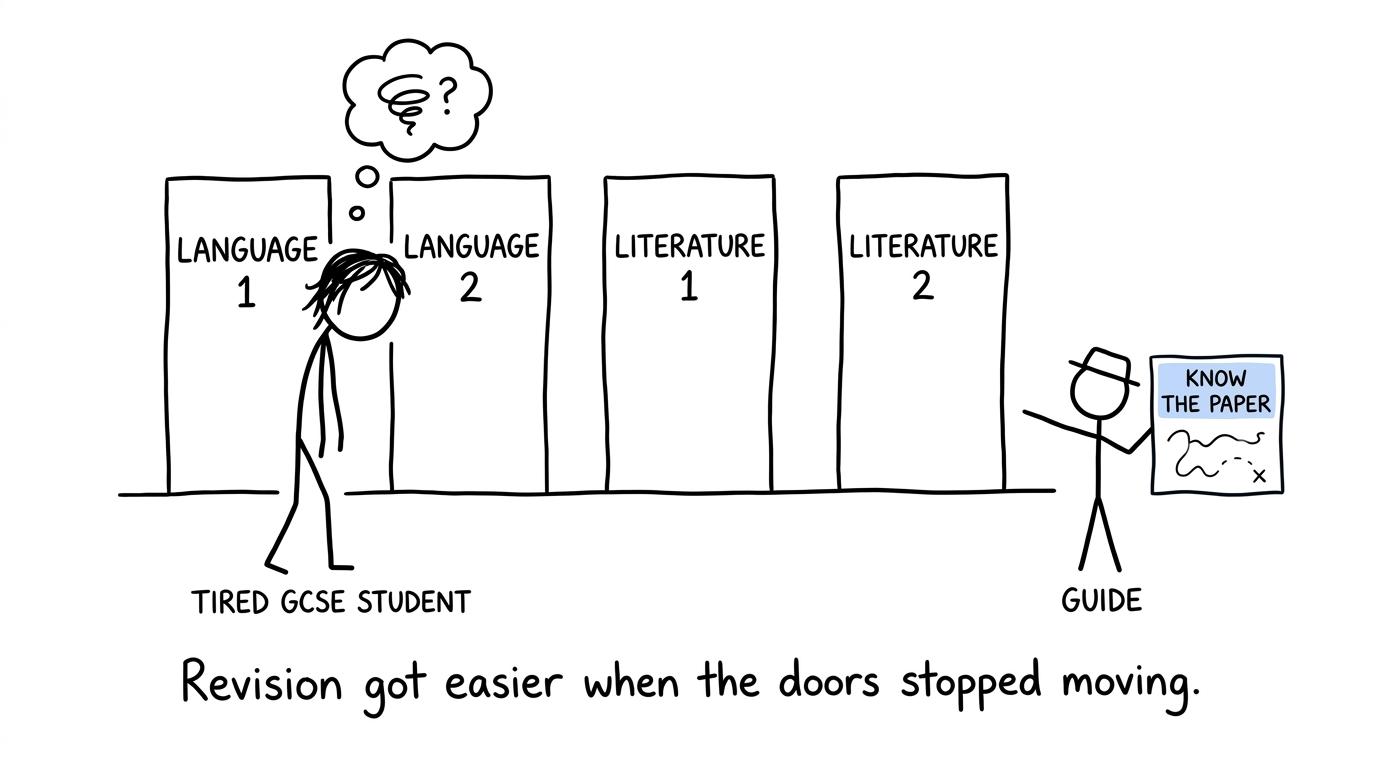 A student uses a map to navigate four GCSE English papers
AQA GCSE English Language papers
AQA English Language specification 8700 has two written papers. Each lasts 111 hour 454545 minutes, carries 808080 marks and contributes 50%50\%50% of the qualification.
Paper 1: Explorations in Creative Reading and Writing
Section A tests reading through an unseen fiction extract, usually drawn from the twentieth or twenty-first century. You answer four compulsory questions that move from identifying information to analysing language, examining structure and evaluating the text.
Section B is creative writing. You complete one extended descriptive or narrative task, normally prompted by an image or written instruction. The section awards marks for communication and organisation as well as vocabulary, sentence control, spelling and punctuation.
Paper 2: Writers' Viewpoints and Perspectives
Section A gives you two unseen non-fiction texts. One is from the nineteenth century and the other is modern. Questions assess information retrieval, synthesis, language analysis and comparison of the writers' viewpoints.
Section B asks you to communicate a perspective through a form such as an article, speech, letter or essay. Purpose, audience and form matter just as much as persuasive techniques.
AQA GCSE English Literature papers
AQA English Literature specification 8702 is assessed through two closed-book examinations.
Paper 1: Shakespeare and the 19th-century novel
Paper 1 lasts 111 hour 454545 minutes, carries 646464 marks and contributes 40%40\%40% of the GCSE.
In Section A, you answer one question on your studied Shakespeare play. An extract is provided, but your response must connect it to the play as a whole. Section B follows the same broad pattern for your nineteenth-century novel: an extract-based question requiring knowledge of the wider text.
Paper 2: Modern texts and poetry
Paper 2 lasts 222 hours 151515 minutes, carries 969696 marks and contributes 60%60\%60%.
It contains three areas:
- one essay on your modern prose or drama text;
- comparison of a named anthology poem with another poem you have studied;
- analysis of one unseen poem followed by a comparison with a second unseen poem.
This is a long paper. Revision should therefore include selecting evidence quickly, planning concise arguments and moving on when your allocated time has passed.
Pearson Edexcel English Language and Literature papers
Edexcel uses specification 1EN0 for English Language and 1ET0 for English Literature.
Edexcel English Language
Paper 1, Fiction and Imaginative Writing, lasts 111 hour 454545 minutes. It is worth 646464 marks and 40%40\%40% of the qualification. Section A focuses on an unseen nineteenth-century fiction extract. Section B asks you to choose one of two imaginative writing tasks.
Paper 2, Non-fiction and Transactional Writing, lasts 222 hours 555 minutes. It is worth 969696 marks and 60%60\%60%. You read two unseen twentieth- and twenty-first-century non-fiction texts, respond to individual texts and compare them. You then complete one transactional writing task from a choice of two.
Edexcel English Literature
Paper 1, Shakespeare and Post-1914 Literature, lasts 111 hour 454545 minutes, carries 808080 marks and is worth 50%50\%50%. The Shakespeare section combines close analysis of an extract with discussion of the wider play. The post-1914 section requires an essay on your studied play or novel.
Paper 2, 19th-century Novel and Poetry since 1789, lasts 222 hours 151515 minutes, carries 808080 marks and is worth 50%50\%50%. It covers your nineteenth-century novel, comparison of anthology poetry and comparison of two unseen contemporary poems.
The literature examinations are closed book. A printed extract or poem is not permission to ignore the rest of the text: the questions still reward secure wider knowledge.
OCR English Language and Literature papers
OCR English Language J351 and English Literature J352 each use two equally weighted written components.
OCR English Language
Component 01, Communicating Information and Ideas, lasts 222 hours, carries 808080 marks and contributes 50%50\%50%. Section A uses two unseen non-fiction texts: one from the nineteenth century and one from the twentieth or twenty-first century. Section B is an extended non-fiction writing task.
Component 02, Exploring Effects and Impact, also lasts 222 hours, carries 808080 marks and contributes 50%50\%50%. Its reading section explores unseen prose fiction or literary non-fiction, while its writing section requires an imaginative response.
OCR introduced accessibility-focused layout changes for English Language papers from the summer 202620262026 series. The paper structure, marks and assessment objectives did not change.
OCR English Literature
Component 01, Exploring Modern and Literary Heritage Texts, is a closed-text examination lasting 222 hours. It is worth 808080 marks and 50%50\%50%. Students respond to one modern prose or drama text and one nineteenth-century prose text, including connections with unseen material where required.
Component 02, Exploring Poetry and Shakespeare, has the same duration, marks and weighting. It covers a poetry cluster, linked unseen poetry and a studied Shakespeare play.
OCR's structure makes balance important. Each half of a literature component is worth the same proportion of the qualification, so spending too long perfecting one response can quietly damage the other.
Eduqas English Language and Literature papers
Eduqas English Language
Component 1, 20th Century Literature Reading and Creative Prose Writing, lasts 111 hour 454545 minutes and is worth 40%40\%40%. Section A examines one unseen twentieth-century literary extract. Section B asks you to complete one creative prose task selected from four titles or prompts.
Component 2, 19th and 21st Century Non-fiction Reading and Transactional/Persuasive Writing, lasts 222 hours and is worth 60%60\%60%. Its reading section uses two unseen non-fiction extracts and includes comparison. Its writing section contains two compulsory transactional or persuasive tasks.
That final detail is easy to miss: unlike boards that offer one substantial transactional response, Eduqas requires two.
Eduqas English Literature
Component 1, Shakespeare and Poetry, lasts 222 hours and contributes 40%40\%40%. It contains an extract question and an essay on the studied Shakespeare play, followed by two anthology poetry questions, including comparison.
Component 2 lasts 222 hours 303030 minutes and contributes 60%60\%60%. It covers post-1914 prose or drama, nineteenth-century prose and unseen poetry.
Eduqas is replacing its English Literature poetry anthology for first assessment in 202720272027. Students should check which anthology applies to their cohort rather than relying on an older revision list.
How to revise around the paper structure
A specification tells you what exists. Practice teaches you how it feels under time pressure.
Start by creating one page for each paper. Record its sections, approximate time allocation, question choices and the evidence you need to recall. Then practise one section at a time before attempting complete papers. Marking should identify whether the problem was knowledge, interpretation, structure, technical accuracy or time management.
The same process works in maths. The MathsGenie GCSE Maths revision hub organises free revision by exam board and provides lessons, practice questions, past papers and solutions. If several subjects feel disorganised, the best order to learn GCSE maths topics can help you sequence your mathematical revision alongside English.
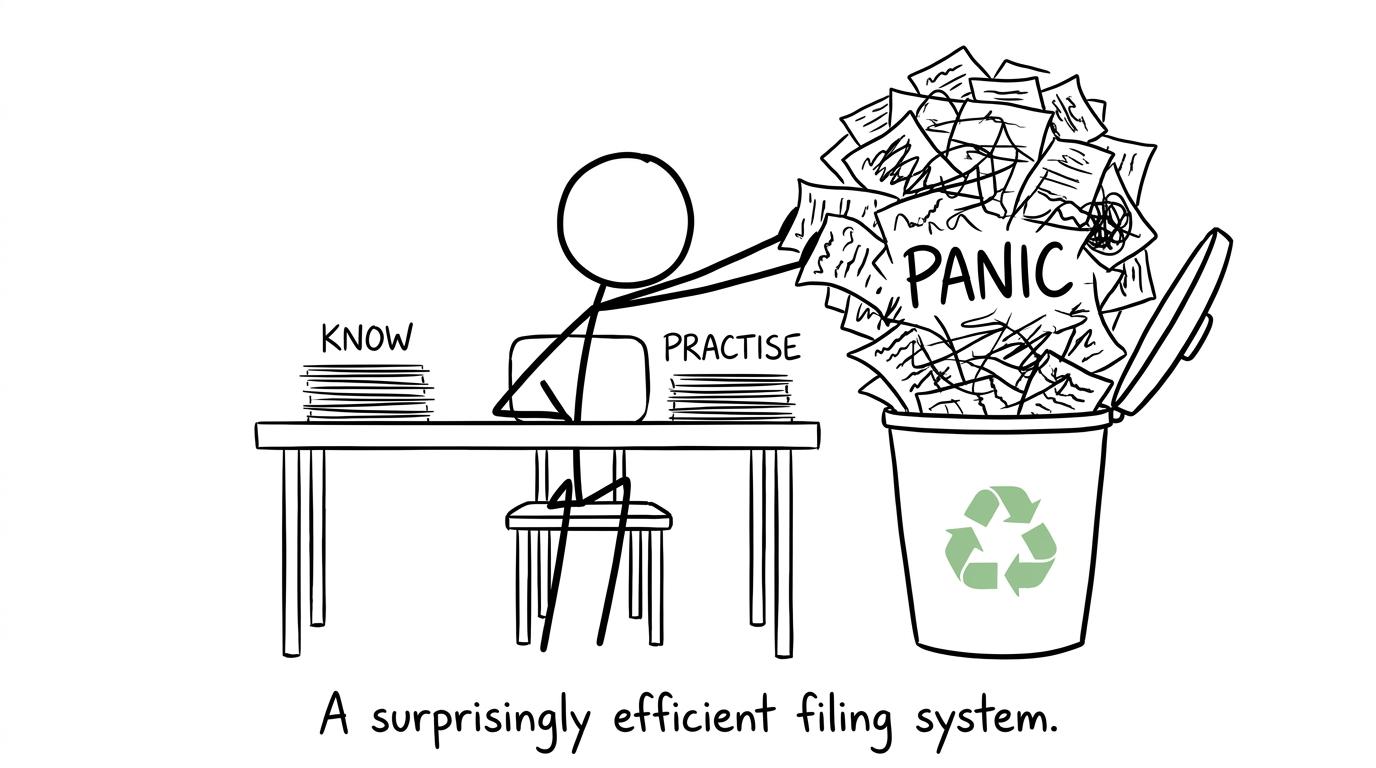 A student replaces a pile of panic with two manageable revision piles
Common mistakes to avoid
Revising the wrong board or text
Question styles are not interchangeable. Check the board name, specification code and set-text list before using any paper or revision video.
Treating Language and Literature as one exam
Language tests how you interpret unseen writing and produce your own. Literature tests detailed knowledge of studied texts alongside analysis. They overlap, but they need different revision materials.
Forgetting a compulsory question
A choice within a section does not mean the whole section is optional. Eduqas Language Component 2, for example, includes two compulsory writing tasks. Read every instruction carefully.
Writing everything you know
Marks reward a focused response to the exact question. Select evidence because it supports an argument, not because it was the quotation you happened to remember.
Practising without marking
Unmarked practice can preserve the same mistake. Use mark schemes and examiner guidance to identify what stronger responses actually do. MathsGenie's GCSE revision loop applies the same principle: attempt, mark, fix and revisit.
Letting one subject consume the week
English essays take time, but so do mathematical skills. Use shorter, deliberate sessions rather than waiting for an empty afternoon. The GCSE maths night-before plan also offers useful ideas for reducing last-minute decisions.
Walk into every paper knowing the route
An exam feels less threatening when its structure is familiar. You know what appears first, what follows and when to move on. That knowledge does not replace thoughtful analysis, but it gives your analysis somewhere to go.
Confirm your board, make a map for each paper and practise its sections under realistic conditions. Then bring the same discipline to maths through MathsGenie's free GCSE and A Level revision resources: revision lessons, practice questions, mini tests, past papers, predicted papers, mark schemes and video solutions. The goal is not to remove every difficult question. It is to make sure the format never catches you off guard.