

GCSE English Language Grade Boundaries Year to Year
GCSE English Language grade boundaries year to year usually shift by a few marks. Compare recent data, learn why they move and revise without guesswork.
The uncomfortable part of waiting for a GCSE result is that the finishing line seems to move. You can mark a past paper, find a grade and still wonder whether the same mark will be enough this summer.
The short answer is reassuring: GCSE English Language grade boundaries year to year usually move by a modest number of raw marks, although some boundaries shift more than others. They change because each new paper is slightly different in difficulty. The aim is not to make a grade easier or harder to earn, but to keep the standard represented by that grade comparable over time.
Past boundaries are therefore useful context, not a reliable prediction. Your safest strategy is to aim above previous thresholds and concentrate on the marks you can control.
The quick answer
Here is what students should remember:
- Grade boundaries are set after the examinations have been taken and marking is nearly complete.
- They commonly move by a few raw marks, but there is no fixed maximum change.
- An easier paper will generally produce higher boundaries; a harder paper will generally produce lower ones.
- Changes vary by exam board, specification and grade.
- GCSE English Language is untiered, so there are no separate foundation and higher boundaries.
- The overall qualification boundary matters more than any notional boundary for one paper.
- Previous figures should guide your revision target, not become your predicted result.
You can check complete historical figures through the AQA GCSE English Language grade boundaries and Edexcel GCSE English Language grade boundaries pages.
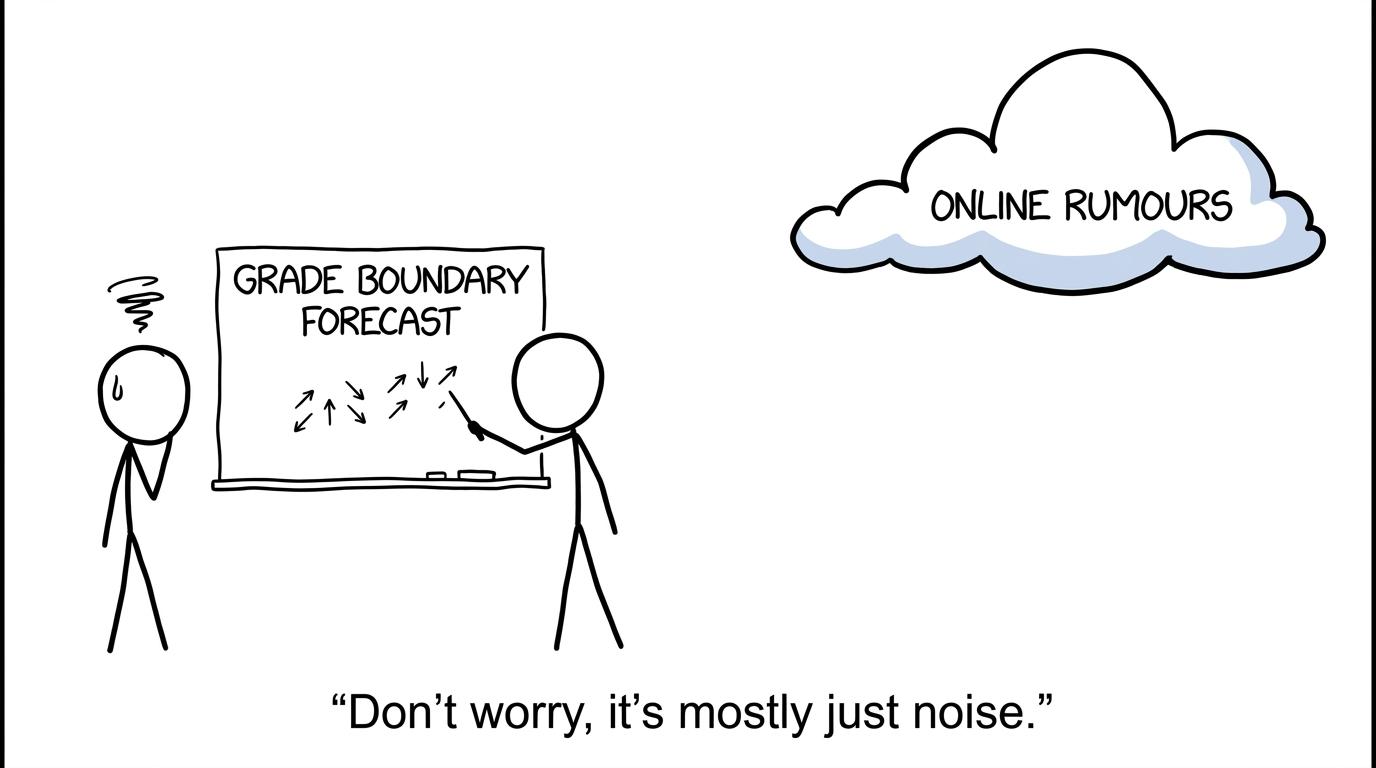 A student watches a dramatic grade boundary weather forecast
How much have recent boundaries actually changed?
Recent summer results show why the phrase “a few marks” is useful, but not a promise. The table compares selected overall subject boundaries for AQA specification 870087008700 and Pearson Edexcel specification 1EN01EN01EN0. Both qualifications had a maximum total of 160160160 marks in these series.
| Exam board and grade | June 202320232023 | June 202420242024 | June 202520252025 |
|---|---|---|---|
| AQA grade 999 | 121121121 | 121121121 | 119119119 |
| AQA grade 777 | 102102102 | 102102102 | 100100100 |
| AQA grade 555 | 818181 | 828282 | 828282 |
| AQA grade 444 | 717171 | 737373 | 737373 |
| Edexcel grade 999 | 131131131 | 132132132 | 131131131 |
| Edexcel grade 777 | 113113113 | 114114114 | 115115115 |
| Edexcel grade 555 | 919191 | 949494 | 959595 |
| Edexcel grade 444 | 808080 | 848484 | 868686 |
The AQA figures were notably stable. Across these selected grades, no one-year change was greater than 222 marks. Edexcel moved more at some thresholds: its grade 444 boundary rose by 444 marks between June 202320232023 and June 202420242024, then by another 222 marks in June 202520252025.
That does not mean Edexcel suddenly made grade 444 harder to achieve. It means the evidence supported different raw-mark thresholds while the intended grade standard was maintained.
It also shows why one headline can be misleading. A boundary might remain unchanged at grade 999 while moving at grade 444. Different parts of a mark distribution do not have to shift by identical amounts.
For a longer view, use the GCSE English Language grade boundaries history. If you need all grades rather than selected thresholds, the GCSE English Language marks per grade guide compares the major boards.
Why GCSE English Language boundaries move
Every examination paper is designed to meet the same specification and level of demand. Yet no two papers can contain exactly the same passages, prompts and questions. Students may find one source unusually accessible, one comparison task more demanding or one writing prompt easier to develop.
The paper's true difficulty only becomes clear once students have taken it and examiners have marked enough scripts. Exam boards then use several forms of evidence.
Statistical evidence
Awarding organisations examine mark distributions and information about the cohort taking the qualification. This helps identify a plausible range for each key boundary.
For English Language and maths, Ofqual can also use evidence from the National Reference Test to monitor changes in national performance over time. The test has been used since 201720172017 as an additional source of evidence. It does not determine an individual student's grade.
Expert judgement
Senior examiners inspect work around provisional boundaries. They compare the quality of that work with scripts from previous series and decide whether it represents the expected standard for the grade.
This matters because a raw mark has no permanent meaning on its own. A total of 100100100 marks may represent slightly different performance on two papers with different demands. The boundary translates the marks from that particular assessment into a stable grade standard.
Regulatory oversight
Ofqual oversees grading in England. Its published guidance for 202520252025 confirmed that boundaries were set after assessments had been taken and marking was nearly complete, using both technical evidence and expert review.
There is no national quota requiring a set number of students to pass or fail. Results can vary because cohorts and performance vary. The objective is to preserve the meaning of each grade, not to force every year's results into an identical pattern.
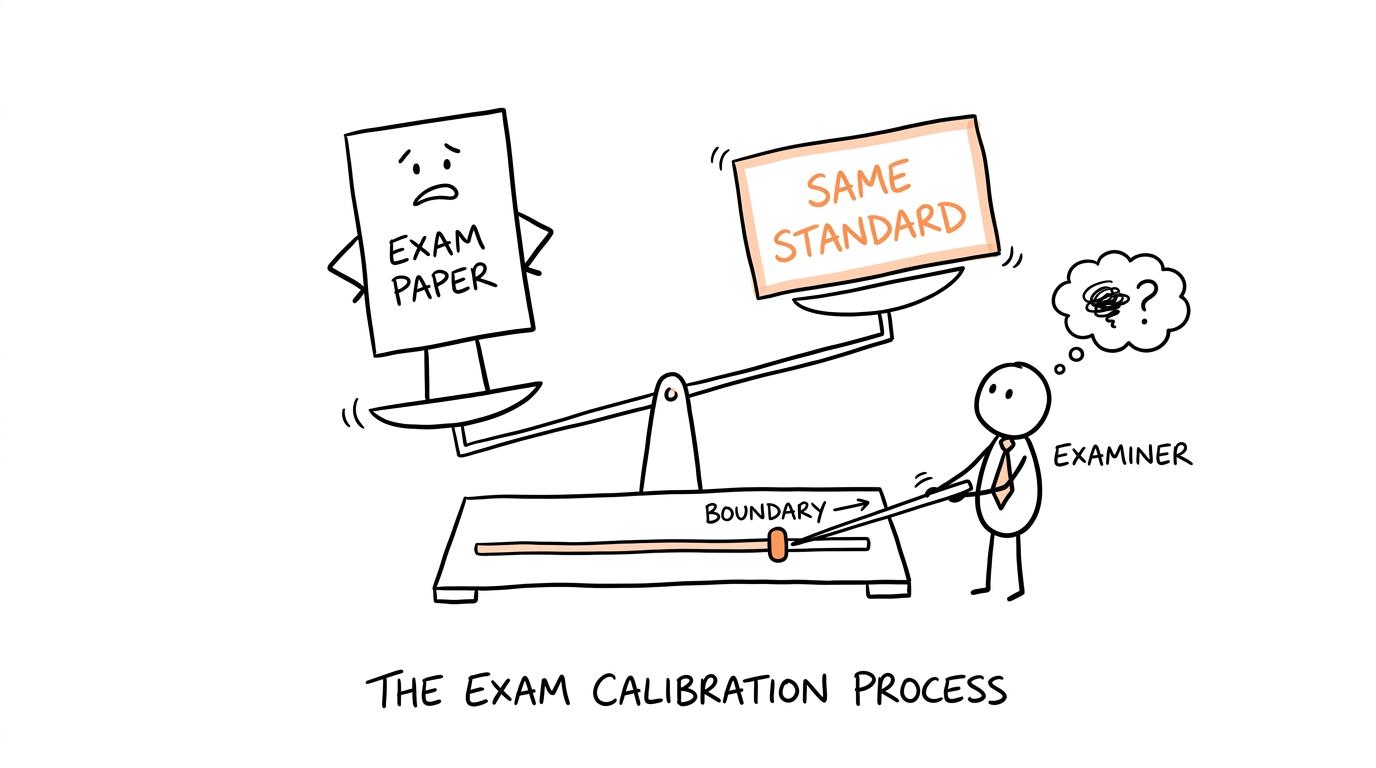 An examiner adjusts a boundary to keep the grade standard balanced
Why boards have different boundaries
AQA, Pearson Edexcel, OCR and Eduqas assess GCSE English Language through their own specifications and papers. Their question structures, maximum marks and assessment models are not necessarily identical.
Consequently, a grade 555 boundary from AQA should not be transferred to Edexcel, OCR or Eduqas. Even when two qualifications have the same maximum mark, that does not make their raw thresholds directly comparable.
Pearson also offers both Edexcel English Language and English Language 2.02.02.0. These are separate specifications with different boundaries. Checking “Edexcel English” without confirming the specification can lead you to the wrong table.
Always match four details:
- the exam board;
- the exact specification;
- the examination series;
- the overall qualification maximum mark.
The GCSE English Language boundaries for 2026 guide explains why the next official thresholds cannot be confirmed in advance.
What changing boundaries mean for your revision
Suppose a past boundary is close to your current mock mark. It is tempting to turn that number into a target. But a target placed exactly on an old boundary has no safety margin for normal variation, a difficult question or a marking error in your self-assessment.
A better approach is to treat the boundary as a range marker. Aim comfortably above it, then measure progress through repeated papers rather than one unusually good result.
Your revision process should be:
- complete a paper under timed conditions;
- mark it carefully using the correct mark scheme;
- combine the relevant paper marks before consulting the overall boundary;
- identify where marks were lost;
- practise those precise skills;
- retest them with fresh questions.
Although the boundary data here concerns English Language, the principle is especially valuable for students balancing English with maths revision. The boundary is outside your control. Topic knowledge, timing and correction of mistakes are not.
MathsGenie's free GCSE Maths revision hub brings together revision lessons, practice questions, past papers, predicted papers, mark schemes and video solutions. Short GCSE mini tests can expose a weak area without requiring a full paper.
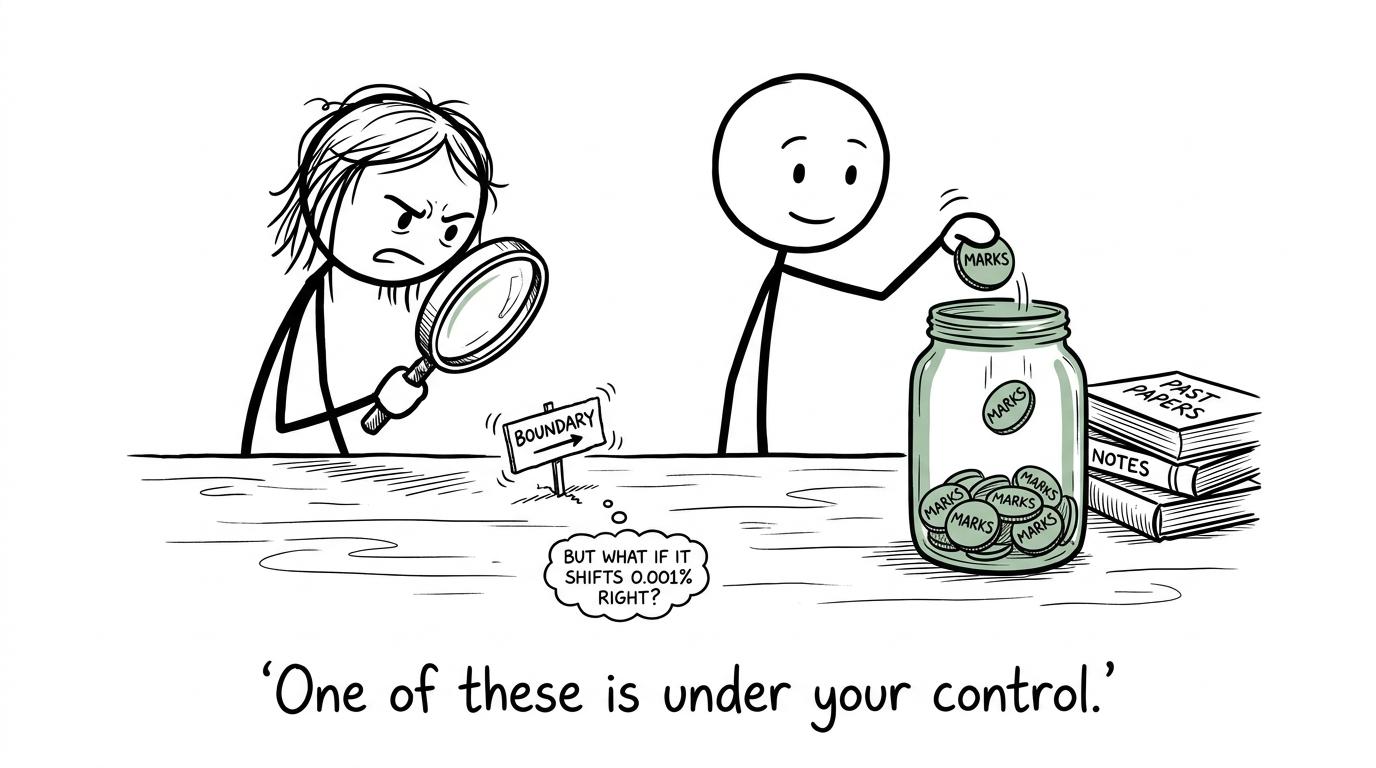 One student watches the boundary while another collects controllable marks
Common mistakes when reading grade boundaries
Treating last year's boundary as a forecast
A previous boundary records what happened in one completed series. It cannot reveal how students will respond to a future paper. No official boundary exists before the awarding process is complete.
Looking at one paper instead of the qualification total
English Language grades are awarded for the complete qualification. Exam boards may publish notional component boundaries, but these are guides rather than separate official paper grades. Add the appropriate component marks and use the overall boundary.
Comparing raw marks across different boards
A lower boundary does not automatically mean an easier route to a grade. It may indicate that the assessment was more demanding. Compare marks only within the correct board, specification and series.
Assuming every grade moves equally
The recent data shows that grade 444 can move while grade 999 remains nearly unchanged. Always inspect the threshold relevant to your target rather than relying on a general statement about boundaries rising or falling.
Revising to scrape the old threshold
Aiming for the exact minimum turns a historical figure into a ceiling. Aim higher and use mistakes as revision instructions. The guide to using GCSE past papers properly explains how to convert every dropped mark into a useful next step.
Focus on marks, not boundary rumours
GCSE English Language boundaries do change from one year to the next, but recent evidence shows that movement is often modest. Some thresholds stay still; others move by several marks. The exact change depends on the board, specification, grade and difficulty of that year's assessment.
The deeper point is simple. Boundaries move so that grades do not lose their meaning.
Use historical tables to understand a sensible range, then return your attention to what improves results: precise practice, honest marking and repeated correction. For maths, start with the MathsGenie revision lessons, diagnose gaps with mini tests, build stamina through past papers and finish with predicted papers and video solutions. The boundary may move. Your preparation can move further.











