GCSE English Language Exam Clash Same Week: A Plan
GCSE English Language exam clash same week? Use a calm revision plan that protects English practice, maths progress, sleep and focus across a busy timetable.
An English Language paper on Tuesday. Maths on Wednesday. Science soon afterwards. At that point, the week can feel less like a timetable and more like a queue of urgent problems.
If you are searching for help with a GCSE English Language exam clash same week, the immediate answer is this: give the nearest exam most of your attention, but keep every later subject alive through short, active sessions. Do not divide your time equally, and do not abandon maths until English is over.
English Language benefits from timed reading, planning and writing. Maths benefits from frequent problem-solving and correction. Your plan should protect both forms of practice without asking you to revise everything every evening.
Your exam-week checklist
Before deciding what to revise, do these things:
- Confirm the date, start time and paper for every exam with your school.
- Check your English exam board and paper structure.
- Check the board, tier and calculator status of each maths paper.
- Rank subjects by exam proximity, confidence and marks still available.
- Give the next exam the longest session.
- Keep the following exams active with short recall or practice blocks.
- Mark completed work rather than simply counting revision hours.
- Leave space for meals, breaks, travel and sleep.
The GCSE maths revision hub is a useful starting point because it brings together free revision lessons, exam questions, past papers and board-specific resources. Keep one relevant page open rather than spending valuable time searching repeatedly.
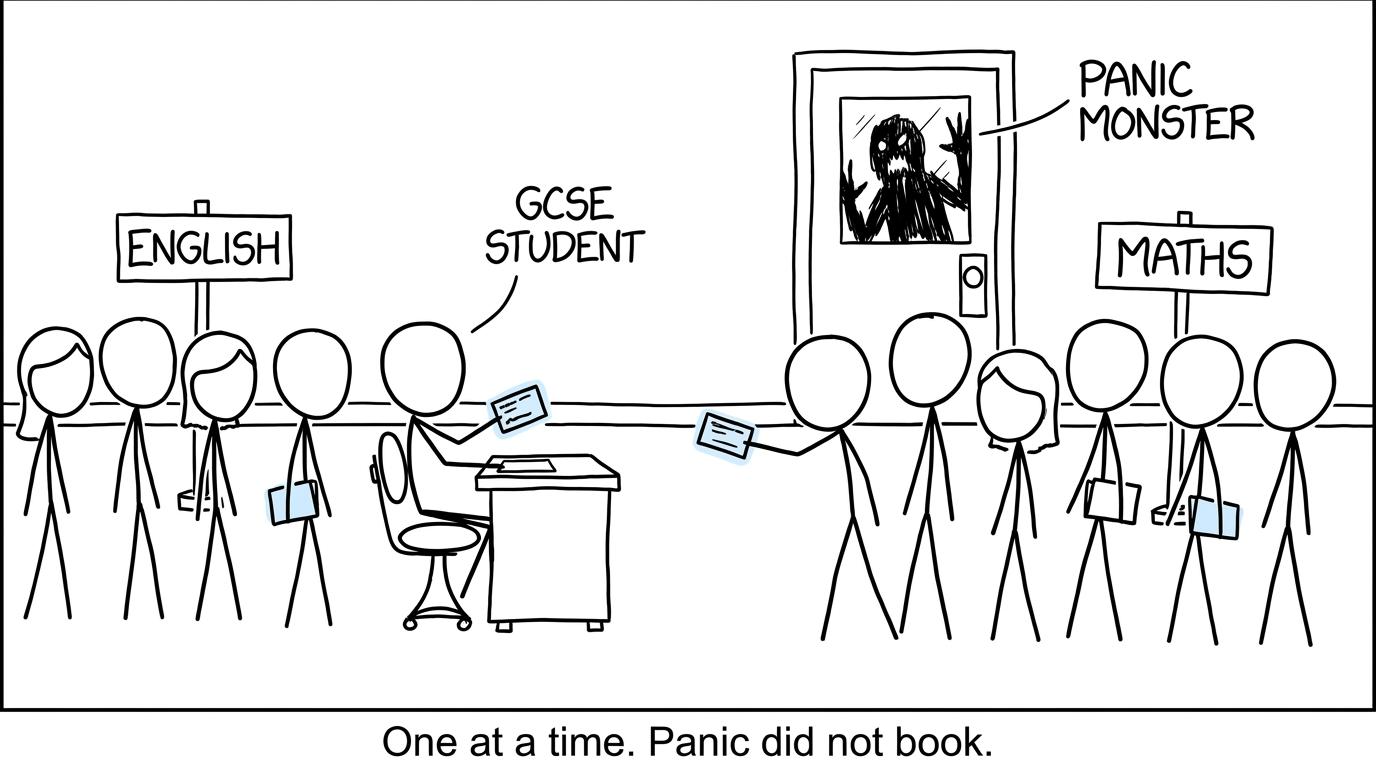 A student calmly schedules English and Maths while panic waits outside
First, decide whether it is really an exam clash
Students often use “clash” to mean several exams falling within a few days. Officially, a timetable clash normally means two or more examinations are scheduled in the same session or create an unusually heavy examination day.
If English and maths are simply in the same week, this is a revision-planning problem. If two papers appear at the same time, speak to your exams officer immediately. Do not decide to miss one or assume that you can sit it later.
Under current Joint Council for Qualifications guidance, schools and colleges manage genuine clashes. Depending on the combined duration and timing of the papers, candidates may sit examinations consecutively or under supervised arrangements. Your centre must explain what applies to you. If supervision is required, there may also be restrictions on phones, internet access and contact with other candidates.
The important distinction is simple: your school resolves an official timetable clash; you resolve a crowded week with sensible priorities.
Split attention by urgency, weakness and exam demands
Equal time sounds fair, but exam weeks are not fair systems. A subject being sooner changes the value of tonight's revision. So does your current confidence.
Use three questions whenever you plan the next session:
- Urgency: Which paper comes first?
- Need: Where are you most likely to lose recoverable marks?
- Maintenance: Which later subject will become rusty if ignored completely?
The nearest exam should usually receive the largest block. A weaker paper may also deserve extra time, provided that this does not erase preparation for tomorrow's exam. Later subjects receive shorter maintenance sessions until they move to the front of the queue.
This rolling approach is more useful than writing a rigid weekly plan and following it after circumstances change. At the end of each paper, reassess the next two examinations and adjust. MathsGenie's guide to building a GCSE maths revision timetable can help you turn that rolling priority into a practical plan.
Protect a small daily maths habit
If English Language comes first, maths does not need to disappear. A short maths session can preserve familiarity with methods, notation and calculator routines.
Use the twenty-minute GCSE maths revision routine when time is tight. Choose one vulnerable topic, attempt a few exam-style questions, mark them and write down the specific error. This is more valuable than rereading several chapters.
If your maths paper is next morning, increase that block and reduce English maintenance once the English paper has finished. Priorities should move with the timetable.
Revise English Language through actions, not pages of notes
English Language is not best revised by trying to memorise large amounts of generic terminology. The exact paper structure varies across AQA, Edexcel, OCR and Eduqas, so use the specification, past papers and guidance for your own board.
Your short English sessions should practise the actions the examination demands:
- reading an unseen extract carefully;
- locating precise evidence;
- explaining how a writer creates meaning or effects;
- comparing texts where your paper requires it;
- planning a clear argument or piece of creative writing;
- writing accurately under time pressure;
- checking paragraphing, punctuation, spelling and sentence control.
A focused session might involve annotating one extract and planning responses without writing every answer in full. Another might involve completing one timed extended response, then comparing it with the relevant mark scheme and teacher guidance.
Keep the task narrow. “Revise English” is too vague to begin. “Practise selecting evidence for a reading question” gives you a visible finish line.
Match the task to the time and energy available
Revision quality changes across an exam day. Immediately after a long paper, you may not be ready for demanding extended writing or a full maths paper. That is not laziness. It is a planning constraint.
Use your sharper periods for tasks requiring sustained judgement:
- timed English responses;
- unfamiliar maths problems;
- full or partial papers;
- detailed marking and correction.
Use lower-energy periods for lighter but still active work:
- reviewing an English question structure;
- recalling writing techniques;
- correcting previously attempted maths questions;
- watching a short video solution and then reproducing the method independently;
- checking equipment and the following day's timetable.
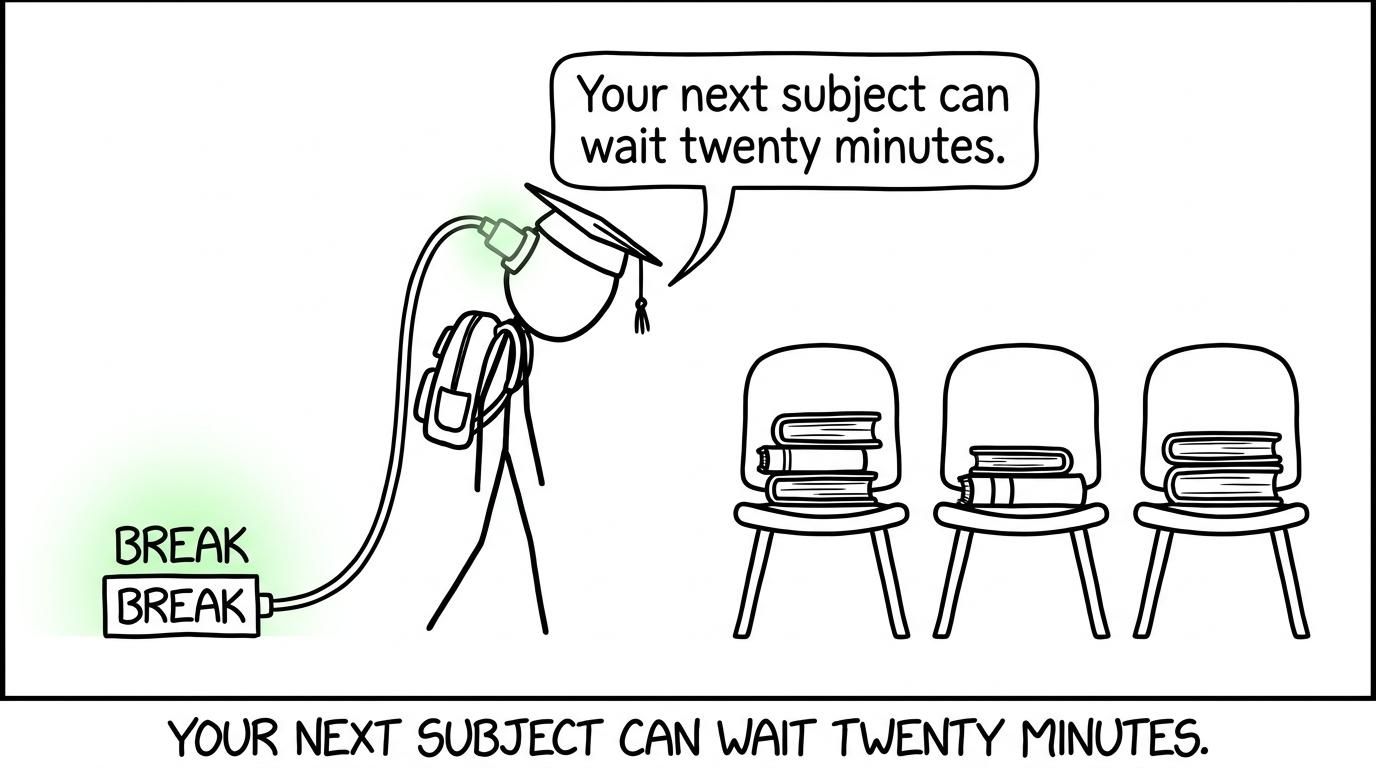 A student's brain takes a short charging break after an exam
A short break after an exam can make the next session productive. Government exam-pressure guidance recommends manageable targets, structured revision and testing what you have learned. It also advises students not to try to do too much at once. Rest belongs inside the plan, not outside it.
Build a rolling plan for the crowded week
Plan only as far ahead as you can see clearly. A useful evening structure is:
- decompress, eat and drink after school or an exam;
- complete the main session for the nearest paper;
- take a proper break;
- complete a shorter maintenance session for the next paper after that;
- mark or review what you attempted;
- prepare equipment and stop at a planned time.
Suppose English is tomorrow and maths follows the next day. English receives the main evening block, centred on a board-specific reading or writing task. Maths receives a shorter active block targeting one known weakness. After English has been sat, maths becomes the main subject.
This is not a fixed formula. If a marked paper shows that maths is secure but your English timing is unreliable, English may need more attention. Use evidence rather than guilt.
For maths, the guide to finding your weakest GCSE topics explains how lost marks can identify the work worth doing next. If you have only a few days, the one-week GCSE maths revision plan provides a broader structure for diagnosis, targeted practice and paper review.
Use past papers without exhausting yourself
A full paper is not automatically the best choice every night. It creates useful evidence, but only if you have enough time and attention to complete and review it properly.
Before a crowded exam week, full papers help build timing and stamina. During the week itself, selected sections, mini tests and targeted questions may offer a better return. The MathsGenie guide to when you should start GCSE past papers explains how paper practice can progress from diagnosis to full timed conditions.
Marking is essential. In English, identify whether the weakness was interpretation, evidence, explanation, organisation, technical accuracy or timing. In maths, separate a knowledge gap from a misread question, arithmetic slip or incomplete method.
A mark scheme is not merely a score counter. It tells you what to change next.
What to do the night before each exam
The night before is for sharpening, not rebuilding the entire course.
For English Language:
- confirm the paper and question sequence;
- remind yourself of approximate timings taught by your school;
- review one or two recurring weaknesses;
- plan or complete a short response;
- stop before tiredness damages the quality of your work.
For maths:
- confirm your board, tier and calculator requirements;
- correct familiar error patterns;
- complete a short mixed set or mini test;
- check your calculator and equipment;
- avoid beginning a full paper too late to review it.
The GCSE maths night-before plan offers a calm checklist for choosing a small exam-style set, fixing mistakes and packing the correct equipment.
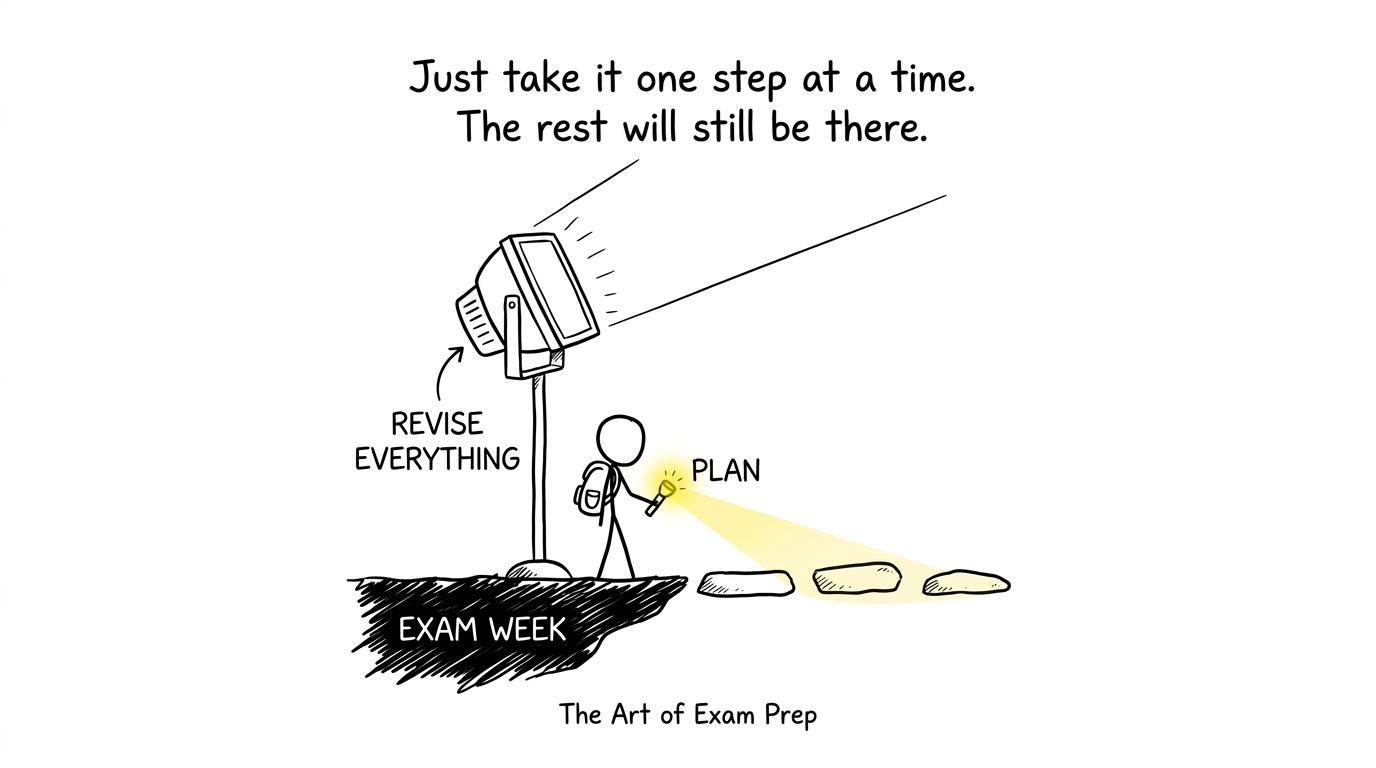 A small plan lights the next steps through exam week
Common mistakes when several exams share a week
Giving every subject identical time
Equal blocks ignore exam order and current confidence. Allocate time according to urgency and evidence, then review the balance each day.
Dropping later subjects completely
Ignoring maths for several days can make familiar methods feel less automatic. A short maintenance session keeps the subject accessible until it becomes the main priority.
Revising English only by reading notes
Recognition can feel like understanding. The exam requires you to select, explain, compare, organise and write. Practise those actions under realistic time pressure.
Completing papers without reviewing them
An unmarked paper tells you that you worked, but not what you learned. Use mark schemes, teacher feedback and video solutions to convert mistakes into a short repair list.
Replaying the exam that has finished
Once a paper is over, discussing every answer can consume the attention needed for the next subject. Note anything genuinely useful, take a break and move the timetable forward.
Sacrificing sleep to create extra hours
Late-night revision can reduce the concentration those hours were meant to improve. Set a stopping time and protect the next day's reading accuracy, judgement and problem-solving.
Move through the week one paper at a time
A crowded week feels overwhelming when every subject demands attention at once. On paper, however, only one task can be completed at a time. The aim is not to feel equally prepared for everything every evening. It is to make the best next decision, preserve later subjects and arrive rested enough to use what you know.
Start by confirming your timetable and English paper. Then open the MathsGenie GCSE maths revision hub, choose your board and tier, and identify the smallest useful maths task for today. Use free revision lessons, practice questions, mini tests, past papers, predicted papers, mark schemes and video solutions to keep maths moving while English takes temporary priority.
A good revision planner does not remove a difficult week. It makes the next step obvious. That is often enough.