

GCSE Economics Paper 2 Exam Date 2026 & Checklist
GCSE Economics Paper 2 exam date 2026: check the AQA and OCR date, morning session, paper lengths, revision priorities and what to take on the day.
The hardest part of an exam timetable is not finding a date. It is trusting that you have found the right date for the right board, paper and qualification. One similar-looking code can quietly send your planning in the wrong direction.
For students taking AQA or OCR in England, the GCSE Economics Paper 2 exam date 2026 was scheduled for Friday 22 May 2026 in the morning session. AQA Paper 2 lasts 111 hour 454545 minutes, while OCR Paper 2 lasts 111 hour 303030 minutes. Your school decides the precise arrival and start arrangements, so its individual candidate timetable remains the document to follow.
This guide explains the confirmed date, what each paper covers, what to revise and what to have ready before entering the exam room.
GCSE Economics Paper 2 exam date 2026 at a glance
The final summer timetables published by AQA and OCR place their GCSE Economics Paper 2 examinations in the same morning session.
| Exam board | Specification and paper | Date | Session | Duration |
|---|---|---|---|---|
| AQA | 8136/28136/28136/2: How the economy works | Friday 22 May 2026 | Morning | 111 hour 454545 minutes |
| OCR | J205/02J205/02J205/02: National and international economics | Friday 22 May 2026 | Morning | 111 hour 303030 minutes |
Before relying on the table, compare it with all four details on your school timetable:
- qualification title;
- exam board;
- specification or component code;
- morning or afternoon session.
This matters because GCSE Economics, International GCSE Economics, A Level Economics and GCSE Business have different papers. Pearson Edexcel students may be taking International GCSE Economics, rather than the AQA or OCR GCSE covered by the table above. Students following CCEA or another specification must also use the timetable issued for that qualification.
If there is any difference between an online summary and your candidate timetable, ask your exams officer immediately. Do not guess.
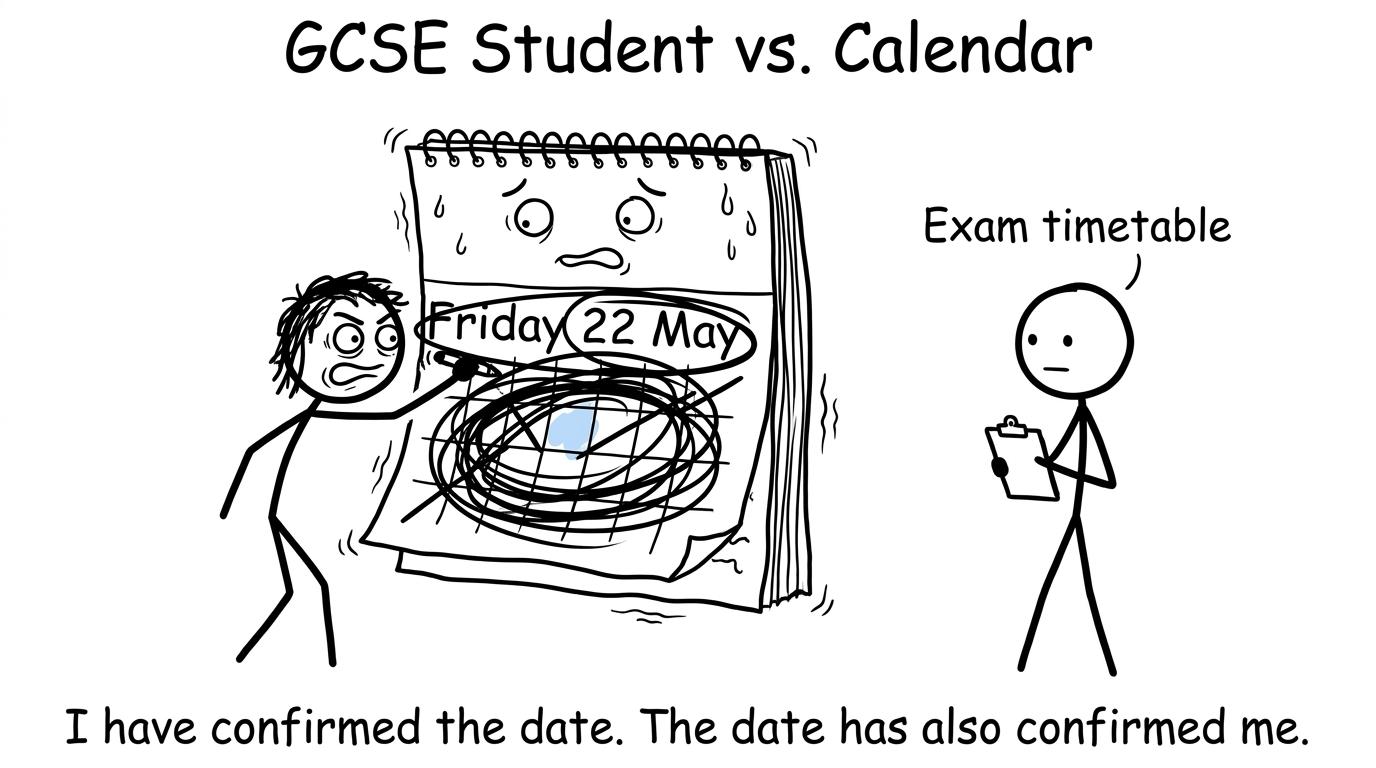 A student and an increasingly nervous calendar confirming the Economics exam date
What is tested on Economics Paper 2?
The shared date does not mean the papers are identical. Each exam board uses its own title, structure and specification language.
AQA Paper 2: How the economy works
AQA component 8136/28136/28136/2 is worth 808080 marks and represents 50%50\%50% of the GCSE. The examination lasts 111 hour 454545 minutes.
Its main focus is the wider economy, including economic objectives, government policies, international trade and the role of money and financial markets. AQA also expects students to draw on knowledge from across the course where questions require a deeper or connected understanding.
That final point is important. Paper 2 revision should be led by macroeconomics, but Paper 1 ideas should not be treated as sealed away. Markets, incentives, costs and consumer or producer behaviour can help explain what happens across an economy.
OCR Paper 2: National and international economics
OCR component J205/02J205/02J205/02 is also worth 808080 marks and contributes 50%50\%50% of the qualification. It lasts 111 hour 303030 minutes.
The specification covers economic objectives and the role of government, followed by international trade and the global economy. The paper includes multiple-choice questions and questions based on short case-study material, with opportunities for short, medium and extended responses.
Both OCR Economics papers assess quantitative skills. You therefore need to be able to move between written economic reasoning, numerical data, tables and graphs without treating them as separate subjects.
Your Paper 2 revision checklist
A date becomes useful when it changes what you do next. Before Friday 22 May, check that you can:
- define the principal macroeconomic objectives precisely;
- explain possible causes and consequences of inflation, unemployment and economic growth;
- distinguish fiscal, monetary and supply-side policies;
- analyse how a policy can affect households, firms and government;
- explain international trade, exchange rates and globalisation at the level required by your specification;
- interpret tables, diagrams and extracts rather than merely copy information from them;
- complete percentage, average and change calculations accurately;
- build extended responses around analysis, context and a supported judgement;
- finish a complete Paper 2 within your board's time limit.
Use the specification as a boundary, not a decoration. A revision session should end with evidence that you can retrieve or apply something, rather than a feeling that the page looked familiar.
MathsGenie's free revision planner can help you place Economics alongside maths and your other GCSE subjects without allowing one approaching paper to consume the entire week. For a repeatable structure, the guide to building a GCSE revision timetable you can follow explains how to combine learning, questions and feedback.
Strengthen the maths used in Economics
Economics questions often hide straightforward maths inside unfamiliar context. The calculation may be manageable; deciding which figures matter is usually the harder step.
Key quantitative skills include percentages, percentage change, averages, ratios and the interpretation of graphs. For percentage change, the underlying relationship is:
percentage change=new value−original valueoriginal value×100\text{percentage change}=\frac{\text{new value}-\text{original value}}{\text{original value}}\times 100percentage change=original valuenew value−original value×100When the result is negative, the quantity has decreased. Keep the sign and explain what it means in context.
You should also be comfortable with the mean:
mean=sum of the valuesnumber of values\text{mean}=\frac{\text{sum of the values}}{\text{number of values}}mean=number of valuessum of the valuesThe calculation is only the beginning. An Economics response should connect the result to the issue in the question. A change in inflation, output or unemployment matters because of its likely effect on economic agents and objectives.
If calculations feel less secure than your written knowledge, use MathsGenie's percentage change revision resources to rebuild the method. The broader MathsGenie GCSE revision hub also provides lessons, questions and videos for the graph, ratio and statistics skills that support data-response work.
How to prepare in the final weeks
The most effective routine is small enough to repeat:
- attempt a Paper 2 or timed section without notes;
- mark it using the official mark scheme;
- classify each lost mark as knowledge, application, analysis, judgement, maths or timing;
- revise the two weakest areas;
- answer fresh questions on those areas;
- retest them several days later.
This creates a feedback loop. Rereading can make a topic feel familiar, but an unseen question reveals whether that familiarity survives under pressure.
The same approach works across your GCSE timetable. MathsGenie's guide to finding your weakest GCSE topics shows how to turn lost marks into focused next actions. You can also use the collection of GCSE past papers to keep your wider exam preparation moving.
Predicted papers should be used carefully. They provide fresh practice, not advance knowledge of the real examination. MathsGenie's GCSE maths predicted papers are valuable for maintaining your maths preparation while Economics revision becomes more intensive.
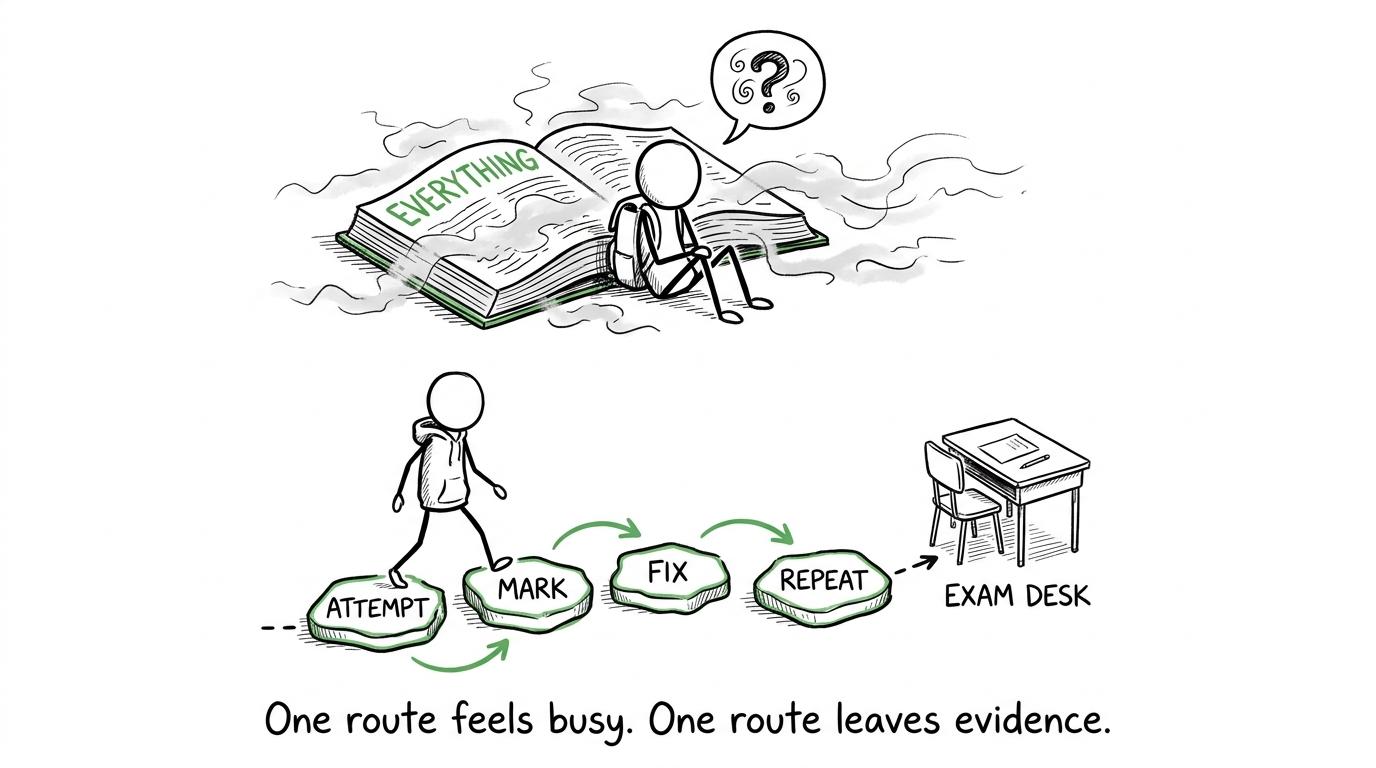 Two revision routes showing the difference between rereading and active feedback
What to have ready before the exam
Pack your equipment the evening before, not while your morning alarm is still ringing.
Your basic exam kit should include:
- at least two working black pens;
- pencils, a rubber and a ruler;
- a completely transparent pencil case;
- a permitted calculator if allowed by the instructions for your paper;
- a transparent, label-free water bottle if your centre permits one;
- any identification or candidate information required by your school.
If using a calculator, check its batteries, clear anything stored in its memory and remove any lid or cover carrying printed instructions. Always read the materials statement on the front of the question paper and follow your centre's guidance.
Do not have notes, a mobile phone, earbuds, smart glasses or any type of watch in your possession in the exam room. Under the JCQ rules for written examinations, possession of unauthorised material can be reported even when you did not intend to use it.
Also confirm:
- where you must assemble;
- the arrival time set by your school;
- your seat or candidate number, if provided;
- your travel plan and a sensible backup;
- any approved access arrangements.
A morning session does not tell you the exact time at which your centre expects you. Follow the instructions from your school rather than assuming that every centre starts identically.
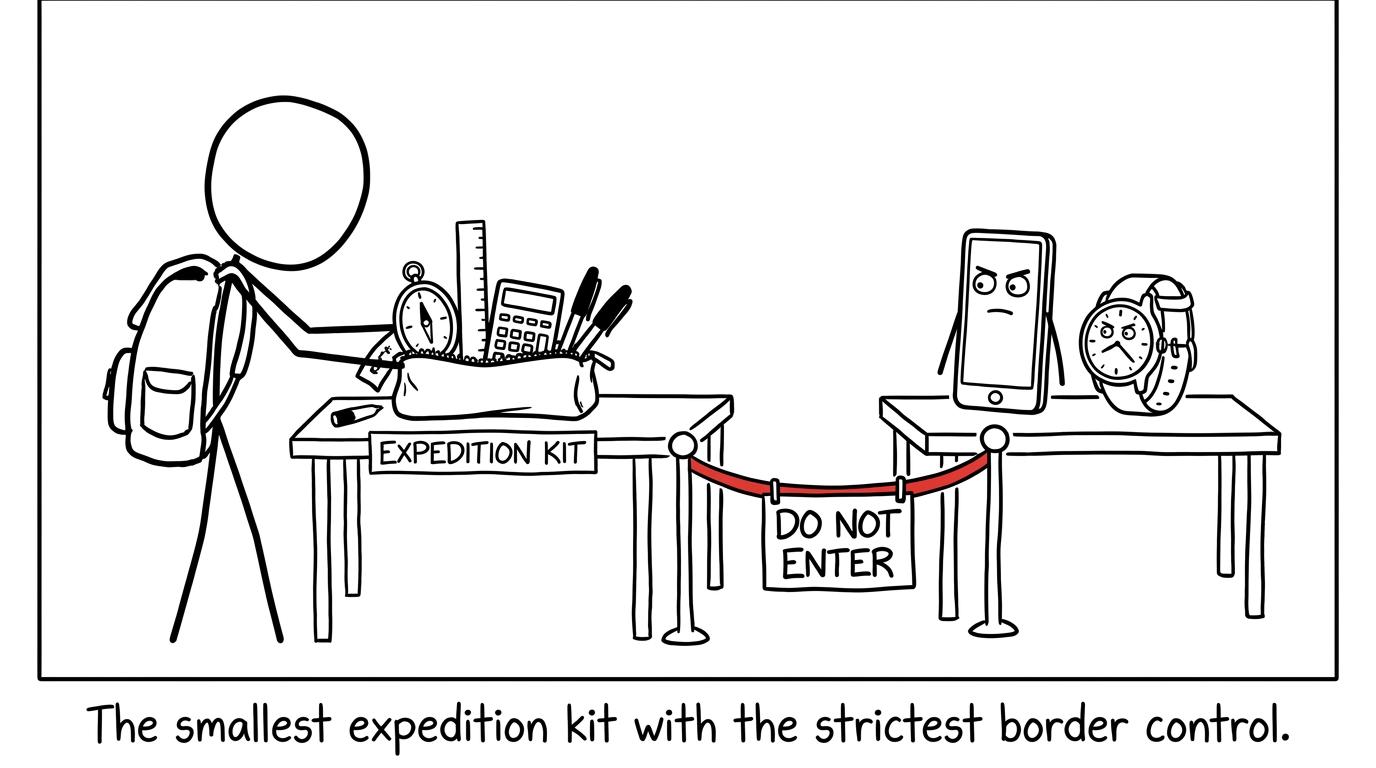 A student packing the tightly controlled expedition kit known as an exam pencil case
Common mistakes to avoid
Confusing Economics with Business
Both subjects discuss firms, consumers and government, but their paper codes and timetables are different. Check that the title actually says Economics.
Remembering the date but not the session
For AQA and OCR, Paper 2 was scheduled for the morning of Friday 22 May 2026. Record the session alongside the date.
Assuming every board has the same duration
AQA students have 111 hour 454545 minutes; OCR students have 111 hour 303030 minutes. Practise using the duration for your own board.
Revising only definitions
Definitions can earn marks, but longer answers require application, connected reasoning and a justified conclusion. Practise explaining how one change leads to another.
Ignoring quantitative skills
Do not abandon a calculation because the surrounding paragraph looks complicated. Identify the required quantities, write the relevant relationship and retain units or percentage signs.
Treating the timetable as permission to stop early
The wider GCSE, AS and A Level examination period included a national contingency day on Wednesday 24 June 2026. Candidates were expected to remain available in case an examination had to be moved because of national or significant local disruption. A contingency day is not an opportunity to rearrange an exam you personally miss.
Turn the date into a plan
For AQA and OCR students, the important entry was clear: Friday 22 May 2026, morning session. But a date alone cannot improve a response. Its value is that it creates a deadline for retrieval, timed practice, honest marking and correction.
Confirm your board and component code today. Then choose one Paper 2 weakness and test it under exam conditions. Keep your wider GCSE maths preparation steady through MathsGenie's free revision lessons, practice questions, mini tests, past papers, predicted papers, mark schemes and video solutions.
When the timetable feels crowded, reduce the number of decisions. Open the MathsGenie revision planner, schedule the next useful task and begin. Calm rarely arrives before preparation. More often, it is what preparation leaves behind.











