

GCSE Economics Lower Grade Than Expected: Next Steps
GCSE economics lower grade than expected? Learn what to check, when to request a review, how resits work and how to create a focused recovery plan.
Opening a results envelope can compress two years of work into one uncomfortable moment. If you received a GCSE economics lower grade than expected, pause before deciding what it means. Your immediate next steps are to check your marks, speak to your teacher or exams officer, consider whether there is evidence for a review of marking, and confirm whether the grade affects your next course.
A disappointing result deserves a careful response, not a panicked one. The grade may remain unchanged, but you still have choices: accept it, request a post-results service where appropriate, or prepare for a resit if your school, college and exam board make that possible.
Your results-day checklist
- Record your overall grade and component marks.
- Check the entry against your correct exam board and specification.
- Compare the result with any sixth-form or college entry requirement.
- Ask your economics teacher whether the mark looks unusual.
- Contact your exams officer promptly about scripts, reviews and deadlines.
- Decide whether changing the result would materially improve your next step.
- Protect your wider plans, including ongoing GCSE maths revision or preparation for A Level study.
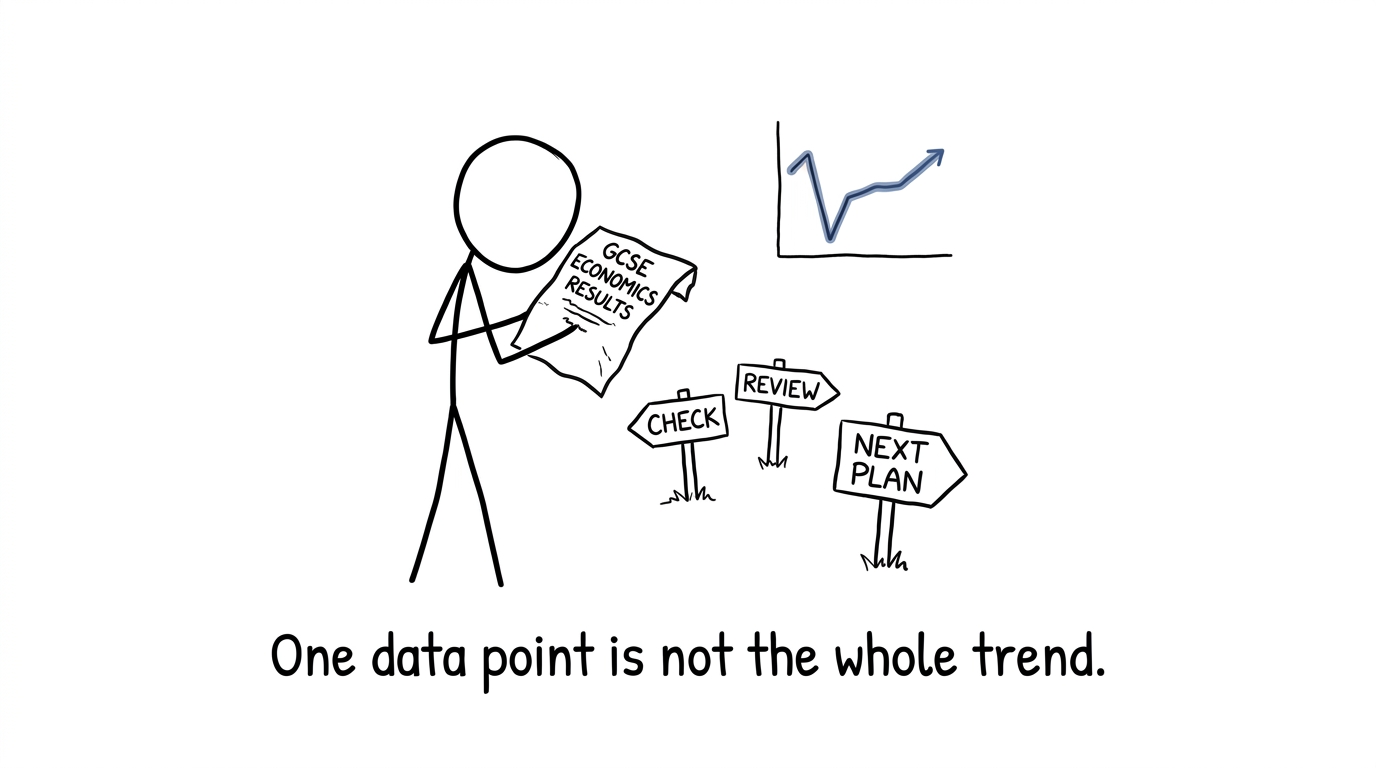 A student sees one disappointing result as one data point rather than the whole trend
Check what the result actually changes
Disappointment often arrives before information. Begin with the practical question: does the grade prevent you from taking the course, apprenticeship or college place you want?
Speak directly to the institution rather than assuming the published requirement ends the conversation. It may consider your full results profile, available places and other evidence, but there is no guarantee. If Economics is not required for your next course, accepting the result may be more sensible than spending time and money pursuing a marginal change.
Also separate an emotional target from an essential one. Missing a hoped-for grade can hurt even when it changes nothing administratively. That feeling is real, but it should not make the decision for you.
Ask to see the evidence
Your teacher can compare the component marks with your usual performance and, where available, inspect your marked scripts. A script is more useful than a vague sense that the examination “went well”. It may reveal an unmarked response, an answer that deserves closer inspection, or simply where the mark scheme was not satisfied.
Your school or college handles official post-results requests. For the June 2026 series, JCQ lists 24 September 2026 as the awarding-body deadline for standard reviews of results. Centres commonly set earlier internal deadlines, so contact your exams officer immediately rather than relying on the final date.
Use these questions:
- Can my teacher examine the script before we decide?
- Is there evidence that the mark scheme was applied incorrectly?
- What is our centre’s internal deadline?
- Is there a fee, and what happens to it if the grade changes?
- Could the mark or grade decrease?
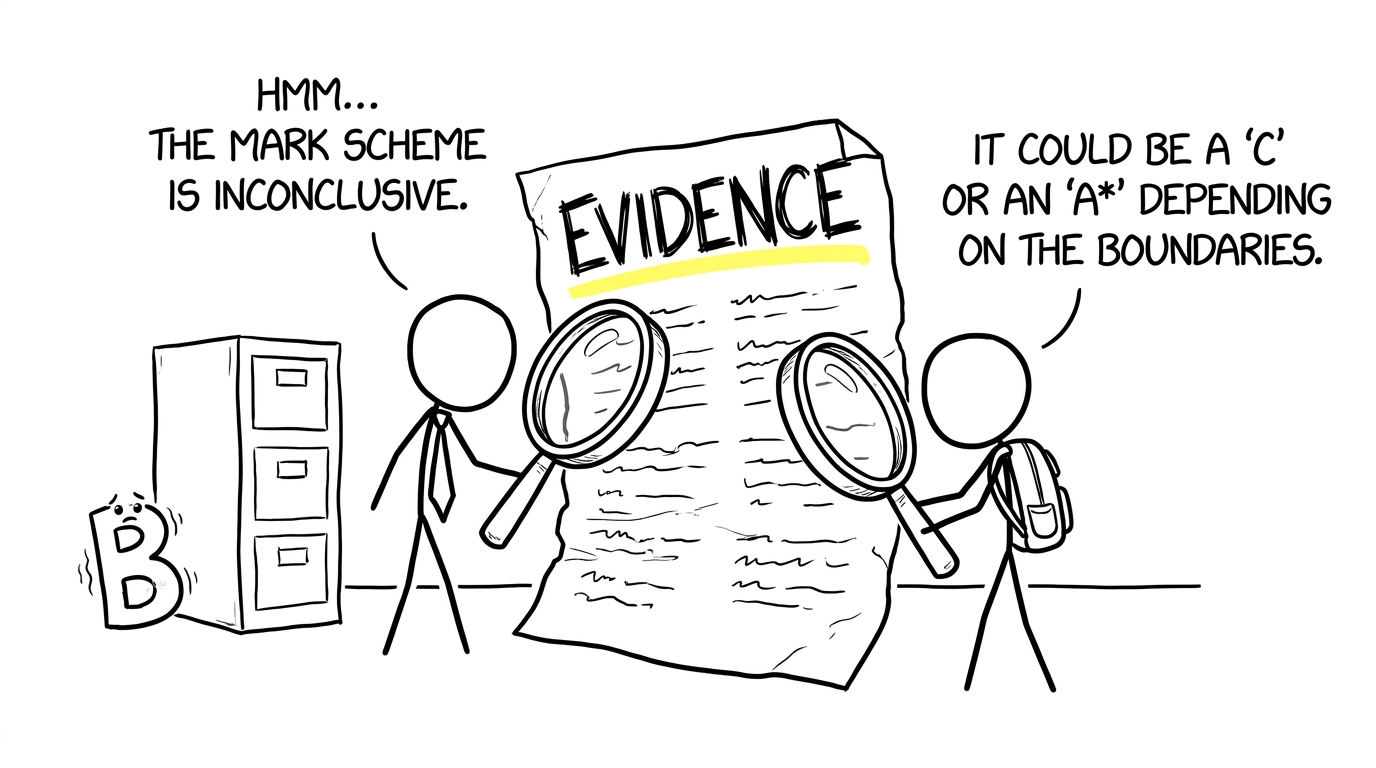 A teacher and student investigate an exam script like evidence detectives
Understand a review of marking
A review of marking is not an automatic fresh re-mark. It checks whether the original marking was carried out correctly and whether the mark scheme was applied properly. Following a review, your mark can rise, remain unchanged or fall. Written candidate consent is therefore required.
Being close to a grade boundary is relevant, but closeness alone is not evidence of a marking error. A review is most defensible when a teacher has examined the available information and identified a credible concern.
A clerical re-check is narrower. It checks processes such as whether all parts were marked and whether marks were totalled and recorded correctly. If a review does not resolve a concern, any formal appeal is normally pursued by the centre on permitted grounds. Ask your exams officer to explain the current procedure for your board.
Decide whether an Economics resit is worthwhile
If your GCSE economics disappointing result blocks an important next step, ask your school or college whether it can enter you again. GCSE Economics resit availability, timing and fees depend on the awarding body and willing examination centre; do not assume that Economics has the same November arrangements as GCSE English language or maths.
Confirm all of the following before planning:
- the next available examination series;
- whether you must retake every required component;
- whether your centre accepts private or former candidates;
- the entry deadline and total fee;
- which specification and exam board you will sit.
For preparation, begin at the free GCSE Economics revision hub. Students following AQA can use AQA GCSE Economics revision resources, while OCR students can find papers and mark schemes in the OCR GCSE Economics revision section.
Build a recovery plan from lost marks
Do not simply repeat the same revision for longer. Diagnose whether marks were lost through knowledge, application, analysis, evaluation, timing or interpretation of data.
Start with one timed paper. Mark it strictly, then create a short error log containing the topic, missing skill and next action. MathsGenie’s guide to finding your weakest GCSE topics explains how to turn paper evidence into targeted practice.
A useful weekly cycle is:
- revisit one weak Economics topic;
- answer exam-style questions without notes;
- compare each response with the mark scheme;
- rewrite incomplete chains of reasoning;
- complete a timed section;
- revisit the same weakness later.
Economics also draws on percentages, graphs, averages and quantitative information. Keep these skills secure through the GCSE maths revision hub, especially if maths is important for your sixth-form options. A manageable GCSE revision timetable can help you balance both subjects without allowing one result to consume the entire year.
Common mistakes after a disappointing result
Requesting a review without teacher advice
A narrow boundary gap is not proof of incorrect marking. Seek evidence and understand the risk of a lower mark first.
Missing the centre’s deadline
The school’s deadline may be earlier than the awarding body’s. Contact the exams officer as soon as possible.
Assuming a resit is automatically available
Economics arrangements differ from compulsory English language and maths resits. Confirm the series, centre, specification and cost in writing.
Re-reading instead of practising
Familiar notes can create false confidence. Use questions, timed papers and mark schemes. The MathsGenie resources collection brings together practice materials, mini tests and predicted papers.
Letting one grade disrupt every subject
A lower Economics grade is one result, not a verdict on your ability. Preserve time for subjects that determine your next destination.
Turn the result into a decision
The best GCSE economics next steps are evidence-led: establish what the grade changes, inspect the available marking evidence, meet every deadline, and resit only when the likely benefit justifies the commitment.
Then move from judgement to practice. Use MathsGenie’s free GCSE Economics resit resources for revision lessons, past papers, practice questions and mark schemes. Alongside them, use MathsGenie’s maths revision lessons, video solutions, mini tests, predicted papers and revision planning tools to keep your wider exam preparation moving. One result can alter a plan. It does not have to shrink your ambition.











