

GCSE Economics Grade 8 Meaning: What It Shows
GCSE economics grade 8 meaning explained: discover the ability it represents, how it compares with old A and A* grades, and how to revise effectively.
A result can look wonderfully precise while hiding a much bigger story. You open the envelope, see a grade 8 and immediately wonder: Is that an A, an A, or something in between?* The short answer to the gcse economics grade 8 meaning question is that it represents very strong performance, just below the highest grade of 9. It shows comprehensive economic knowledge, confident application, effective quantitative work and the ability to reach reasoned, evidence-based judgements.
It is commonly described as sitting between the old A and A* grades. That comparison is useful, but it is not an exact conversion. The numbered system was designed differently, and grade 8 has its own standard.
Grade 8 at a glance
A grade 8 in GCSE Economics normally indicates that you can:
- explain a wide range of economic concepts accurately;
- apply economic ideas to familiar and unfamiliar situations;
- select appropriate data, diagrams and economic tools;
- handle percentages, ratios, graphs and other quantitative information;
- analyse chains of cause and effect rather than listing disconnected points;
- evaluate evidence and recognise that outcomes depend on circumstances;
- make supported judgements using precise economic terminology.
One important distinction is that a grade describes performance across the completed qualification. It does not mean that every answer was perfect, nor that every topic was equally strong.
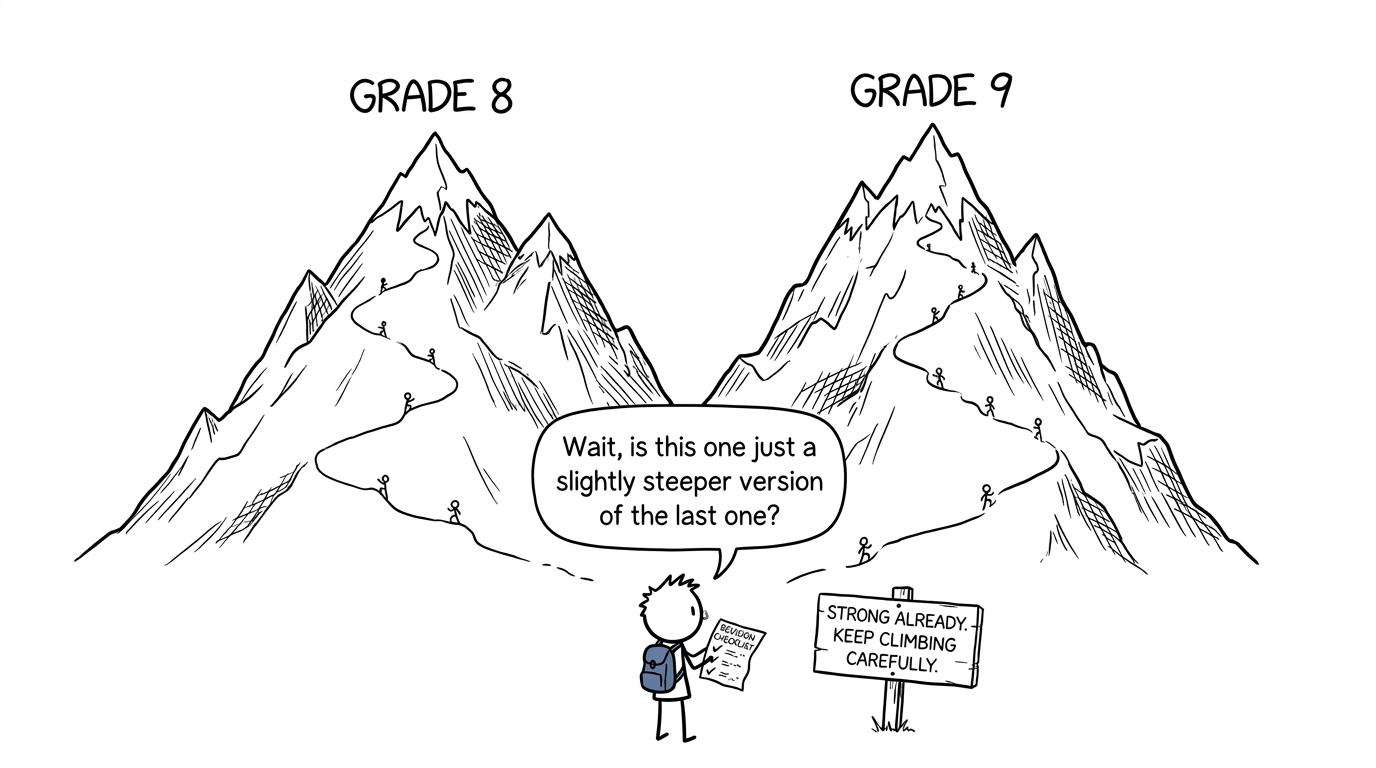 A student looking up at the Grade 8 and Grade 9 mountains with a revision checklist
What a grade 8 actually represents
Official GCSE Economics grade descriptors focus on the quality of a student's thinking, not merely the quantity of facts recalled. The grade 8 descriptor refers to relevant and comprehensive knowledge across a wide range of concepts and issues. It also expects students to apply their understanding critically in familiar and unfamiliar, theoretical and applied contexts.
That final distinction matters. Knowing that an increase in demand can raise equilibrium price is useful. A high-grade response must also recognise when the model fits the information supplied, explain the likely consequences and consider factors that could alter the outcome.
Knowledge that can be used, not merely repeated
Economics contains many definitions, including scarcity, opportunity cost, inflation, unemployment and market failure. Accurate definitions help with shorter questions, but grade 8 performance goes further. Knowledge must become usable.
A strong student can connect concepts. For example, they understand that a policy affecting firms' costs may influence supply, prices, employment and government objectives. The precise conclusion depends on the context and evidence in the question.
Analysis built through logical chains
Analysis answers the question, “What happens next, and why?” A developed argument moves through a logical chain rather than jumping from a policy to a final outcome.
This is where disciplined thinking matters more than impressive-sounding vocabulary. Each link should follow from the previous one. If an assumption is necessary, it should be acknowledged rather than hidden.
Evaluation that earns its conclusion
Evaluation is not the habit of adding “however” near the end of an answer. At grade 8 level, it means testing an argument against evidence, time periods, stakeholder effects, assumptions and possible alternatives.
A reasoned judgement should emerge from that comparison. It should answer the exact question and explain why one consideration carries more weight than another. This is what turns a balanced answer into a decisive one.
How grade 8 compares with the old letter grades
The safest description is that grade 8 lies within the high-performance range previously covered by A and A*. It is often summarised as being between an A and an A*, or as broadly comparable with a lower A*. Neither phrase is an official one-to-one conversion.
The officially comparable points are more limited:
| Current GCSE scale | Official comparison point |
|---|---|
| Bottom of grade 7 | Comparable with the bottom of old grade A |
| Bottom of grade 4 | Comparable with the bottom of old grade C |
| Bottom of grade 1 | Comparable with the bottom of old grade G |
There are now three grades 7, 8 and 9, covering the part of the scale previously occupied by A and A*. Grade 9 was introduced to provide greater distinction among the very highest performances. That is why simply declaring grade 8 “equal to A*” loses some of the nuance.
For applications or forms, use the grade actually awarded unless an institution specifically asks for an old-scale comparison. A grade 8 is already widely understood as a high GCSE grade.
Marks, boundaries and the meaning of a result
A grade 8 does not correspond to one permanent percentage. Grade boundaries are set for each examination series so that differences in the demand of papers can be taken into account. The minimum mark can therefore change from year to year and between awarding organisations.
For example, AQA GCSE Economics uses two papers carrying 808080 marks each, producing a total of 160160160 marks. Its June 202520252025 grade 8 boundary was 125125125 marks. That historical figure helps you interpret that particular series, but it is not a prediction for another year or another exam board.
Use the GCSE Economics grade boundaries guide to understand total qualification boundaries and why notional paper boundaries should be treated cautiously.
Your final grade is based on your total qualification mark. One difficult paper or one disappointing question does not independently decide the result.
What examiners are assessing
Across regulated GCSE Economics specifications, the assessment objectives are weighted as follows:
| Assessment objective | What it assesses | Weighting |
|---|---|---|
| AO1 | Knowledge and understanding of economic concepts and issues | 35%35\%35% |
| AO2 | Application to different contexts | 35%35\%35% |
| AO3 | Analysis and evaluation of evidence and issues | 30%30\%30% |
These proportions explain why memorising a revision guide cannot secure the highest grades on its own. AO2 and AO3 together account for 65%65\%65% of the assessment. Most of the qualification therefore rewards what you can do with your knowledge.
Current AQA and OCR GCSE Economics specifications are linear and use two written papers. Unlike GCSE Maths, they are not divided into foundation and higher tiers. Check your own specification and paper instructions because timings and question structures differ between boards.
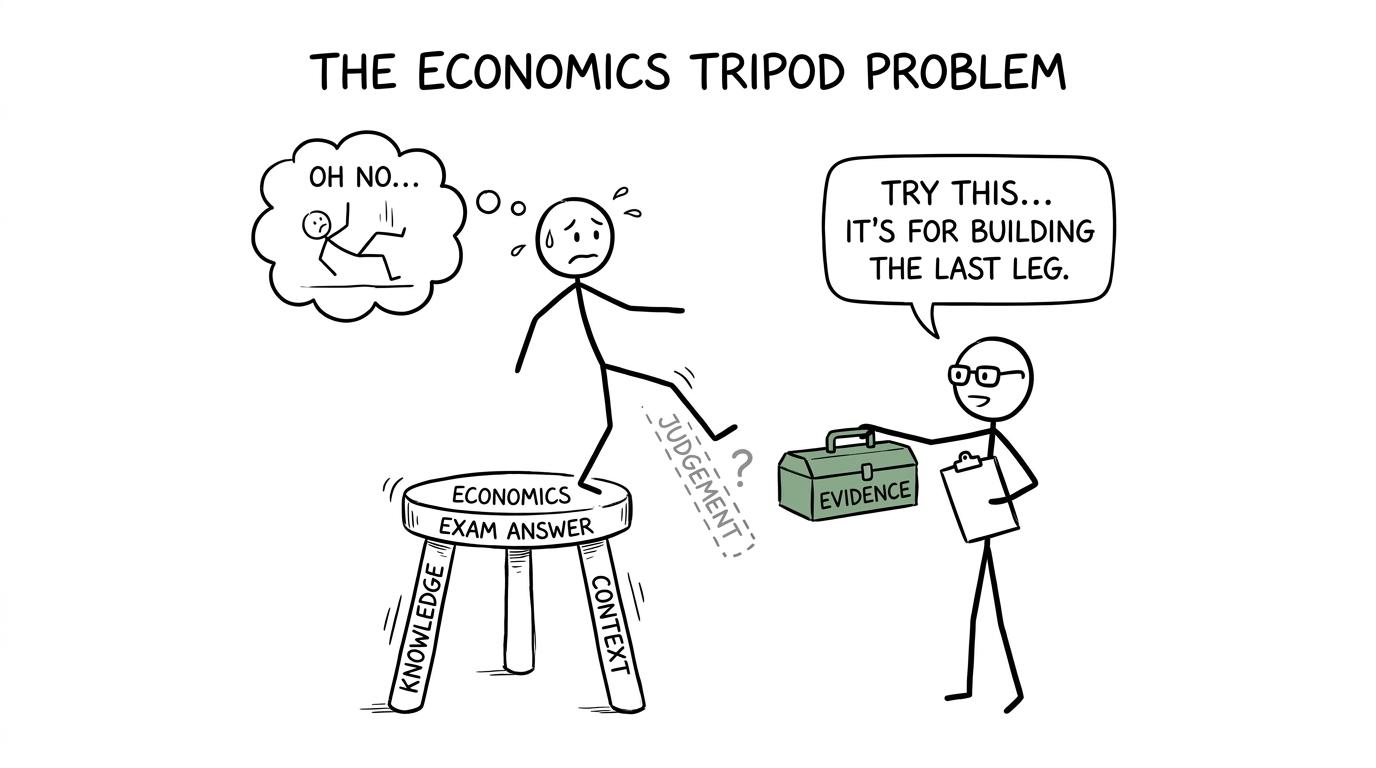 An economics answer represented by a three-legged stool of knowledge, context and judgement
Why maths skills matter in GCSE Economics
Economics is an essay-based subject, but numbers often provide the evidence that makes an argument credible. A grade 8 student should be comfortable selecting and interpreting quantitative information rather than treating it as decoration.
Useful skills include:
- calculating and interpreting percentages;
- finding percentage changes;
- comparing ratios and proportions;
- reading line graphs, bar charts and tables;
- interpreting averages and changes over time;
- distinguishing correlation from a justified causal claim;
- checking units, scales and axes.
Percentage change is commonly expressed as:
Percentage change=new value−original valueoriginal value×100\text{Percentage change}=\frac{\text{new value}-\text{original value}}{\text{original value}}\times 100Percentage change=original valuenew value−original value×100The calculation is only the beginning. In Economics, you must then explain what the change means for consumers, firms, workers or the government.
If data interpretation is costing you marks, use the statistical skills revision guide to revisit averages, spread, percentage change and graph interpretation. The drawing linear graphs guide can also strengthen your confidence with axes, scales and plotted relationships.
Students preparing simultaneously for GCSE Maths can choose their board through the GCSE Maths revision hub. Economics itself is not tiered, but your maths revision should still match your correct foundation or higher tier entry.
A practical checklist for targeting grade 8
A high grade is usually built through a repeatable process rather than one dramatic revision weekend.
Learn the precise economic language
Create concise definitions, then test whether you can use each term in a fresh context. Pair concepts that are easily confused, such as demand and quantity demanded, or economic growth and economic development.
Practise paragraph decisions
Before writing a longer response, identify the claim, contextual evidence, chain of reasoning and limitation. This prevents answers from becoming long but directionless.
Treat data as part of the argument
Quote or calculate relevant figures with units, then interpret them. Avoid copying every number from a source. Selection is part of the skill.
Mark for quality, not reassurance
Use mark schemes and examiner guidance to ask why an answer earns a particular level. Record whether lost marks came from knowledge, application, analysis, evaluation or numerical accuracy.
For the mathematical side of your preparation, the one-month GCSE revision plan offers a useful structure for retrieval, topic practice and timed work. If your schedule is crowded, adapt the 20-minute maths revision routine to percentages, graphs and data interpretation.
Common mistakes when interpreting or targeting grade 8
Treating grade 8 as an exact A*
It is reasonable to call it a very high grade, but there is no exact official conversion equating every grade 8 with an old A*. Use “between A and A*” only as an informal guide.
Revising from one historical boundary
A previous boundary is evidence about one exam series, not a guaranteed target. Build a margin for variation and focus on answer quality rather than chasing a fixed percentage.
Confusing knowledge with analysis
Accurate facts can earn AO1 marks without producing a developed argument. Keep asking what consequence follows, why it follows and what could weaken the connection.
Writing generic evaluation
Statements such as “it depends” need to explain what the outcome depends on. Relevant conditions might include the time period, elasticity, policy size, stakeholder or state of the economy.
Neglecting quantitative skills
A small error in percentage change or a misread graph can damage both the calculation and the economic argument built upon it. Revisit weak foundations through MathsGenie's recommended GCSE maths topic order, then practise applying them in unfamiliar data.
Turn the meaning into a revision plan
The real value of understanding a grade is knowing what to do next. A grade 8 in GCSE Economics represents command rather than perfection: broad knowledge, careful application, logical analysis, sound quantitative skills and judgements supported by evidence.
Start by identifying which of those elements is least secure. Repair one weakness at a time. For your supporting maths skills, MathsGenie provides free revision lessons, practice questions, mini tests, past papers, predicted papers, mark schemes and video solutions. Begin at the GCSE Maths revision hub, choose your exam board and tier, and turn every lost mark into a specific next action.
A grade may be printed as one character. The ability behind it is built one clear decision at a time.











