

GCSE Drama Weak Topic: How to Fix It
GCSE drama weak topic? Use this practical diagnose, practise, mark and retest plan to stop avoiding it and build reliable confidence before exam day.
A topic can begin to feel impossible long before it actually is. You answer one question badly, struggle with it again and quietly decide that it is simply not your strength. From then on, avoidance does the rest.
The practical response to a GCSE drama weak topic is not to reread the whole course. Identify the smallest skill that is failing, compare your work with the assessment criteria, practise that skill in isolation, collect feedback and retest it without notes. This turns a vague worry into a specific job.
That method matters whether your difficulty is analysing live theatre, explaining an acting choice, evaluating devised work or remembering details from a set text. It is also the same principle that makes maths revision effective: diagnose the lost marks before choosing what to revise.
Your weak-topic repair checklist
Use this sequence rather than starting another long revision session without a clear target:
- Name the exact task that goes wrong.
- Check which assessment objective it tests.
- Find one previous response or piece of teacher feedback.
- Separate missing knowledge from weak application.
- Practise one small part under light time pressure.
- Mark or review the attempt immediately.
- Rewrite, rehearse or improve only the weakest part.
- Retest with a different prompt a few days later.
The important word is exact. “I am bad at Drama” cannot guide revision. “I describe the performance but do not evaluate its effect on the audience” can.
Define the GCSE Drama weak topic precisely
GCSE Drama combines practical, creative and written demands. Although component names and assessment arrangements vary between AQA, Pearson Edexcel, OCR and Eduqas, current specifications assess the creation and development of ideas, the application of theatrical skills, knowledge and understanding of drama, and analysis and evaluation.
That means a weakness can sit in several different places.
Knowledge gaps
You may not securely remember the set text, production context, dramatic terminology, practitioner conventions or details from the live production you watched. If the information is missing, polishing your paragraph structure will not solve the underlying problem.
Application gaps
You may know what vocal pitch, pace, lighting or proxemics mean but struggle to select an appropriate choice for a particular moment. Here, the problem is not recall. It is turning knowledge into a justified theatrical decision.
Analysis and evaluation gaps
A response may identify what happened without explaining why it mattered. Analysis connects a theatrical choice to meaning or effect. Evaluation makes a supported judgement about how successfully that choice achieved an intention.
Performance or design gaps
In practical work, the weakness may involve consistency, communication, collaboration or the realisation of an artistic intention. A performer might understand a character but communicate that interpretation unevenly. A designer might have an interesting concept without enough precise detail to make it workable.
Write your difficulty as a sentence beginning with: “When I am asked to..., I tend to...” That sentence becomes your revision target.
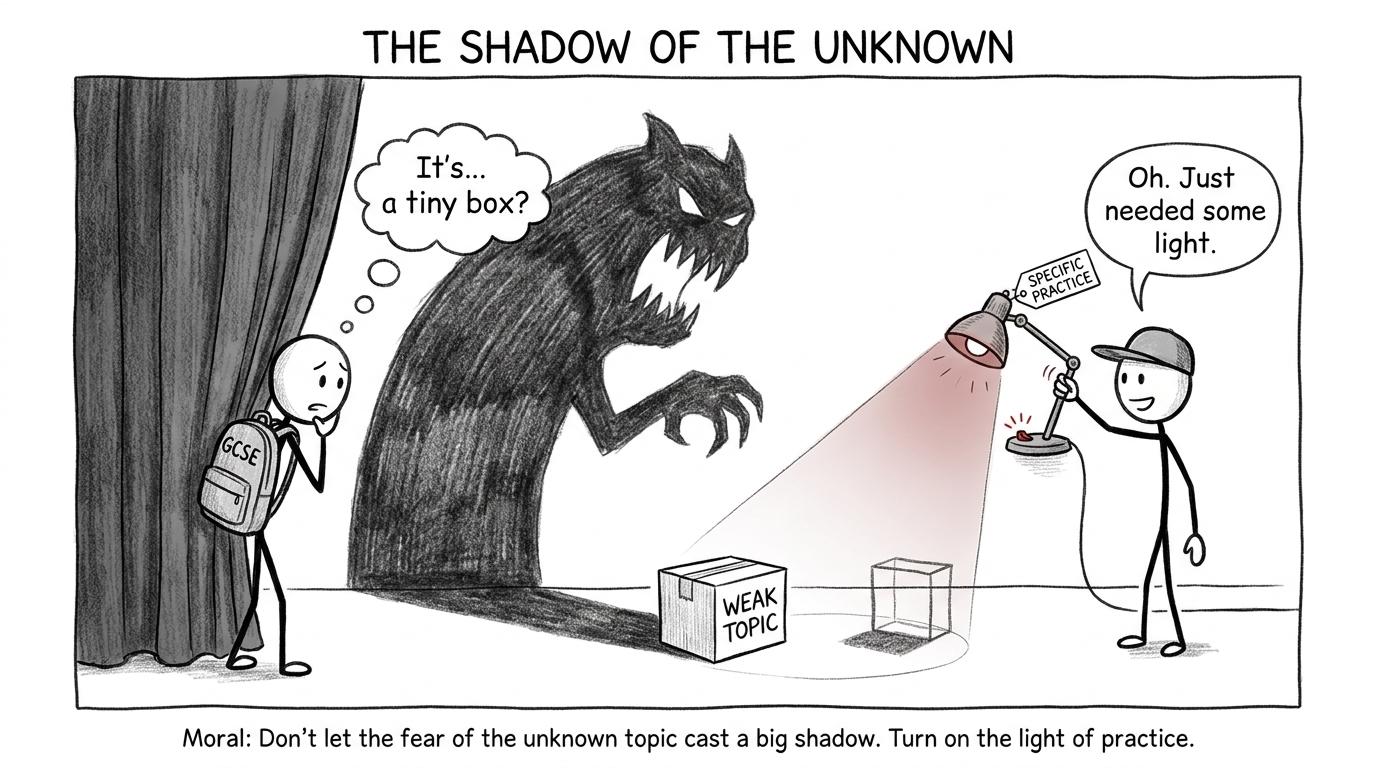 A student discovers that a weak topic's shadow is larger than the topic itself
Diagnose why you keep getting it wrong
The same wrong answer can have different causes. Treating every error as “I need to revise more” is like treating every stage problem by turning up the volume.
Take a previous response, rehearsal note or piece of teacher feedback and classify the problem:
- Recall: you could not remember the relevant detail or term.
- Selection: you knew several ideas but chose one that did not answer the task.
- Explanation: you named a choice without showing how it communicated meaning.
- Evidence: you made a broad claim without a precise moment from the text, performance or rehearsal process.
- Evaluation: you described what happened but did not make and support a judgement.
- Timing: you understood the task but could not complete it efficiently.
- Precision: your language was too general to make the acting or design choice clear.
This is a form of metacognition: planning an approach, monitoring whether it works and evaluating the result. Educational evidence supports teaching these habits alongside specific subject content rather than as generic “learning skills”. In other words, do not merely think about thinking. Apply the process to the exact Drama task in front of you.
MathsGenie uses the same evidence-first principle in its guide to finding your weakest GCSE topics. The subject may be different, but the diagnostic question is identical: where did the marks actually disappear?
Match your revision method to the problem
Once the cause is clear, choose a method that addresses it directly.
If the problem is recall
Use brief, closed-book retrieval. Sketch the sequence of a scene, list the production details you can remember or write definitions of essential theatrical terms. Then check your notes and correct omissions in another colour.
Do not make repeated copying your main strategy. Neat notes can create familiarity without proving that you can retrieve the information independently.
If the problem is theatrical choices
Choose a short moment and generate specific acting or design decisions. For acting, consider voice, movement, facial expression, gesture, posture, interaction and use of space. For design, consider the relevant combination of lighting, sound, set, costume, hair and make-up.
Every choice should answer three questions:
- What exactly would be done?
- What intention would it communicate?
- What response or understanding should it create for the audience?
This prevents terminology from becoming a decorative list.
If the problem is analysis or evaluation
Reduce the task to a reliable reasoning chain:
- identify a precise theatrical choice;
- connect it to a particular moment;
- explain the meaning or effect it created;
- judge how successfully it served the production's intention.
Your exam board's command word matters. “Describe”, “explain”, “analyse” and “evaluate” do not ask for interchangeable responses. Check the wording used in your specification, classroom materials and mark schemes.
If the problem is practical performance
Make the rehearsal target observable. “Be more confident” is difficult to measure. “Maintain the selected posture and vocal quality throughout the confrontation” is something you and your teacher can review.
Ask for feedback on that single target. Trying to improve voice, movement, characterisation, interaction and timing simultaneously can make the feedback too broad to use.
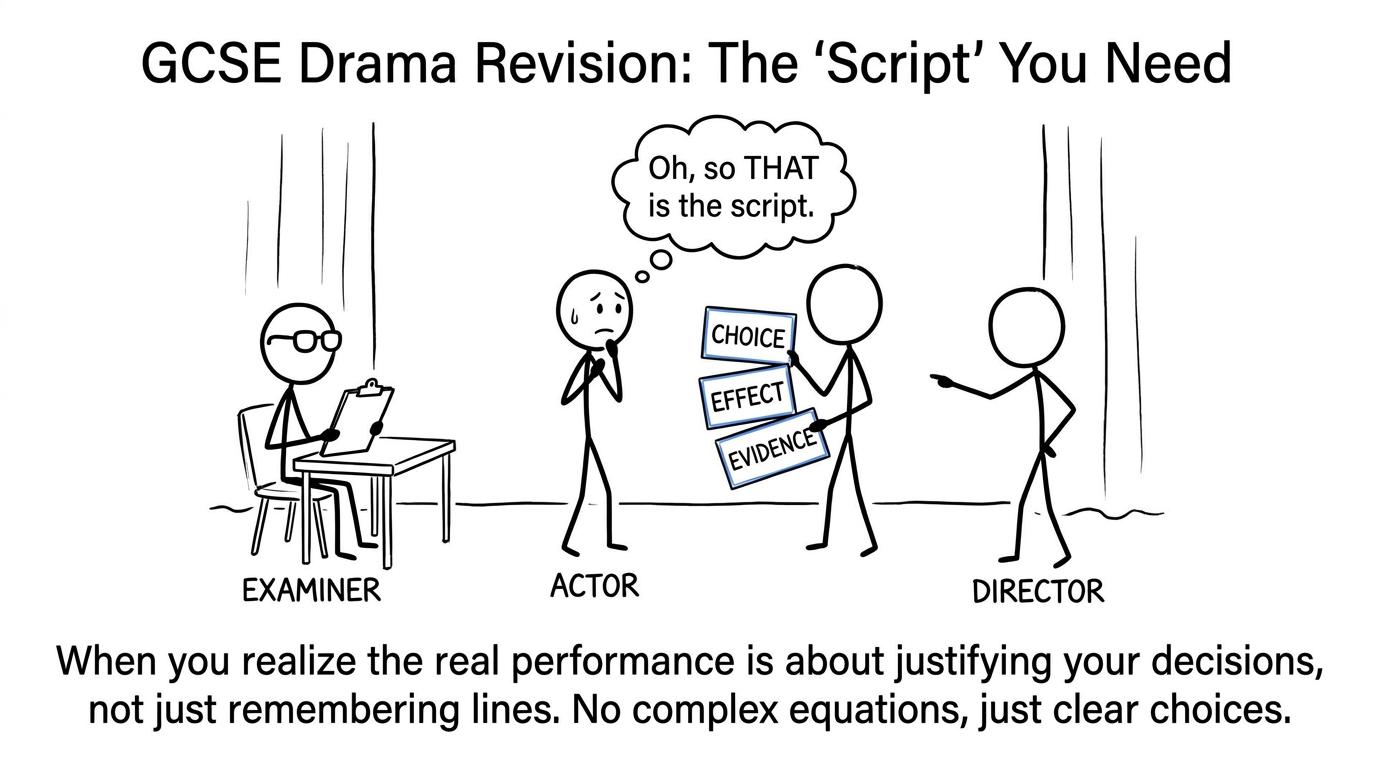 An examiner reveals the useful cue cards: choice, effect and evidence
Build a short repair cycle
A weak topic improves through repeated contact, not one heroic evening. Use a compact cycle across several days.
First session: isolate and relearn
Spend a short session reviewing the relevant teacher material, specification language and feedback. Produce a small checklist describing what a successful response or performance must contain.
Stop when you can explain the requirement without looking at your notes. Time spent is not the test. Independent recall is.
Second session: controlled practice
Attempt one narrow task. You might plan a response, annotate a short extract, rehearse a brief moment or design one aspect of a scene. Keep the challenge limited enough that you can concentrate on the skill being repaired.
Third session: feedback and correction
Compare the attempt with your teacher's criteria, an authorised mark scheme or previous feedback. Record one correction that changes what you will do next time. “Add more detail” is too vague; “describe the actor's movement before explaining its effect” is actionable.
Fourth session: delayed retest
Return to the skill after a gap and use a different prompt. Do not begin by rereading your correction. Retrieval after a delay reveals whether the improvement is becoming secure.
This structure resembles the learn, practise, mark, fix and retest loop used throughout MathsGenie's GCSE revision guidance. When you are balancing Drama with maths, using one revision system for both subjects reduces the number of decisions you need to make.
Use an error log that leads to action
An error log should be small enough to revisit. For each attempt, record:
- the task or scene;
- the skill being tested;
- the reason marks or quality were lost;
- the correction you made;
- the date of your next retest.
Avoid copying entire answers into it. The purpose is to expose patterns. If “unclear audience effect” appears repeatedly, that is more useful than a folder containing several separately marked essays.
For maths revision, the GCSE Maths revision hub offers topic lessons, practice questions and paper resources that support the same process. You can also organise both subjects around a realistic weekly routine using the GCSE maths revision timetable. Drama needs rehearsal and written practice; maths needs question practice. Both need scheduled correction.
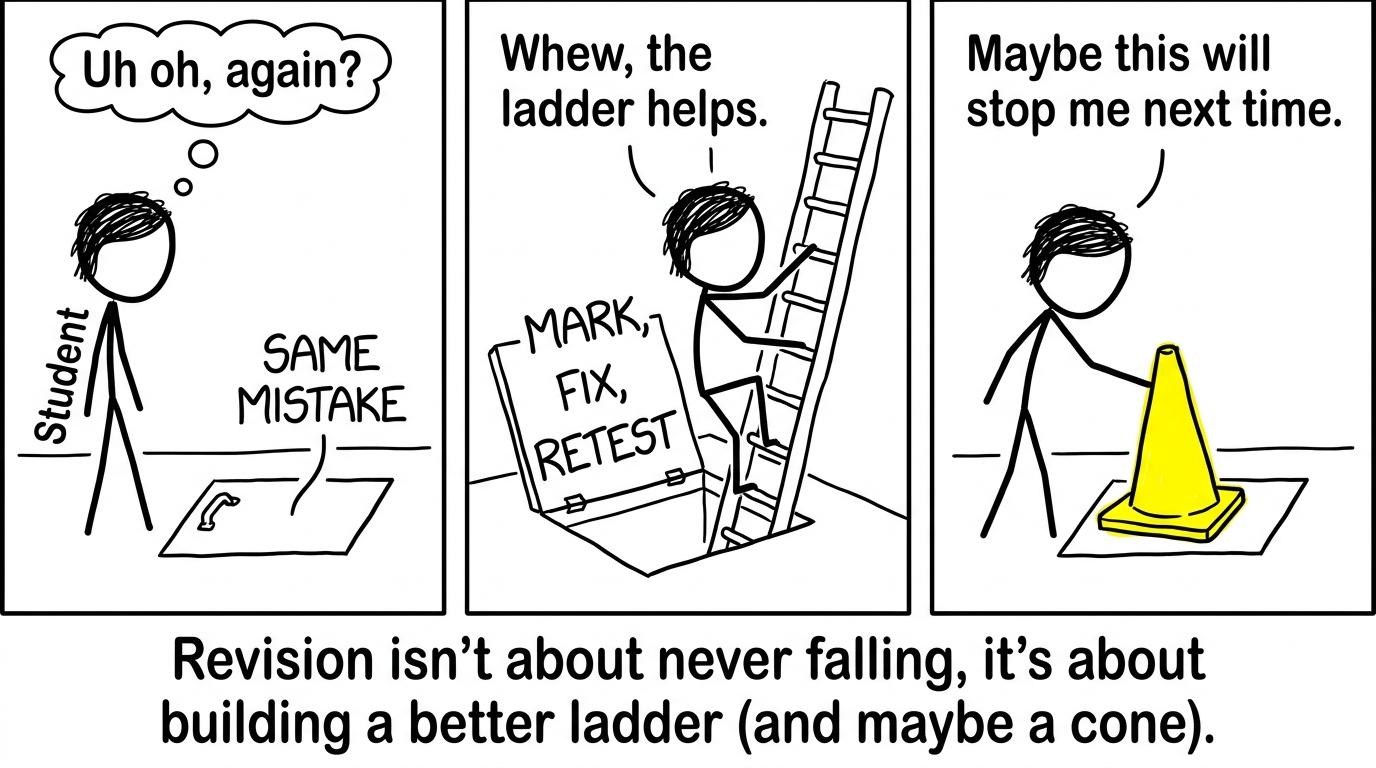 A student escapes the same mistake using a mark, fix and retest ladder
Move from topic practice to exam pressure
Success in a quiet, untimed task is the beginning, not the finish. Increase the difficulty gradually:
- start with notes and a narrow prompt;
- repeat without notes;
- answer under a short time limit;
- place the skill inside a longer section;
- return to it in mixed revision.
Do not use a full paper every time you want to repair one weakness. Full papers are useful for timing, stamina and question selection, but they are inefficient when the same small error keeps recurring.
This distinction also matters in maths. Topic questions build a method; papers test whether you can recognise and apply it under pressure. MathsGenie's Edexcel GCSE Maths past papers include mark schemes and solutions for that later testing stage. Students with more time can structure the process with the one-month GCSE revision plan, while last-minute preparation should remain selective rather than panicked, as the GCSE night-before plan explains.
Common mistakes when fixing a weak topic
Revising the whole subject
Broad revision feels productive but hides the original weakness. Narrow the task until you know what successful practice looks like.
Only reading model material
A strong response can clarify expectations, but recognition is not independent performance. Close the model and produce your own plan, explanation or rehearsal choice.
Practising without feedback
Repeating an error makes it familiar. Use teacher comments, assessment criteria and mark schemes to check whether the new attempt is genuinely better.
Memorising a rigid response
Prepared ideas are helpful, but an inflexible answer may not address the actual question. Learn adaptable knowledge, precise evidence and a reasoning process rather than one paragraph for every prompt.
Retesting immediately
An instant second attempt often measures short-term memory. Return after a gap and use a different question or scene.
Avoiding the topic once it improves
A repaired skill can become fragile again. Keep it in mixed practice, even when another weakness becomes the priority.
Turn avoidance into evidence
A weak topic is not a permanent label. It is a pattern in your current work, and patterns can be changed when they are made specific.
Name the failing skill. Connect it to the assessment objective. Practise a small task, obtain useful feedback and retest after a delay. Then place the skill back into timed, mixed work. The goal is not to make the topic feel comfortable. It is to produce evidence that you can now handle it independently.
When your Drama session is complete, bring the same discipline to maths. Start at the MathsGenie GCSE Maths revision hub, choose your exam board and tier, and use free revision lessons, practice questions, mini tests, mark schemes and video solutions to repair individual gaps. Then test the result with past papers and predicted papers. One weak topic at a time is how a revision plan becomes progress.










