

GCSE Design and Technology Revision Timetable: Worth It?
GCSE design and technology revision timetable worth it? Learn when a written plan helps, when flexibility wins, and how to balance D&T revision with maths.
Revision timetables can become strangely convincing. A carefully coloured grid makes the weeks ahead look controlled, even before any revision has happened. Then one session overruns, Tuesday falls apart, and the whole plan begins to feel like evidence that you are behind.
If you have searched “gcse design and technology revision timetable worth it”, the short answer is yes, but only if the timetable helps you begin, revisit topics and respond to mistakes. A written timetable does not improve outcomes by itself. Flexible revision can work equally well when it still includes clear priorities, active practice and regular review.
For students balancing Design and Technology with GCSE maths, the strongest option is usually a flexible weekly framework rather than a rigid hour-by-hour calendar.
The quick revision timetable checklist
A useful plan should:
- identify specific D&T knowledge and exam skills to practise;
- include short, repeated sessions rather than one large weekly block;
- reserve time for GCSE maths and your other subjects;
- state what you will produce, not merely what you will read;
- include questions, self-testing and mark scheme review;
- leave spare capacity for homework, illness and difficult topics;
- change when your results show that priorities have changed.
If your timetable does most of these things, it is worth keeping. If maintaining it takes more energy than following it, simplify it.
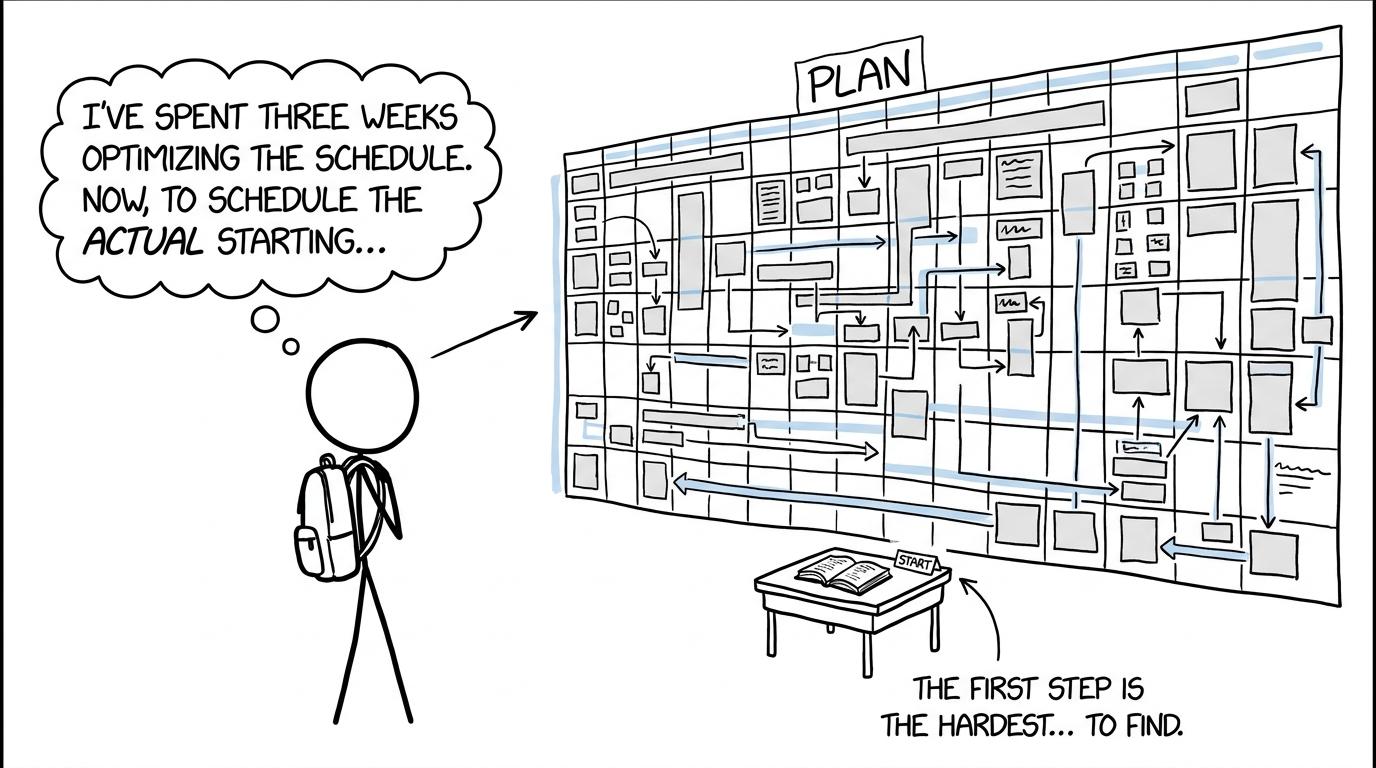 A student discovers that designing the perfect revision timetable has replaced starting revision
What a timetable can actually change
A timetable cannot place knowledge into your memory. Its real purpose is narrower and more valuable: it reduces the number of decisions you must make at the moment you are supposed to start.
“Revise D&T tonight” still leaves several questions unanswered. Which topic? For how long? Using which resource? What counts as finished? A better timetable entry might specify materials properties, retrieval questions and one extended-response plan. That gives the session a visible starting point and outcome.
Educational evidence on self-regulated learning supports planning, monitoring and evaluating learning. The important detail is that these processes work together. Planning without monitoring becomes wishful thinking; monitoring without changing the plan simply records the same problem repeatedly.
A good timetable therefore operates as a cycle:
- Plan: choose a specific topic and useful task.
- Act: complete the task with notes closed where appropriate.
- Check: use answers, teacher feedback or a mark scheme.
- Adjust: decide what needs another session.
This principle also sits behind the MathsGenie guide to finding weak GCSE topics. The next revision task should be chosen using evidence, not whichever page happens to look familiar.
Written timetable or flexible revision?
The apparent choice is misleading. You do not have to choose between a strict written timetable and complete improvisation. What matters is whether your approach reliably produces effective revision.
When a written timetable is worth it
A visible plan is particularly useful when you:
- regularly postpone difficult subjects;
- lose time deciding what to revise;
- have several GCSE exams close together;
- forget to return to topics after first reviewing them;
- spend too much time on subjects you already enjoy;
- need to coordinate schoolwork, NEA commitments and revision.
Writing the plan down also reveals unrealistic assumptions. Ten subjects cannot all receive an uninterrupted evening. Seeing that conflict early allows you to make a sensible trade-off rather than discovering it at nine o'clock.
When flexible revision can work just as well
Flexible revision can be effective if you maintain a short priority list, protect regular revision windows and record what you complete. This suits students whose homework load or weekly commitments change often.
The crucial distinction is between flexible and unplanned. Flexible revision changes the task while preserving the habit. Unplanned revision waits for motivation and often drifts towards passive activities.
Learning research strongly supports distributing practice over time and retrieving knowledge rather than relying only on rereading. It does not require every student to follow an identical calendar. A flexible plan can therefore preserve the parts that matter: spacing, retrieval and feedback, without pretending every Wednesday will unfold perfectly.
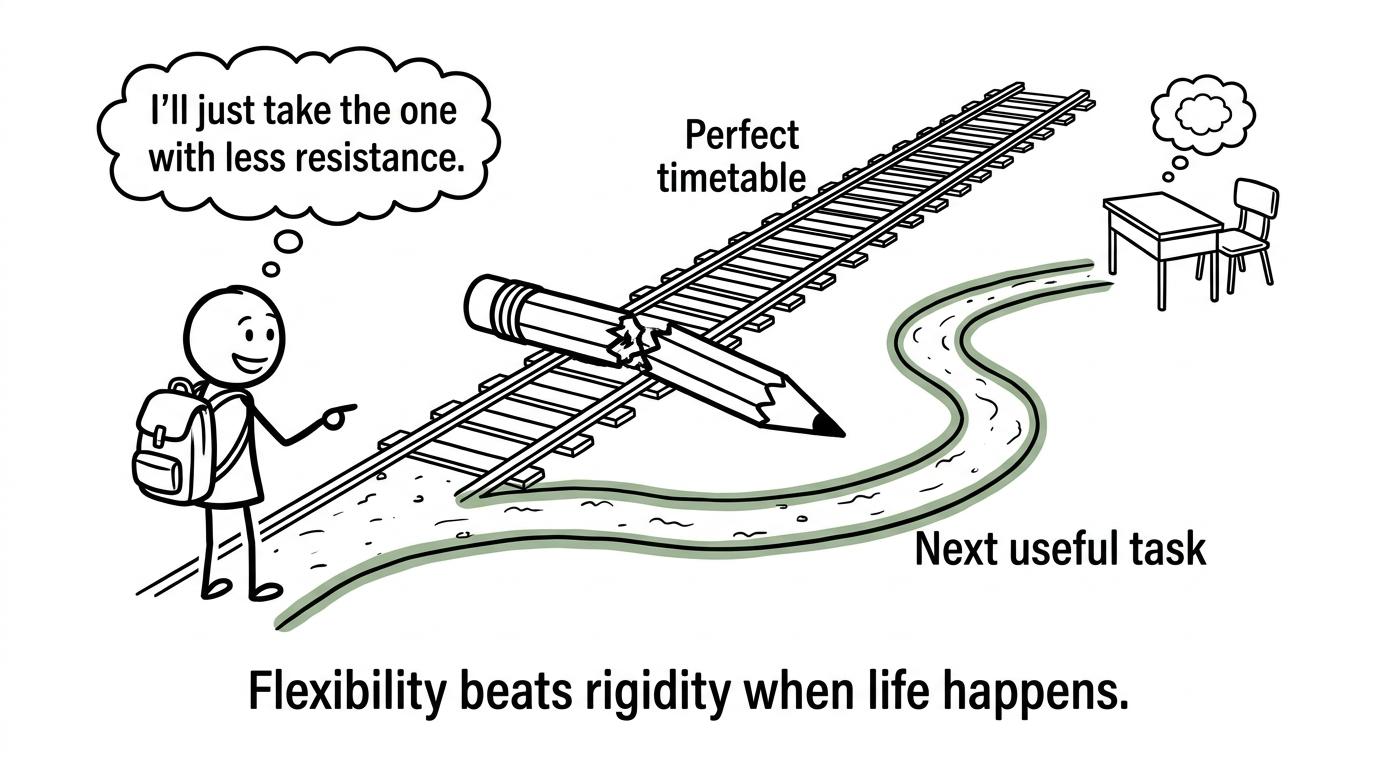 A flexible revision path finds a way around the fallen pencil blocking the perfect timetable
Why Design and Technology needs planned revision
Current GCSE Design and Technology specifications from AQA, Pearson Edexcel, OCR and Eduqas divide assessment between a written examination and non-exam assessment, with each contributing 50%50\%50% of the qualification. Students should always confirm the precise requirements and timings for their board with their teacher because specifications can be updated.
That assessment structure creates a common trap. The NEA is large and visible, so it can dominate attention during the course. Once that work is complete, the breadth of knowledge needed for the written paper can feel surprisingly distant.
A timetable helps you distribute attention across areas such as:
- core and specialist technical principles;
- materials, components and manufacturing processes;
- designing and making principles;
- sustainability and wider design issues;
- analysing products and evaluating design decisions;
- calculations and mathematical applications;
- short-answer and extended-response technique.
Do not turn these broad labels directly into sessions. “Revise materials” is too vague. Break each area into small, observable tasks such as recalling properties, comparing processes or planning an evaluative response.
The maths connection students should not ignore
GCSE Design and Technology is not separate from maths. The current specifications require mathematical skills to be assessed in the written paper, commonly accounting for at least 15%15\%15% of that examination. Depending on the question, this may involve measurements, percentages, ratios, area, volume, graphs, tolerances or using formulae in a design context.
This is good news if you plan intelligently. Some revision can strengthen both subjects. However, the context still matters: understanding a maths method does not automatically guarantee that you will recognise when to use it in a D&T question.
Keep your main maths preparation aligned with your exam board and foundation or higher tier. The GCSE maths revision hub provides free revision lessons, worksheets, question banks and paper resources for boards including Edexcel, AQA, OCR and Eduqas.
Short sessions are useful when the week is crowded. The twenty-minute GCSE maths revision routine shows how to combine recall, exam-style questions and immediate marking without surrendering an entire evening.
A flexible framework that survives real life
Instead of filling every available hour, create a weekly framework with three layers.
Fixed revision windows
Choose a small number of reliable periods during the week. Decide when you will start and stop, but do not necessarily assign every detailed topic several weeks ahead.
A revision window should be short enough to begin without negotiation and long enough to complete one meaningful cycle of recall, practice and checking.
A ranked task list
Keep a list containing:
- topics you cannot yet explain without notes;
- question types that have cost marks;
- content not revisited recently;
- upcoming school assessments;
- one reserve task for a low-energy day.
At the start of a window, select the highest useful task. This preserves flexibility without forcing you to invent a plan from nothing.
A weekly review
Once a week, look at what you actually completed. Move unfinished work only if it remains important. Remove tasks that no longer deserve your time and add weaknesses revealed by questions.
For maths, a one-month GCSE revision plan can provide the wider rhythm while still allowing individual sessions to respond to lost marks. If you need a short diagnostic rather than a full paper, Edexcel GCSE maths mini tests offer focused timed practice with answers and solutions where available.
Plan tasks that create evidence
Timetable entries should describe actions that reveal what you know. “Read D&T notes” measures time spent looking at a page. It does not reliably show whether you can recall, apply or evaluate the content in an exam.
Stronger tasks include:
- answering retrieval prompts without notes;
- labelling a process or product diagram from memory;
- comparing two materials for a stated purpose;
- planning an extended response under a time limit;
- completing calculation questions;
- marking an answer and recording why marks were lost;
- returning to the same weakness on another day.
The same rule applies to maths. Lessons rebuild understanding, but questions test whether the method is available when you need it. Once topic knowledge is secure, introduce timed work. MathsGenie's guide to when to start GCSE past papers explains how to move from topic practice towards complete exam papers.
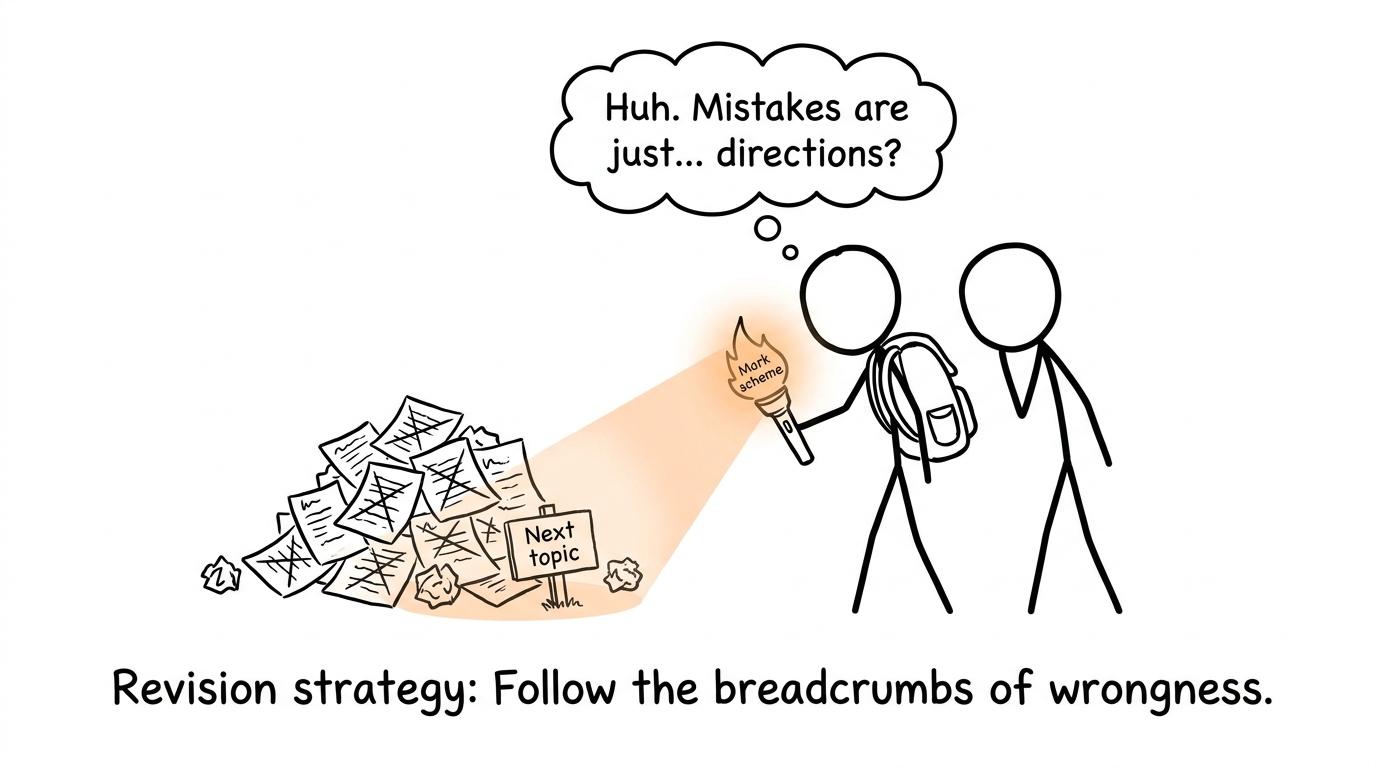 A mark scheme torch reveals that mistakes point towards the next revision topic
Common revision timetable mistakes
Designing the timetable instead of revising
Colour coding can make a plan readable, but decoration has sharply diminishing returns. Set a short limit for building the first version, then begin the first task immediately.
Planning every minute
A plan with no spare capacity assumes that nothing will take longer than expected. Leave some sessions unassigned or use them for catch-up and review.
Treating all topics equally
Equal time feels fair but may be inefficient. Give more attention to weak, frequently assessed or prerequisite knowledge while continuing brief retrieval of stronger areas.
Confusing completion with improvement
Ticking a box means a task happened. It does not prove the knowledge is secure. Record question results, recurring mistakes and topics that need another attempt.
Abandoning the plan after one missed session
A timetable is a tool, not a contract. Move the most important task, remove something less valuable and continue. Rebuilding the entire week usually creates more delay.
Forgetting full exam practice
Topic work develops knowledge in isolation. Papers require you to recognise the topic, choose a method and manage time. Nearer the maths exams, combine official past papers with fresh GCSE predicted papers, then use mark schemes and video solutions to repair specific gaps. Predicted papers should support, not replace, official past-paper practice.
So, is the timetable worth making?
Yes: if it is brief, adjustable and built around actions that improve recall and exam performance. No: if producing and maintaining it becomes a substitute for revision.
The best timetable is not the most detailed. It is the one you still use after a tiring school day, a difficult homework task or an unexpected change of plan. Give the week some structure, keep the individual tasks flexible and let marked work decide what comes next.
For the maths side of your GCSE preparation, begin with the MathsGenie GCSE revision hub. Use free revision lessons to rebuild a method, practice questions and mini tests to check it, then move into past papers and predicted papers. Mark every attempt carefully and use the mark schemes and video solutions to turn each lost mark into the next useful task.










