

GCSE Dance Different Exam Centre: What to Do
GCSE dance different exam centre arrangements explained: find an approved centre, confirm practical assessments, fees and deadlines, and protect revision time.
The difficult part is often not learning the choreography. It is discovering that your school does not offer the qualification, then wondering whether all that practice can lead to a recognised GCSE.
The short answer to the GCSE dance different exam centre question is yes: you may be able to take GCSE Dance as a private candidate at another approved school, college or exam centre. However, Dance includes practical non-exam assessment, so you need a centre willing to manage the entire qualification, not merely provide a desk for the written paper.
That distinction matters. Finding a centre for a written exam can be relatively straightforward. Finding one that can supervise, authenticate, assess, record and administer practical dance work requires more planning.
Your quick GCSE Dance centre checklist
Before committing to independent preparation, confirm all of the following:
- The exact exam board, specification and entry code.
- Whether the centre accepts private candidates for GCSE Dance specifically.
- Whether it can deliver every practical and written component.
- Who will teach or supervise the assessed work.
- How performance partners, rehearsal space and recordings will be arranged.
- The centre's entry deadline, internal assessment dates and total fees.
- Whether it can provide any required access arrangements.
- Which identification and previous candidate details you must supply.
- When you will receive a statement of entry.
Do not begin by asking only, “Can I sit a GCSE here?” Ask about Dance by name. A centre may accept private candidates for written subjects while being unable to offer practical or non-examined components.
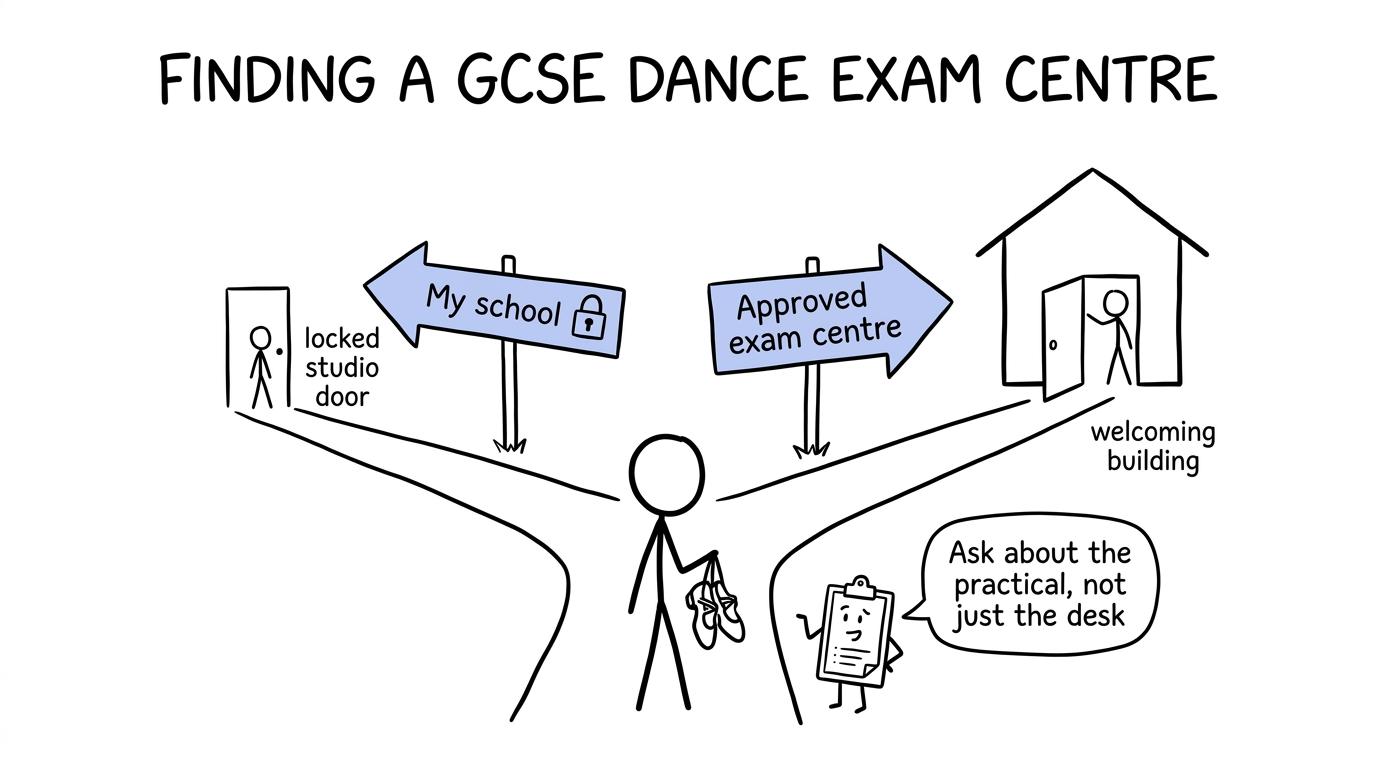 A student follows the route from a locked school studio towards an approved exam centre
Can you sit GCSE Dance somewhere other than your school?
Yes, provided an approved centre agrees to enter you and accepts responsibility for the required assessments. If you are not enrolled there as one of its students, you will normally be treated as a private candidate.
Acceptance is not automatic. Individual schools and colleges decide whether they will take private candidates, which qualifications they can deliver and what they will charge. A centre appearing in a private-candidate directory does not necessarily mean it offers GCSE Dance.
This is why the most useful answer is not simply “yes”. It is:
Yes, but secure a centre that can administer the practical assessment before building your course around the qualification.
For example, the current AQA GCSE Dance specification includes performance and choreography as non-exam assessment, worth 60%60\%60% of the qualification, alongside a dance appreciation written examination worth 40%40\%40%. The practical work is internally assessed and externally moderated. It cannot be treated as an informal performance completed elsewhere and handed to an exam centre at the last moment.
The entering centre must follow the specification and current assessment rules. It needs suitably qualified staff, appropriate facilities, reliable authentication and the ability to complete recordings and assessment administration correctly.
Why the practical assessment changes everything
A written paper happens at a fixed time under standard exam conditions. Practical assessment develops over a longer period and depends on evidence that the work is genuinely yours.
For AQA GCSE Dance, students complete solo performance work and a duet or trio performance, as well as choreography. The written dance appreciation paper lasts one hour and 303030 minutes. The qualification is linear, so all required components must be completed for certification in the relevant series.
A prospective centre may therefore need to answer questions such as:
- Does it have a teacher able to assess the current specification?
- Can it provide or approve appropriate rehearsal and performance facilities?
- How will the duet or trio be organised?
- Can another dancer participate without being entered for the qualification?
- When must assessed performance and choreography take place?
- Who records the final practical evidence?
- How will work completed away from the centre be supervised and authenticated?
- Will you receive teaching, assessment support or administration only?
Independent lessons at a dance school can help you develop technique, but they do not automatically satisfy exam-board controls. Your entering centre must be confident that it can authenticate and assess the work under the relevant rules.
What to do if your school does not offer GCSE Dance
Speak to your school before looking elsewhere
Start with your head of year, curriculum lead or examinations officer. Explain that you want to take GCSE Dance and ask whether the school can:
- make the entry itself;
- work with a nearby school or college;
- arrange shared teaching through a formal partnership; or
- recommend a local centre already equipped for practical arts qualifications.
Your school is not necessarily required to introduce a subject it does not offer. Even so, a conversation may uncover local arrangements that are difficult to find through a general search.
Ask for the response in writing. You need to know whether your current school will be involved in the entry or whether another centre must take complete responsibility.
Search for an approved private-candidate centre
The Joint Council for Qualifications maintains a searchable service for centres that have indicated they may accept private candidates. Use it as a starting point, then contact centres directly. Some suitable centres may not appear, while a listed centre may not offer Dance or may have no remaining capacity.
Try:
- secondary schools with an established Dance department;
- sixth-form or further education colleges;
- independent schools;
- approved private examination centres; and
- local performing arts providers that work formally with an approved exam centre.
Contact several places. Practical qualifications require staff time and facilities, so the first centre you approach may not be able to help.
Send a precise enquiry
A short, specific email is more useful than a broad request. Include:
- your age and current school year;
- the exam series you hope to enter;
- the proposed board and specification code;
- whether you have already started the course;
- whether you have a teacher or tutor;
- whether access arrangements may be needed; and
- your approximate location and ability to travel.
Then ask whether the centre will provide all components, including practical assessment, authentication, marking, recording, moderation administration and the written examination.
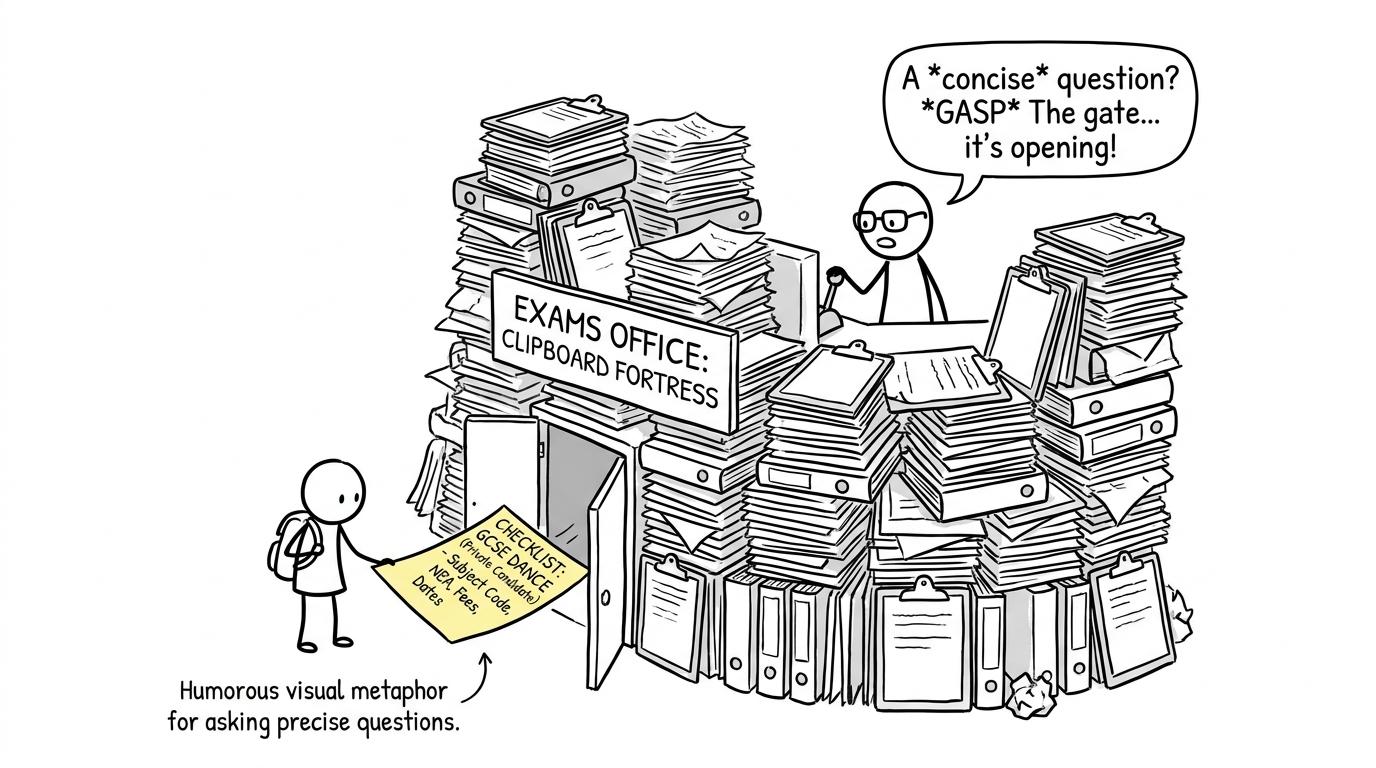 A concise checklist makes its way through the exams officer's clipboard fortress
Confirm the complete cost and timetable
Private-candidate fees are set by the centre and vary. Dance may involve charges beyond the awarding body's entry fee because the centre could need to provide teaching staff, assessment time, studio space, recording, administration and additional sessions.
Ask for a written breakdown covering:
- qualification entry;
- centre administration;
- practical assessment and recording;
- tuition or supervision;
- rehearsal or studio hire;
- late-entry charges;
- access-arrangement assessment, where applicable; and
- cancellation or refund terms.
Centres also set internal deadlines, often earlier than the awarding organisation's final deadline. Contact them well in advance rather than relying on a date found for a previous exam series.
Check your statement of entry
Once accepted, provide the requested personal details, photographic identification and any existing Unique Candidate Identifier. Check your statement of entry carefully when it arrives. Your name, qualification, board, specification and exam series must all be correct.
If you need reasonable adjustments or access arrangements, raise this during your first conversation. The centre must establish and administer the arrangements under the current rules; they cannot safely be added as an afterthought immediately before assessment.
Private candidates and transferred candidates are different
A private candidate is entered through an approved centre where they are not enrolled as a normal student. A transferred candidate, by contrast, has already been entered by one centre but sits an eligible timetabled written examination at another host centre.
Current JCQ transferred-candidate arrangements do not cover non-examined components such as practical assessments and GCSE non-exam assessment. They are also subject to formal approval and are not a convenient way to split GCSE Dance between unrelated centres.
If your school has already entered you, do not independently book the written paper elsewhere. Ask the examinations officers at both centres to speak with the awarding organisation. For a new private entry, the clearest arrangement is usually one centre accepting responsibility for the complete qualification.
Protecting your maths revision while arranging Dance
Finding a centre can consume every spare afternoon if you let it. Give the administration its own limited slot, perhaps one session each week for emails, calls and document checking, then return to the qualifications you are already preparing for.
For maths, begin with the GCSE Maths revision hub, where resources are organised by board and tier. If you are learning independently, the guide to self-studying GCSE Maths provides a realistic structure rather than an endless list of topics.
Keep your weekly plan simple:
- one Dance administration session;
- scheduled Dance teaching and rehearsal;
- short maths topic sessions;
- one mini test or timed paper section; and
- time to mark mistakes and revisit them.
Maths students can use AQA GCSE Maths past papers, Edexcel GCSE Maths past papers or the OCR GCSE Maths revision hub, depending on their entry. Nearer the exams, GCSE predicted papers can provide fresh timed practice after topic gaps have been addressed.
If the whole year feels crowded, adapt the GCSE maths revision timetable around fixed rehearsals and assessment dates. A timetable is useful because it protects attention. Without one, the newest problem tends to swallow every subject.
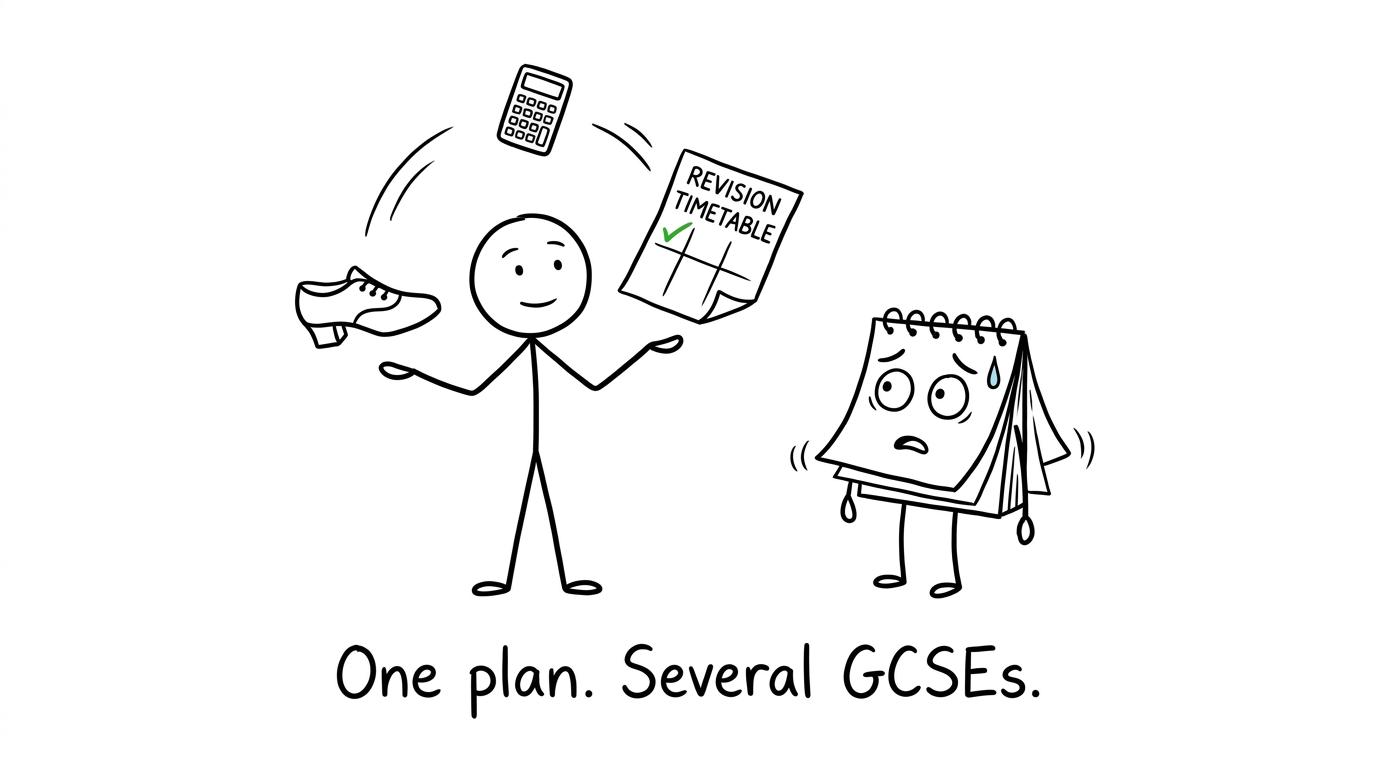 A student calmly balances dance shoes, a calculator and one revision plan
Common mistakes when arranging GCSE Dance elsewhere
Assuming every private centre offers every subject
Private-candidate acceptance may be limited to written examinations. Confirm GCSE Dance and every practical component explicitly.
Preparing the wrong specification
Do not assume that resources for one board match another qualification. Obtain the exact specification and entry code from the centre before committing to course materials.
Leaving the centre search until Year 11 is nearly over
Practical work must be supervised, authenticated and assessed properly. A late request may leave too little time, even if the written-entry deadline has not passed.
Booking only the written examination
Passing through an exam hall does not complete a qualification with substantial non-exam assessment. The practical and written components form one award.
Assuming an external dance tutor can sign off everything
A tutor may provide valuable teaching, but the approved entering centre remains responsible for assessment controls and administration. Agree roles before starting assessed work.
Forgetting partners and recording requirements
Ask how duet or trio performers, final recordings, music, rehearsal space and assessment dates will be managed. These are central arrangements, not minor details.
Take the next clear step
You can potentially sit GCSE Dance at a different exam centre when your school does not offer it. The real test is whether another approved centre will accept you as a private candidate and manage the full qualification, including its practical assessment.
Start by speaking to your school. Then contact several approved centres with the exact specification and a written checklist. Confirm assessment responsibilities, fees, dates, facilities and access arrangements before treating the entry as secure.
Once the administration is moving, protect the rest of your GCSE preparation. MathsGenie gives you a free, organised place to continue: use revision lessons to rebuild understanding, practice questions and mini tests to strengthen weak topics, then past papers, predicted papers, mark schemes and video solutions to prepare for the real examination. One subject may require a different building. Your revision can still follow one calm plan.











