GCSE Chemistry Results Day: Is Your Grade Wrong?
GCSE chemistry results day wrong grade? Learn what to check in the first hour, how marking reviews work, key deadlines and when to request a script.
Results day can compress two years of work into one small line on a screen. If that line is lower than your mock or predicted result, the disappointment arrives before the explanation. If you are searching for GCSE chemistry results day wrong grade advice, the immediate answer is simple: speak to your school’s exams team, confirm the qualification and component marks, check the official grade boundary, and ask whether a chemistry teacher can inspect your marked scripts before any review is requested.
Do not assume that an unexpected grade must be incorrect. But do not ignore a credible concern either. A predicted grade is an estimate; an awarded grade is based on assessed work. The useful question is not, “Does this feel wrong?” It is, “Is there evidence of an administrative or marking error?”
For the June 2026 series, GCSE results are released to candidates on Thursday 20 August 2026. Schools may set their own post-results deadlines earlier than the exam boards, so the first conversation should happen on results day.
Your results-day checklist
In the first hour:
- Check whether the result is for separate GCSE Chemistry or Combined Science.
- Confirm your exam board, specification and tier.
- Ask for your overall mark and individual paper or component marks.
- Compare the total with the correct official boundary for that exam series.
- Tell your chemistry teacher and exams officer why the result concerns you.
- Ask whether your marked papers can be obtained through Access to Scripts.
- Record the school’s deadline, possible fee and consent process.
- Contact your intended sixth form or college if your place may be affected.
- Do not submit a review until you understand that the mark can rise, fall or remain unchanged.
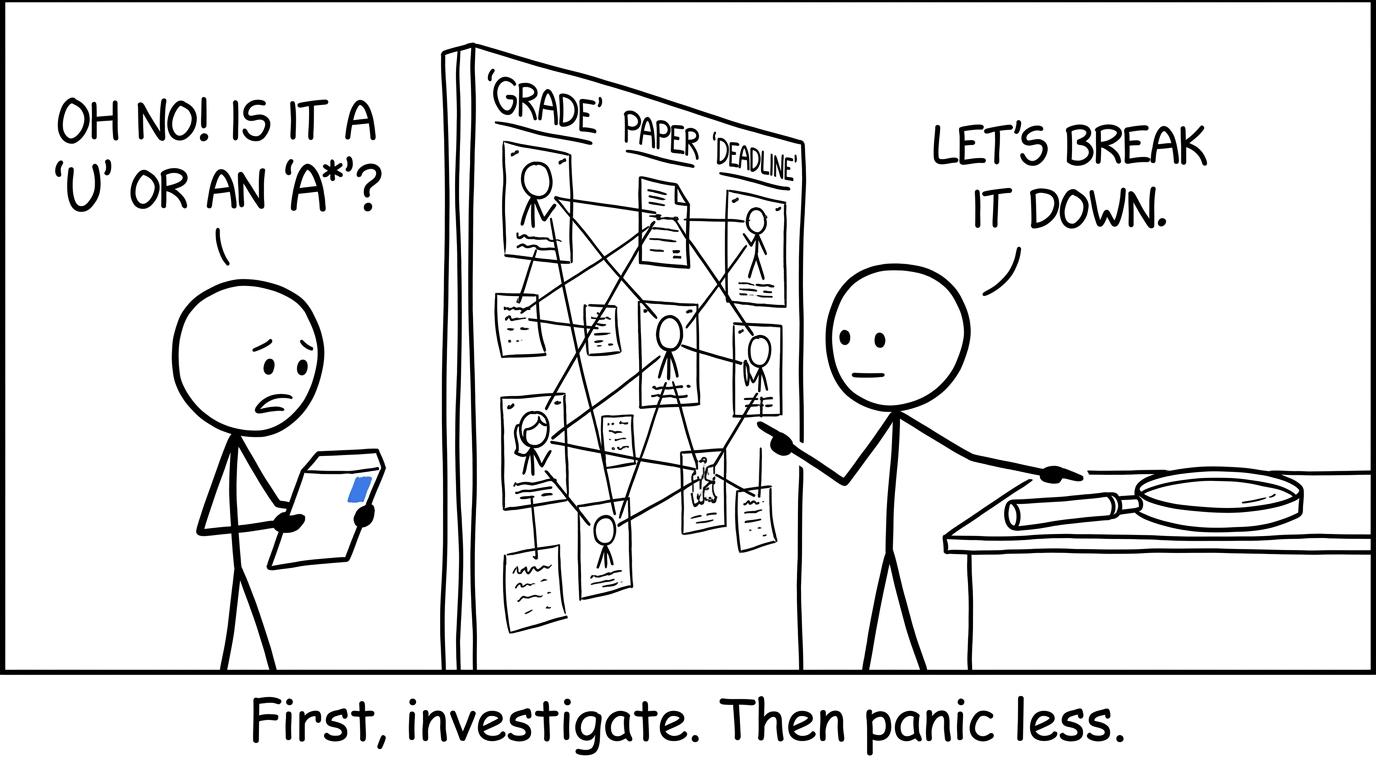 A student investigates an unexpected result with a teacher
What to do in the first hour
Read the result carefully
Before thinking about a review, establish what has actually been awarded. Separate Science students receive an individual grade from 9 to 1 for Chemistry. Combined Science students receive a double award, represented by two equal or adjacent grades, such as 777-777 or 666-555. Their chemistry papers contribute to an aggregate result alongside biology and physics papers.
That distinction matters. A lower Combined Science result does not necessarily mean that the chemistry marking caused it. You need the component marks to see where the difference arose. The GCSE Combined Science remark guide explains how individual paper reviews feed into the overall double award.
Check your name and candidate details too. If a result is missing, shown as pending or attached to the wrong qualification, report it immediately. That is different from disagreeing with an examiner’s judgement.
Confirm the board, tier and specification
AQA, Pearson Edexcel, OCR and Eduqas publish different grade boundaries. Boundaries can also differ between separate Chemistry and Combined Science, between foundation and higher tier, and between exam series.
Use the MathsGenie GCSE and A Level grade boundaries hub to locate the relevant information. Do not compare your mark with a boundary circulated before results day or with last year’s figures. Boundaries are set for the completed exam series and are not fixed permanently.
Your distance from the next boundary can be written as:
marks required=next grade boundary−current total mark\text{marks required} = \text{next grade boundary} - \text{current total mark}marks required=next grade boundary−current total markThis calculation tells you what a mark change could achieve. It does not tell you whether the marking was wrong.
Ask for component marks
Your overall grade hides useful detail. Ask the exams officer for:
- your total qualification mark;
- the mark for each chemistry paper;
- the relevant component codes;
- the maximum mark for each component;
- the boundary for the qualification as a whole.
For example, some separate Chemistry specifications contain two equally weighted written papers, but you should check the arrangement for your own board and specification rather than assuming every course is identical.
Look for a component that is unexpectedly weak compared with your other assessed work. This is not proof of an error, but it helps your teacher decide which script deserves attention. Reviews are normally requested by component, so identifying the relevant paper matters.
Speak to the right people
Go to your chemistry teacher, head of science or examinations officer. Say clearly that the grade differs from your expectations and that you want to understand the component marks before deciding anything.
Most students cannot send a review request directly to an exam board. Schools and colleges normally submit it, and they need the student’s written consent. Private candidates can contact the awarding organisation or the centre that entered them.
If the result affects a sixth-form or college offer, contact the admissions team promptly. Explain that you are checking the result through your school. Do not promise that the grade will change; simply ask what evidence or interim information the provider needs.
Predicted and mock grades are clues, not proof
A mock grade and a final GCSE grade are produced under different conditions. The papers, boundaries, marking and level of preparation may differ. Predicted grades are professional estimates, not guaranteed outcomes.
An unexpectedly low result becomes more persuasive when several pieces of evidence align:
- the component is far below your performance on comparable assessments;
- a marked answer appears to have been missed;
- marks seem to have been totalled or recorded incorrectly;
- a teacher identifies a reasonable concern about how the mark scheme was applied;
- you are close enough to the next boundary for a genuine correction to affect the grade.
The strongest decisions come from the script, not from disappointment alone. This is the same principle behind effective maths revision: treat a result as data, then investigate the source. MathsGenie’s guide to understanding GCSE grade boundaries provides more context on what boundaries do and do not mean.
Access to Scripts, clerical checks and reviews of marking
These services sound similar, but they answer different questions.
Access to Scripts
Access to Scripts allows your centre to obtain a copy of your marked paper. A chemistry teacher can then compare your responses with the mark scheme and look for plausible marking issues.
This is often the most informative first step. Access arrangements and deadlines vary by exam board, and a school may impose an earlier internal deadline. Ask the examinations officer on results day whether a priority script can be requested before the review deadline.
Clerical re-check
A clerical re-check examines administrative processes. It checks matters such as whether every part of the script was marked and whether marks were totalled and recorded correctly. It does not reconsider academic judgement in the same way as a review of marking.
This may be appropriate when the concern is a missing page, an unmarked question or an apparent totalling problem.
Review of marking
A review of marking checks whether the original mark scheme was applied correctly. It is not a complete re-mark by someone instructed to be more generous. The reviewer considers the original marking and corrects genuine errors.
The outcome may be:
- a higher mark;
- the same mark;
- a lower mark.
Your final grade changes only if the revised total crosses a qualification boundary. Written consent is required because the result can go down.
For the June 2026 series, the JCQ deadline for standard reviews of results is 24 September 2026. Your school’s deadline may be considerably earlier, particularly if staff want time to obtain and inspect a script. Fees and refund policies vary, so confirm the current position with your centre rather than relying on an old online figure.
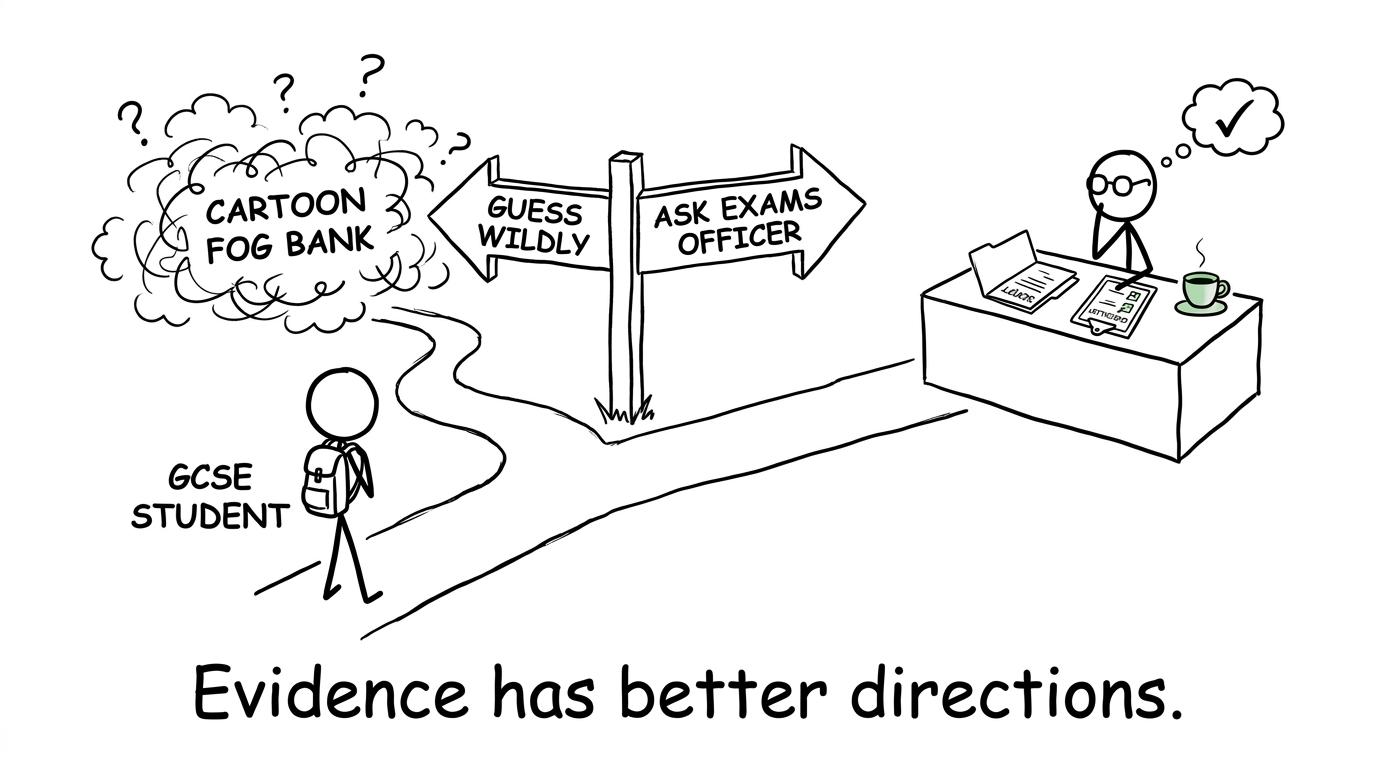 A student chooses evidence over guessing on results day
When requesting a review is reasonable
A review deserves serious consideration when a teacher has inspected the paper and identified specific credit that may have been missed or an answer where the mark scheme may not have been applied correctly. It may also be worth investigating when the result controls access to a required course and you are close to the relevant boundary.
Be cautious when the case rests entirely on a predicted grade, when no one has checked the script, or when you would need a large mark increase without identifiable errors. There is no official rule saying that you must be within a particular number of marks. The sensible test is whether credible evidence exists.
Ask these questions before consenting:
- Which paper or component will be reviewed?
- Has a subject teacher inspected the script?
- What potential error has been identified?
- How many marks are needed for the next grade?
- Could a lower mark reduce the overall grade?
- What fee applies, and when might it be refunded?
- What is the school’s internal deadline?
- When should the outcome arrive?
Standard reviews are normally completed within the published exam-board timeframe, but do not build an urgent admissions decision around an assumed return date. Keep your sixth form or college informed.
What happens if the review does not resolve the concern?
If your school believes a marking error remains or the exam board did not follow its procedures properly and fairly, it may be able to appeal after the review outcome. An appeal is not the first step and cannot be used simply because you dislike the grade boundary. The setting of a grade boundary is not itself grounds for appeal.
Internal candidates normally rely on the head of centre to submit an appeal. Private-candidate arrangements differ. Ask the examinations officer for the relevant exam board’s current procedure and deadline rather than waiting.
Common mistakes on GCSE Chemistry results day
Treating a prediction as a promise
Predicted grades help schools describe likely performance. They do not override the work assessed in the final papers. Use the prediction as a reason to investigate, not as proof that the awarded grade is wrong.
Checking the wrong boundary
A boundary from another board, tier, specification or year is irrelevant. Combined Science boundaries are also different from separate Chemistry boundaries.
Looking only at the final grade
A subject grade cannot show which paper created the shortfall. Obtain the component marks before choosing a review.
Calling every review a re-mark
The official process is a review of marking. The reviewer checks whether the mark scheme was applied correctly; the work is not simply marked again in the hope of a friendlier decision.
Forgetting that marks can fall
A review can raise, confirm or lower the mark. Read the consent information carefully and consider the possible effect on the final grade.
Missing the school’s deadline
The national deadline is not necessarily your working deadline. Schools need time to process consent, payments and exam-board submissions. Ask for the internal date during the first results-day conversation.
Turn uncertainty into a practical next step
A surprising result feels personal, but the post-results process is procedural. Check the qualification. Gather the component marks. Compare the correct boundary. Obtain the script where possible. Then let a subject specialist judge whether there is evidence for a review.
Once that conversation is underway, turn your attention to the next decision. If you are preparing for a maths resit or beginning A Level study, the GCSE maths resit results-day plan can help you organise the weeks ahead. You can also use the GCSE maths revision hub for board-specific lessons and practice questions, then test progress with GCSE past papers and mark schemes.
Nearer your next examination, add Edexcel GCSE Maths predicted papers, mini tests and video solutions. MathsGenie keeps the useful parts together: revision lessons, exam questions, past papers, predicted papers and clear marking support. Start with evidence today, then build the revision plan that gives your next result the strongest possible foundation.