

GCSE Combined Science Remark: Results Day Guide
GCSE combined science remark guidance: learn how reviews of marking work, when to request one, the risks, deadlines and results-day steps.
Results day can shrink your attention to one line on a screen. If your Combined Science grade is lower than expected, a GCSE combined science remark may be worth considering, especially when you are close to the next double-grade boundary and a teacher identifies possible marking errors.
But do not request one simply because the result feels disappointing. A remark is formally called a review of marking. Your school or college requests it for a particular paper, your mark can rise, fall or remain unchanged, and written consent is required.
Here is the short version:
- Check the correct overall grade boundary.
- Find your marks for each component.
- Ask a science teacher to examine the relevant script where possible.
- Identify a realistic marking concern, not just a hoped-for mark increase.
- Confirm the fee, deadline and risk with your exams officer.
- Give written consent only when you understand the possible outcomes.
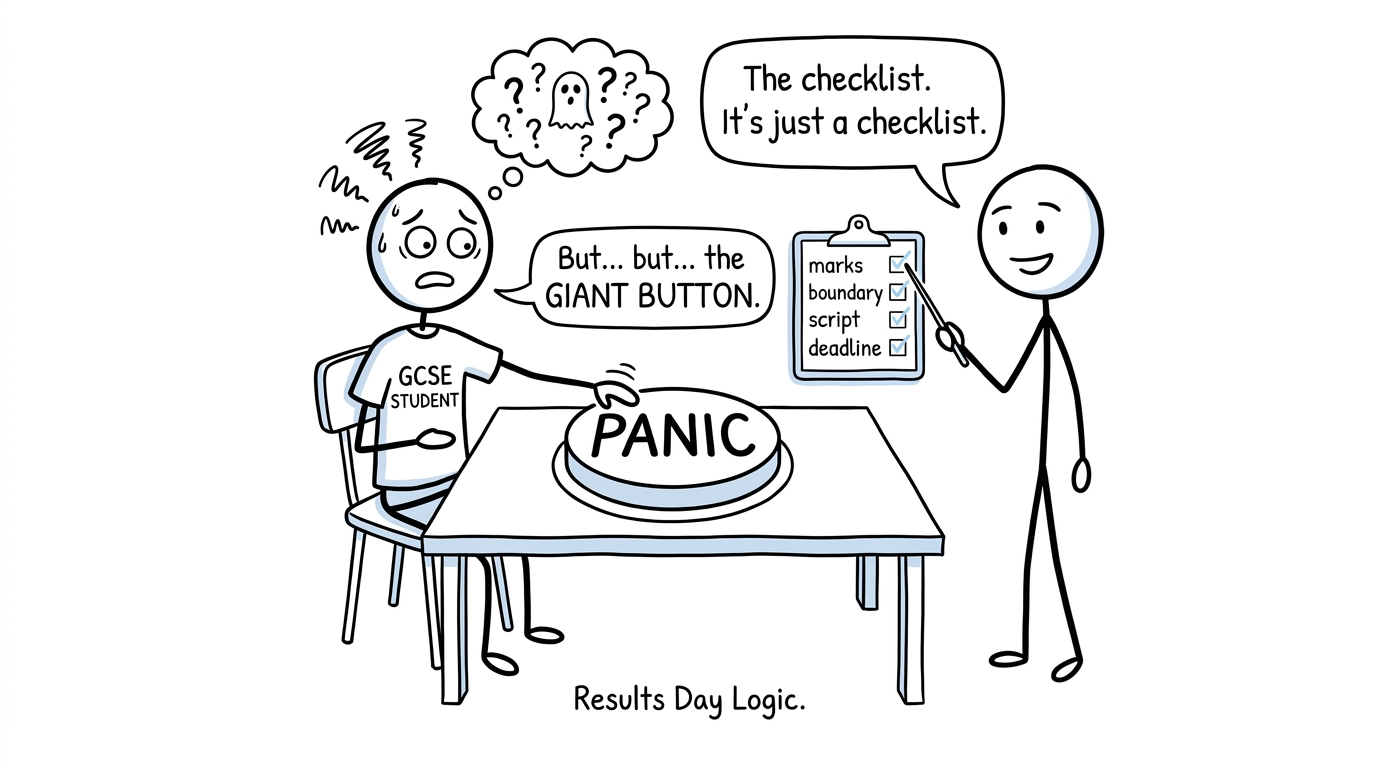 A calm checklist defeats the tempting results-day panic button
What a GCSE Combined Science remark actually does
The phrase “re-mark” is slightly misleading. During a review of marking, an independent reviewer checks whether the original examiner applied the agreed mark scheme correctly. Genuine marking or administrative errors are corrected, but the paper is not marked again from scratch under a more generous standard.
A standard Service 2 review also includes an administrative check. This confirms that the questions were marked and that the marks were totalled and recorded correctly. A clerical re-check alone may be suitable if the concern is missing or incorrectly added marks rather than judgement in an extended answer.
Only your school or college can submit the request to AQA, Edexcel, OCR or Eduqas. Students and parents cannot normally send a review directly to the exam board. Your school must obtain your written consent after results are published because the final mark and grade can go down as well as up.
For the June 2026 series, the JCQ deadline for standard reviews of marking is 24 September 2026. Schools commonly set earlier internal deadlines, so contact your exams officer on or soon after results day rather than waiting.
Why Combined Science needs a subject-specific decision
Combined Science is a double-award qualification. You receive a paired grade such as 666-555 or 555-555, based on your aggregate performance across several biology, chemistry and physics components. It is not three separate GCSE grades.
That changes the decision. A review is normally requested for an individual paper or component, but any corrected marks feed into the qualification total. You therefore need to ask two different questions:
- How far is the overall total from the next Combined Science boundary?
- Which individual paper has credible marks to recover?
Start with the boundary matching your exam board, specification, tier and exam series. MathsGenie provides dedicated pages for AQA GCSE Combined Science grade boundaries and Edexcel GCSE grade boundaries, alongside the wider GCSE and A Level grade boundaries hub.
Do not compare your result with a boundary from another year or specification. Boundaries can change between exam series, and AQA Trilogy and Synergy do not have the same maximum mark.
The GCSE Combined Science re-mark process
Check your component marks
Ask for your mark on every paper, not only the final paired grade. This helps your teacher identify an unexpectedly weak component and shows how many aggregate marks separate you from the next boundary.
A small gap makes a review more consequential, but it does not prove that an error occurred. Grade boundaries tell you what a change would achieve; they do not predict whether your marks will change.
Ask whether your script can be reviewed first
Exam boards provide access-to-script services, although arrangements and deadlines vary. Your exams officer may be able to obtain the marked paper so that a science teacher can compare your answers with the mark scheme.
This is especially useful for explanations, practical-method questions and longer responses where professional judgement may matter. A clearly incorrect calculation or blank answer is not evidence of faulty marking simply because it cost marks.
Choose the component carefully
Reviews are generally charged per paper or component, so requesting every Combined Science paper can become expensive. Ask your teacher which script contains the strongest evidence of missed credit.
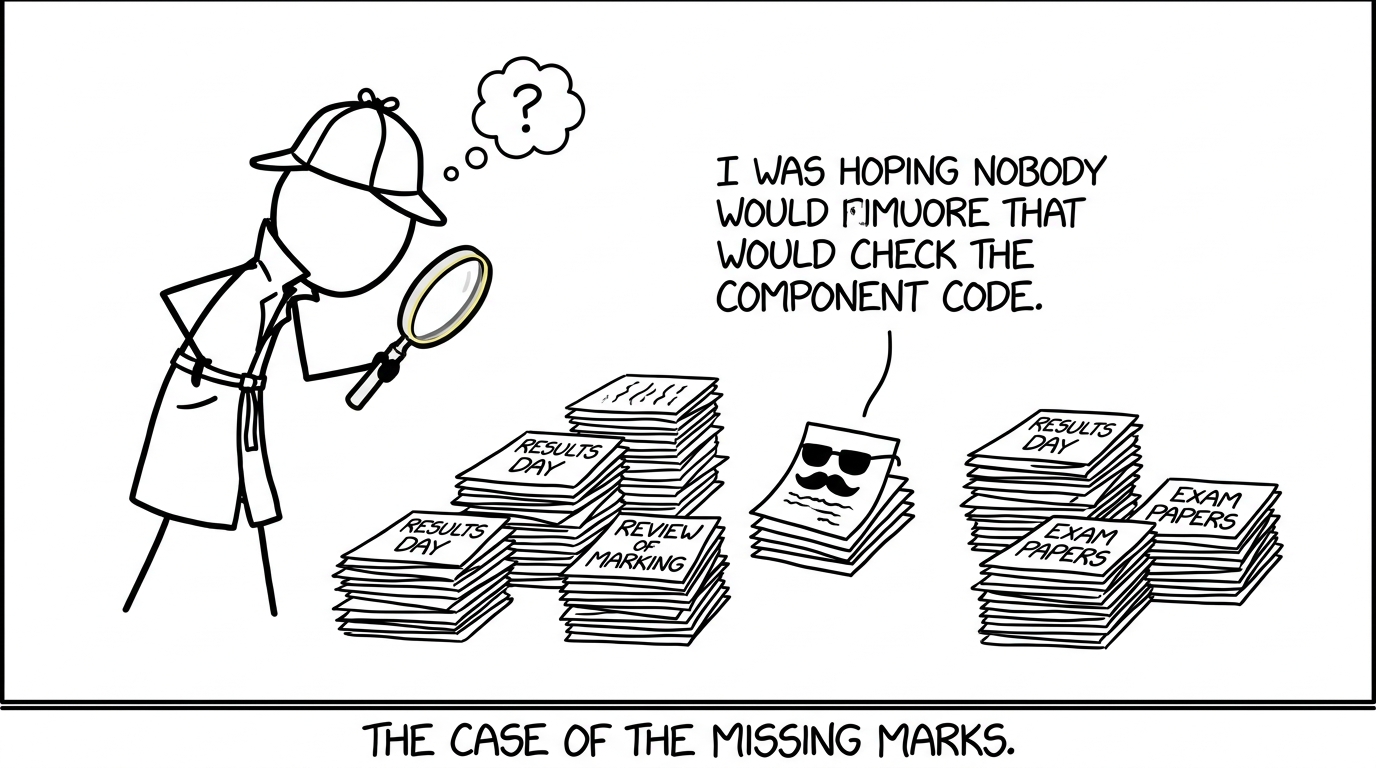 A student detective searches for the correct Combined Science component
Confirm the practical details
Before agreeing, ask your exams officer:
- Which component will be reviewed?
- What is the school’s internal deadline?
- What fee applies?
- Is a script available first?
- How long should the outcome take?
- Could the result affect a sixth-form or college place?
Standard reviews are normally completed within 20 calendar days of the exam board receiving the request. Priority GCSE reviews are not universally available across exam boards; current government guidance states that Pearson offers a priority GCSE service. Check the current board rules rather than assuming your request can be fast-tracked.
Give written consent and await the outcome
Once submitted, the review cannot simply be cancelled because the mark falls. The outcome may confirm, raise or lower the component mark, potentially changing either part of the double grade.
If you remain concerned after the review, an appeal is a separate stage. Appealing a GCSE Combined Science grade is not a second attempt to obtain extra marks. The centre normally needs specific grounds concerning the marking review or the exam board’s procedures, and strict deadlines apply.
Decision checklist: should you request a review?
A review is more reasonable when:
- you are close to the next overall boundary;
- a teacher has inspected the script and identified potentially missed credit;
- one component is unexpectedly inconsistent with your established performance;
- the grade affects entry to a sixth-form, college course or science pathway;
- you accept that the mark could decrease.
Pause before requesting one when:
- the decision is based only on a predicted grade;
- nobody has checked the component marks or script;
- you are many marks from the required boundary;
- the hoped-for marks come from answers that do not meet the mark scheme;
- you have not checked the fee or school deadline.
Common mistakes to avoid
Treating a review as a free second opinion. It is a check for marking errors, not a request for generosity.
Looking only at the paired grade. Component marks and the overall aggregate boundary are essential to a sensible decision.
Reviewing every paper automatically. Target the component with the clearest concern.
Missing the school deadline. Your school may stop accepting requests before the JCQ deadline.
Assuming the grade cannot fall. There is no general grade protection for a review of marking. Read the consent statement carefully.
Make the next decision calmly
A result can feel personal, but the best response is procedural: check the boundary, inspect the evidence, speak to your teacher and act before the deadline. That is how you turn uncertainty into a decision you can defend.
If you are preparing for a resit or moving towards A Level study, return to the GCSE Maths revision hub. MathsGenie brings together free revision lessons, practice questions, mark schemes, video solutions, GCSE predicted papers, mini tests and past papers. Begin by checking the GCSE Combined Science grade boundaries, then speak to your exams officer while there is still time to act.











