

GCSE Business Lower Grade Than Expected: Next Steps
GCSE Business lower grade than expected? Check your marks, consider a review, plan a resit and rebuild exam technique with this clear, calm action plan.

A results slip can make months of work feel as though they have been reduced to one small number. If you received a GCSE Business lower grade than expected, pause before deciding what it means. Your immediate next steps are to check whether the grade affects your plans, ask your school for your marks and marked scripts, consider a review only when the evidence supports it, and explore a resit if the grade still matters.
Disappointment is real, but it is not a strategy. The useful question is not, “How did this happen?” It is, “What can I do now?”
Your GCSE Business results-day checklist
- Confirm your grade and marks for each paper or component.
- Check whether the result affects your sixth-form, college or apprenticeship place.
- Speak to your Business teacher and exams officer promptly.
- Ask whether accessing your marked scripts would help.
- Compare your answers with the mark scheme before requesting a review.
- Check the cost, deadline and possible outcomes of a review.
- If necessary, discuss a resit and build a focused revision plan.
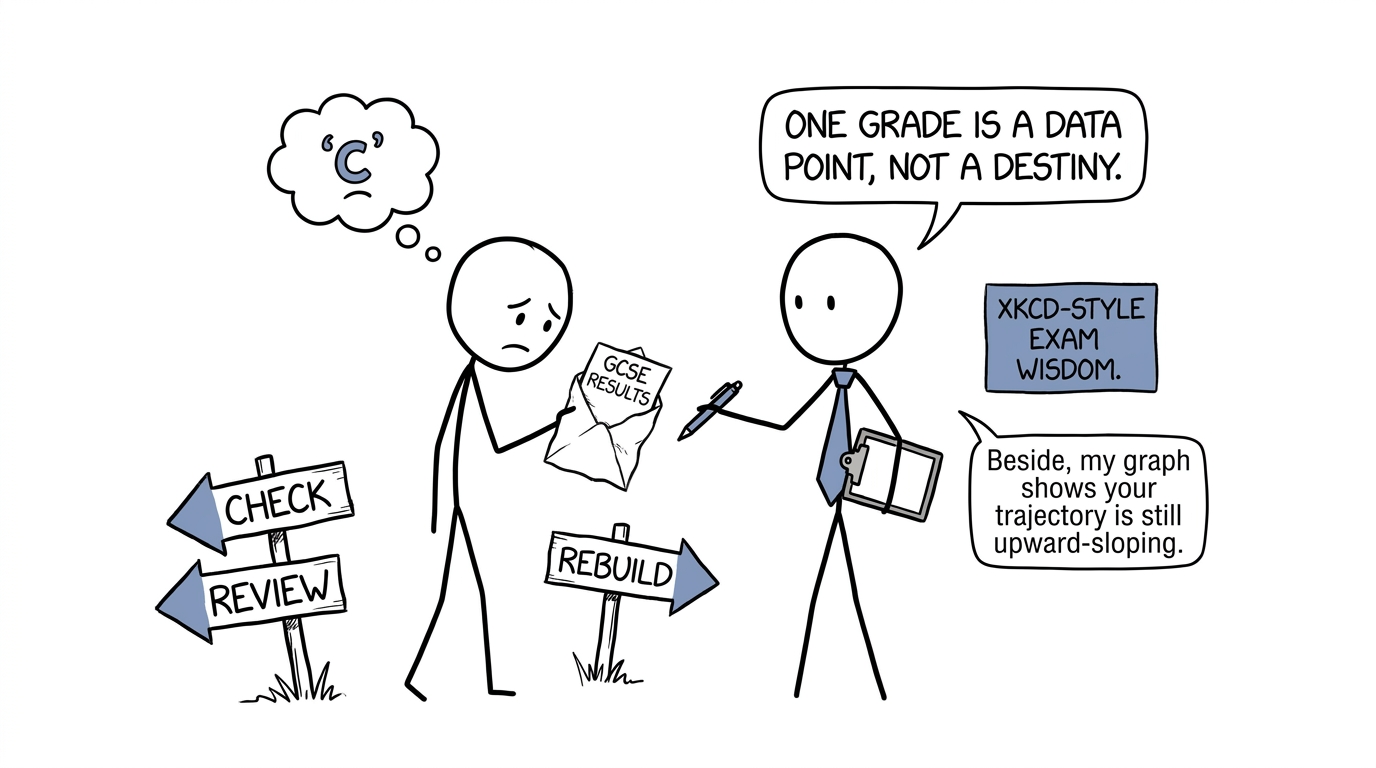 A student choosing calm next steps after a disappointing GCSE result
Check what the disappointing result actually changes
A lower grade can feel urgent without being practically important. Begin by checking the entry requirements for the course or route you want to follow. Contact the sixth form, college or training provider if you are uncertain rather than assuming that your place has disappeared.
GCSE Business is not one of the subjects that students are generally required to continue until they achieve a particular grade. That makes the decision personal. A resit may be worthwhile if Business is required for your next course, if the result significantly weakens an application, or if you want firmer foundations before studying Business at A Level. If it changes none of those things, directing your energy towards your next qualifications may be wiser.
Treat the grade as information, not identity. It reports one performance under particular conditions. It does not measure your future judgement, work ethic or ability to improve.
Ask for the marks and marked scripts
Your overall grade alone cannot tell you whether something went wrong. Ask your teacher or exams officer for the marks awarded on each paper and how far you were from the next grade boundary.
Schools and colleges can request access to marked GCSE scripts. A teacher can then compare your responses with the published mark scheme and decide whether there is a credible reason to request a review of marking. Most exam boards do not accept requests directly from students, while private candidates may have different arrangements.
Look for specific evidence:
- an answer or page that appears unmarked;
- a mark total that may have been calculated incorrectly;
- a response where the mark scheme appears to have been applied incorrectly;
- an extended answer that your teacher believes deserves closer examination.
Being close to a boundary is not, by itself, evidence of a marking error. It simply makes the possible effect of any genuine error more significant.
Decide whether to request a review of marking
A review of marking checks whether the original mark scheme was applied correctly. It is not a fresh attempt to award the most generous possible mark. Your mark and grade can rise, remain unchanged or fall, so your school needs your written consent.
For the June 2026 series, the JCQ deadline for awarding bodies to receive standard reviews of results is 24 September 2026. Your school will set an earlier internal deadline, so speak to the exams officer immediately. Fees and access-to-script arrangements differ between AQA, Pearson Edexcel, OCR and Eduqas.
A review is most sensible when:
- a teacher identifies a plausible marking issue;
- the required mark change is realistic;
- the higher grade would materially affect your next step;
- you understand the fee and the risk of a lower mark.
If your school refuses to request a review or access your script, it must provide an internal appeals route. A formal appeal to an exam board normally comes only after the relevant post-results review has been completed.
Plan GCSE Business next steps if the grade stands
For most mainstream GCSE Business qualifications in England, the next examination opportunity is normally the following summer rather than the November GCSE series used for English Language and maths. Availability varies by qualification and country, so confirm the series, specification and entry arrangements with your school or an approved examination centre.
Before committing, ask:
- Will my school enter me, or must I find another centre?
- Will I resit the whole linear qualification?
- Is the same specification still available?
- What are the entry fees and deadlines?
- Can the revision timetable fit alongside my new courses?
Then begin with the Edexcel GCSE Business revision hub, where MathsGenie brings together lessons, questions, past papers and mark schemes. Even if you used a different exam board, the underlying revision principle remains useful: check your specification first, diagnose weaknesses and practise the exact assessment style you will face.
Rebuild the skills that cost marks
A disappointing result is often caused by several small leaks rather than one dramatic failure. Sort lost marks into three groups: knowledge, application and exam technique.
Knowledge gaps include unfamiliar terms or formulas. Application gaps happen when you know a concept but do not use the case-study information. Technique problems include misreading command words, giving undeveloped points or spending too long on low-mark questions.
Business also relies on numerical confidence. Revisit the GCSE maths revision hub for percentages, averages, ratio and graphs. The Edexcel GCSE Maths revision area includes topic lessons, practice questions and videos, while AQA ratio revision offers focused practice for a skill that transfers across business calculations.
Keep essential relationships secure, such as:
Revenue=selling price×quantity sold\text{Revenue}=\text{selling price}\times\text{quantity sold}Revenue=selling price×quantity sold Profit=revenue−total costs\text{Profit}=\text{revenue}-\text{total costs}Profit=revenue−total costsDo not only memorise formulas. Practise selecting the right figures, showing working, including units and interpreting what the result means for the business.
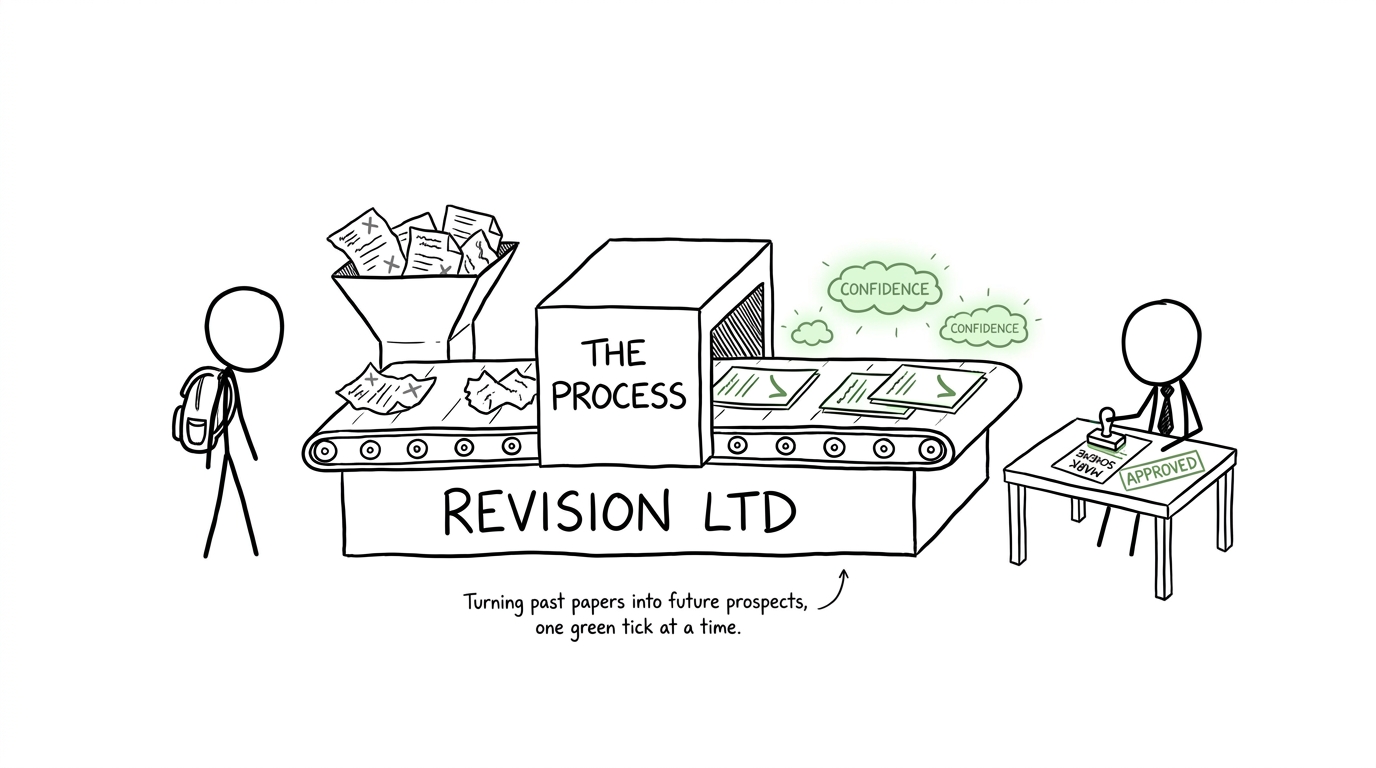 Revision Ltd turning mistakes into corrected answers
Use a revision cycle that produces evidence
Begin with one timed paper, mark it strictly and record why every mark was lost. The guide to finding your weakest GCSE topics explains how to turn errors into priorities rather than rereading everything.
Use this repeating cycle:
- review one weak topic through a short lesson;
- answer exam-style questions without notes;
- mark them using the mark scheme;
- rewrite one incomplete response;
- return to the skill several days later;
- complete another timed paper to measure progress.
If other subjects also need attention, use the GCSE catch-up revision plan and the wider MathsGenie resources collection to organise manageable sessions. For maths preparation, GCSE predicted papers can provide additional timed practice after topic gaps have been repaired.
Common mistakes after a lower GCSE Business grade
Requesting a review immediately: First obtain the marks and, where useful, the script. A review should be evidence-led.
Assuming the mark can only rise: Reviews can leave a mark unchanged or reduce it as well as increase it.
Missing the school deadline: Exam centres usually need requests before the published exam-board deadline.
Resitting without diagnosing the problem: Repeating the same revision habits may reproduce the same outcome. Separate knowledge, application and technique errors.
Ignoring maths weaknesses: Business calculations can become reliable marks when percentages, averages, graphs and formulas are practised deliberately.
Turn the result into a decision
A GCSE Business disappointing result deserves an honest response, not a panicked one. Establish what the grade changes, inspect the evidence, use the post-results process when justified and resit only when it supports a meaningful goal.
If a resit is the right choice, start with MathsGenie’s GCSE Business resit resources. Combine revision lessons with practice questions, past papers and mark schemes, then use mini tests, video solutions and predicted papers where available to check that weaknesses are actually shrinking. The grade is already printed. Your next decision is not.











