

GCSE Business Grade Sixth Form Entry: Does It Matter?
GCSE business grade sixth form entry explained: learn when Business matters, what colleges prioritise, and how maths can strengthen your course choices.
There is a particular kind of worry that appears before GCSE results day. One grade begins to feel as though it controls the whole future. If Business is that subject for you, the short answer to the GCSE business grade sixth form entry question is reassuring: most sixth forms and colleges consider your complete grade profile, not GCSE Business alone.
Your Business grade may matter directly if you want to study A Level Business or a Level 333 business qualification. For unrelated courses, it will usually contribute to your overall GCSE total but carry less weight than English, maths and relevant subject-specific grades. There is no single national entry rule, however. Each provider publishes its own requirements.
The entry requirements checklist
Before deciding whether your Business result is a problem, check four separate things:
- the provider's general requirement for joining Year 121212
- its minimum English and maths grades
- the specific requirements for each course you want to study
- whether GCSE Business is required only when you have previously taken it
These conditions are not interchangeable. Meeting the general sixth-form threshold does not automatically qualify you for every A Level. Equally, missing a preferred Business grade does not always mean losing your entire place.
MathsGenie's guide to sixth form entry requirements and GCSE grades explains this distinction in more detail.
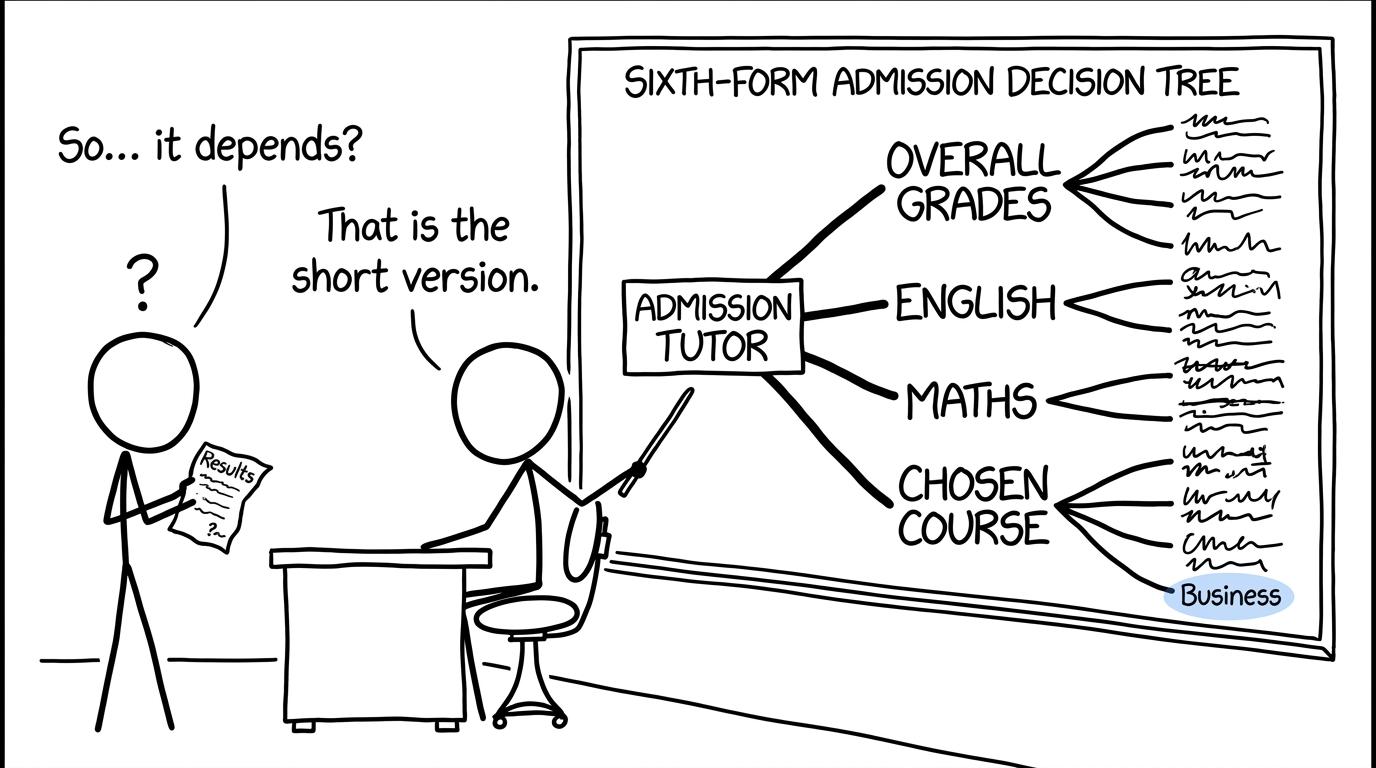 A student discovers the complicated sixth-form admissions decision tree
How much weight does a GCSE Business grade carry?
The honest answer is that its weight changes with the course and provider. A review of published entry criteria for 202620262026 shows considerable variation. Some providers ask for GCSE English and maths grades but set no separate Business requirement. Others require a Business grade between 444 and 777 when the applicant studied the subject at GCSE.
That variation is why broad online claims such as “you need a grade 666” are unreliable. The decisive evidence is the current admissions policy, course prospectus and conditional offer from your chosen provider.
| Application situation | Likely weight of GCSE Business |
|---|---|
| Applying for A Level Business | Often relevant, although some providers accept students who have not taken it |
| Applying for a Level 333 vocational business course | Potentially relevant, alongside overall grades and English or maths |
| Applying for A Level Maths or sciences | Usually limited; subject-specific maths and science grades matter more |
| Applying for unrelated humanities or creative courses | Usually part of the overall grade profile rather than a decisive subject |
| Meeting a general requirement based on several GCSEs | It may count as one qualifying grade |
The phrase “if studied” is especially important. A sixth form may accept students who did not have the opportunity to take GCSE Business, while expecting those who did take it to achieve a stated grade. Some providers instead use English or maths as evidence that a new Business student can cope with written analysis and numerical work.
When your Business grade matters most
You want to continue with Business
A Level Business builds on ideas such as revenue, costs, profit, cash flow, marketing, operations and decision-making. A strong GCSE result can therefore provide evidence that you are ready to continue.
However, GCSE Business is not universally required for A Level Business. Current published policies include providers that focus on English and maths, providers that specify a Business grade “if taken”, and more selective sixth forms that set higher thresholds across all three subjects.
The same principle applies to vocational routes. A Level, BTEC and other Level 333 programmes can have different general and course-specific criteria, even within one college. Read the entry for the exact qualification rather than assuming every business course follows the same rule.
Your Business grade helps you meet the overall threshold
Suppose a provider requires a specified number of GCSEs at grade 444, 555 or above. Business may count towards that total in the same way as another accepted GCSE. In this situation, the subject itself is not receiving special weight; it is helping you satisfy the wider academic profile.
Some selective providers use a best-subject total or require several grades at 666 or 777. GCSE Business may be included, but you must check which qualifications the provider accepts in its calculation.
The course is oversubscribed
Meeting minimum requirements establishes eligibility, not always priority. Where applications exceed available places, a published admissions policy may use additional criteria. These can include overall GCSE performance or other stated oversubscription rules.
Never assume that exceeding the Business threshold guarantees admission. Course capacity, the timetable and completion of enrolment steps can still matter. The relevant policy should explain how places are allocated.
When other GCSE grades matter more
For many applications, English and maths are the larger boxes to carry.
In England, students who have not achieved grade 444 in GCSE English or maths will generally need to continue studying the relevant subject during post-161616 education, under current funding rules. Providers also commonly place English and maths within their own general entry requirements.
Maths becomes especially important when you apply for A Level Maths, Further Maths, Physics, Chemistry, Computer Science or Economics. These courses frequently have their own mathematics thresholds. A weak Business grade is unlikely to outweigh meeting a demanding subject-specific maths requirement; a strong Business grade will not replace it either.
English can be important for Business because the course involves explanation, evaluation and extended responses. Maths supports percentages, financial calculations, interpreting data and quantitative decision-making. That is why some sixth forms admit students to A Level Business using English and maths grades even when GCSE Business was unavailable.
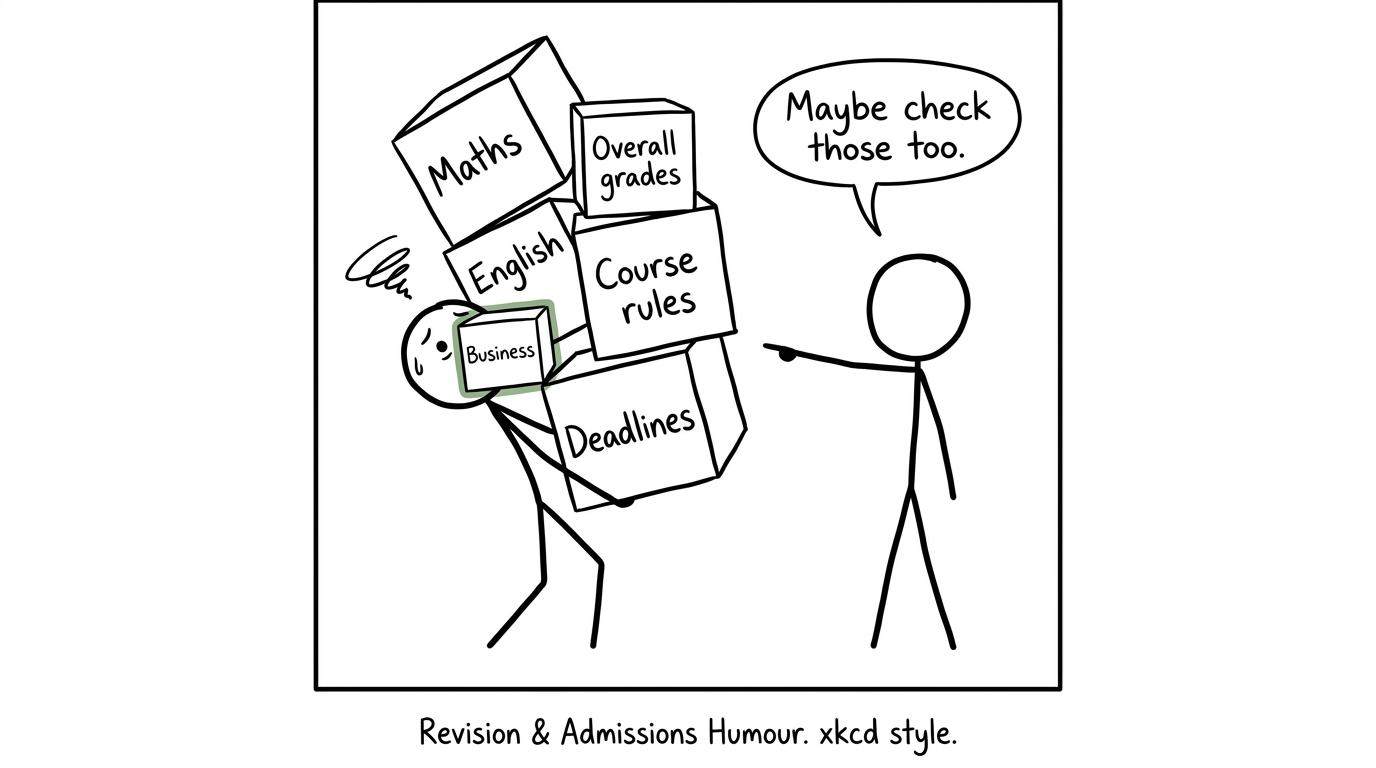 A student worries about one small Business box while carrying larger admissions requirements
Read the policy rather than guessing
Admissions anxiety grows in the space left by missing information. Close that space with a short investigation.
For every sixth form or college on your list:
- open its current admissions policy
- find the general Year 121212 entry threshold
- open the page for your intended course
- note the exact GCSE subjects and grades required
- check how vocational qualifications are treated
- record the application and enrolment deadlines
- ask admissions to clarify any ambiguous wording
Create a shortlist containing an ambitious option, a realistic option and a secure alternative. Requirements can be reviewed annually, so use the policy for your intended entry year rather than an old prospectus or a friend's experience.
Applications made during Year 111111 are often assessed using predicted grades, with places remaining conditional on final GCSE results. On results day, compare your results with both the general and subject-specific conditions. Follow every instruction for uploading results, contacting admissions or attending enrolment. The MathsGenie guide to GCSE results and sixth-form offers can help you prepare.
What if your GCSE Business grade is lower than expected?
First, separate disappointment from the actual admissions decision. A missed subject threshold and a lost sixth-form place are not necessarily the same thing.
Contact the provider promptly and report your grades accurately. Ask whether:
- you can still be considered for the original course
- another business qualification has different entry criteria
- a different subject combination is available
- there is a waiting list or formal review process
- your place remains available for other courses
Do not claim that you “almost” achieved a grade unless the provider asks about marks or a post-results service. Admissions staff need your confirmed result and a clear question. If you are considering a review of marking, discuss the risks, deadlines and possible outcomes with your school before acting.
A lower Business grade may close one route at one provider. It does not establish that every business course is closed. Colleges often offer several programme levels, and their criteria can differ substantially.
Why maths revision still deserves priority
If you are preparing for GCSE exams now, the most useful response is not to predict every admissions conversation. It is to protect the grades that appear repeatedly across entry policies.
Start at the GCSE Maths revision hub, where you can choose your exam board, including Edexcel, AQA, OCR and Eduqas, and work at the correct foundation or higher tier. Use a simple cycle:
- diagnose a weak topic
- learn or review the method
- complete practice questions
- mark the work carefully
- correct the precise error
- retest the skill later
The one-month GCSE maths revision plan turns that cycle into a manageable schedule. If the exams are much closer, use the one-week GCSE maths revision plan to prioritise rather than panic.
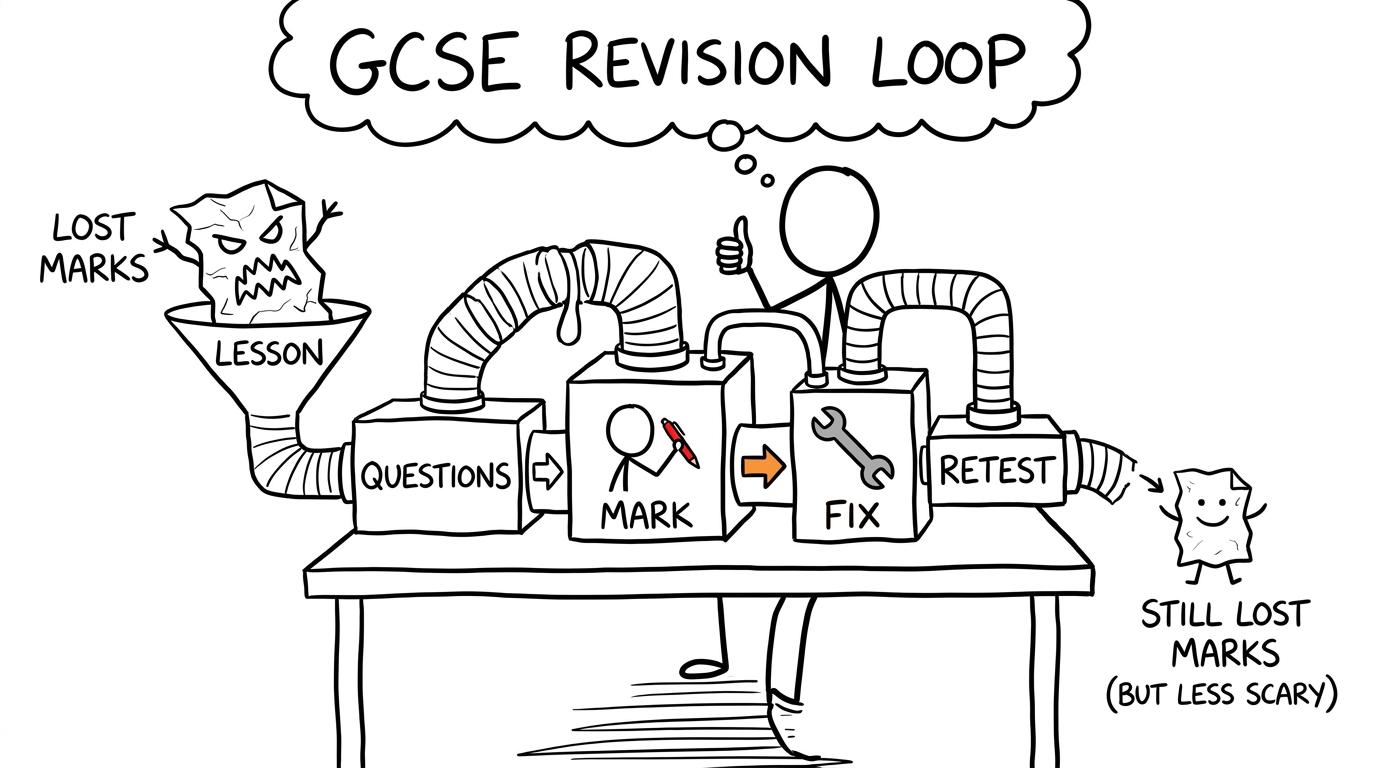 A revision machine makes a lost-marks monster smaller through practice and correction
Once you know the content, timed papers reveal whether you can retrieve it under pressure. Read when to start GCSE past papers, then use mark schemes and video solutions to understand every lost mark. Predicted papers can provide fresh practice near the exams, but they should supplement official past papers rather than replace them. The guide to predicted GCSE topics and effective revision explains how to use them sensibly.
Common mistakes when judging sixth-form entry
Treating one provider's rule as universal
Entry requirements are local to the sixth form, college and course. A grade accepted in one place may be below the threshold elsewhere.
Looking only at the general requirement
You may qualify to join the sixth form but not meet the higher requirement for a particular A Level. Check both layers.
Assuming GCSE Business is always compulsory
Many providers accept A Level Business applicants who did not study Business at GCSE. They may use English, maths or related subjects instead.
Assuming GCSE Business never matters
At some providers, your result is explicitly required if you took the subject. It may also help you reach an overall GCSE threshold.
Ignoring maths because you are choosing Business
Business courses often use numerical information, and maths commonly appears in general entry rules. Give it the attention its wider importance deserves.
Waiting until results day to read your offer
Know your conditions, contacts and enrolment instructions beforehand. A calm plan is more useful than hurried searching on the morning results arrive.
Turn uncertainty into a plan
Your GCSE Business grade can matter, particularly when you want to continue the subject or need it within an overall set of qualifying grades. But sixth forms and colleges rarely judge an application through that single result. They consider general entry rules, English and maths, course-specific thresholds and the conditions stated in your offer.
Check each policy directly. Keep alternative routes ready. Then put your energy into the part you can still influence: your preparation.
Make MathsGenie your free revision base. Use revision lessons to rebuild weak methods, practice questions and mini tests to improve accuracy, and past papers, predicted papers, mark schemes and video solutions to prepare for exam conditions. One grade may feel enormous today. A clear revision plan makes it smaller, one recovered mark at a time.











