

Sixth Form Entry Requirements: GCSE Grades Needed
Sixth form entry requirements explained: typical GCSE grades for A levels, vocational courses and T Levels, plus what to check before applying.

Opening a sixth form prospectus can feel like reading two documents at once. One page describes exciting subjects and future careers. The next lists grades, averages and subject-specific rules.
The short answer is that sixth form entry requirements vary by school, college and course. A common starting point for an A Level programme is around five GCSEs at grades 999 to 555, often including English and maths, with a grade 666 or 777 in subjects you want to continue. These are typical patterns, not national guarantees. Always check the published admissions policy for each provider.
This guide explains the GCSE grades needed for sixth form, how requirements differ by course type and what to do if your predicted grades are close to the threshold.
Sixth form entry requirements at a glance
Before applying, check four separate things:
- the provider's overall GCSE requirement
- the required grades in English and maths
- any subject-specific requirements
- whether the offer is conditional on your final results
Do not rely on a friend's entry requirements from another school. Recent admissions policies show considerable variation: some sixth forms ask for five GCSEs at grade 555 or above, while more selective providers may expect several grades at 666 or 777. Requirements for individual A Levels can be higher than the general threshold.
| Course type | Typical GCSE pattern | Important detail |
|---|---|---|
| Three A Levels | Often five GCSEs at grades 999 to 555 or 999 to 444 | Individual subjects may require grade 666 or 777 |
| A Level Maths | Commonly grade 777 in GCSE Maths | Some providers accept grade 666; others require grade 777 |
| A Level Further Maths | Often grade 888 or 999 in GCSE Maths | Usually taken alongside A Level Maths |
| Science A Levels | Often grade 666 or 777 in the relevant science or Combined Science | Maths requirements may also apply |
| Vocational Level 333 course | Often four or five GCSEs at grade 444 or above | Requirements depend on the course and provider |
| Mixed academic and vocational programme | Commonly GCSE grades 444 to 666 | Each component may have separate conditions |
| T Level | Set by the individual provider | Some courses expect relevant GCSEs and particular English or maths grades |
| Level 222 programme | Usually lower GCSE thresholds than Level 333 study | Can provide progression towards Level 333 courses |
These ranges are a planning guide rather than an offer. Read the latest course guide and admissions policy for the year in which you intend to enrol.
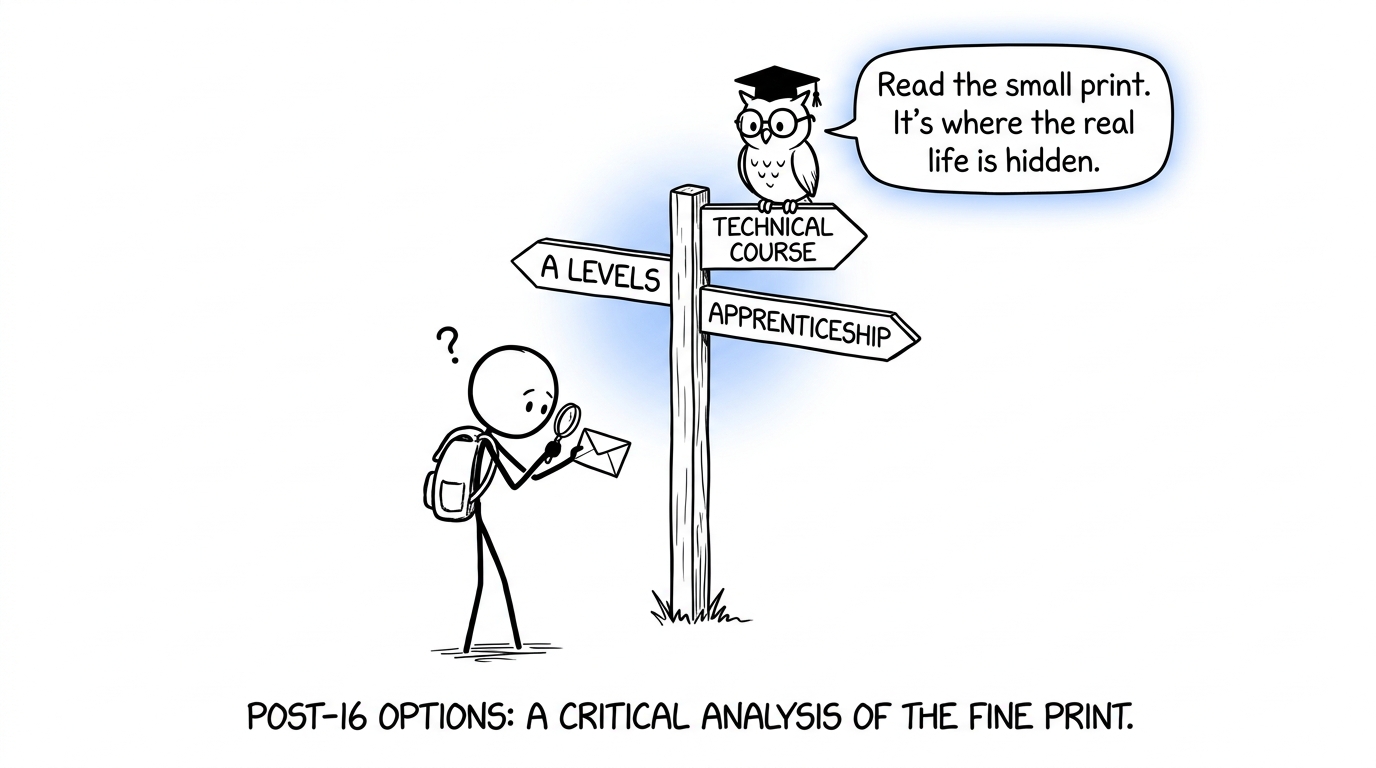 A student examines signposts for different post-16 routes
GCSE grades needed for different sixth form courses
A Level programmes
A Levels are Level 333 qualifications. Sixth forms commonly assess whether your GCSE profile shows that you can manage several demanding subjects at once. This is why an overall requirement may include five or more GCSEs at certain grades rather than only the subjects you plan to continue.
A provider might accept you onto its general A Level programme but not into every subject. For example, meeting an overall five-GCSE threshold does not automatically satisfy the entry requirement for Maths, Chemistry or a modern foreign language.
A Level Maths and Further Maths
A Level Maths builds quickly on higher-tier GCSE algebra, graphs, trigonometry and probability. Many providers therefore ask for grade 777 in GCSE Maths, although policies differ. Further Maths commonly has a higher threshold, often grade 888 or 999.
If maths is part of your plan, explore the A Level Maths revision hub and its subject pages before making your final choice. The Edexcel A Level Maths resources, for instance, show the style and depth of lessons, questions and papers awaiting you.
A grade requirement is not merely a gate. It is a clue about the fluency the course expects on day one.
Science, economics and computer science
Science A Levels often require strong grades in separate sciences or Combined Science. Providers may also specify a maths grade because subjects such as Physics and Chemistry use substantial numerical reasoning.
Economics and Computer Science may have GCSE Maths conditions even when you did not take the subject at GCSE. English-based subjects can similarly require a particular grade in English Language or Literature.
Read every subject page separately. The small print often matters more than the headline entry requirement.
Vocational courses and T Levels
Level 333 vocational qualifications and T Levels can have different requirements from an all-A-Level programme. T Levels are two-year Level 333 courses combining classroom learning with an industry placement. Entry decisions remain with individual schools and colleges, so there is no single GCSE threshold covering every T Level.
Vocational does not mean undemanding. The form of learning is different, and providers still need evidence that you can manage the course content and placement responsibilities.
Why English and maths grades matter
GCSE grades 444 to 999 are Level 222 passes. In England, students on relevant post-161616 programmes who have not achieved grade 444 in GCSE English or maths must normally continue studying the missing subject as part of their programme.
That does not mean every sixth form requires only grade 444. A provider can set a higher admissions threshold, and individual courses may ask for grade 555, 666 or above.
For maths improvement, begin with the GCSE Maths revision hub. Choose your board, including Edexcel, AQA, OCR or Eduqas, then use lessons and topic questions that match your specification. Edexcel students can follow the structured GCSE Maths lessons, while AQA students can use the AQA GCSE Maths revision page.
What to do if your predicted grades are borderline
A predicted grade is useful information, but it is not your final result. Treat the gap between your current grade and the requirement as a planning problem.
- Confirm the exact requirement with the sixth form.
- Ask whether it applies to your overall programme, a particular subject or both.
- Keep a realistic alternative course on your application.
- Identify the topics currently losing you marks.
- Practise them, mark your work and retest them.
- Attend open evenings and ask what happens when an applicant narrowly misses an offer.
Use GCSE predicted papers alongside past papers rather than instead of them. The MathsGenie revision resources also include short tests that can make progress easier to measure.
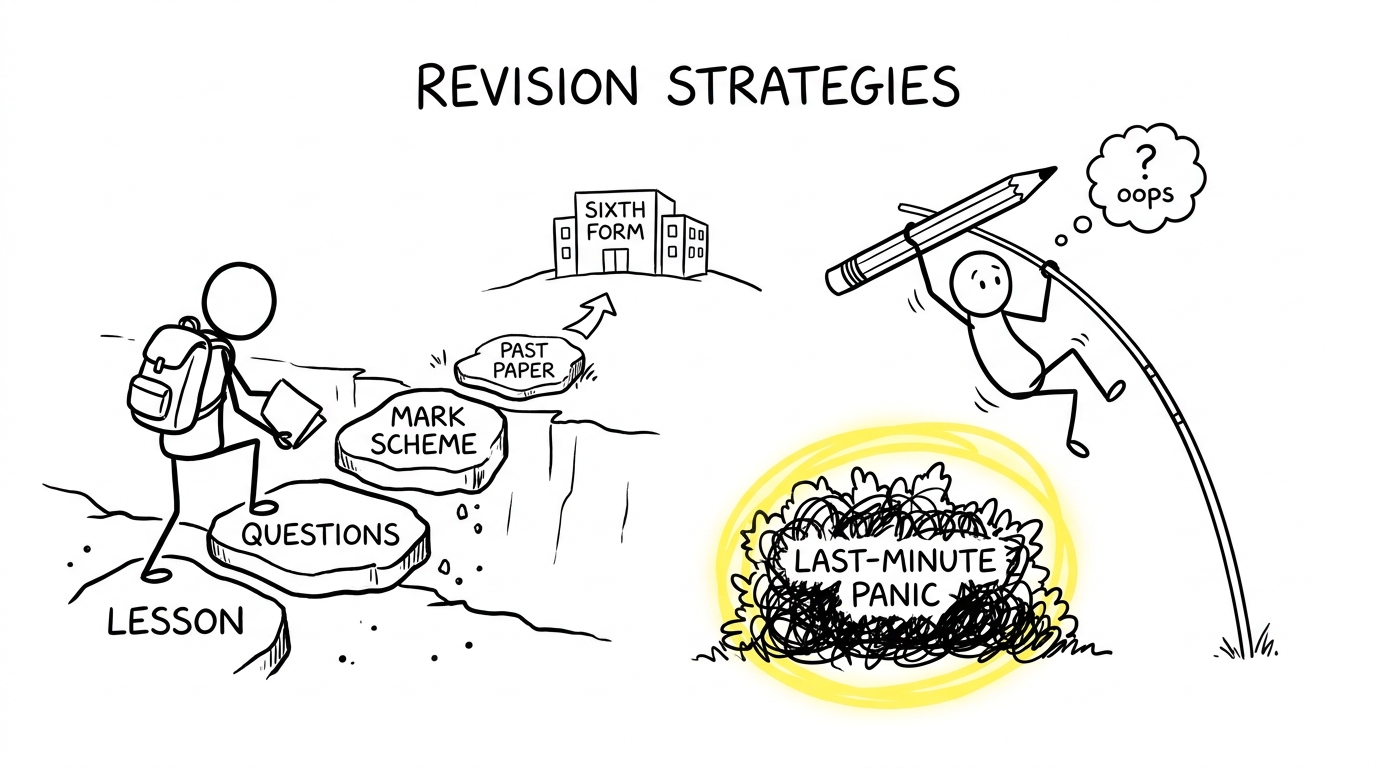 A calm revision bridge beats a last-minute pencil pole vault
Common mistakes when checking entry requirements
Confusing the general and subject requirements
The overall threshold gets you considered for the programme. A higher subject requirement determines whether you can take a particular A Level.
Assuming every sixth form uses the same grades
There is no universal admissions table. Requirements can differ between neighbouring providers and may change between entry years.
Looking only at predicted grades
Applications may use predictions, but offers are usually conditional on final GCSE results. Keep revising after submitting your application.
Ignoring course combinations
Some subjects support one another, while particular combinations may not fit the timetable. Check availability before treating your choices as final.
Completing papers without reviewing them
A paper only becomes revision when you analyse the mark scheme. Use the Edexcel GCSE question bank to target weak topics after each timed paper.
Turn the requirement into a revision target
Sixth form entry requirements can initially look like a verdict. They are more useful as a map. Find the exact grades your intended programme requires, identify any subject-specific conditions and build alternatives that still move you towards your longer-term goal.
Then make the next step practical. Use MathsGenie's free revision lessons and practice questions to strengthen individual topics, mark your work carefully, and test your progress with mini tests, past papers and predicted papers. When GCSEs finish, explore the A Level Maths subject pages so that your next course begins with preparation rather than surprise.











