GCSE Business Exam Day Kit: What You Actually Need
GCSE business exam day kit checklist: pack the right pens, calculator, ID and water, avoid banned items, and arrive calm, organised and ready to perform.
The smallest exam-day problems can feel surprisingly large. A pen stops working. A calculator is still on the kitchen table. The water bottle has a label that must be removed before you enter the room.
A sensible GCSE business exam day kit prevents those avoidable distractions. At minimum, prepare black pens, a pencil, ruler, eraser and an approved calculator, plus any identification or candidate card requested by your school. Put everything in a transparent pencil case, bring water in a clear label-free bottle if your centre permits it, and leave prohibited items outside the examination room.
Your school's instructions and the rules printed on the front of your paper always take priority. Requirements can vary by centre, exam board and paper, so check them before packing.
Your GCSE Business exam day kit checklist
Prepare this simple kit the night before:
- At least two working black pens
- A sharpened pencil
- A ruler with clear markings
- An eraser
- An approved scientific calculator
- Spare calculator batteries, if appropriate for your model
- A transparent pencil case
- A clear water bottle with its label removed, if permitted
- Your candidate card, timetable or identification, if your school requires it
- Any centre-approved access-arrangement equipment
- Glasses, hearing equipment or essential medication arranged according to your school's instructions
Keep your phone, smartwatch, notes, revision cards and calculator instructions out of the examination room. If you are uncertain about an item, ask your exams officer rather than guessing.
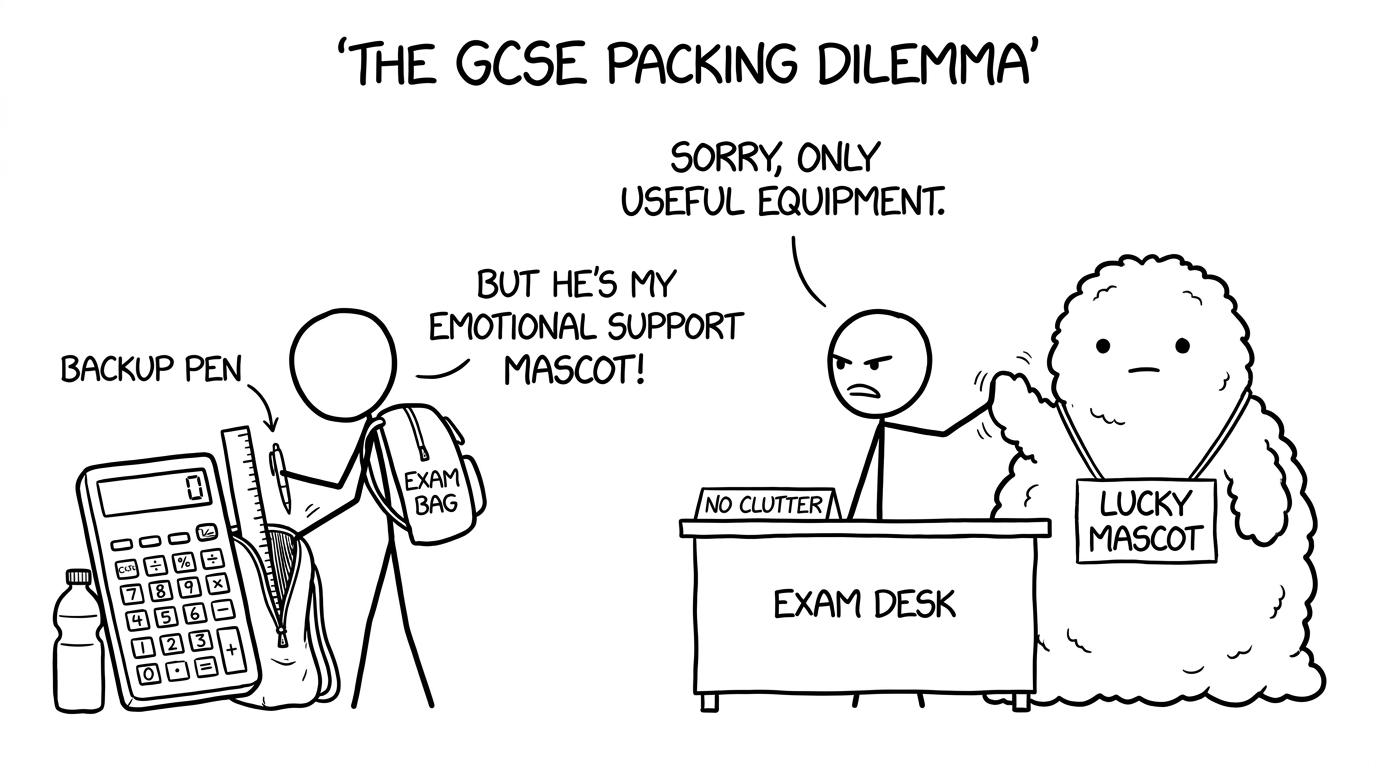 A student discovers that a useful spare pen beats an enormous lucky mascot
The essential writing equipment
Two or three reliable black pens
Black ink is the safest standard choice for externally marked examinations because scripts are commonly scanned. Pack more than one pen, test each one, and choose pens that feel comfortable during extended writing.
GCSE Business involves more writing than many students expect. You may need to explain an effect, analyse a decision and evaluate competing options. A spare pen is therefore not excessive preparation. It is a simple way to remove a predictable risk.
Avoid relying on erasable pens, coloured ink or gel pens that smudge easily. Follow the instructions on the front of the question paper and any guidance issued by your centre.
Pencil, ruler and eraser
A pencil is useful for diagrams, annotations and planning, but final written answers should normally be completed in black ink unless the paper tells you otherwise. Pack a ruler even if you do not expect to draw a graph. It can help you read tables accurately, connect plotted values and keep written plans organised.
An eraser is useful for pencil work, although crossing out an incorrect written response neatly is usually better than attempting to erase ink. Do not use correcting fluid or correction tape unless your centre has explicitly confirmed that it is acceptable.
Choosing and checking your calculator
Business papers can require percentages, averages, revenue, costs, profit, margins, cash flow, break-even calculations and investment appraisal. A calculator therefore belongs in your kit whenever it is permitted by the paper.
Use a familiar scientific calculator rather than borrowing an unfamiliar model on the morning of the exam. Before packing it:
- Switch it on and test the main keys.
- Check that the display is clear.
- Clear any stored information where required.
- Remove its protective case before entering the examination room if instructed.
- Pack spare batteries if your model uses replaceable batteries.
- Make sure there are no notes, formula cards or instructions inside the case.
Current examination arrangements are controlled by the instructions for the specific paper and your centre. Check the front of your paper and follow the invigilator's directions. If you need a specialist calculator or equipment as part of an approved access arrangement, confirm this with your school in advance.
The calculator only helps when the underlying method is secure. MathsGenie's free OCR GCSE Business calculation revision guide reviews the numerical ideas used in business contexts. Even if you follow another board, check every formula against your own AQA, Edexcel, OCR or Eduqas specification.
Useful relationships to recognise include:
Revenue=selling price per unit×quantity sold\text{Revenue}=\text{selling price per unit}\times\text{quantity sold}Revenue=selling price per unit×quantity sold Profit=total revenue−total costs\text{Profit}=\text{total revenue}-\text{total costs}Profit=total revenue−total costs Profit margin=profitrevenue×100\text{Profit margin}=\frac{\text{profit}}{\text{revenue}}\times 100Profit margin=revenueprofit×100Do not turn the night before into a long calculation session. If percentages remain uncertain, make one focused visit to the GCSE percentages revision page, answer a short set of questions, check the solutions and stop.
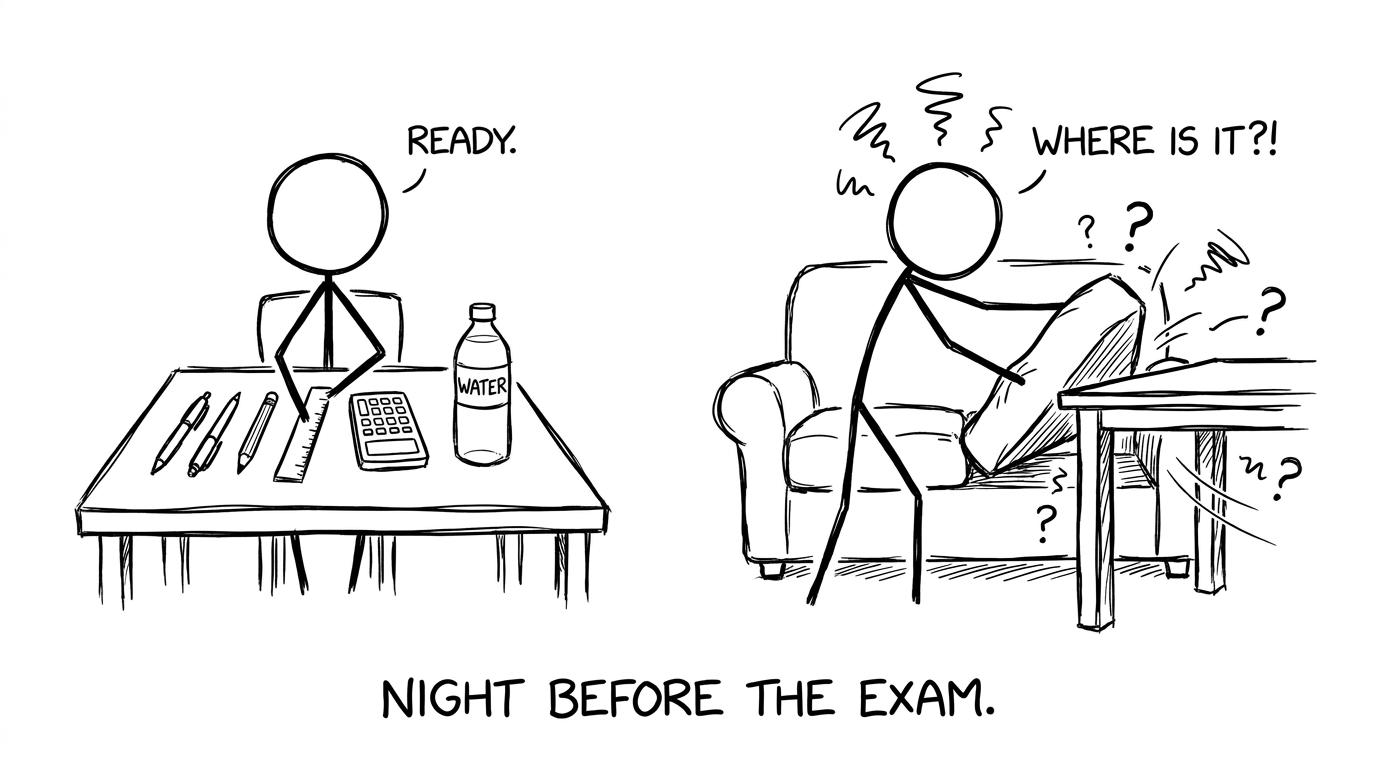 A calm student packs equipment while another searches dramatically for a calculator
What to prepare beyond stationery
Your timetable, venue and start time
Read your official timetable rather than relying on a screenshot sent by a friend. Confirm the date, start time, room and expected arrival time. If your school uses different venues for access arrangements, check which location applies to you.
Plan the journey and allow for ordinary delays. The aim is not to arrive dramatically early. It is to avoid spending the final minutes before the paper negotiating traffic, a missed bus or an unfamiliar room.
Identification and candidate information
Some centres ask students to bring photographic identification, a candidate card or another school-issued document. Others place candidate details on the examination desk. Follow your school's process and do not assume that another centre uses the same system.
You do not need to memorise every candidate detail if your school supplies it, but you should know your legal name and be ready to check that the information on your desk or paper is correct.
Water and personal needs
If your centre permits water, use a transparent bottle and remove its label. Do not bring food into the room unless your school has authorised it for a medical reason.
Arrange essential medication, coloured overlays, hearing equipment, rest breaks or other approved access arrangements before exam day. Access arrangements are organised through the centre; they are not improvised by bringing extra items into the room without approval.
What should stay outside the exam room?
The easiest rule is to carry less, not more. Phones, watches and internet-connected devices can create serious problems even when they are switched off or unused. Leave them at home or hand them in exactly as your centre directs.
Do not take in:
- A mobile phone
- A smartwatch or conventional wristwatch
- Earbuds or headphones
- Revision notes or formula cards
- Calculator manuals or cases containing notes
- A pencil case that is not transparent
- A water bottle with writing or a label
- Unauthorised paper
- Correction fluid, unless explicitly permitted
Invigilators will explain the room procedure. Listen carefully even if you have heard it before. Rules can change, and the instructions for the paper in front of you matter more than habit.
The night-before packing routine
A good routine reduces the number of decisions left for the morning. Lay everything on a table and inspect it rather than dropping items into your bag from memory.
Check the paper first
Confirm the subject, exam board, date and paper. GCSE Business specifications differ across Edexcel, AQA, OCR and Eduqas, so make sure your final review matches the paper you will actually sit.
Test, pack and place
Test your pens and calculator. Sharpen the pencil. Remove the water-bottle label. Put permitted stationery in the transparent pencil case, then place the kit beside your bag with your timetable and any required identification.
Choose your clothes and set an alarm. If possible, use a second alarm or ask someone at home to check that you are awake. This is not pessimism. It is the same logic as carrying a spare pen: small safeguards are cheap, while preventable panic is expensive.
For a broader routine, use the GCSE maths night-before plan. The subject is different, but the central principle travels well: complete one short, purposeful review and then protect your sleep.
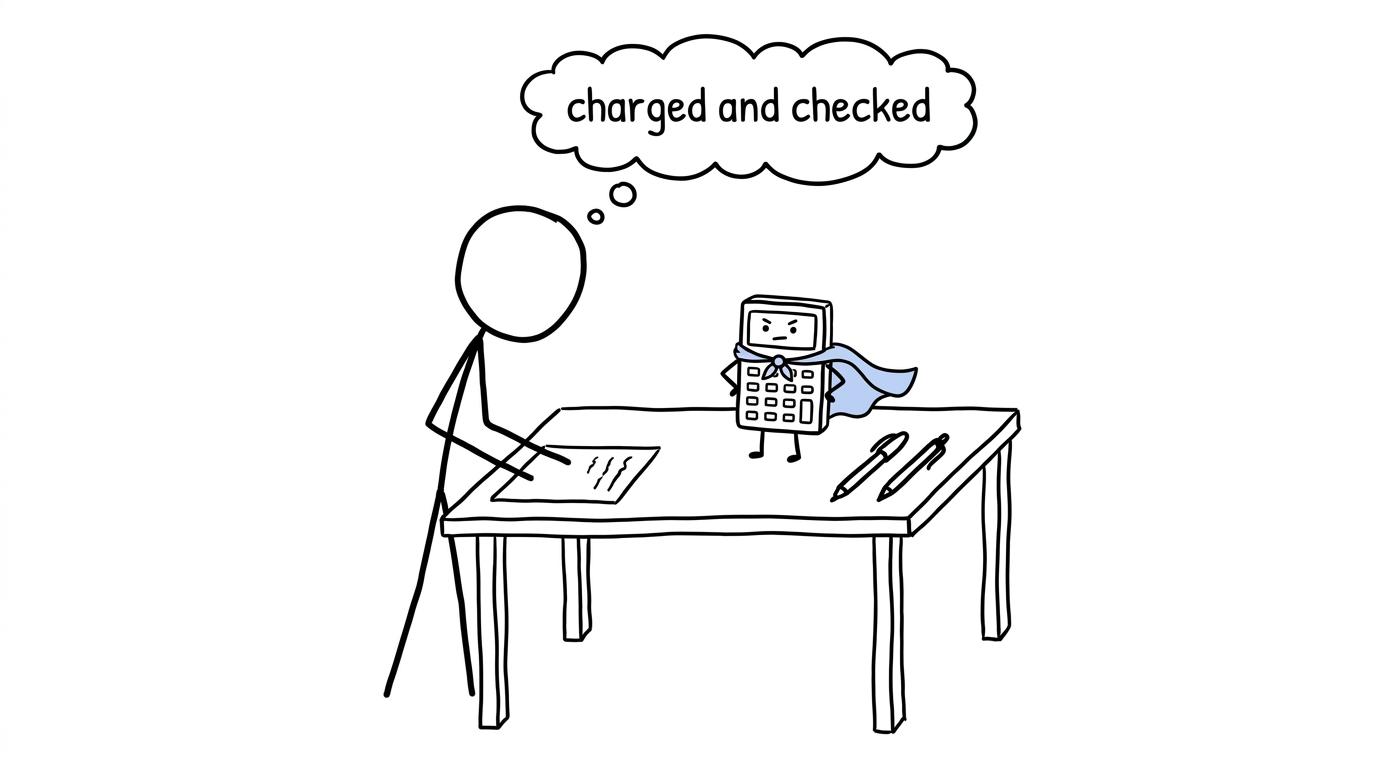 A calculator in a tiny superhero cape waits beside two checked pens
A short final revision check
Packing is only half the preparation. Your final review should refresh ideas, not attempt to rebuild the whole course.
Check that you can recognise the main command words. Calculate requires a numerical result and visible method. Explain requires a developed chain of reasoning. Analyse asks you to connect evidence, causes and consequences. Evaluate requires a supported judgement that responds to the context.
For numerical questions, remind yourself to:
- Write the formula or method.
- Substitute values carefully.
- Keep enough accuracy during the calculation.
- Give the correct unit, such as pounds or a percentage.
- Interpret what the result means for the business when requested.
A calculation without business meaning may not complete an analysis question. Likewise, a long paragraph cannot compensate for an incorrect numerical method when the question specifically asks you to calculate.
If you want a short diagnostic task before packing, use MathsGenie's GCSE predicted papers or a mini test, then mark it immediately. The guide to starting GCSE past papers explains why reviewing errors matters more than simply completing another paper. Stop once you have identified and corrected a small number of useful issues.
Common exam-day kit mistakes
Packing without testing
Owning a calculator is not the same as having a working calculator. Test the display and keys. Scribble briefly with each pen. A ten-second check can prevent a distracting start.
Bringing too many items
A crowded desk makes useful equipment harder to find and increases the chance of carrying something unauthorised. Bring what you need, not every item from your school bag.
Assuming every centre has identical rules
General examination rules provide a common framework, but practical arrangements differ. Identification, bags, water, arrival procedures and access arrangements should all be checked with your school.
Leaving the calculator case on
Calculator cases can conceal instructions or notes. Remove the case when directed and ensure nothing is stored inside it.
Cramming instead of packing
Revision can expand to fill every available minute. Set a stopping point. The GCSE one-week revision plan shows how short, marked practice can replace unfocused cramming. By the final evening, calm preparation is usually more useful than opening an entirely new topic.
Walk in with fewer things to worry about
An exam-day kit cannot answer a GCSE Business question for you. What it can do is protect your attention. When the pens work, the calculator is familiar and the timetable has been checked, your mind is free to focus on the case study, the data and the judgement the examiner wants.
Pack tonight, verify your school's latest instructions and place the bag somewhere you cannot overlook it.
Then let MathsGenie support the part that equipment cannot cover. Use the free MathsGenie revision library for clear lessons and practice questions, strengthen quantitative skills with topic resources, and use past papers, predicted papers, mark schemes, video solutions and mini tests to make your preparation measurable. The goal is not to carry more into the room. It is to arrive needing less reassurance.