GCSE Biology Edexcel Grade Boundaries Explained
GCSE biology Edexcel grade boundaries for 2025 explained clearly, plus 2026 results day, Foundation and Higher marks, and what students should do next.
Opening a results envelope can make months of work feel as though they have been compressed into one number. Yet that grade rests on something more precise: your total raw mark and the boundary set after the papers were marked.
For GCSE biology results day 2026, the final GCSE Biology Edexcel grade boundaries will not be confirmed in advance. Pearson sets them after reviewing evidence from the summer exam series, then publishes them on results day. Until then, the June 2025 boundaries are the latest reliable guide, not a prediction of exactly what will happen in 2026.
 A student calmly observes a results envelope before panicking
GCSE Biology results day: the quick checklist
- GCSE results are released to candidates on Thursday 20 August 2026, from 8.00 am8.00\text{ am}8.00 am under the JCQ timetable.
- Your school or exam centre decides its collection time and method.
- Check that your result is for Pearson Edexcel GCSE Biology, specification code 1BI01\text{BI}01BI0, rather than Combined Science or International GCSE Biology.
- The qualification has two papers worth 100100100 marks each, giving 200200200 marks overall.
- Your final grade is based on the combined total from both papers; individual papers do not receive separate grades.
- Use the official boundary for your tier and exam series, not an estimate shared before results day.
You can check the published figures on the Maths Genie Edexcel GCSE Biology grade boundaries page.
Latest GCSE Biology Edexcel grade boundaries
The table below shows Pearson's official June 2025 boundaries for GCSE Biology 1BI01\text{BI}01BI0. These are the latest available boundaries before the summer 2026 results are released.
| Tier | Maximum mark | Grade 999 | Grade 888 | Grade 777 | Grade 666 | Grade 555 | Grade 444 | Grade 333 | Grade 222 | Grade 111 |
|---|---|---|---|---|---|---|---|---|---|---|
| Foundation | 200200200 | Not available | Not available | Not available | Not available | 130130130 | 111111111 | 818181 | 515151 | 222222 |
| Higher | 200200200 | 167167167 | 155155155 | 144144144 | 124124124 | 104104104 | 848484 | 747474 | Not available | Not available |
A boundary is the minimum mark needed for that grade. For example, on the 2025 Higher tier, a total of at least 144144144 marks produced grade 777. A mark below one boundary is assessed against the next boundary down.
Foundation tier normally awards grades 111 to 555. Higher tier targets grades 444 to 999, with a narrow grade 333 safety net for candidates who fall just below the grade 444 boundary. Marks beneath the lowest published threshold receive an unclassified result.
Why Edexcel Biology grade boundaries change
Grade boundaries are not chosen before students sit the examination. Ofqual explains that exam boards set them when marking is nearly complete, using statistical evidence and senior examiners' reviews of work around potential boundaries.
This matters because two papers can test the same specification without being identical in difficulty. If an exam proves more demanding, its boundaries may be lower. If it proves less demanding, they may be higher. The purpose is to preserve the standard represented by each grade, rather than forcing every year's mark thresholds to remain unchanged.
There is also no fixed quota limiting how many students can receive a particular grade. Your result reflects the quality of your assessed work against the standard for that exam series.
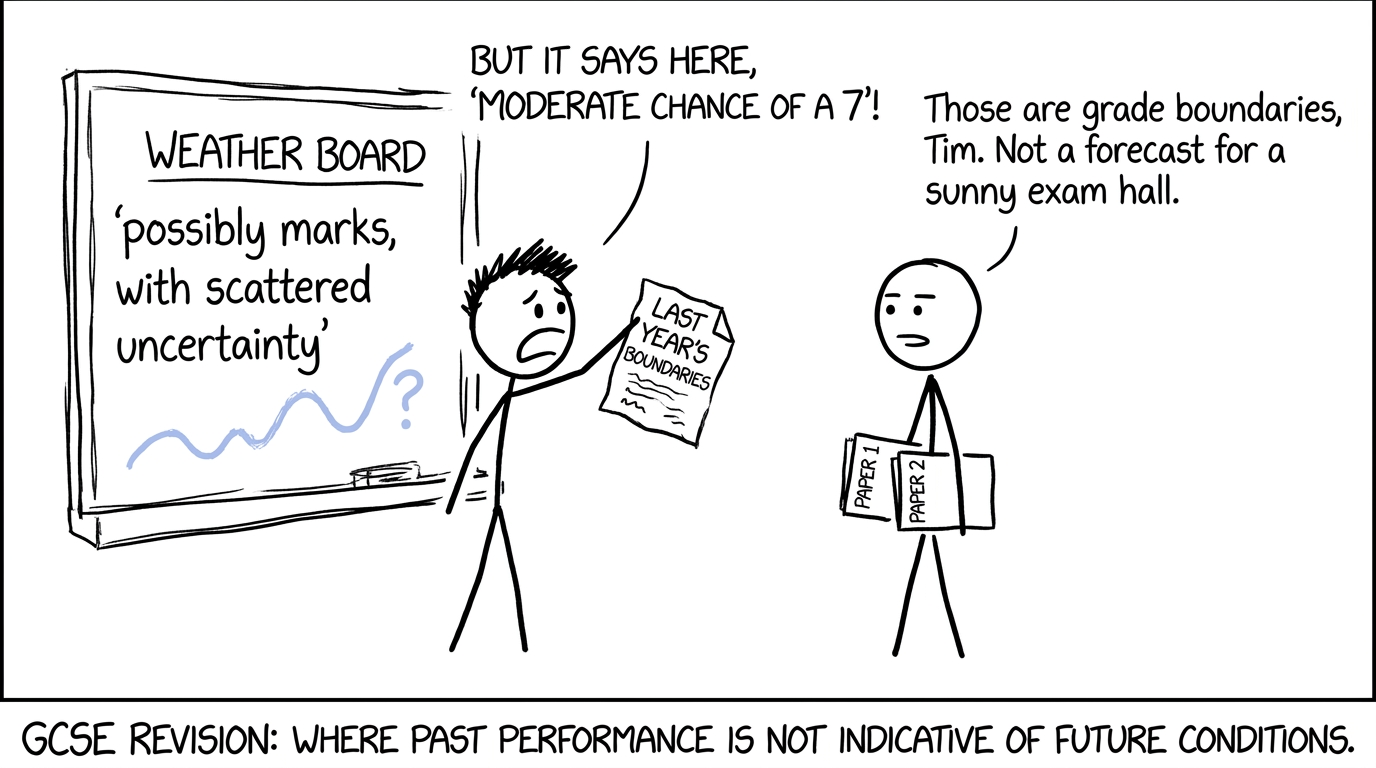 A student discovers that last year's boundary is not a weather forecast
Understanding your two-paper total
Edexcel GCSE Biology contains two externally examined papers at the same tier. Each lasts 111 hour 454545 minutes, carries 100100100 marks and contributes 50%50\%50% of the qualification.
Paper 111 and Paper 222 marks are added before the overall boundary is applied:
Qualification mark=Paper 1 mark+Paper 2 mark\text{Qualification mark}=\text{Paper 1 mark}+\text{Paper 2 mark}Qualification mark=Paper 1 mark+Paper 2 markThis means one paper can compensate for the other. A disappointing Paper 111 does not create a separate paper grade that follows you into Paper 222.
Make sure you are comparing like with like. The boundaries above apply to separate GCSE Biology 1BI01\text{BI}01BI0. They do not apply to Edexcel Combined Science, which produces a double grade through a different assessment structure. If you are uncertain, compare your entry information with the Edexcel GCSE Biology revision and papers page or visit the wider GCSE Biology revision hub.
How to use boundaries before results day
Past boundaries are useful as reference points when marking practice papers, but they should not become promises. A better revision target is to create a margin above the previous threshold rather than aiming for precisely one historical mark.
Use a simple feedback cycle:
- complete a paper under timed conditions;
- mark it strictly using the mark scheme;
- separate lost marks into knowledge, application, practical and calculation errors;
- revise the weakest topics;
- answer fresh questions and test them again.
The guide to revising GCSE Biology without wasting time explains this process, while the GCSE Biology active recall guide helps turn notes into questions you can answer from memory.
Biology also rewards mathematical accuracy through graphs, rates, percentages and data interpretation. Students balancing science with maths revision can use the GCSE Maths revision centre and GCSE predicted papers to keep those skills active.
Common grade-boundary mistakes
Treating 2025 boundaries as confirmed for 2026
They are historical evidence only. The 2026 figures cannot be known reliably until Pearson completes the awarding process.
Looking at the wrong qualification
Separate Biology, Combined Science and International GCSE Biology have different papers, totals and boundaries. Check the specification code on your entry or results slip.
Applying a boundary to one paper
Edexcel awards the qualification grade from the combined 200200200-mark total. Notional paper boundaries may support analysis, but they do not create separate certified grades.
Assuming a higher boundary means a harsher year
A higher threshold usually indicates that the assessment was less demanding overall. Boundaries move so that the grade standard remains comparable.
Turn the result into your next step
Results day ends the uncertainty, but it does not erase what you learned while preparing. Check your tier, specification and official boundary calmly. If a result affects your next course or seems unexpected, speak to your teacher or exams officer before making decisions about a review of marking.
For revision before the next assessment, begin with the Maths Genie Edexcel GCSE Biology resources. Use the revision guides to rebuild understanding, then move through practice questions, past papers, predicted papers and mark schemes. Maths Genie gives you a clear route from uncertainty to evidence: one carefully corrected answer at a time.