GCSE Active Recall: Turn Biology Notes Into Results
GCSE active recall made simple: turn Biology notes into self-testing prompts, spaced practice and exam-ready answers, with a maths-friendly method.
GCSE revision has a quiet trap: you can spend an hour reading Biology notes and feel productive, then sit a question and realise the knowledge won’t come when you call it. It’s not because you’re “bad at science”. It’s because rereading creates familiarity, not retrieval. GCSE active recall flips that. It turns your notes into prompts that force your brain to produce the answer, the same way an exam does. And if you’re a maths student, you already understand the logic: marks come from what you can do under pressure, not what looks tidy in your folder.
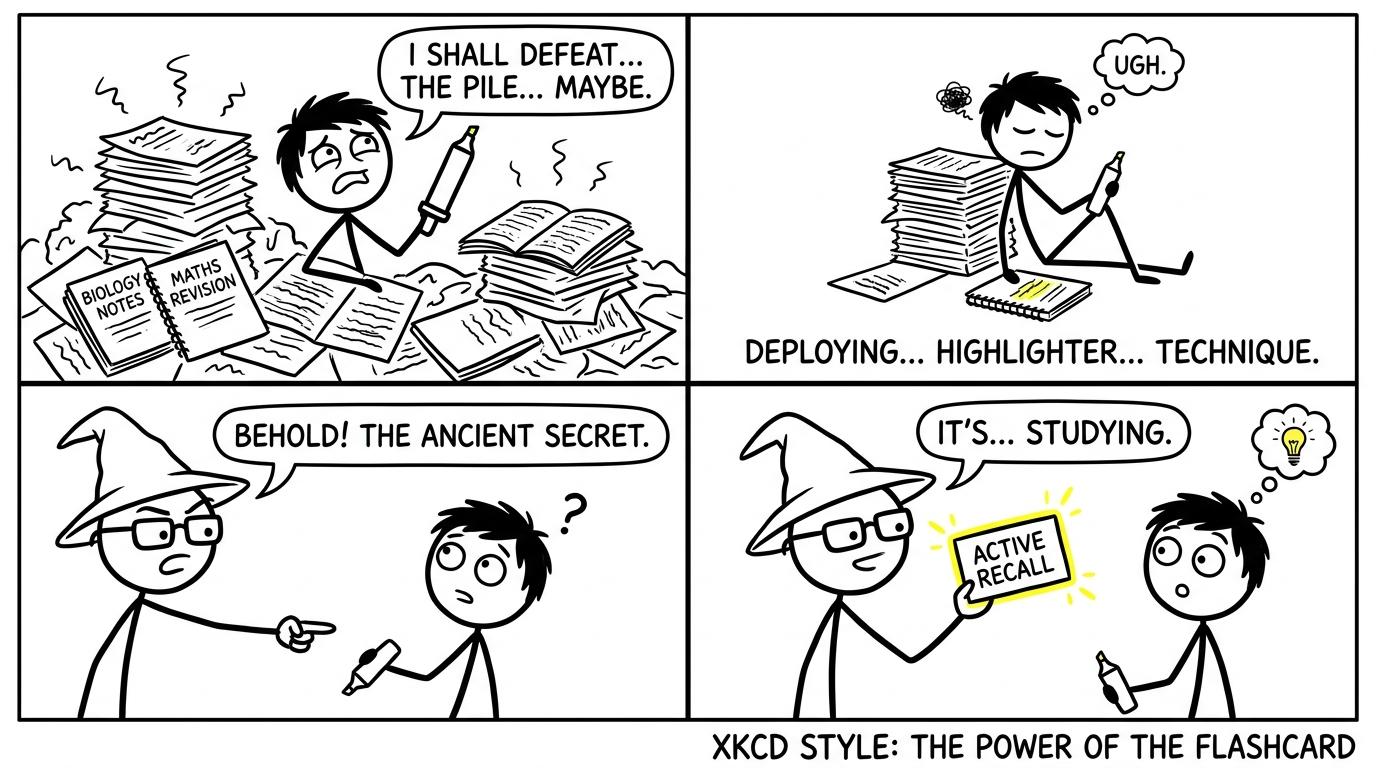 Student battles notes with Active Recall flashcard
This post shows you how to turn GCSE Biology notes into active recall, using a method that feels familiar to anyone revising maths. You’ll build prompts, schedule retrieval, and mark yourself like an examiner. Then we’ll bridge it to how you should revise maths on YesGenie, because the same principle powers both.
A quick checklist for GCSE active recall (from notes to memory)
Use this as your anchor when revision feels messy:
- Convert each page of notes into questions (not summaries).
- Answer from memory first, then check notes and mark scheme wording.
- Fix gaps immediately with a “correction line” (one sentence, one fact).
- Re-test using spaced practice (same content, longer gaps).
- Mix topics (interleaving) so recall survives context changes.
- Track what you get wrong, not what you’ve “covered”.
If you want the maths version of this structure later, you’ll use practice questions, mark schemes, and timed papers from YesGenie such as GCSE Past papers and Edexcel GCSE Maths Predicted Papers.
Why GCSE Biology notes don’t automatically turn into marks
A student can read the same GCSE Biology page three times and still lose marks. The exam isn’t asking “Have you seen these words before?” It’s asking you to retrieve and assemble ideas in the right order, with the right command words, in the right amount of detail.
That’s the same in maths. Knowing that the gradient formula exists is different from producing it under time pressure. If you can retrieve the method, you can get the marks. If you can’t, it doesn’t matter how highlighted your notes are.
So the goal of GCSE active recall is simple: practise the skill the exam rewards: retrieval.
The “maths student” method: treat Biology like a mark scheme game
In maths, you can often see exactly where marks come from: method marks for steps, accuracy marks for the final answer. Biology can feel fuzzier, but it still has mark scheme patterns: keywords, linked statements, cause-and-effect chains, and required examples.
Your job is to turn notes into prompts that force you to:
- Name the key term.
- Explain the mechanism.
- Link it to an example.
- Use the wording that earns marks.
To keep it practical, we’ll use a maths-style routine: attempt, check, correct, re-attempt.
Step 1: Convert notes into prompts (the “question factory”)
Take one page of GCSE Biology notes and rewrite it into 10-20 short prompts.
Good prompts look like exam questions, not like headings.
- Weak: “The heart”
- Better: “State the function of the left ventricle.”
- Strong: “Explain why the left ventricle has a thicker wall than the right ventricle (include pressure and distance).”
Make three types of prompts:
- Definition prompts (1 mark)
- Process prompts (2-4 marks)
- Application prompts (4-6 marks)
If you’re used to maths revision, think of it like moving from “What is Pythagoras?” to “Use Pythagoras in a non-right-angled context after you create a right angle.” On YesGenie you’d do that progression via GCSE Maths Revision lessons and then harder exam questions.
Step 2: Do “closed book attempts” in short bursts
Active recall only works if you actually try before checking.
Set a timer for 8 minutes. Cover your notes. Answer as many prompts as you can. If you get stuck, write what you think is true, then move on.
This is where the magic is: the effort of retrieval is what strengthens memory, even if you’re wrong.
Step 3: Self-mark like an examiner
Now check your notes or a mark scheme-style answer. Don’t just tick “sort of”. Be specific:
- Did you include the keyword?
- Did you link cause to effect?
- Did you include the required example?
In maths, you can practise this habit constantly by checking full worked solutions. YesGenie is built for that: topic practice, mark schemes, and video solutions (for example, June 2019 Paper 1 - Video Solutions). That “attempt then check” loop is exactly what you want in Biology too.
Step 4: Write correction lines (your personal mark scheme)
For every prompt you miss, write one correction line that is:
- as short as possible,
- as mark-scheme-like as possible,
- and precise enough to reuse.
Example format:
- “Left ventricle wall is thicker because it pumps blood at higher pressure around the whole body.”
Then retest that prompt at the end of the session.
Worked example: turning a GCSE Biology page into an active recall set
Imagine your notes are on diffusion, osmosis, and active transport. Here’s how to convert them.
Build prompts from the notes
Prompts (examples):
- Define diffusion.
- State two factors that increase the rate of diffusion.
- Define osmosis.
- Explain why plant cells become turgid in a dilute solution.
- Compare diffusion and active transport.
- Explain why active transport is needed for mineral ion uptake in roots.
Add a maths-style “rate” mini-structure
Even in Biology, students lose marks by being vague about “faster” or “slower”. You can make it concrete using a simple proportional reasoning statement.
If you use the idea “rate is proportional to surface area”, you’re rehearsing a maths relationship:
rate∝surface area \text{rate} \propto \text{surface area} rate∝surface areaSo doubling surface area doubles rate (all else equal).
If a cell’s surface area increases from 12 cm212\text{ cm}^212 cm2 to 24 cm224\text{ cm}^224 cm2, the factor change is:
2412=2 \frac{24}{12} = 2 1224=2So you can write: “The rate would double because the surface area doubled.”
That kind of clear, proportional statement often earns you the explanation mark in GCSE Biology.
Mark your answers using keywords
For the prompt “Compare diffusion and active transport”, a mark-scheme-ready answer often needs:
- Diffusion: net movement from high to low concentration.
- Active transport: movement from low to high concentration.
- Active transport: requires energy from respiration.
If you missed “energy”, your correction line becomes the smallest fix that wins marks:
- “Active transport requires energy from respiration to move substances against a concentration gradient.”
Make it stick: spacing and interleaving (without becoming a timetable robot)
Many GCSE students start strong with flashcards, then stop because it turns into admin. Keep it lightweight.
A simple spacing pattern:
- Day 1: make prompts and test.
- Day 3: retest missed prompts.
- Day 7: retest everything.
- Day 14: retest everything again.
Interleave by mixing topics: do 10 prompts on cells, then 10 on ecology, then 10 on infection. The struggle to switch is the point. It makes recall more exam-proof.
In maths, interleaving is one of the biggest grade boosters because GCSE papers mix topics constantly. YesGenie supports this naturally through mixed resources like GCSE Past papers, Resources (mini tests and 45-minute papers), and exam-board-specific sections like Edexcel GCSE Maths Revision.
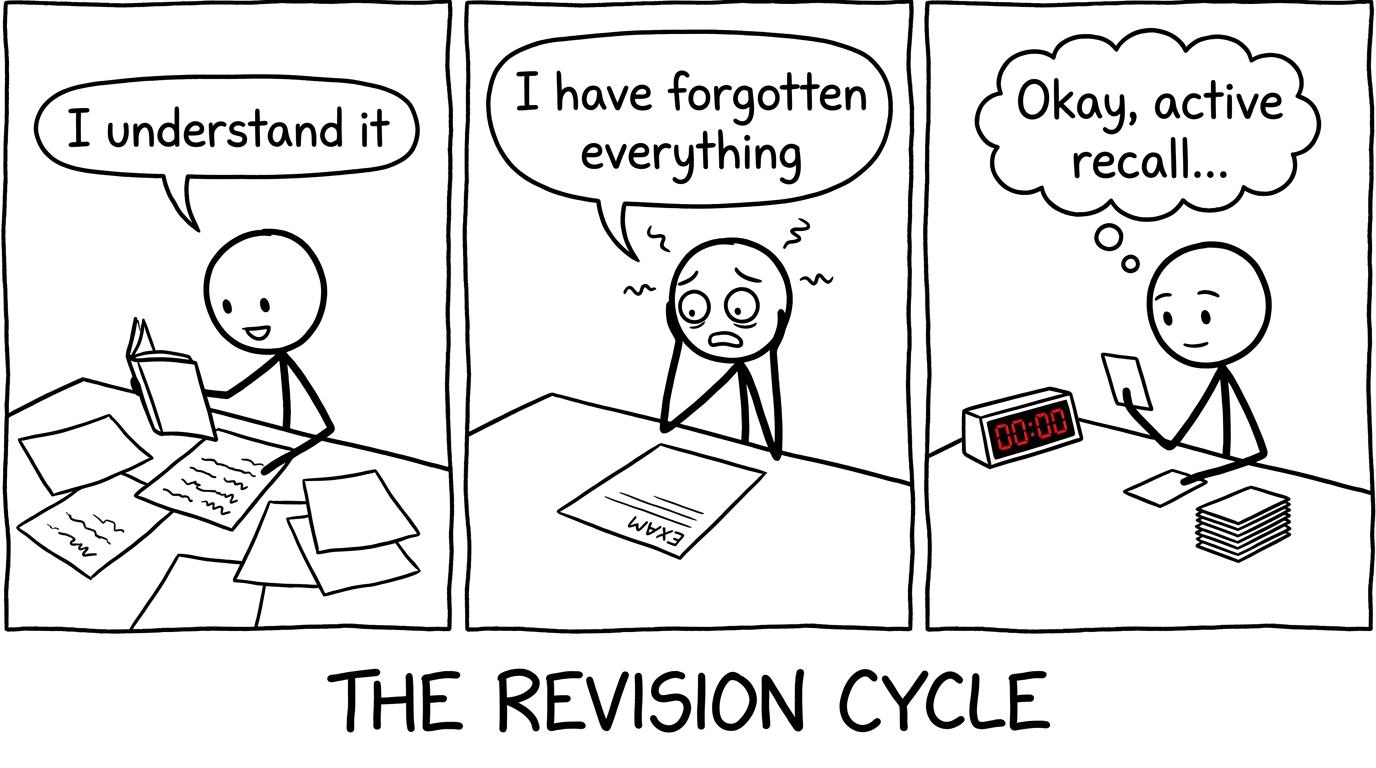 Three-panel comic about rereading vs active recall
Translating GCSE Biology active recall into GCSE maths revision (so you don’t revise in two different worlds)
If you can turn Biology notes into GCSE active recall, you can turn maths revision into something even sharper: exam-style retrieval with instant feedback.
Here’s the direct translation:
- Biology prompts == maths practice questions.
- Biology marking == maths mark scheme checking.
- Biology spacing == maths mini tests and timed papers.
- Biology correction lines == maths error log with one fixed method.
For maths, this is where YesGenie becomes the obvious home base:
- Use GCSE Maths Revision to choose a topic.
- Do targeted questions via your exam board area, e.g. Eduqas GCSE Maths Revision.
- Move to exam conditions with Edexcel GCSE Maths Past Papers or Edexcel GCSE Maths Predicted Papers.
If you’re doing A Level as well, the same philosophy scales: attempt, mark, correct, re-attempt. Try Edexcel A Level Maths Past Papers for the exam-condition version of active recall.
Common mistakes when turning GCSE Biology notes into active recall
- Turning notes into prettier notes. If you rewrite, highlight, and reorganise but never test, you’re still doing recognition practice, not recall.
- Writing prompts that are too vague. “Explain photosynthesis” is too broad; you need prompts that match 1-6 mark chunks.
- Checking too early. If you look after two seconds, you remove the retrieval effort that creates learning.
- Not marking harshly enough. GCSE mark schemes reward specific linked statements; “I kind of meant that” doesn’t get marks.
- No correction system. Without correction lines, you repeat the same mistakes politely for weeks.
- No spacing. If you only test the day you made the prompts, you’re measuring short-term memory, not exam readiness.
The quiet win: making GCSE revision feel honest
The best thing about GCSE active recall is that it tells you the truth early. You find out what you can’t yet retrieve, while there’s still time to fix it. Turning your GCSE Biology notes into prompts, then spacing and marking them, makes revision feel less like hope and more like evidence.
And if you want the same honest system for maths, YesGenie is built around that loop: revision lessons, practice questions, mark schemes, video solutions, mini tests, and timed exam practice. Start with GCSE Maths Revision, then prove it under pressure with Edexcel GCSE Maths Past Papers or Edexcel GCSE Maths Predicted Papers. Bring your error log back to the lesson pages, and repeat.
Do that, and your notes stop being a record of what you once understood. They become a machine that produces marks, in GCSE Biology, and in GCSE maths.