

GCSE Biblical Hebrew vs GCSE Modern Hebrew
GCSE Biblical Hebrew vs GCSE Modern Hebrew compared by content, papers and skills. Find which qualification suits you and plan revision alongside maths.
Choosing a GCSE can feel strangely permanent. A subject name sits in one column of an options form, yet behind it are lessons, revision sessions and exam papers that may shape the next two years. With GCSE Biblical Hebrew vs GCSE Modern Hebrew, the practical answer is this: choose Biblical Hebrew if you are stronger at close reading, grammar, translation and literary analysis; choose Modern Hebrew if you prefer listening, speaking and communicating about everyday themes.
They share a writing system and some vocabulary, but they are not interchangeable courses. Biblical Hebrew is studied as an ancient language through unseen passages and set literature. Modern Hebrew is assessed as a living language through listening, speaking, reading and writing. Your existing Hebrew, available teaching and preferred type of exam matter more than which title appears more impressive.
The quick comparison checklist
Before choosing, ask yourself:
- Do I enjoy analysing how individual words and grammatical forms work?
- Would I rather interpret historical literature or discuss contemporary life?
- Am I comfortable speaking under assessment conditions?
- Do I learn vocabulary more easily through conversation or written texts?
- Does my school offer suitable teaching for the qualification?
- Can the course fit beside my maths and other GCSE revision?
- Have I looked at the current specification and sample assessments?
A useful first move is to ask each teacher for a representative lesson and an assessment task. The experience of doing the work is more revealing than the subject title.
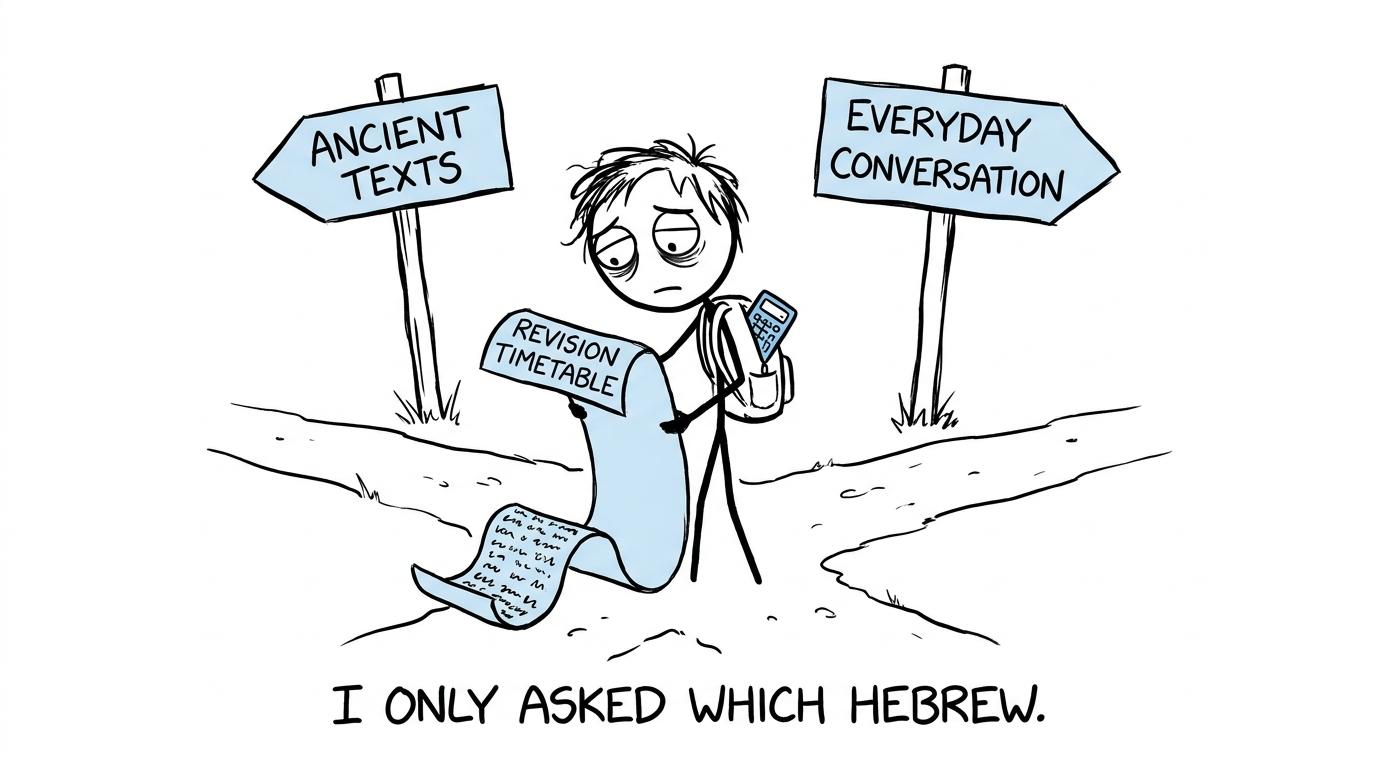 A student discovers that choosing between two Hebrew courses creates a surprisingly dramatic fork in the road
What GCSE Biblical Hebrew actually involves
Pearson Edexcel currently offers GCSE Biblical Hebrew under specification code 1BH0. It is a linear, untiered qualification, so there is no separate foundation or higher tier. Assessment consists of two externally examined components taken in the same May or June series.
The language component
Component 1 is a two-hour written examination worth 50%50\%50% of the qualification and 100100100 marks. It tests comprehension and translation using unseen Biblical Hebrew passages.
Students also encounter an optional element within the comprehension sections. They can demonstrate understanding of grammatical structures or translate simple English sentences into pointed, or vocalised, Biblical Hebrew. The precise route prepared by a centre should be discussed with the teacher before enrolling.
This component suits students who enjoy:
- recognising roots, forms and grammatical patterns;
- reading slowly and precisely;
- using context to interpret an unfamiliar passage;
- translating accurately into natural English;
- checking small details rather than relying on the general idea.
There is no speaking or listening paper. That can be attractive if oral performance is not your strength, but it does not make the subject easy. The challenge is concentrated in textual accuracy.
The literature component
Component 2 is another two-hour written examination worth the remaining 50%50\%50% and 100100100 marks. Students study two prescribed set texts and must understand their content, context, grammar and literary features. They translate extracts, analyse material and construct evidence-based responses.
Across the full qualification, the official assessment objectives place 50%50\%50% on language knowledge, 25%25\%25% on knowledge and understanding of literature, and 25%25\%25% on analysing, evaluating and responding to literature.
Set texts and administrative details can be updated, so students should use the specification and information supplied by their centre for their examination series. Old notes may still teach useful language, but they are not a safe guide to current prescribed content.
What GCSE Modern Hebrew actually involves
AQA currently offers GCSE Modern Hebrew under specification code 8678. It is a linear modern foreign language qualification with foundation tier, covering grades 111 to 555, and higher tier, covering grades 444 to 999. A student must take all four assessments at the same tier and in the same examination series.
The course is organised around broad themes including identity and culture, local and global areas of interest, and current and future study and employment.
Four distinct language skills
Listening, speaking, reading and writing each contribute 25%25\%25% of the GCSE.
The listening paper tests understanding of spoken Modern Hebrew. Speaking includes a role-play, a photo-card task and a general conversation, with preparation and assessment timings depending on tier. Reading includes comprehension and translation from Modern Hebrew into English. Writing includes structured responses and translation from English into Modern Hebrew.
Modern Hebrew is likely to fit you if you enjoy:
- responding in real time;
- learning language through sound and conversation;
- expressing opinions and giving reasons;
- understanding texts about contemporary situations;
- writing for practical communicative purposes;
- building competence across several different skills.
The four-paper structure spreads the assessment across different forms of performance. A weaker speaking result does not define the entire qualification, but speaking and listening cannot be avoided.
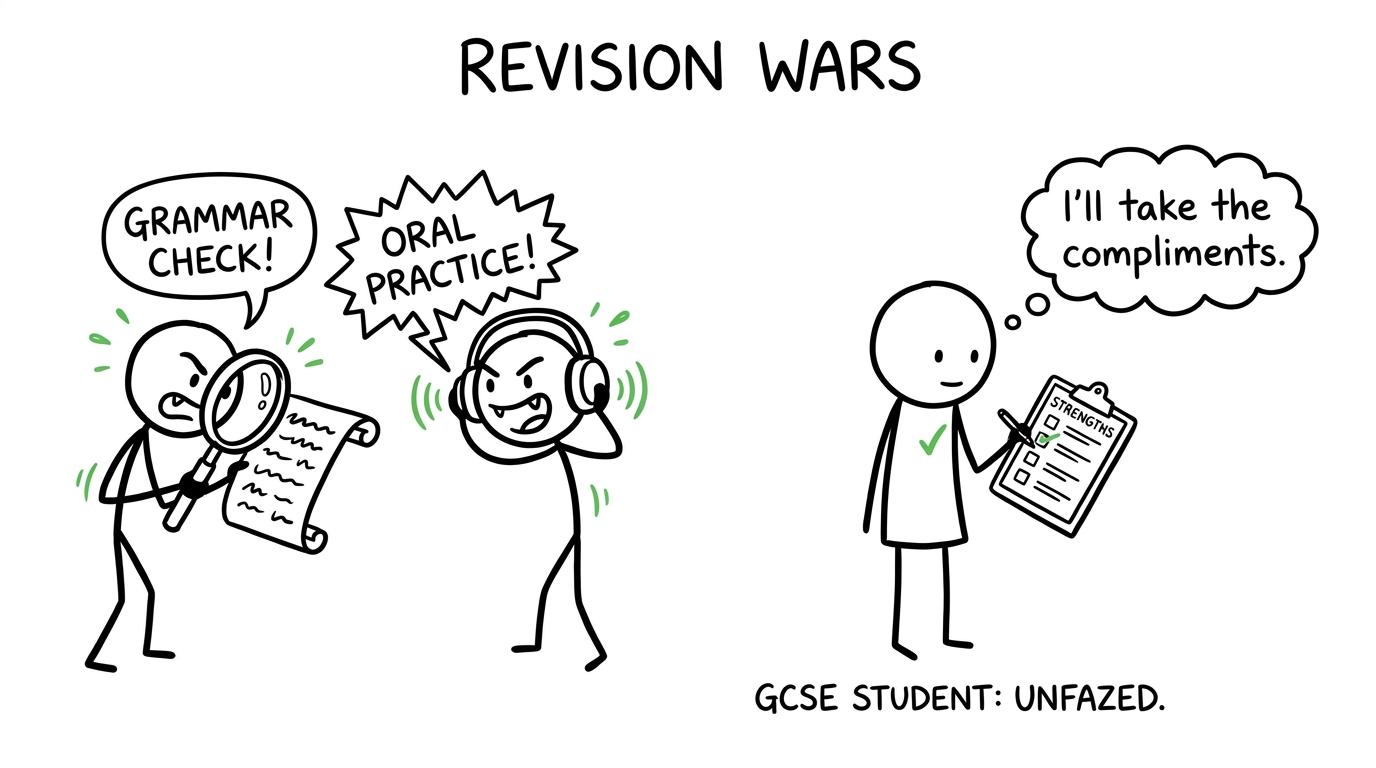 Two revision monsters represent detailed ancient texts and modern spoken communication while a student checks personal strengths
GCSE Biblical Hebrew vs GCSE Modern Hebrew: the real differences
The deepest difference is not simply old language against new language. It is the kind of thinking each course rewards.
Biblical Hebrew asks you to pause. A word ending, sentence structure or repeated phrase may carry much of the meaning. Modern Hebrew asks you to move between receptive and productive skills: hearing, speaking, reading and writing.
Grammar and vocabulary
Both courses require disciplined vocabulary learning, but the vocabulary serves different worlds. Biblical Hebrew focuses on the language and contexts of biblical texts. Modern Hebrew covers contemporary topics and everyday communication.
The grammar is related historically, yet pronunciation, vocabulary, usage and assessment conventions differ. Knowing one may provide a helpful foundation, but it does not automatically prepare you for the other specification.
Translation and interpretation
Translation is central to Biblical Hebrew. You must interpret unseen material and produce accurate English while showing control of grammar. The literature paper then adds analysis and evaluation.
Modern Hebrew includes translation in the reading and writing papers, but it is one part of a wider communicative course. You must also understand recorded speech and produce spoken responses.
Tiering and exam structure
Biblical Hebrew is untiered. Every candidate takes the same two written papers, each lasting two hours.
Modern Hebrew is tiered. Foundation and higher candidates face different levels of demand, timings and task lengths, while all four skills retain equal weighting. Tier decisions should be made with a teacher who knows your current attainment.
Transferable strengths
Biblical Hebrew may appeal to a student who likes algebraic structure: identify the form, apply a rule, check the result and explain what the evidence supports. Modern Hebrew may appeal to someone comfortable switching rapidly between representations, rather like moving between a graph, a table and a written interpretation.
These are comparisons, not promises. Enjoying algebra does not prove that Biblical Hebrew is right for you, and confidence in discussion does not guarantee high speaking marks. Use actual sample tasks to test the fit.
Which Hebrew GCSE fits your strengths?
Choose Biblical Hebrew if most of these statements sound like you:
- I prefer written examinations to speaking assessments.
- I enjoy detailed grammar and translation.
- I can retain forms and vocabulary accurately.
- I like analysing literature and supporting conclusions with evidence.
- I am willing to revisit the same texts closely.
Choose Modern Hebrew if you are more likely to say:
- I want to communicate in a living language.
- I enjoy listening and conversation.
- I can recover when I do not understand every word.
- I like discussing familiar, contemporary themes.
- I want speaking, listening, reading and writing to contribute equally.
Existing experience matters. A student who speaks Modern Hebrew at home may find parts of AQA Modern Hebrew familiar, although formal accuracy and examination technique still require preparation. Experience reading biblical texts may make Edexcel Biblical Hebrew more accessible, but students must still satisfy the specification's grammatical and analytical demands.
Course access may settle the decision. A qualified teacher, reliable feedback and a centre prepared to enter you correctly are more valuable than choosing a course that looks ideal on paper but is difficult to study properly.
Balancing Hebrew with GCSE maths revision
The hidden cost of any option is time. Four hours spent rescuing one subject cannot also be spent on quadratic equations, ratio or geometry. A good choice should be sustainable across your whole GCSE timetable.
Begin with the GCSE Maths Revision hub, where you can select your exam board and find free lessons, practice questions, papers and solutions. Edexcel, AQA, OCR and Eduqas maths students follow common national content, but paper structures differ, as the GCSE maths topics by board and tier guide explains.
Use short, specific blocks. A Hebrew session might target vocabulary retrieval or one literature paragraph. A maths session might target one weak skill followed by exam questions. The GCSE revision timetable guide can help you build a realistic weekly pattern rather than an ambitious plan that collapses after three days.
For maths, follow a repeatable cycle:
- learn or revisit one method;
- answer practice questions without notes;
- check the mark scheme;
- record the exact reason for each lost mark;
- retest the skill later.
The same principle works in either Hebrew course. Feedback matters most when it changes the next attempt. MathsGenie's guide to using GCSE mark schemes as a revision coach and its advice on using past papers properly show how to turn errors into a focused revision list.
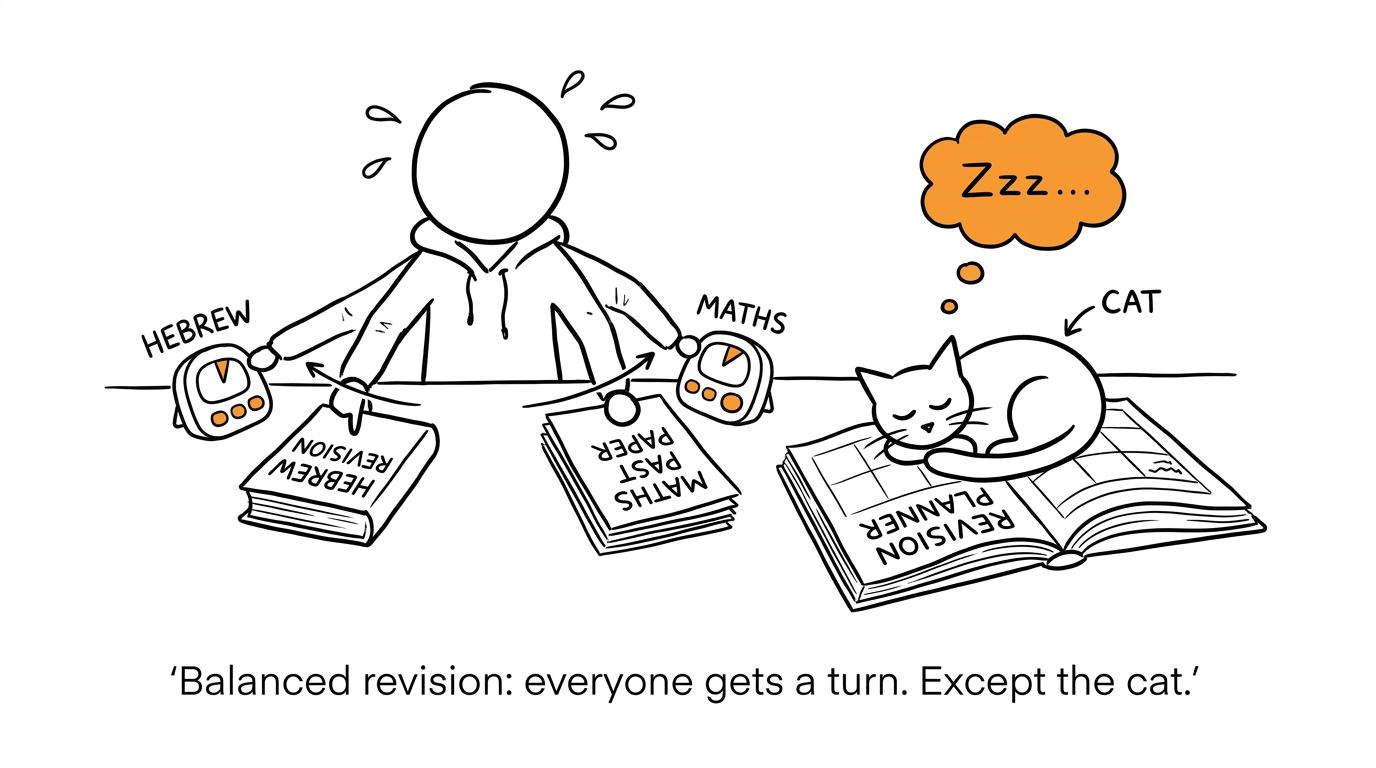 A student balances Hebrew revision with a maths paper while a cat takes complete control of the revision planner
Common mistakes when making the choice
Assuming Biblical Hebrew is simply formal Modern Hebrew
The courses are related, but they assess different language forms, contexts and skills. Compare the current specifications and sample papers rather than relying on the shared alphabet.
Choosing only to avoid speaking
No speaking paper may make Biblical Hebrew more suitable, but it replaces oral assessment with sustained demands in grammar, unseen translation and literature. Choose it because those tasks fit your strengths, not because one Modern Hebrew component feels uncomfortable.
Ignoring the literature requirement
Biblical Hebrew is not solely a translation qualification. Half of the Edexcel GCSE is a literature component requiring knowledge, analysis and evaluation of set texts.
Underestimating Modern Hebrew speaking
Conversation ability helps, but examination speaking also rewards relevant development, accuracy and controlled responses to the task. Informal fluency and exam readiness are not identical.
Using out-of-date materials
Set texts, instructions and assessment arrangements must be checked for your series. Your school and the current awarding-body specification should guide Hebrew preparation.
Letting one subject consume the timetable
Protect regular maths practice even when Hebrew has an approaching assessment. Start with shorter tasks, then introduce timed papers using the guidance on when to begin GCSE past papers. Near the examinations, the GCSE maths exam-week checklist can keep revision calm and selective.
Make the choice by testing the work
The best subject is not the one that sounds more unusual or seems easier from a distance. It is the one whose daily work fits how you learn.
Ask about teaching access, try representative tasks and inspect the papers. If close reading, grammatical precision and literary analysis draw you in, Biblical Hebrew is probably the stronger match. If you want to listen, speak, read and write about modern life, Modern Hebrew is likely to offer the more natural route.
Then make room for the rest of your GCSEs. Use MathsGenie as your free maths revision base: learn through revision lessons, build fluency with practice questions and mini tests, and develop exam technique with past papers, predicted papers, mark schemes and video solutions. Choose your Hebrew course thoughtfully, but keep your whole revision plan moving.










