GCSE Biblical Hebrew 5 to 8: A Grade-Raising Plan
GCSE Biblical Hebrew 5 to 8: discover how sharper translation, textual evidence and timed practice can turn a secure pass into strong Grade 8 performance.
A Grade 5 in GCSE Biblical Hebrew usually means the foundations are there. You can follow much of an unseen passage, recognise familiar forms and explain the broad meaning of a set text. But marks still escape through imprecise translation, uncertain grammar or literature answers that describe rather than analyse.
Moving from GCSE Biblical Hebrew 5 to 8 is therefore not about learning three times as much. It is about becoming more exact. You need to identify how forms create meaning, preserve who did what to whom in translation, select precise textual evidence and perform those skills under time pressure.
There is no fixed national mark that always separates the grades because grade boundaries are set after each examination series. Yet the qualities behind stronger performance are clear: secure language knowledge, detailed textual understanding and reasoned analysis supported by evidence.
Your Grade 5 to Grade 8 checklist
Use this as your starting map:
- Diagnose lost marks by skill, not simply by paper.
- Make vocabulary retrieval fast and contextual.
- Analyse verb forms, suffixes and syntax before translating.
- Produce accurate, natural English without changing the sense.
- Know both set texts as connected narratives, not isolated extracts.
- Explain literary effects rather than merely spotting them.
- Support conclusions with precise textual evidence.
- Practise complete sections under the official time limit.
- Use mark schemes to improve the next response, not just score the last one.
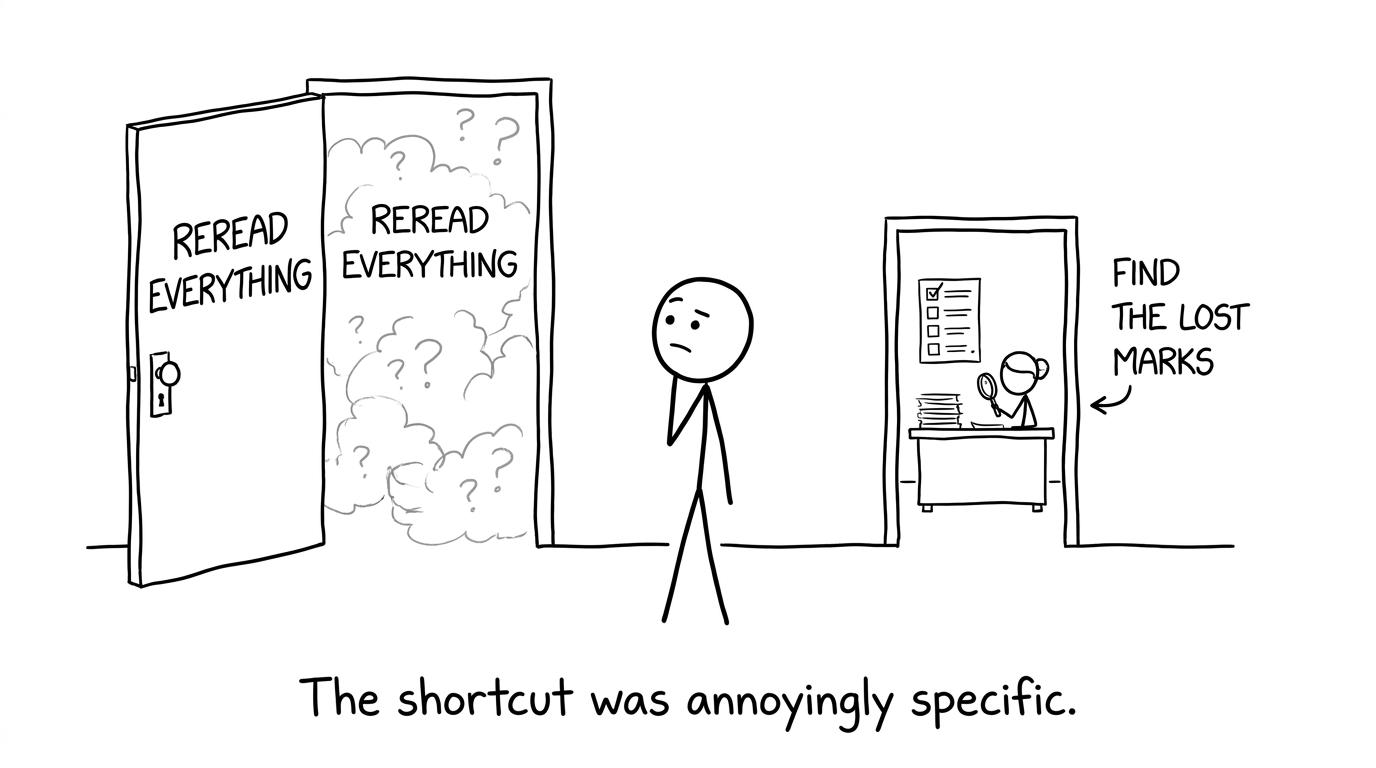 A student discovers that finding specific lost marks is the useful revision shortcut
Understand what the qualification rewards
The current Pearson Edexcel GCSE in Biblical Hebrew has two externally examined components. Component 1 is Language and Component 2 is Literature. Each lasts two hours, carries 100100100 marks and contributes 50%50\%50% of the qualification.
Across the complete qualification, the assessment objectives are:
- AO1, language: 50%50\%50%
- AO2, knowledge and understanding of literature: 25%25\%25%
- AO3, analysis, evaluation and response: 25%25\%25%
The Language paper tests comprehension and translation of unseen passages. For optional questions, students show their understanding of grammatical structures or translate simple English sentences into pointed Biblical Hebrew. Confirm with your teacher which route you have prepared.
The Literature paper tests both prescribed texts through short responses, set-text translation, extended writing and a synoptic question. For examinations from 202620262026 to 202820282028, Pearson specifies Genesis chapters 414141 to 434343, concerning Joseph's rise to power, and Kings chapters 444 to 777, concerning the miracles of Elisha. Always revise from the specification for your own examination year because set texts can change.
Unlike GCSE maths, where students may sit Edexcel, AQA, OCR or Eduqas papers at foundation or higher tier, the current GCSE Biblical Hebrew qualification is Pearson Edexcel and is not divided into tiers. That makes specification accuracy especially important.
What separates a Grade 5 from a Grade 8?
A grade is awarded from performance across the whole qualification, so no single habit guarantees a Grade 8. The following differences are practical tendencies, not official grade descriptors.
| At around Grade 5 | Moving towards Grade 8 |
|---|---|
| Understands the general narrative | Preserves precise relationships, emphasis and sequence |
| Recognises common vocabulary | Chooses the correct meaning for the context |
| Identifies some grammatical forms | Explains how morphology and syntax determine meaning |
| Produces a broadly sensible translation | Produces accurate, coherent English with few significant omissions |
| Spots a literary feature | Explains its effect and relevance to the question |
| Retells the set text | Selects evidence and builds a reasoned interpretation |
| Revises familiar passages repeatedly | Alternates retrieval, unseen work and timed responses |
The shift is from recognition to control. At Grade 5, you may recognise a root. At Grade 8, you are more likely to account for its stem, aspect, person, number, gender, attached elements and role in context before committing to an English meaning.
Make language accuracy your first priority
Language represents half of the qualification. It is also where small misunderstandings can alter an entire sentence.
Pearson's translation guidance distinguishes between errors that preserve the sense and errors that compromise it. Aspect or tense mistakes can be major. Misreading a binyan can also become a major error when, for example, an active meaning replaces a passive or causative one and changes who performs the action. Incorrect pronouns, syntax and omissions can cause the same problem.
Build vocabulary in context
A vocabulary card should do more than pair one Hebrew word with one English word. Record its root, likely meanings, common forms and an indication of the contexts in which those meanings occur.
Then test in both directions. Seeing the answer and thinking “I knew that” is recognition; producing it without a prompt is retrieval. The same principle appears in MathsGenie's advice on stopping forgotten GCSE content: attempt first, check second, then revisit after a gap.
Parse before you translate
Before polishing the English, establish the grammatical structure:
- locate the main verb or verbal form;
- identify its root and binyan;
- determine aspect, person, number and gender;
- identify the subject and object;
- inspect prefixed and suffixed elements;
- check whether word order or a construction adds emphasis;
- notice whether a conjunction changes narrative sequence.
An examiner report has specifically highlighted confusion around conversive forms, binyanim, suffixes and context-dependent vocabulary. These are not decorative technicalities. They decide the sentence's sense.
Write clear English
Literal analysis comes first, but the submitted translation should be intelligible English. Do not smooth it so aggressively that you remove emphasis, change the subject or conceal an uncertainty. Equally, do not leave an awkward sequence merely because it follows Hebrew word order.
A useful final check is: Have I preserved the meaning, relationships and emphasis while writing coherent English?
Turn set-text knowledge into analysis
Knowing what happens is necessary, but a Grade 8 response must do something with that knowledge.
For each episode, create a compact text map containing:
- its position in the wider narrative;
- motives, decisions and changes in power;
- significant words or phrases;
- relevant grammatical details;
- literary features and their effects;
- ideas, values and social practices shown within the prescribed books;
- links and contrasts with the other set text.
Official subject content makes an important distinction: Biblical Hebrew specifications do not require study beyond the books from which the set texts are taken, and comparison between the ancient and modern worlds is not required. Avoid importing broad historical claims that cannot be supported from the permitted material.
Move from feature spotting to explanation
Naming repetition, direct speech, word order, sound, clause length or another literary device is only the beginning. A stronger paragraph explains why the feature matters at that moment and how it shapes the reader's understanding.
Use a simple mental chain:
claim: evidence: language or literary detail: effect: conclusion
The conclusion should answer the wording of the question. It should not merely repeat the claim.
Prepare for comparison
The synoptic task rewards controlled selection. Build comparison sheets organised by themes rather than trying to memorise a universal essay. Compare how each text presents leadership, power, recognition, danger, obedience, provision or another specification-relevant idea. Record both similarities and differences, then attach precise evidence.
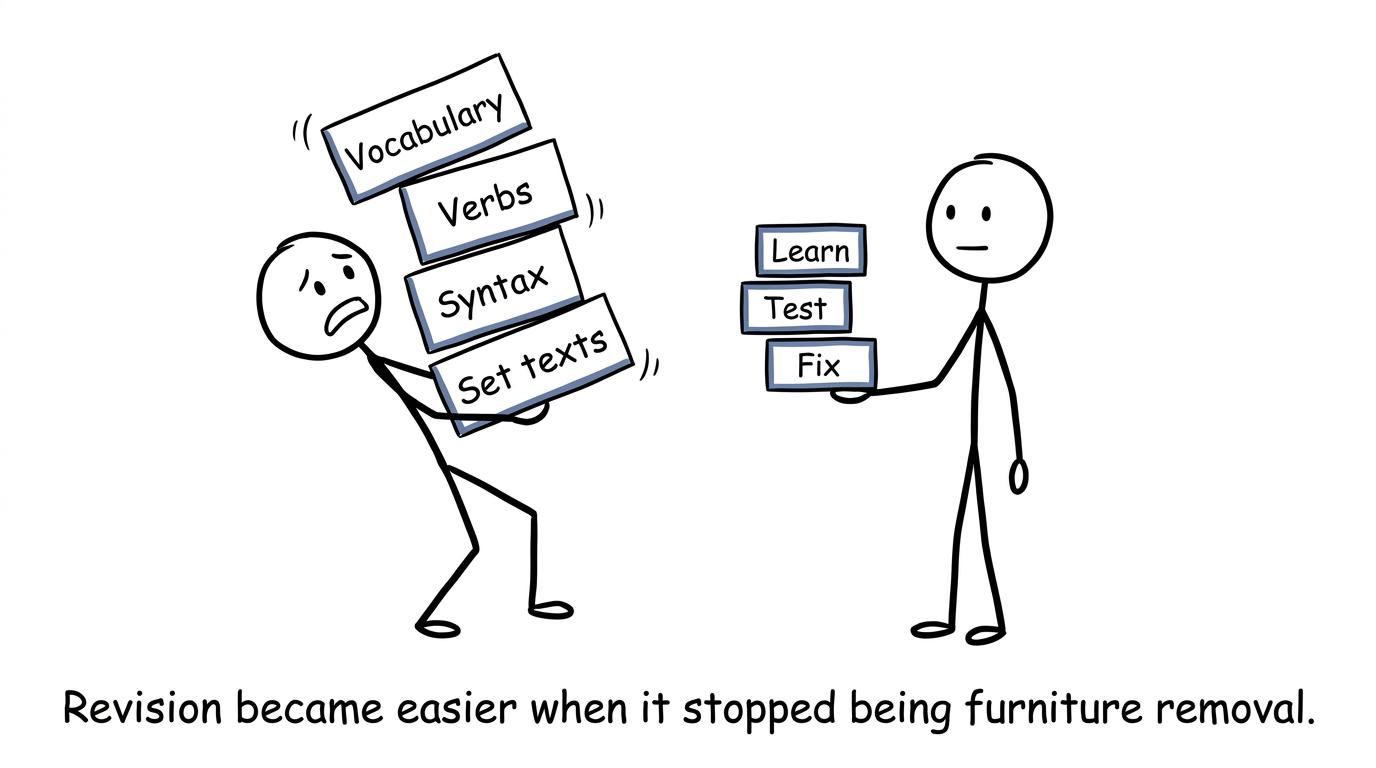 A large tower of revision cards becomes three manageable boxes labelled Learn, Test and Fix
Use a marks-first revision cycle
The most productive routine is short enough to repeat:
- Attempt: complete an unseen translation, comprehension set or literature response without notes.
- Mark: apply the official mark scheme strictly.
- Classify: label each lost mark as vocabulary, morphology, syntax, translation, textual recall, evidence, analysis or timing.
- Repair: revise the smallest skill responsible.
- Retest: attempt fresh material after a delay.
This is the same diagnostic logic used in MathsGenie's guide to finding your weakest GCSE topics. A total mark tells you where you are. An error category tells you what to do next.
Keep an error log with four columns: task, lost mark, cause and next action. “Translation weak” is too broad. “Misidentified the subject because I ignored the verb ending” is useful.
A weekly plan that moves the grade band
A balanced week might contain:
- Session A: vocabulary retrieval and parsing drills;
- Session B: an unseen passage followed by detailed correction;
- Session C: set-text recall and one analytical response;
- Session D: a timed mixed section and error-log review;
- Short revisits: previously missed forms or quotations on later days.
Spacing matters because familiarity can imitate mastery. MathsGenie's one-month GCSE revision plan and GCSE revision timetable show how to combine retrieval, targeted practice and timed papers without turning every evening into a marathon.
Start timed work before you feel completely ready. The guide to when to begin GCSE past papers explains the central principle: papers are most valuable while there is still time to respond to what they reveal.
For Biblical Hebrew, use official Pearson papers, sample assessment materials and mark schemes supplied by your school or exam board. MathsGenie does not currently provide Biblical Hebrew papers, but its free GCSE maths revision hub and Edexcel maths past-paper system model the same effective loop: attempt, mark, diagnose, repair and repeat.
Common mistakes that hold students at Grade 5
Translating the root but ignoring the form
A familiar root can create false confidence. Check the complete word, including the binyan, aspect, person, number, gender, prefixes and suffixes.
Letting Modern Hebrew override Biblical Hebrew
Pearson examiner feedback has warned that Modern Hebrew habits can disadvantage candidates, particularly in composition and when Biblical constructions differ. Treat the specification's grammar and vocabulary as the authority.
Paraphrasing before securing the sense
A fluent English sentence earns little if it changes agency, sequence or emphasis. Establish the grammar first; improve the style second.
Retelling instead of analysing
Narrative knowledge answers “what happened”. AO3 asks what the evidence suggests, how the writing creates its effect and what conclusion follows.
Memorising one essay
A prepared essay rarely matches the precise command word and focus. Memorise evidence, comparisons and analytical connections instead.
Marking generously
If the mark scheme requires distinct evidence or explanation, do not award yourself a mark for something you merely intended. Strict marking now is kinder than surprise later.
Spending too long on one question
Use the marks shown as a guide to time, move on when necessary and return later. Practise that decision before the examination. Even MathsGenie's calm night-before GCSE plan rests on the same idea: fix known patterns rather than attempting one final, unfocused content sweep.
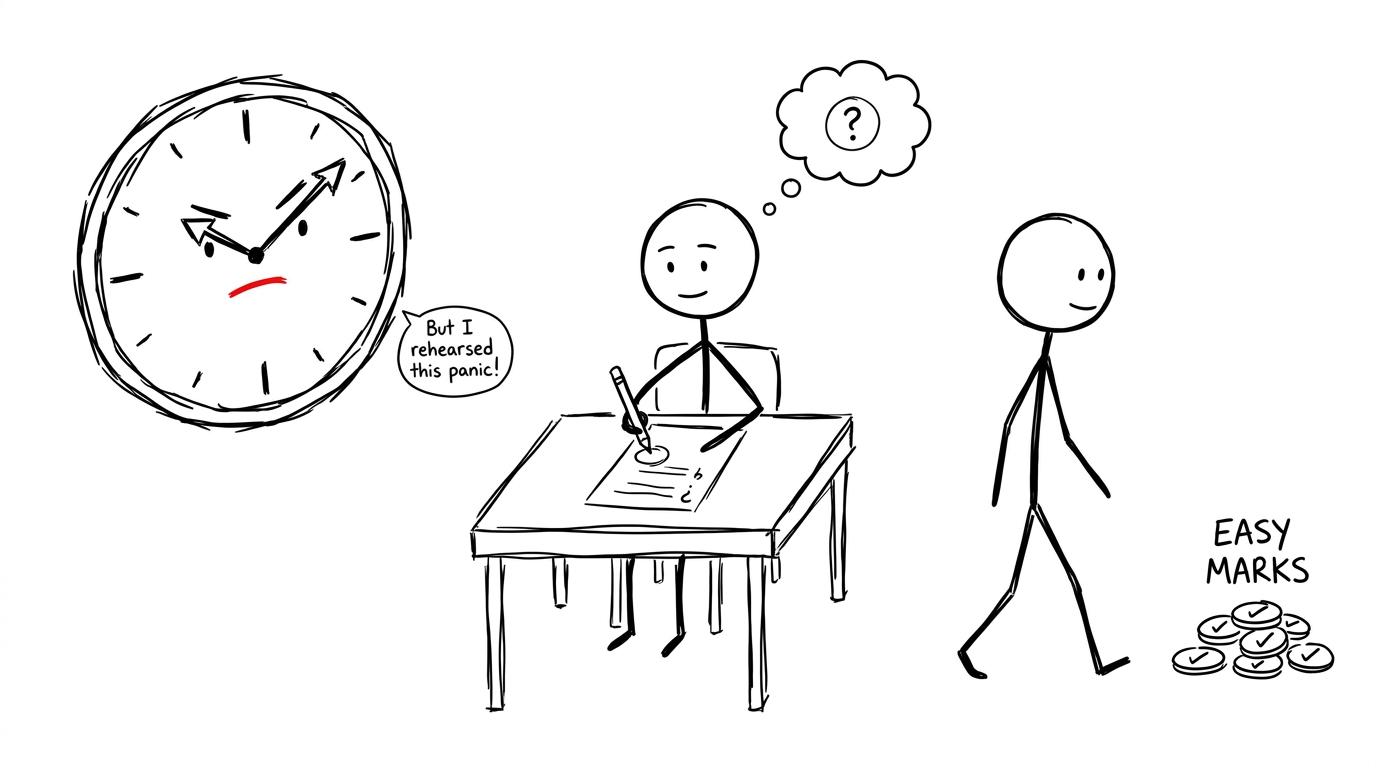 A dramatic exam clock is disappointed when a student calmly moves on and banks easier marks
Precision is the real grade-raising habit
The journey from Grade 5 to Grade 8 is less dramatic than it looks from a distance. It is built from repeated, precise corrections: one suffix noticed, one verb form properly parsed, one quotation attached to a conclusion and one timed section reviewed honestly.
Begin with a diagnostic Language section and a Literature response. Classify every lost mark, choose the two most expensive weaknesses and build next week's revision around them. Then retest.
For your wider GCSE preparation, make MathsGenie's free GCSE maths resources your revision base. Use revision lessons and practice questions to rebuild weak skills, mini tests to check retrieval, and past papers, predicted papers, mark schemes and video solutions to develop exam performance. Different subjects reward different knowledge, but improvement follows a remarkably consistent rhythm: learn, practise, mark, fix and return.