

GCSE Bengali: No Background Knowledge Needed?
GCSE Bengali no background knowledge? See if starting from scratch is realistic, what AQA assesses and how to catch up alongside your maths revision.
A new GCSE can look deceptively manageable from a distance. You see another subject on the timetable, imagine learning some vocabulary, and wonder whether it could become an extra qualification. Then you open a paper and meet an unfamiliar script, spoken questions and a translation task.
So, is GCSE Bengali with no background knowledge realistic? Officially, yes: the current AQA GCSE Bengali specification states that there are no previous learning requirements. In practice, starting completely from scratch is ambitious because you must develop listening, speaking, reading and writing, including control of Bengali script. It may be possible if your school permits the entry, you have enough preparation time and you can access consistent teaching or fluent support.
The important distinction is between being allowed to start and being ready to succeed. This guide will help you judge both while protecting the revision time you need for GCSE maths and your other subjects.
The quick reality check
Before committing, confirm that you can answer yes to most of these questions:
- Will your school or exam centre enter you for AQA GCSE Bengali?
- Can the centre arrange, supervise and authenticate the speaking assessment?
- Do you know whether you would enter Foundation or Higher tier?
- Can you already recognise Bengali script, or begin learning it immediately?
- Do you have a teacher, tutor or fluent speaker who understands standard Bengali?
- Can you practise listening, speaking, reading and writing every week?
- Is there enough time left before the exam series to develop all four skills?
- Can you add Bengali without weakening essential maths, English and science revision?
If several answers are no, pause before entering. That is not pessimism. It is useful information arriving early enough to influence your decision.
Can you officially take GCSE Bengali without prior study?
AQA currently offers GCSE Bengali under specification code 863886388638. Its published administration information says there are no previous learning requirements. However, entry requirements for a course remain at the discretion of individual schools and colleges.
That means the exam board does not require you to prove that you studied Bengali earlier, speak it at home or completed a particular course. Your school can still decline an entry if it cannot provide teaching, conduct the speaking assessment or satisfy the necessary exam arrangements.
Private candidates may also be accepted through an approved centre, but finding a centre is not automatic. The centre must be willing and able to handle the speaking component. Speak to an exams officer before paying for tuition or building a long revision plan.
You should also confirm the qualification name. AQA GCSE Bengali is not the same as Pearson Edexcel International GCSE Bangla. They have different assessment structures. Never prepare from materials labelled only “Bengali GCSE” until you have checked the board, specification code and tier.
What does AQA GCSE Bengali assess?
The qualification is linear, so the assessments are completed at the end of the course in the same exam series. AQA assesses four skills:
- listening
- speaking
- reading
- writing
Each skill contributes approximately rac{1}{4} of the overall qualification. This matters because strength in one area cannot completely hide the absence of another. Conversational confidence does not replace reading and writing; accurate writing does not remove the need to understand spoken Bengali.
Foundation tier covers grades 111 to 555, while Higher tier covers grades 444 to 999. You must take all four components at the same tier. The decision should therefore reflect your performance across the whole language, not simply the paper you find easiest.
The speaking assessment includes a role-play, a photo-card discussion and a general conversation. Reading includes comprehension and translation from Bengali into English. Writing requires communication in Bengali and includes translation from English into Bengali. Dictionaries are not permitted during the speaking test or its supervised preparation period.
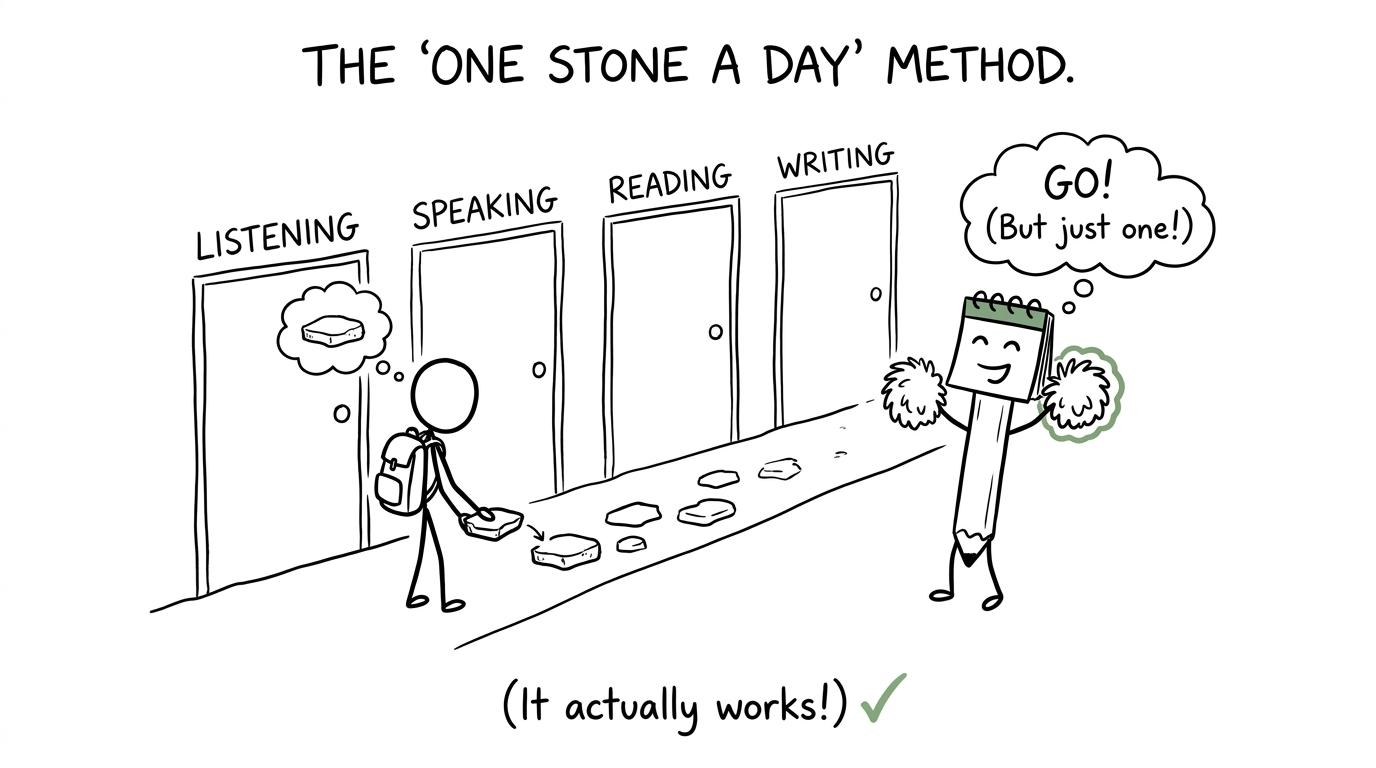 A student approaches the four GCSE Bengali skills one step at a time
Why starting from scratch is difficult
Bengali script is a foundational skill
A learner with no background knowledge must first become comfortable with a new writing system. This includes recognising characters, writing them clearly, understanding how sounds are represented and dealing with combined forms.
Script knowledge cannot be postponed until the final revision phase. It is the doorway to vocabulary lists, reading questions, written answers and translation. If decoding each word takes too long, even familiar vocabulary can feel unknown under timed conditions.
Aim first for accurate recognition and formation rather than speed. Fluency grows from frequent contact. Short daily sessions are generally more manageable than trying to rebuild the script during one long weekend session.
Spoken and written Bengali may feel different
Some students hear Bengali at home but have limited experience of reading or formal writing. Others know a regional or family variety that does not always match the standard language expected in assessment materials.
A genuine beginner faces a larger distance: new sounds, sentence patterns, vocabulary and script all develop together. This does not make progress impossible, but it makes informed feedback essential. A fluent relative may help with conversation, while a teacher familiar with the specification can identify whether your language is suitable for an assessed response.
Four skills compete for limited revision time
Vocabulary lists alone can create false confidence. Recognising a word on a flashcard is not the same as hearing it at normal speed, using it spontaneously or writing it accurately.
Your weekly plan therefore needs all four skills. If Bengali is added late, it can also consume time intended for compulsory subjects. Use the MathsGenie GCSE revision hub to keep your maths work organised rather than allowing the new subject to push it aside.
How to catch up fast if your school allows it
“Fast” should mean removing wasted effort, not pretending that fluency can be rushed. The best plan builds the foundations in the right order and tests progress honestly.
Begin with the specification and an entry decision
Ask your teacher or exams officer to confirm:
- the exam board and specification code
- the proposed tier
- the speaking assessment arrangements
- the entry deadline used by your centre
- who will teach and assess your preparation
- which official sample and past materials you should use
Do this first. A beautifully organised revision plan has little value if the centre cannot enter you or conduct the speaking assessment.
Build script and sound knowledge together
Learn characters with their sounds rather than treating handwriting and pronunciation as separate courses. Practise reading aloud, hearing short phrases and writing familiar words from memory.
Daily contact matters more than occasional intensity. A useful early routine might include:
- script recognition and handwriting
- listening and repetition
- retrieval of high-frequency vocabulary
- one short reading passage
- one brief spoken response
Keep sessions focused enough to repeat. The aim is to reduce the mental effort required to decode the language, leaving more attention available for meaning.
Organise vocabulary by specification theme
AQA groups content around themes involving identity and culture; local, national, international and global areas of interest; and current and future study and employment.
Build vocabulary in connected groups, then attach language functions to it: describing, giving an opinion, explaining a reason, comparing, referring to different time frames and asking a question. Exam performance depends on doing something with vocabulary, not merely recognising a list.
Practise every assessed skill from the beginning
Do not wait until your vocabulary feels “finished”. It never will. Use short, accessible tasks early:
- listen for key details
- read for the main idea
- answer aloud in complete sentences
- write brief responses accurately
- translate short, specification-appropriate material
Move gradually towards timed official assessment materials. Mark schemes are especially useful because they reveal whether marks reward communication, accuracy, range or coverage of required content.
Get regular corrective feedback
Without feedback, beginners can repeat the same pronunciation, spelling or grammar error until it becomes automatic. Arrange frequent checks from someone who knows standard Bengali and, ideally, the AQA course.
For speaking, practise responding to unpredictable follow-up questions rather than memorising one polished speech. For writing, ask for corrections that explain the pattern behind an error. A corrected page is useful; understanding why it was corrected is better.
Protecting your GCSE maths revision
An extra language should expand your options, not quietly damage your performance elsewhere. Treat available revision time like a budget.
Start with a fixed weekly allocation for compulsory subjects. A realistic GCSE maths revision timetable can help you reserve repeatable sessions before placing Bengali around them.
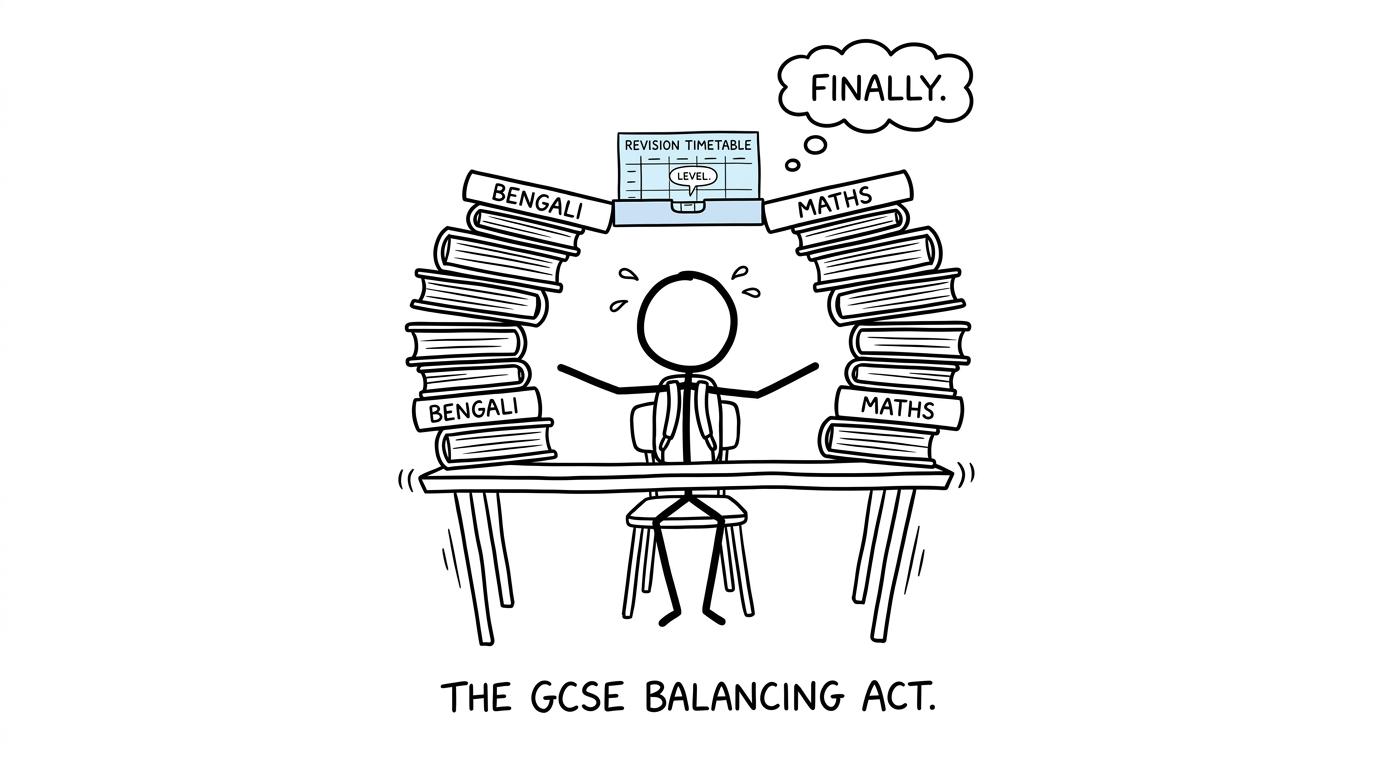 A GCSE student balances Bengali and maths using a revision timetable
Use different resources for different stages:
- Learn or revisit methods through the GCSE maths revision resources.
- If you take AQA maths, use AQA GCSE Maths past papers with mark schemes.
- Edexcel students can add Edexcel GCSE Maths predicted papers near the examination period.
- OCR students can keep lessons, questions and papers together in the OCR GCSE Maths revision hub.
- Read the guide to when you should start GCSE past papers so that full papers are introduced at a useful stage.
A simple weekly review can prevent overload. Ask: Did Bengali receive practice in all four skills? Did maths still receive topic practice and exam questions? Which subject has an urgent gap? Adjust the next week using evidence rather than guilt.
Signs that the plan is realistic
Starting without the usual background becomes more credible when you can see measurable progress. Positive signs include:
- you can read unfamiliar but accessible Bengali words without guessing every character
- you understand the structure of all four assessments
- your teacher confirms that your responses are becoming accurate and relevant
- you can sustain a short conversation beyond memorised answers
- you complete regular reading and writing without constant transcription help
- your maths mock performance and core-subject workload remain stable
If progress is slow, that does not automatically mean you should stop. It may mean the tier, timetable or support needs changing. Make that decision with your teacher and exams officer while options remain open.
Common mistakes when starting GCSE Bengali late
Assuming there is no prerequisite, so no preparation is needed
“No previous learning requirements” is an entry rule, not a statement that the qualification is easy for beginners. The assessment standard remains the same.
Revising only vocabulary
Vocabulary is necessary, but the qualification assesses communication through listening, speaking, reading and writing. Words must become usable language.
Ignoring Bengali script at first
Transliteration may help briefly with sound, but dependence on it delays the reading and writing skills required in the examination.
Memorising speaking answers word for word
A memorised response can collapse when the examiner changes the wording or asks a follow-up question. Learn flexible sentence patterns and practise genuine interaction.
Using resources for the wrong qualification
AQA GCSE Bengali and International GCSE Bangla do not share one interchangeable format. Check the board, code, tier and assessment structure on every resource.
Sacrificing maths revision without noticing
The cost of an extra subject often appears gradually. Continue using mini tests, revision lessons and timed papers to check that your maths is moving forward. MathsGenie makes those checks visible through practice questions, mark schemes and video solutions.
Make the decision from evidence
Taking GCSE Bengali without the usual background knowledge is officially possible, but it is not a casual extra. A complete beginner must build script knowledge, vocabulary, grammar and four assessed language skills while securing an approved entry and speaking arrangements.
Talk to your school first. Then test the reality with several weeks of consistent practice and informed feedback. If progress is strong and your wider timetable remains healthy, you have evidence that the plan may be workable. If the entry arrangements or support are missing, discovering that early protects your time.
Meanwhile, keep your compulsory maths revision steady. Open MathsGenie, choose your exam board, use revision lessons to close topic gaps, practise with exam questions and mini tests, and finish with past papers or predicted papers under timed conditions. Ambition works best when it has a structure strong enough to carry it.











