

GCSE Bengali Grammar Needed: What Really Matters
GCSE Bengali grammar needed for confident writing: learn which rules matter most, what can stay shaky, and how to revise efficiently for your exam board.
The GCSE Bengali grammar needed for strong marks is not every rule ever written. You need dependable control of common structures: time frames, verb forms, negatives, pronouns, case markers, word order and linking words. More advanced grammar can improve a Higher-tier answer, but it cannot rescue writing whose basic meaning is unclear.
That distinction matters. A long specification can make grammar feel like a warehouse in which every shelf must be memorised. The exam asks for something more practical: can you understand Bengali and communicate an accurate, coherent message?
Before revising, confirm your qualification. AQA GCSE Bengali and Pearson Edexcel International GCSE Bangla are different courses with different assessments. Use the specification and past papers named by your school rather than assuming that advice for one applies exactly to the other.
The short grammar checklist
Prioritise these areas in roughly this order:
- accurate present, past and future time frames
- familiar, polite and respectful verb and pronoun forms
- negatives and questions
- Bengali word order and complete sentence construction
- case endings and postpositions
- articles, classifiers, singulars and plurals
- common conjunctions and sequencing expressions
- comparisons and descriptions
- complex clauses for Higher-tier range
- spelling and punctuation checks
You do not need perfect knowledge of grammatical terminology. You do need to recognise and use the structures themselves.
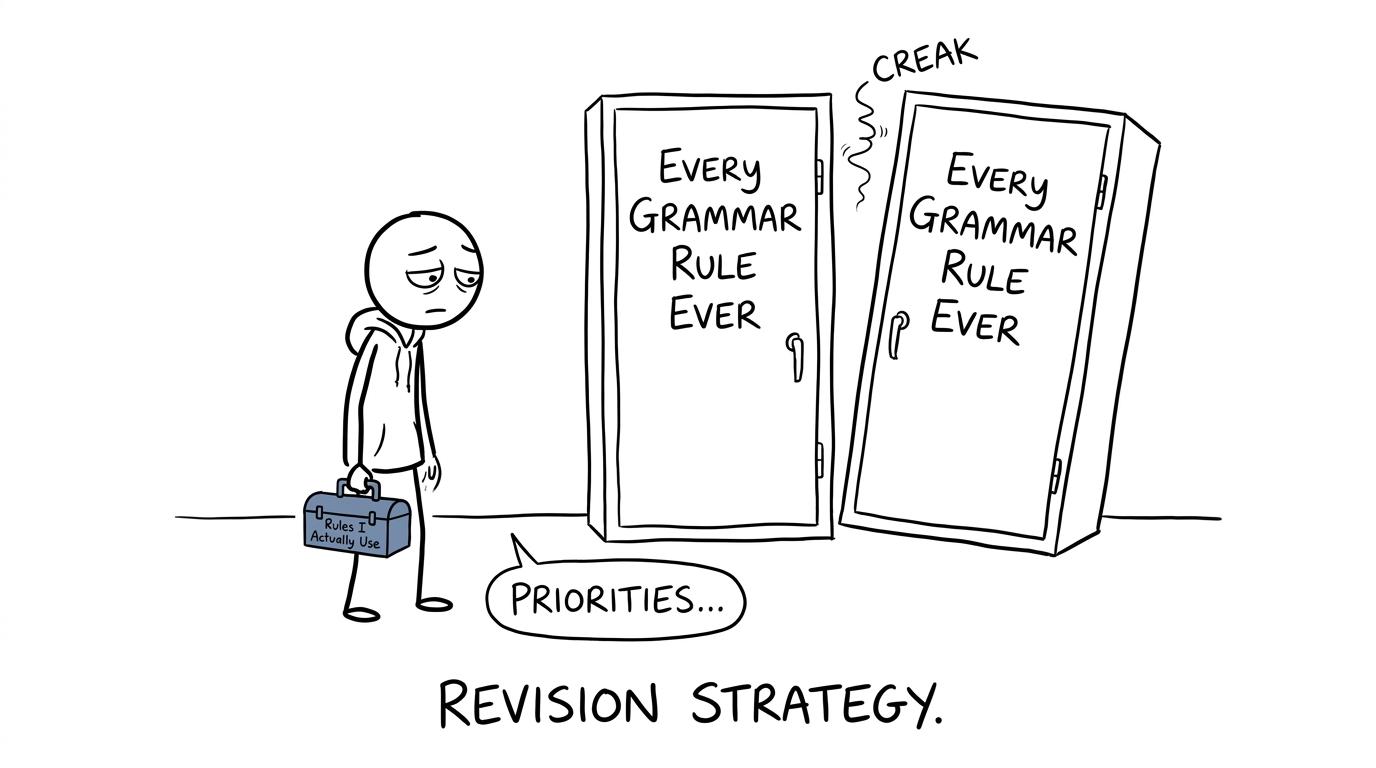 A student chooses a small practical grammar toolbox instead of an enormous cabinet of every rule
Check which Bengali qualification you are taking
The name on your entry matters more than the name students use casually at school.
AQA GCSE Bengali
AQA GCSE Bengali 863886388638 is a tiered qualification. Foundation tier covers grades 111 to 555, while Higher tier covers grades 444 to 999. Students take listening, speaking, reading and writing at the same tier, with each skill contributing 25%25\%25% of the qualification.
AQA publishes separate Foundation and Higher grammar requirements. Some Higher-tier structures require only receptive knowledge, marked with an “R” in the specification. That means you may need to understand the form when reading or listening without being expected to deploy it confidently in your own writing.
Pearson Edexcel International GCSE Bangla
Pearson Edexcel International GCSE in Bangla 4BA04\mathrm{BA}04BA0 is not the same assessment. It uses one externally assessed paper covering reading, writing and translation. The official specification assigns 404040 marks to reading, 404040 to writing and 202020 to translation, and dictionaries are not permitted.
Its grammar list still matters because candidates must use grammatical conventions to communicate accurately. However, there is no AQA-style speaking or listening component in this International GCSE.
Do not choose revision material merely because it says “Bengali” or “Bangla”. Check the board, qualification and entry code first. The familiar maths-board list of Edexcel, AQA, OCR and Eduqas does not mean that all four boards provide the same Bengali course.
Grammar that genuinely matters
Verb forms and time frames
Verbs do much of the heavy lifting. If you can move clearly between present, past and future, you can describe routines, recount an event and explain a plan. These functions appear naturally across topics such as family, education, holidays, health, technology and employment.
Prioritise commonly used simple and continuous forms before unusual constructions. AQA’s requirements include a broad collection of tenses, with familiar and polite forms. Pearson likewise expects candidates to use a wide range of grammatical structures in writing.
The practical goal is control, not display. A short answer with three accurate time frames is usually more convincing than an ambitious answer in which the reader must guess when events happened.
Pronouns, politeness and register
Bengali changes according to the relationship between speakers. Familiar, polite and respectful forms affect pronouns and verb choices. Mixing them carelessly can make an answer sound inconsistent even when the vocabulary is understandable.
Learn each high-frequency verb as part of a usable pattern, not as an isolated dictionary form. When planning an answer, decide who is speaking to whom and keep the register stable. This is particularly important in speaking tasks, messages and writing addressed to a particular audience.
Negatives, questions and commands
You need to say what did not happen, what someone should not do and what you want to know. Negative forms are therefore core grammar rather than decorative detail. The same applies to interrogatives and common imperative forms.
These structures also give answers variety. Without them, candidates often produce a chain of positive statements that communicates basic information but cannot develop contrast, advice or interaction.
Word order, case markers and postpositions
A collection of correct words is not automatically a correct sentence. Bengali usually places the verb towards the end of a clause, while case endings and postpositions show relationships such as possession, location and the object of an action.
AQA’s Foundation list explicitly includes nominative, accusative, genitive and locative-instrumental cases. You do not have to recite those labels in the examination. You do need to attach and position the relevant forms accurately enough for the sentence to mean what you intend.
This is especially important in translation. Literal English word order can produce awkward or incorrect Bengali, even when every individual word seems plausible.
Articles, classifiers and plurality
Forms such as definite or indefinite articles, classifiers for people and plural endings appear constantly in ordinary communication. Because they are small, students sometimes treat them as optional. Repeated small inconsistencies, however, weaken the accuracy of an entire response.
Focus first on the forms attached to vocabulary you use most. Reliable control of everyday nouns is more useful than memorising an obscure variation that never appears in your speaking or writing.
Connectives and complex sentences
Common conjunctions allow you to explain reasons, contrast ideas, sequence events and express conditions. They turn separate remarks into a developed response.
At Foundation tier, aim to join ideas accurately rather than forcing complexity. At Higher tier, relative clauses, conditional structures and more varied conjunctions can demonstrate greater range. Complexity earns its place only when it remains clear.
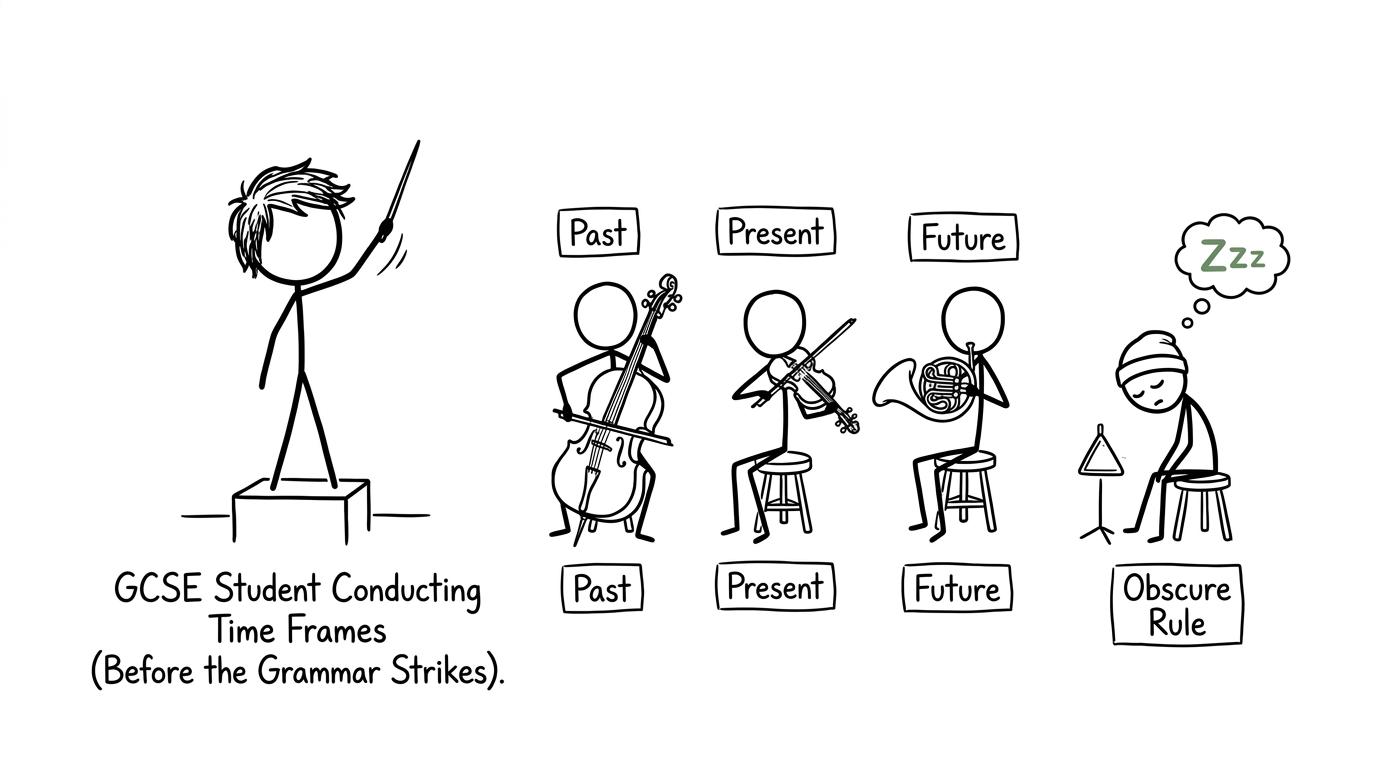 A student conducts an orchestra of past, present and future while an obscure grammar rule sleeps
Grammar you can afford to be shakier on
Being “shaky” does not mean ignoring part of the specification. It means allocating revision time according to likely usefulness.
You can give lower priority to:
- rare literary constructions that do not appear in your normal topic answers
- technical names for structures you can already recognise and use
- obscure alternative forms when you have not secured the common form
- active production of structures marked as receptive-only in the AQA specification
- elaborate sentences that repeatedly cause agreement, spelling or register errors
- exceptional spelling patterns before high-frequency spellings are secure
AQA also distinguishes between recognition and active use in parts of its Higher-tier guidance. For example, recognition of most conjunct letters is expected at Higher tier, but that does not mean every difficult conjunct must become a centrepiece of your writing.
The principle is simple: secure high-frequency grammar before low-frequency sophistication. This resembles effective maths revision. You would not spend an evening on one unusual problem while repeatedly losing straightforward algebra marks. MathsGenie’s guide to finding your weakest GCSE topics explains how to let evidence, rather than preference, determine what you revise next.
A revision method that makes grammar usable
Grammar improves when you retrieve, apply, check and revisit it. Reading a list can create familiarity, but familiarity is not the same as being able to produce a correct sentence under time pressure.
Build a grammar error log
After a writing task, translation or speaking practice, classify each problem:
- wrong time frame
- incorrect verb or register
- missing case marker
- English-influenced word order
- incorrect negative
- weak connective
- spelling or punctuation
Then count patterns rather than isolated mistakes. If tense control appears repeatedly, it deserves more time than a rare form missed once. This is the same feedback loop described in MathsGenie’s guide to using past papers properly: attempt, mark, diagnose, repair and retest.
Revise in small contrasts
Practise one distinction at a time: present against past, familiar against polite, affirmative against negative, or simple against complex sentences. Small contrasts reveal exactly where your control breaks down.
Return to the same distinction after a gap. The advice in how to stop forgetting GCSE content is written for maths, but its learn, retrieve and space principle transfers well to language grammar.
Use board-specific past material
Past questions show which grammar must survive inside real communication. Complete a short task without notes, check it against your teacher’s feedback and the official mark scheme, then rewrite only the weak section.
A past paper is not useful merely because it has been completed. The useful part is discovering what failed. Maths students can develop the same habit through the MathsGenie past-paper library, where papers and mark schemes support deliberate review.
Keep Bengali and maths revision separate but consistent
This article explains Bengali grammar, while MathsGenie specialises in free GCSE and A Level maths revision. A shared timetable prevents one subject from quietly consuming every available evening.
Use a short Bengali grammar block followed by a focused maths session, or alternate subjects across the week. The GCSE revision timetable guide offers a realistic structure, while the main GCSE maths revision hub provides board-specific lessons, questions and papers.
Common mistakes in GCSE Bengali grammar revision
Memorising rules without producing language
Knowing that a tense exists does not prove that you can use it. Retrieval must include writing or speaking without copying a model.
Translating English word by word
Translation is a transfer of meaning, not a word-replacement exercise. Rebuild the message using natural Bengali order, appropriate case forms and a consistent time frame.
Changing register halfway through
Select familiar, polite or respectful forms according to the audience. Check pronouns and verbs together during proofreading.
Forcing advanced structures
Higher-tier range matters, but unsuccessful complexity can obscure communication. Add a structure because it expresses an idea you need, not because it sounds impressive.
Treating every error as equally urgent
One rare spelling error and six recurring tense errors should not receive equal revision time. Track frequency and the effect on meaning.
Revising for the wrong qualification
AQA GCSE Bengali and Pearson Edexcel International GCSE Bangla have different paper structures. Always use the correct specification, sample materials and mark schemes.
The grammar target to carry into the exam
You do not need flawless command of every corner of Bengali grammar. You need a dependable core that lets you communicate across several topics and time frames, followed by enough variety to suit your tier and target grade.
Start with verbs, register, negatives, sentence order, case markers and common connectives. Then add complexity where it remains accurate. Let marked work decide what comes next.
For maths alongside your Bengali preparation, make MathsGenie your free revision base. Use the revision lessons and practice questions to repair individual topics, mini tests to check recall, and past papers or predicted papers to build exam stamina. Mark with the provided mark schemes, use video solutions when a method is unclear, and keep repeating the cycle until the mistake no longer returns.










