

GCSE Bengali at a Different Exam Centre: Guide
GCSE Bengali different exam centre guide: learn how to enter privately, arrange the speaking test, compare fees and protect your maths revision time.
A school timetable can make something feel impossible when it is merely inconvenient. You want to take Bengali, perhaps because you already speak it at home or have studied it independently, but your school does not offer the subject. The useful answer is simple: a GCSE Bengali different exam centre arrangement is possible if an approved centre agrees to enter you as a private candidate and can conduct every required assessment.
The difficult part is not getting permission from the exam board in principle. It is finding a centre willing and able to manage the entry, particularly the speaking assessment. Start early, ask precise questions and do not pay until the qualification, tier, assessments and total fee are confirmed in writing.
Your quick action checklist
- Speak to your school’s exams officer first, even if Bengali is not taught there.
- Confirm that you want AQA GCSE Bengali, specification 8638, rather than International GCSE Bangla.
- Decide whether Foundation or Higher tier is appropriate.
- Find an approved centre accepting private candidates.
- Check that the centre can conduct and authenticate the speaking assessment.
- Request its entry deadline, complete price and refund terms in writing.
- Discuss access arrangements before registering, if you need them.
- Submit identification and previous candidate details promptly.
- Check your statement of entry as soon as it arrives.
- Keep every exam and speaking-assessment date clear in your revision planner.
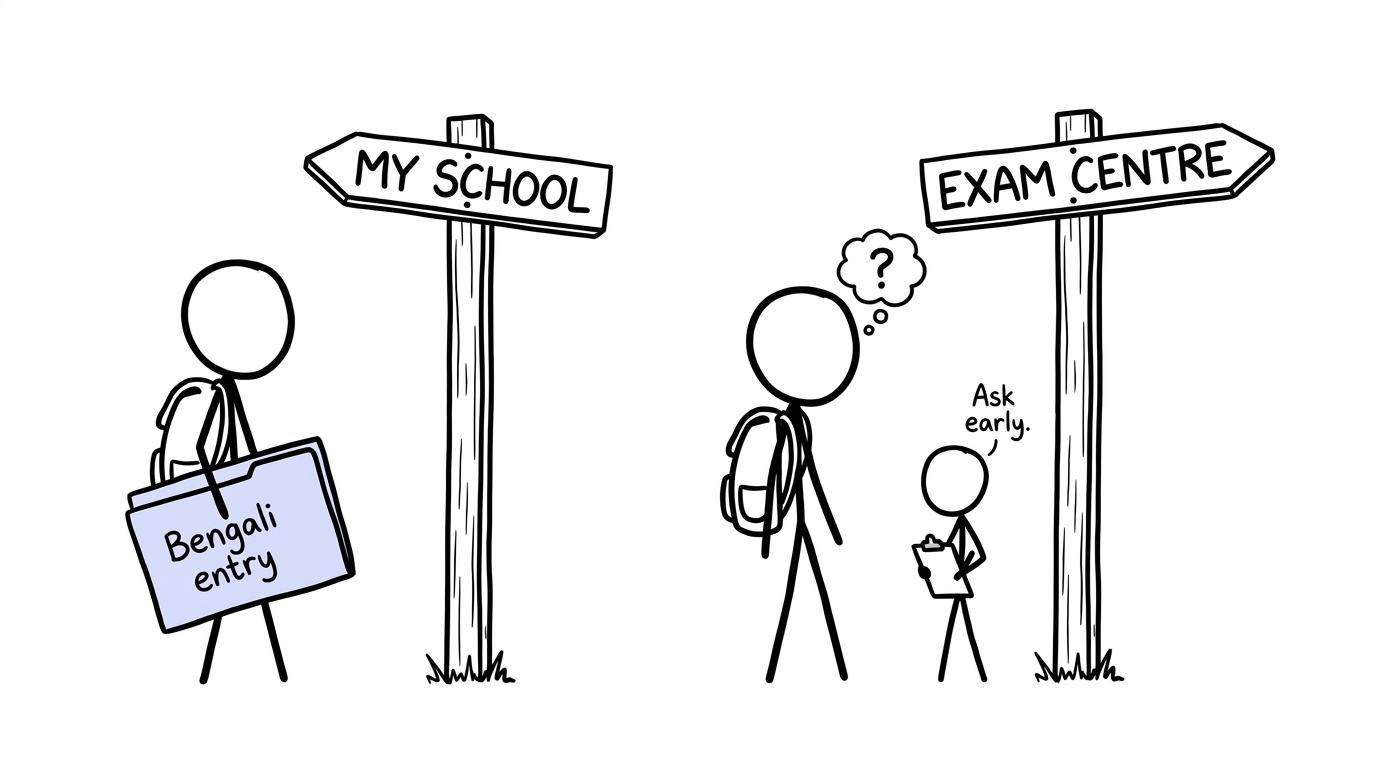 A student choosing between their school and another exam centre while an exams officer advises them to ask early
Can you sit GCSE Bengali somewhere other than your school?
Yes. AQA’s current GCSE Bengali specification is available to private candidates based in the UK. A private candidate takes the qualification through an approved school, college or examination centre without being enrolled there as a student.
The new centre does not simply lend you a desk on the written examination days. It becomes your entering centre and accepts responsibility for the qualification. It submits your entry, checks your identity, administers the assessments under the required rules and handles results-related processes.
This distinction matters because GCSE Bengali includes listening, speaking, reading and writing. A centre may accept private candidates for written GCSEs but decline Bengali because it cannot provide a suitable person, room or administrative process for the speaking test. Acceptance for “GCSE examinations” does not automatically mean acceptance for this particular subject.
Your first conversation should still be with your own exams officer. A school that does not teach Bengali might nevertheless be prepared to make an entry or help locate a partner centre. It does not have to do so, however, and another centre is free to set its own acceptance policy and fees.
Confirm the exact Bengali qualification first
For the regulated GCSE route in England, the current qualification is AQA GCSE Bengali (8638). Its entry codes are 8638F for Foundation and 8638H for Higher. Students must take all four language skills at the same tier.
Do not assume that “Bengali”, “Bangla”, “GCSE” and “International GCSE” describe an identical course. Pearson Edexcel International GCSE Bangla is a separate qualification with a different specification code and assessment structure. Before approaching centres, write down:
- the awarding organisation: AQA;
- the qualification: GCSE Bengali;
- the specification code: 8638;
- your intended tier: Foundation or Higher;
- the examination series you want to enter.
This short list prevents one of the costliest administrative mistakes: preparing for one specification while being entered for another.
Choosing a language tier also deserves care. Foundation and Higher differ in demand and available grades, and all components must use the same tier. Ask a Bengali teacher or experienced tutor to assess your listening, speaking, reading and writing before you commit. Being fluent in everyday conversation is valuable, but examination writing, accuracy and unfamiliar listening material require separate preparation.
Why the speaking assessment affects centre availability
AQA GCSE Bengali has four equally weighted components: listening, speaking, reading and writing. The speaking component is treated as a non-exam assessment and must be conducted within the board’s specified window under controlled conditions.
AQA states that an entering centre accepting a private candidate must supervise and authenticate the relevant speaking component. That is why you should ask a centre this exact question:
Can you enter a private candidate for AQA GCSE Bengali 8638 and conduct the Foundation or Higher speaking assessment?
A vague yes to “Bengali exams” is not enough. Confirm who will conduct the assessment, where it will happen, when the centre expects to schedule it and whether its quoted price includes it. The speaking appointment will normally be separate from the nationally timetabled written papers, so you must be available for both.
Do not plan to sit the speaking assessment casually with a family member or tutor and then send in a recording yourself. The approved entering centre controls the assessment and must follow the awarding organisation’s security, supervision and authentication requirements.
How to find and contact another exam centre
The Joint Council for Qualifications maintains a private-candidate search service listing schools, colleges and other approved centres that have indicated they accept private candidates. The list is a starting point, not a guarantee that every centre offers Bengali.
Search geographically, then contact several centres. Capacity, staffing and subject availability differ, and a nearby centre may accept AQA mathematics but not a language with a speaking component.
When you email, include:
- your full name and age;
- your postcode;
- AQA GCSE Bengali 8638;
- your preferred tier;
- the required examination series;
- whether you have taken public examinations before;
- whether you require access arrangements;
- a request for the full fee and internal deadline.
Ask for a written response covering the entry, all four components, speaking-test administration, late fees, transfer or cancellation terms, results collection and certificate delivery.
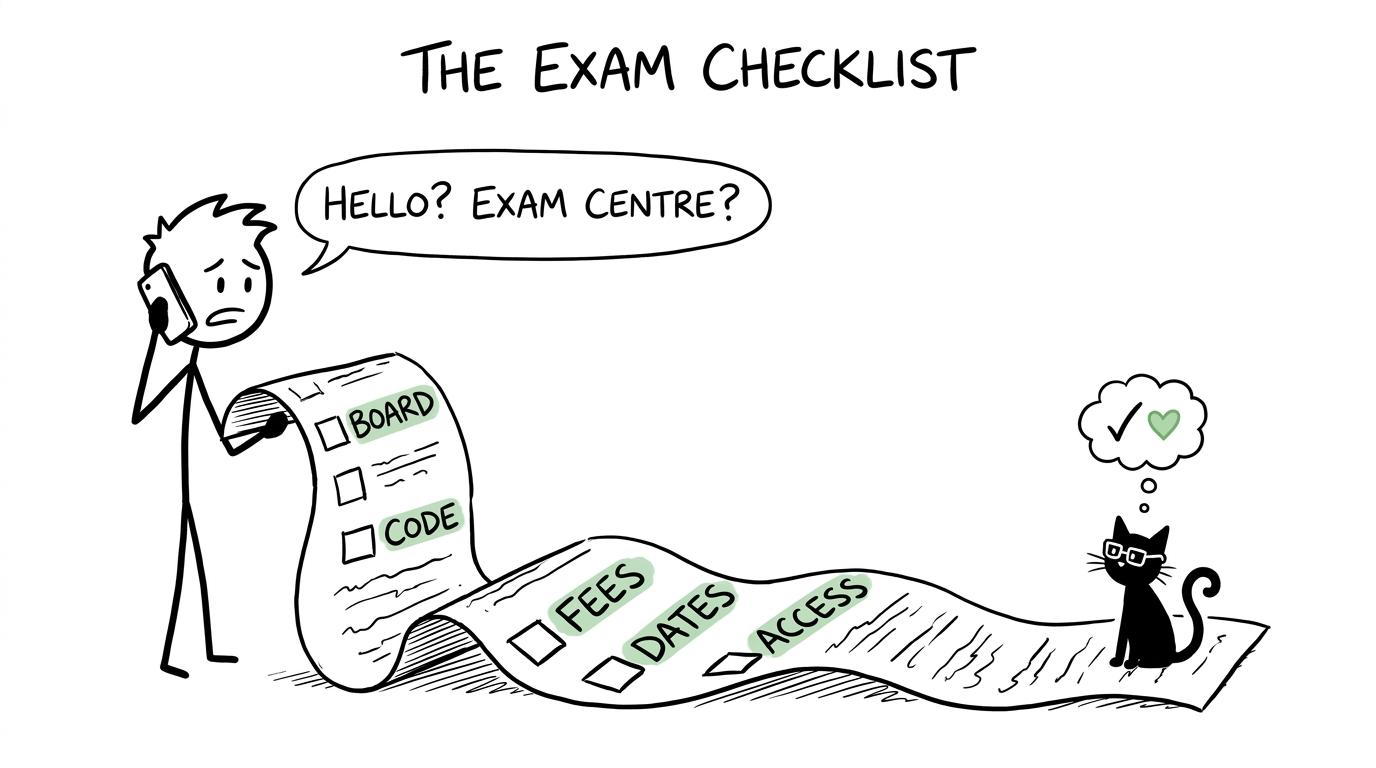 A student phones an exam centre beside an enormous checklist supervised by a very serious cat
What registration usually involves
Once a centre agrees, it will tell you what evidence and forms it requires. This commonly includes your legal name, date of birth, address, contact details and photographic identification. If you have previously taken UK public examinations, provide your Unique Candidate Identifier if available so that your records can be matched correctly.
The centre, not the student, sends the formal entry to AQA. You will normally pay the centre’s total charge, which may combine the awarding organisation’s entry fee with administration, invigilation, room hire and speaking-assessment costs. Prices vary, so there is no reliable universal fee. Compare what is included rather than choosing from the headline figure alone.
Centres often set internal deadlines earlier than the awarding organisation’s final entry deadline. Late entries can cost more and may be refused entirely if speaking-test capacity is full. Contacting centres during the autumn term for the following summer series is far safer than waiting until spring.
After registration, check your statement of entry carefully. Your name, date of birth, subject, board, specification, tier and component details must all be correct. Raise errors immediately.
Access arrangements must be discussed early
If you normally receive extra time, supervised rest breaks, a reader or another approved arrangement, tell the prospective centre during your first enquiry. Access arrangements are not transferred informally because another school once provided them.
The entering centre must follow current JCQ rules, review the available evidence and complete any necessary applications. It may need information from your school or a qualified assessor. A centre can decline an entry if it cannot establish or provide the required arrangement, so this should never be left until the examination timetable arrives.
Protecting your maths revision while arranging Bengali
Administration has an odd habit of occupying more attention than its size deserves. One unanswered email can follow you through an entire algebra session. The solution is to give the centre search its own small slot rather than allowing it to leak across the week.
Use one folder for centre emails, receipts, identification, entry confirmation and dates. Then return to a predictable maths routine. The GCSE Maths revision hub brings together free lessons, exam questions and paper practice, while the GCSE topic list by board and tier can help you decide what to revise next.
Keep your work aligned with your actual maths board. Students following AQA can use the AQA GCSE Maths revision collection, while Edexcel students can build timed practice through Edexcel GCSE Maths past papers.
A steady cycle works well: learn a method, answer practice questions, mark them and revisit the error. When examination season approaches, add Edexcel predicted papers where relevant. If you are unsure when full papers should enter your routine, the guide to starting GCSE past papers gives a calmer progression from topic practice to timed work.
 A prepared student revises maths while an alarming deadline monster discovers the calendar is already organised
Common mistakes when arranging GCSE Bengali elsewhere
Confusing GCSE Bengali with International GCSE Bangla
These are different qualifications. Confirm the board, title and specification code before paying or buying resources.
Assuming any private centre offers every subject
A centre may take private candidates for written examinations but not offer Bengali speaking assessments. Ask specifically about AQA 8638 and all four components.
Contacting only one centre
Policies and capacity vary. Contact several approved centres and compare complete written quotations.
Leaving the speaking test until later
The speaking component is part of the qualification, not an optional add-on. A centre must be willing to supervise and authenticate it when accepting your entry.
Missing an internal deadline
The date advertised by an awarding organisation may not be the date your centre uses. A centre can close entries earlier because it needs time for checks, staffing and assessment planning.
Arranging access support too late
Tell the centre at the enquiry stage. Evidence and applications can take time, and previous arrangements are not automatically carried across.
Failing to check the statement of entry
A wrong tier or misspelt legal name is easier to correct early. Read every field rather than assuming the paperwork must be right.
Make the arrangement early, then return to revision
Sitting GCSE Bengali at a different exam centre is possible, but it depends on finding an approved centre prepared to enter you as a private candidate and manage the speaking assessment as well as the written papers. Begin with your school’s exams officer, confirm AQA specification 8638, contact multiple centres and get every important detail in writing.
Once the booking is secure, let the administration become boring. That is success. Put the dates in your planner, keep the documents together and turn your attention back to preparation.
For maths, MathsGenie can carry the structure: use free revision lessons to rebuild methods, practice questions and mini tests to expose gaps, then past papers, mark schemes, video solutions and predicted papers to make your skills reliable under examination conditions. Start with the best order for learning GCSE maths topics, choose one useful task and keep moving.











