

GCSE Astronomy Study Planner: Work Backwards
GCSE astronomy study planner: work backwards from exam day, organise both papers, schedule observations and strengthen the maths behind exam questions.
The hardest part of revision is often not the content. It is deciding what to do next. One evening becomes lunar phases, another becomes galaxies, and suddenly an untouched past paper is waiting a week before the exam.
A GCSE astronomy study planner removes that guesswork. Start with the dates of your two papers, reserve time for final practice, then work backwards through timed questions, topic revision and diagnostic checks. Each week receives a clear purpose before day-to-day distractions can take over.
This guide is designed around Pearson Edexcel GCSE Astronomy, the current GCSE Astronomy qualification. It also shows you how MathsGenie can strengthen the calculation, graph and data-handling skills that astronomy questions rely on.
Your backward-planning checklist
Before planning individual sessions, collect the information that controls the plan:
- your confirmed Paper 1 and Paper 2 dates from your school or centre;
- the current Pearson Edexcel specification and paper codes;
- school deadlines for observational work;
- a list of all specification topics;
- one recent past or sample paper for each paper;
- the corresponding mark schemes;
- a realistic count of the evenings and weekends available;
- your other GCSE exam dates and non-negotiable commitments.
Do not copy exam dates from an old revision post or a classmate’s timetable. Pearson publishes the official timetable, but your personalised school timetable should be the final reference.
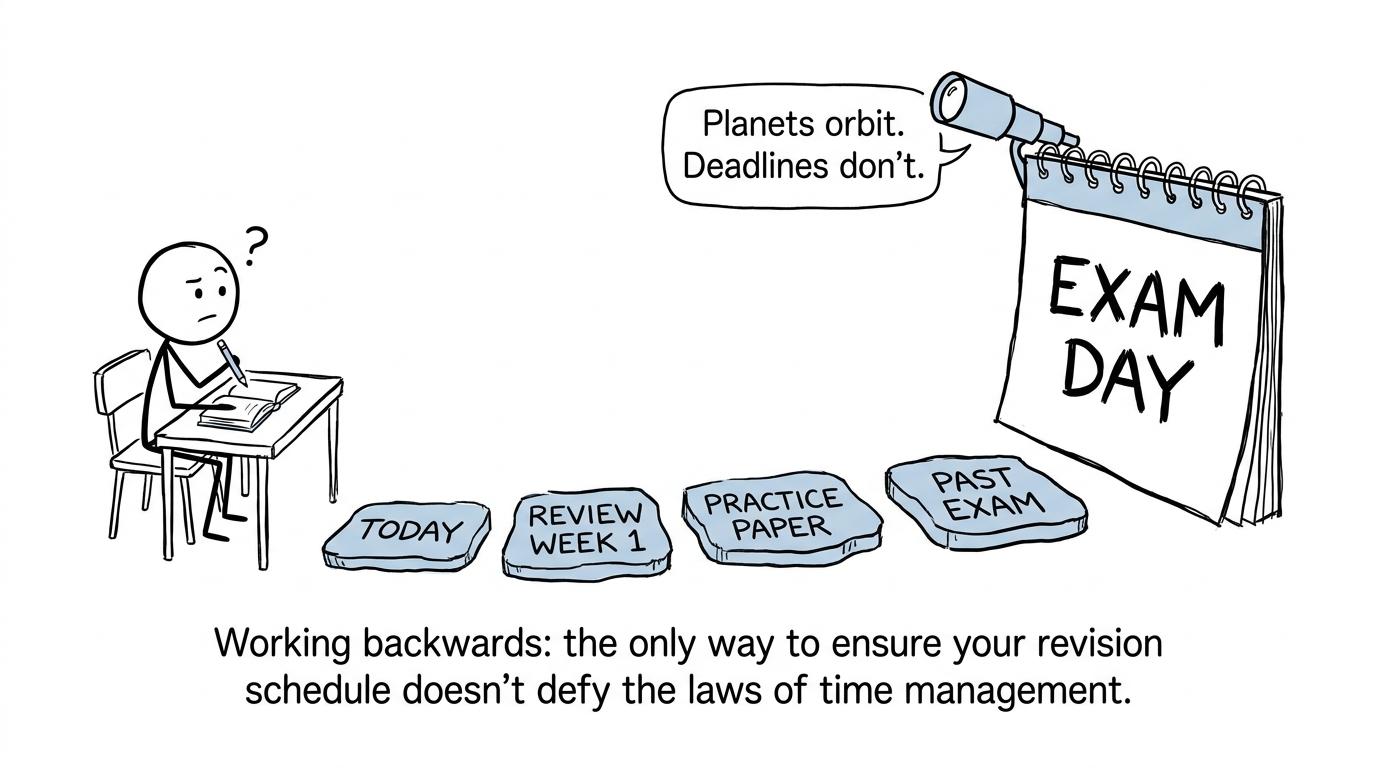 A student builds stepping stones backwards from exam day while a telescope comments on deadlines
Begin with the real shape of GCSE Astronomy
A useful plan reflects the assessment rather than treating astronomy as one enormous subject.
Pearson Edexcel GCSE Astronomy consists of two externally examined papers. Paper 1 is Naked-eye Astronomy and covers Topics 1 to 8. Paper 2 is Telescopic Astronomy and covers Topics 9 to 16. Each paper lasts 111 hour 454545 minutes, carries 100100100 marks and contributes 50%50\%50% of the qualification.
Both papers can include multiple-choice, short-answer, calculation, graphical and extended open-response questions. Calculators may be used. Unlike GCSE maths, GCSE Astronomy is not divided into foundation and higher tiers.
That structure gives your planner four separate demands:
- secure knowledge across all specification statements;
- calculation and graph fluency;
- written explanations using precise astronomical language;
- enough timed practice to make decisions under pressure.
The course also develops observational skills through aided and unaided observation. Put your school’s observation and write-up deadlines into the planner immediately. The night sky does not rearrange itself because a deadline was forgotten, and suitable observing conditions cannot always be summoned at short notice.
Work backwards in four revision phases
A backward plan begins at the finish line and assigns each earlier period a job. The exact number of weeks can shrink or expand, but the order should remain broadly the same.
| Phase | Main purpose |
|---|---|
| Final few days | Recall, corrections and calm preparation |
| Final two weeks | Full timed papers and targeted repairs |
| Middle phase | Topic questions, calculations and written responses |
| Opening phase | Audit the specification and rebuild weak knowledge |
Final few days: protect what you already know
The final days are for consolidation, not an attempt to relearn all sixteen topics. Schedule short recall sessions, review your error log and redo a small number of previously incorrect questions.
Check practical details as well: calculator, ruler, pens, travel arrangements and the correct examination time. Stop heavy revision early enough to sleep properly. A tired extra hour is not automatically a productive hour.
Keep Paper 1 and Paper 2 separate in this part of the plan. Once Paper 1 has been completed, redirect the remaining sessions towards Paper 2 rather than continuing to revise both equally.
Final two weeks: rehearse the assessment
Reserve this period before filling earlier weeks. Complete official past or sample papers under the correct 111 hour 454545 minute limit, then mark them carefully.
A paper is not finished when the timer stops. Record every lost mark under one of four headings:
- missing knowledge;
- calculation or unit error;
- weak explanation;
- timing or question-reading error.
Your next sessions should be determined by this evidence. If graph interpretation is repeatedly costing marks, use MathsGenie’s scatter graphs revision resources to reinforce reading scales, interpreting trends and making sensible estimates. The resource is written for GCSE maths, but the underlying graph discipline transfers directly.
Middle phase: turn topics into usable knowledge
This is where most improvement happens. Divide each specification topic into small, testable tasks. “Revise stars” is too vague. A useful task identifies an outcome, such as recalling a sequence, interpreting a diagram or answering calculation questions without notes.
Mix three kinds of session:
- Knowledge sessions: retrieve definitions, processes and comparisons from memory.
- Application sessions: answer calculations, graph questions and unfamiliar-context problems.
- Communication sessions: practise concise explanations using the command word and available marks.
The maths deserves deliberate attention. Astronomical contexts often involve very large distances, very small angles, formula substitution, proportional reasoning and graphical information. MathsGenie’s standard form revision guide is particularly useful when powers of ten feel less secure than the astronomy itself. For angle and distance reasoning, revisit the SOHCAHTOA trigonometry guide.
Opening phase: diagnose before you organise
At the beginning, print or copy the sixteen-topic specification list. Label each area:
- secure;
- partly secure;
- not yet secure.
Base those labels on retrieval or questions, not familiarity. Recognising a page of notes is not the same as producing an answer in an exam.
Complete a short diagnostic set for each paper. Do not worry if the result is uncomfortable. Early mistakes are useful because there is still time to act on them. The MathsGenie GCSE revision hub uses the same principle: learn a method, practise it, check the solution and respond to what the marks reveal.
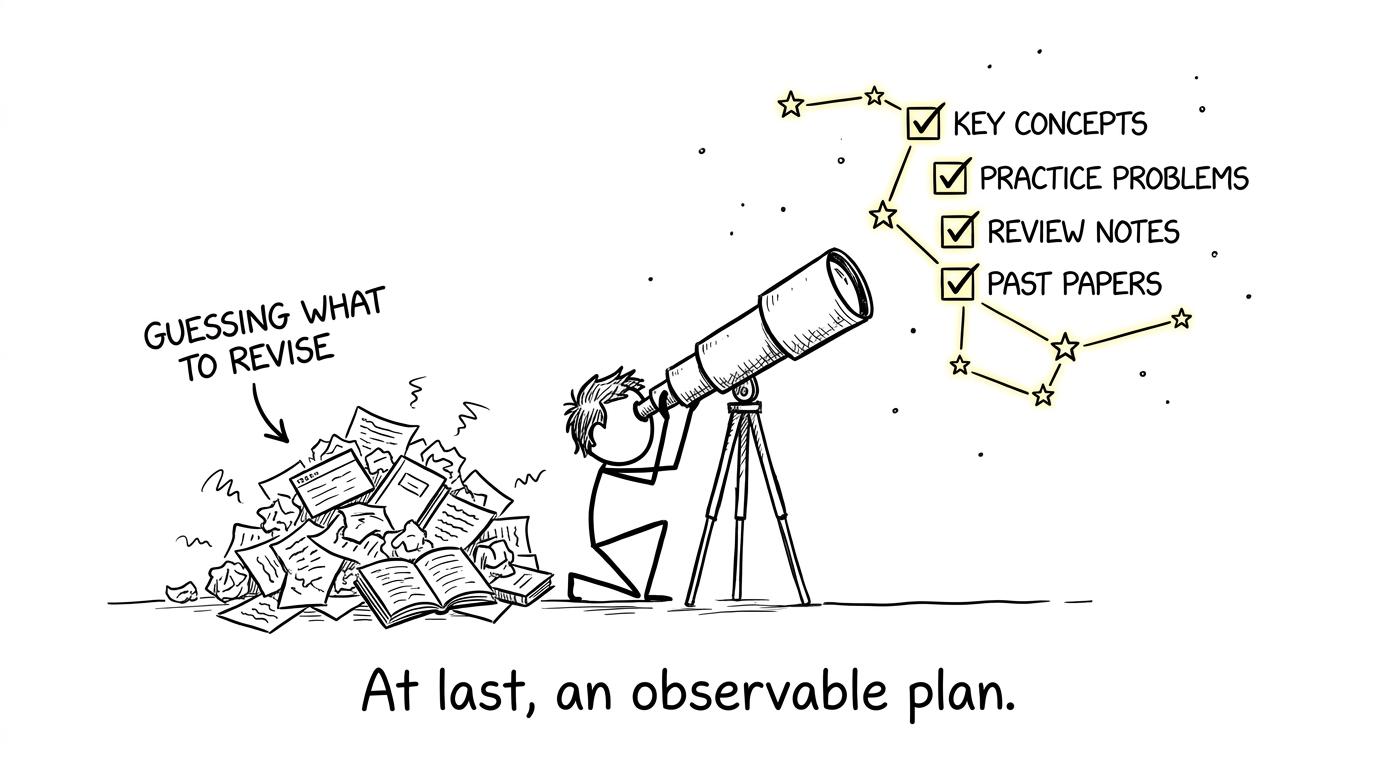 A telescope finds a constellation shaped like a revision checklist while random flashcards sit behind the student
Convert the phases into a weekly timetable
Now count the time you genuinely have. If MMM is the number of available revision minutes and each focused block lasts bbb minutes, your approximate session capacity is
N=Mb.N = \frac{M}{b}.N=bM.Always round down and leave some capacity unallocated. Illness, schoolwork and tired evenings happen. A planner that assumes perfect attendance is really a list of future disappointments.
Give the two papers broadly equal total time because each contributes 50%50\%50%. Within each paper, weight topics according to need rather than size alone. One simple priority score is
P=W×F,P = W \times F,P=W×F,where WWW represents weakness and FFF represents how frequently that weakness appears in your marked practice. This is not an exam-board formula. It is a planning tool that stops comfortable topics consuming all your attention.
A balanced week might contain:
- two knowledge-retrieval blocks;
- two question-practice blocks;
- one maths-skills block;
- one longer timed section;
- one short review and rescheduling block.
Keep other GCSEs visible. Astronomy should not occupy every evening simply because its planner is the newest. If GCSE maths is also approaching, use the GCSE maths revision timetable guide to coordinate both subjects rather than creating competing plans.
Build every session around an observable result
A session needs a finish line. “Do astronomy for an hour” encourages passive reading because almost anything can count. A better structure is:
- retrieve key facts without notes;
- check gaps briefly;
- answer relevant questions;
- mark the work;
- record one specific next action.
For calculations, show substitutions, units and intermediate steps. For graphs, check labels, scale and whether the question asks for description, interpretation or calculation. For extended responses, use the command word to decide whether you must describe, explain, compare or evaluate.
MathsGenie’s guide to using past papers properly explains a transferable cycle: sit the paper, mark it, diagnose the error, repair the weakest area and reattempt selected questions. Although the linked papers concern GCSE maths, the method works just as well for astronomy.
Use a correction loop, not a completion counter
Counting completed hours feels reassuring, but the exam rewards corrected weaknesses. Keep an error log with four columns: topic, lost mark, reason and next action.
A vague entry such as “careless” is rarely useful. Write the precise behaviour: omitted unit, misread scale, confused two definitions, rounded too early or gave a description when an explanation was required.
Revisit the question after a delay. The first correction may only show that you understood the mark scheme while it was open. A later attempt tests whether the idea has become retrievable.
For shorter maths checks, MathsGenie’s GCSE mini tests can expose weaknesses without requiring a full paper. Near the maths exams, the GCSE predicted papers provide fresh exam-style practice. These are maths resources, not Astronomy predictions, so use them to strengthen transferable numerical skills rather than as a forecast of astronomy content.
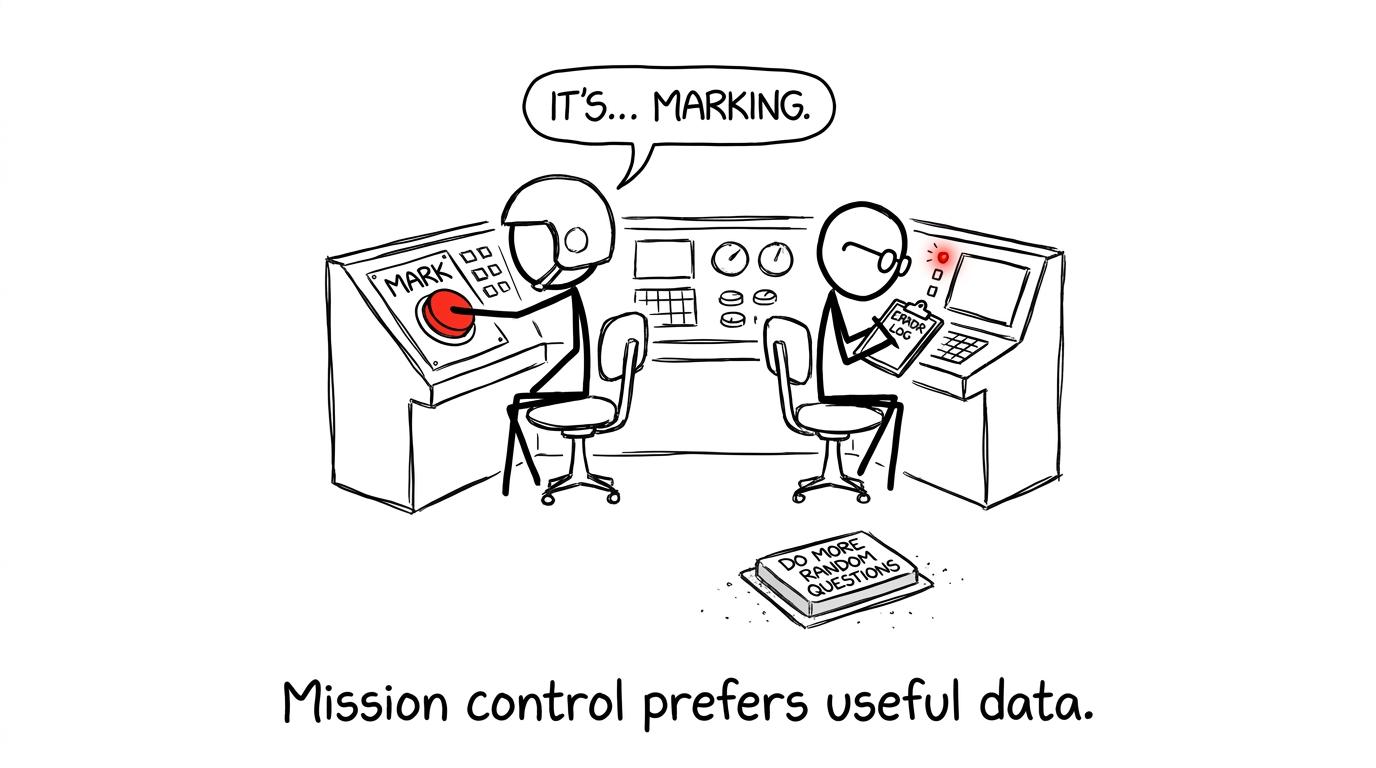 Mission control chooses marking and an error log instead of more random questions
Common mistakes when building the planner
Planning from today forwards
This fills early weeks with favourite topics and leaves timed papers wherever they happen to fit. Reserve the final practice period first, then move backwards.
Treating both papers as one checklist
Paper 1 and Paper 2 assess different topic groups. Give each its own coverage tracker, diagnostic score and error list.
Ignoring observational deadlines
Observational work depends on school instructions, equipment and suitable opportunities. Record the required tasks and internal deadlines separately from written-paper revision.
Scheduling full papers too early or too late
If knowledge is very incomplete, constant full papers mainly repeat the diagnosis. If papers begin only in the final days, there is no repair time. Start with sections, then increase the length and formality as the exam approaches. The MathsGenie guide on when to start GCSE past papers explains this gradual transition.
Filling every available hour
Plans need recovery time and spare capacity. Leave at least one movable block each week so missed work can be rescheduled without collapsing the entire timetable.
Revising content but neglecting marks
Knowing astronomy is necessary, but answers must still fit the command word, use correct terminology, show calculations and address the question asked. Mark schemes turn knowledge into exam technique.
A plan should become more specific as exam day approaches
Early revision asks, “What do I need to learn?” Later revision asks, “Why am I still losing marks?” That change is the purpose of working backwards.
Write in your confirmed exam dates, reserve the final two weeks, separate Paper 1 from Paper 2 and use your first diagnostic questions to populate the middle of the plan. Review it weekly. Move sessions when evidence changes, but do not abandon the structure because one evening went wrong.
Then make MathsGenie your free base for the numerical side of the journey. Use revision lessons to rebuild methods, practice questions and mini tests to expose gaps, mark schemes and video solutions to correct them, and past papers or predicted papers to prepare for your GCSE maths assessments. A calm plan does not predict every obstacle. It simply ensures that, when the evidence changes, you already know what to do next.











