

GCSE Astronomy Study Group: Make It Actually Work
GCSE astronomy study group advice to turn good intentions into focused weekly revision, stronger calculations, useful feedback and reliable attendance.
The first meeting is usually easy to imagine: a few friends, a shared interest in space and a determined promise to revise every week. The harder part comes later, when the GCSE astronomy study group becomes a group chat full of vague messages, unanswered polls and plans that never quite leave orbit.
The solution is not more enthusiasm. It is a small, repeatable system: choose a fixed time, arrive with questions, test one another, mark the work and leave with a clear next action. For students preparing for GCSE maths as well as astronomy, that structure can also strengthen calculations, graphs, standard form, ratio and geometrical reasoning.
The quick study group checklist
A productive group should have:
- between three and five committed members
- one fixed weekly meeting time
- a written topic plan linked to the specification
- individual retrieval before discussion
- exam questions and mark schemes at every meeting
- rotating roles so nobody carries the group
- a shared error log
- a clear finish time
- separate plans for observation sessions and desk-based revision
The principle is simple. A study group should make everyone produce work. If most of the meeting is spent listening, scrolling or deciding what to do, it is a social gathering with astronomy nearby.
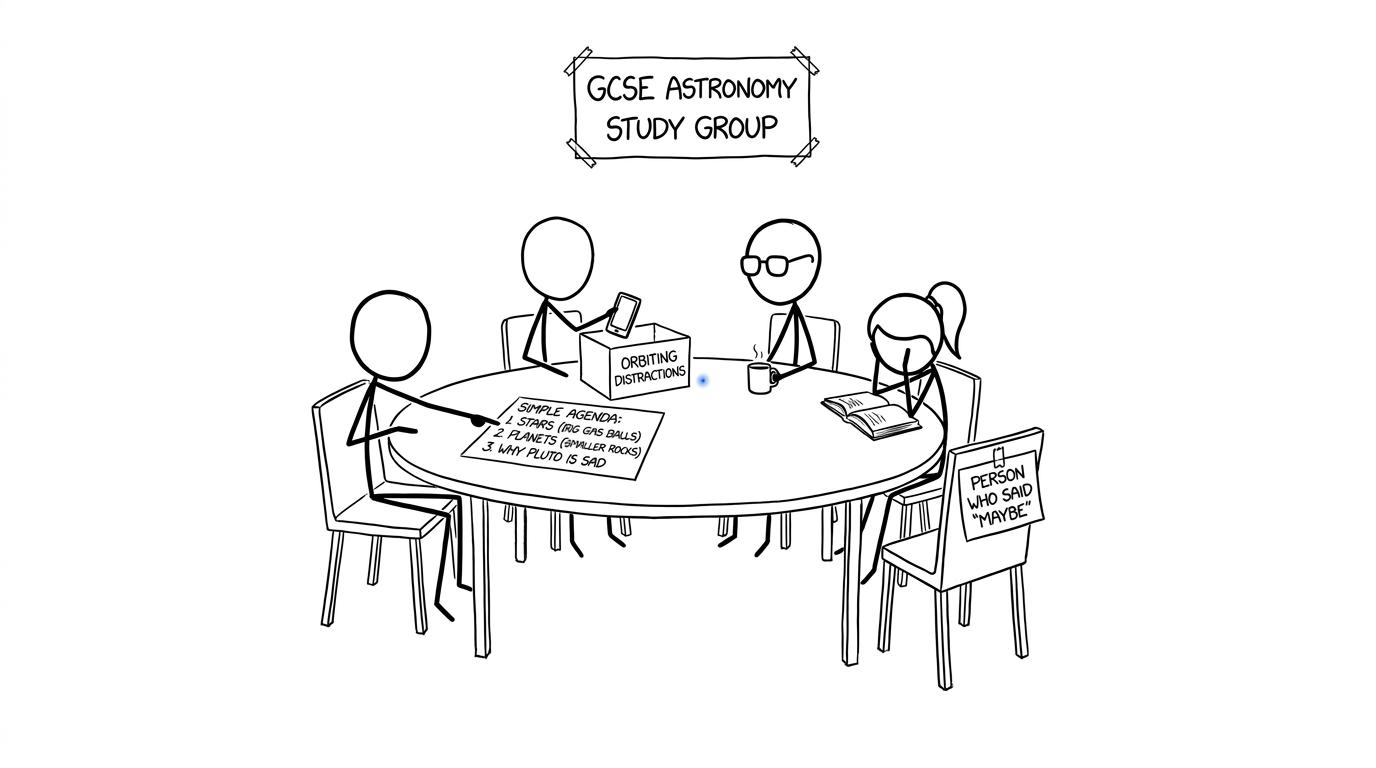 A study group puts distracting phones into orbit while waiting for the mysterious member who said maybe
Start with the actual GCSE Astronomy course
In England, the current GCSE Astronomy qualification is Pearson Edexcel GCSE Astronomy, specification 1AS0. It is untiered, unlike GCSE maths, so there is no foundation or higher paper.
The qualification contains two equally weighted written examinations:
- Paper 111, Naked-eye Astronomy, covers Topics 111 to 888
- Paper 222, Telescopic Astronomy, covers Topics 999 to 161616
- each paper lasts 111 hour 454545 minutes
- each paper carries 100100100 marks and contributes 50%50\%50% of the qualification
Questions include multiple choice, short answers, calculations, graphical work and extended open responses. Students must also complete at least one unaided and one aided observation. The written assessments test understanding of how observations are designed, made, analysed and evaluated.
That structure should shape your meetings. Do not organise revision around whichever topic somebody happens to mention that evening. Divide the specification into manageable sections and keep both papers moving forward. Synoptic questions can connect ideas from different topics, so earlier content should continue appearing in retrieval quizzes.
Choose people who will attend, not just people you like
Three reliable students can achieve more than ten names in a chat. A smaller group makes it easier to choose a time, notice absences and give everybody a chance to explain an answer.
Before inviting someone, agree on three expectations:
- members attend unless they give reasonable notice
- everyone attempts the set questions before answers are discussed
- the chat is for practical messages, not endless planning
A useful first message is specific: “We meet every Wednesday from 4:154{:}154:15 to 5:155{:}155:15, starting next week. We will revise one astronomy topic, complete a short calculation set and finish with an exam question.”
That is easier to answer than “Does anyone want to revise sometime?” Specific plans create commitment. Vague plans create another poll.
Give every meeting the same reliable structure
A routine removes the need to negotiate the session each week. Try this 606060-minute format.
Retrieval without notes
Spend the first 101010 minutes answering short questions independently. Include material from the previous meeting and an older topic. Retrieving information from memory is more useful than beginning with another passive read-through.
Nobody should call out answers during this stage. Silent individual thinking matters because group confidence can hide individual gaps.
One focused topic
Use the next 151515 minutes to compare definitions, diagrams, processes and formula choices. Each person should explain part of the topic without reading directly from notes.
If an explanation becomes confused, check the specification, textbook or teacher-approved resource rather than deciding by majority vote. Four confident people can still share the same misconception.
Calculations and data
Spend 151515 minutes on calculations, graphs or data interpretation. Astronomy can involve skills such as standard form, unit conversion, ratios, gradients and rearranging relationships. A calculation is not finished when the calculator displays a number; units, significant figures and whether the result is sensible also matter.
If your underlying maths needs attention, use MathsGenie’s GCSE maths topics by exam board and tier to identify the relevant skill. The best order for learning GCSE maths topics can help if several members have gaps in number, algebra or graphs.
Exam question and marking
Use 151515 minutes for an exam-style question completed independently, preferably under a time limit. Then mark it closely. Compare the wording of the response with what the mark scheme rewards, especially for explanations, observation plans and evaluation.
Finish with a 555-minute decision: what will each person do before the next meeting? The task should be small and measurable, such as completing a particular question set or correcting two errors.
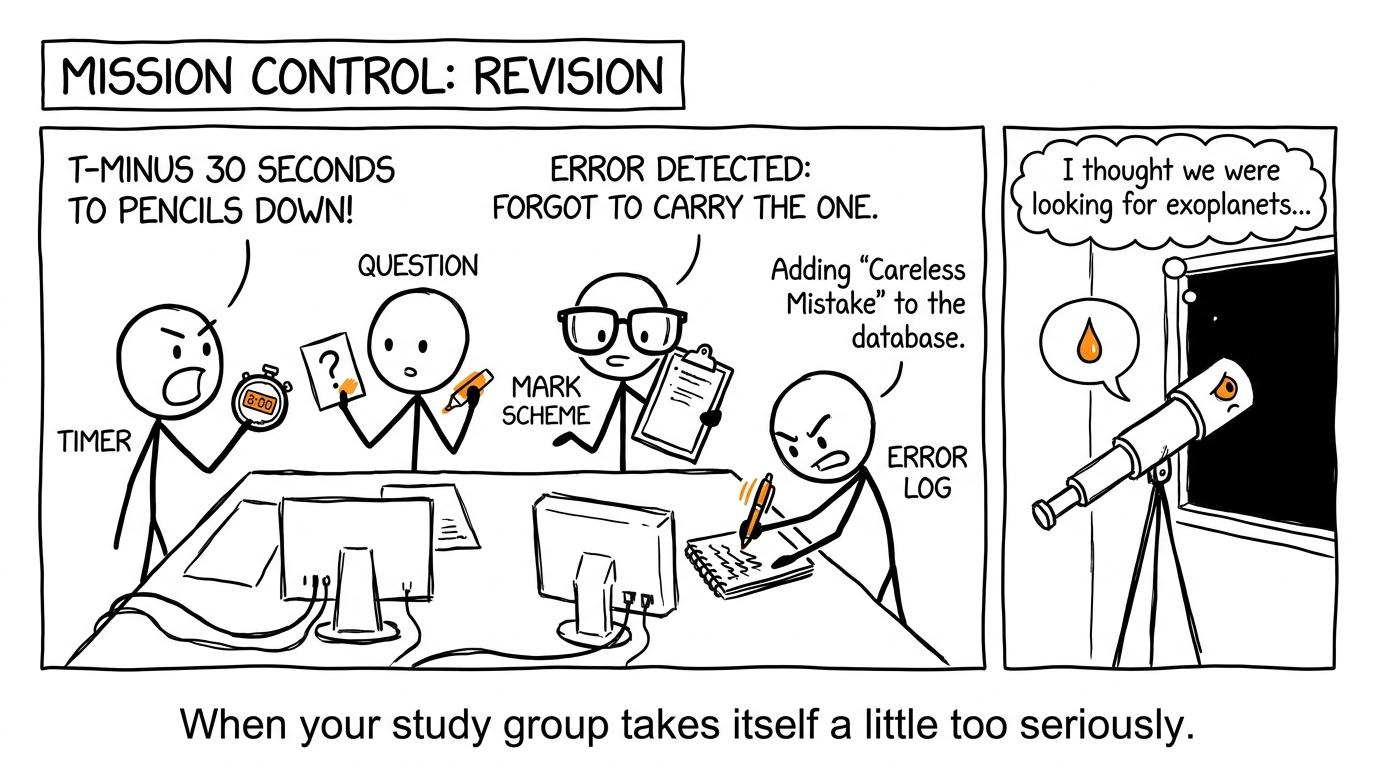 Astronomy revision mission control uses a timer, question cards, a mark scheme and an error log
Use roles to stop one person doing everything
Rotate four simple roles:
- Coordinator: confirms the room, time and topic
- Quiz setter: prepares retrieval questions with checked answers
- Timekeeper: keeps each stage moving
- Marker: brings the relevant mark scheme and records disputed questions
In a group of three, combine the last two roles. These are organisational responsibilities, not positions of authority. Rotation prevents the most organised student from becoming an unpaid teacher while everyone else arrives empty-handed.
If someone repeatedly fails to complete their role, simplify the job once. If the pattern continues, discuss whether they genuinely want to participate. A functioning group depends on honest expectations.
Connect astronomy revision to GCSE maths skills
A study group for astronomy should remain focused on astronomy, but calculation errors often reveal a separate maths weakness. Record that weakness precisely.
“Bad at maths” is not a useful diagnosis. “Incorrect index when dividing numbers in standard form” or “read the graph scale incorrectly” gives you something to repair.
Useful links between the subjects include:
- standard form for very large and very small quantities
- ratio and proportion when comparing scales or measurements
- rearranging formulae before substitution
- graphs, gradients and interpreting trends
- angles, scale drawings and bearings
- checking units and converting measurements
For angular and directional work, the AQA bearings revision resources show how diagrams, north lines and clockwise measurements are handled in GCSE maths. Students following another maths board should use their own specification-matched page. Likewise, SOHCAHTOA revision for Eduqas is useful only when right-angled trigonometry is the specific skill being repaired.
Do not let this turn the astronomy meeting into a general maths lesson. Add the weakness to an individual action list, use a MathsGenie revision lesson and practice questions separately, then return to an astronomy calculation later to check that the skill transfers.
Keep a shared error log
A total mark tells you how a paper went. An error log tells you what to do next.
Use five categories:
- Knowledge: a fact or definition was missing
- Application: the relevant idea was known but not applied
- Calculation: algebra, arithmetic, units or rounding caused the loss
- Communication: the response lacked detail, structure or correct terminology
- Observation: the plan, record, analysis or evaluation was incomplete
Record the topic, error and corrective action. Do not copy whole answers into the log. Its purpose is to reveal patterns.
Maths students can use the same method after a timed paper. MathsGenie’s guide to redoing GCSE past papers effectively explains why marking, targeted repair and delayed retesting are more valuable than immediately repeating a paper from memory.
Plan observational work separately and safely
An observation is not an ordinary revision meeting. It depends on suitable conditions, equipment, supervision and your centre’s instructions. Your teacher remains the authority on approved tasks, records and safety arrangements.
Before an agreed observation, clarify the target, location, date, time, equipment and recording method. Pearson’s guidance requires observational details such as date, time, location, seeing conditions and information about optical instruments where used.
Never observe the Sun directly or through binoculars or a telescope without properly approved specialist equipment and qualified supervision. A group should never improvise a solar observation from something seen online.
Afterwards, meet indoors to analyse the records and evaluate limitations. Keep individual work genuinely individual where your teacher requires it. Collaboration can help you discuss technique, but it must not become copied evidence.
Common mistakes that stop a study group working
Spending the meeting making the plan
Choose topics before the session. Planning should take minutes, not consume the revision time.
Letting the strongest student explain everything
Explanation can help the speaker while everyone else remains passive. Require individual answers before discussion and rotate who explains.
Marking generously
A friendly group can quietly award marks that an examiner would not. Use the mark scheme, identify missing details and ask your teacher when the scheme remains unclear.
Revising only favourite topics
Interesting subjects such as black holes or stellar evolution can attract attention while weaker areas disappear. Build meetings from the specification and error log, not curiosity alone.
Turning every session into a full paper
Full papers matter, but they diagnose rather than automatically repair weaknesses. Alternate timed questions with focused revision and later retesting. A structured one-month GCSE maths revision plan demonstrates the same learn, practise, mark and revisit rhythm.
Relying on predicted content
Predictions should never replace full specification coverage. In maths, MathsGenie’s Edexcel predicted papers are best used alongside topic revision and official past papers. Apply the same caution to astronomy: prepare broadly rather than gambling on a shortlist.
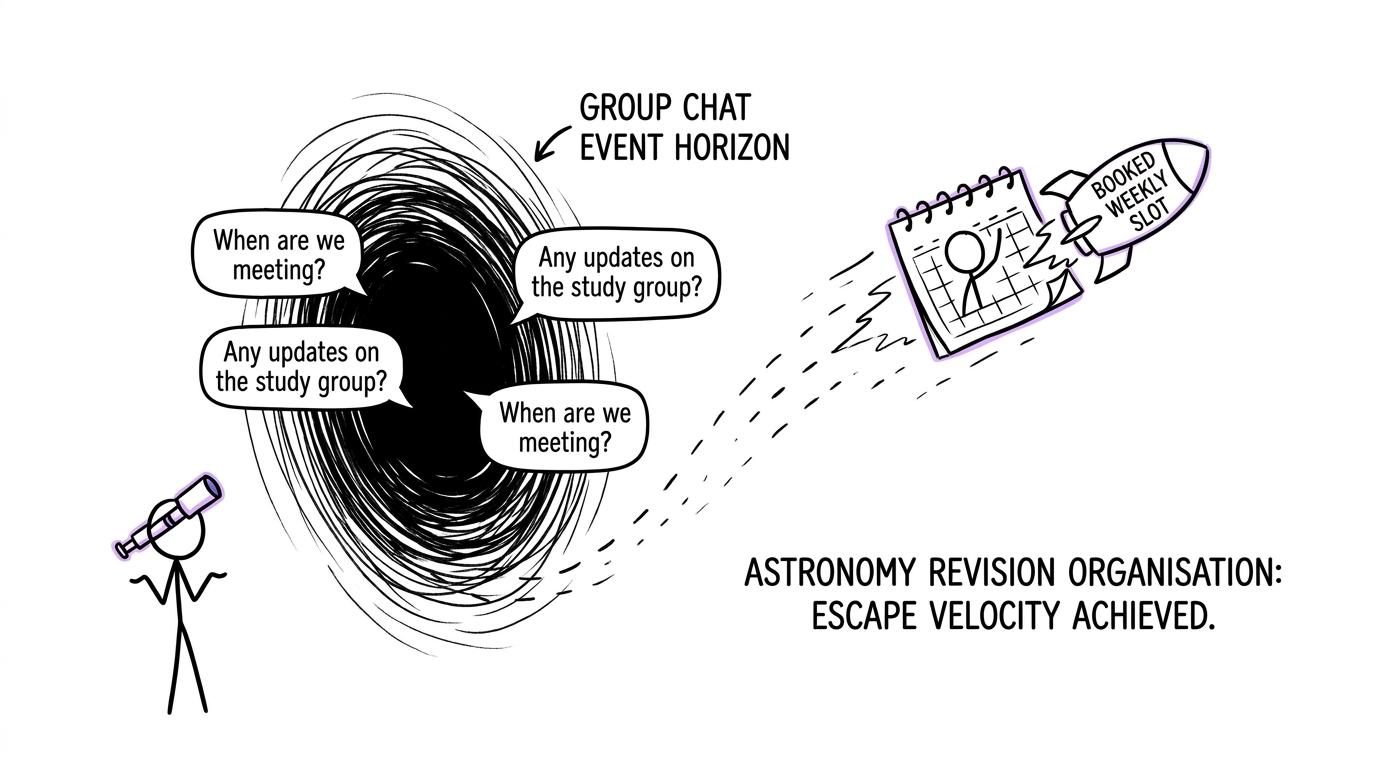 A calendar escapes the black hole of endless messages by booking one weekly revision slot
Make the group survive busy weeks
The real test is not the first meeting. It is the week when everyone has homework, mocks and competing commitments.
Set a minimum viable session: even if only two people attend, complete a 101010-minute quiz, one exam question and a brief marking discussion. Do not cancel automatically because the ideal meeting is impossible. Consistency is more valuable than occasional heroic sessions.
Review the group every four weeks. Ask whether attendance is reliable, whether weak topics are improving and whether everyone is completing independent work. Change the routine only when there is a clear problem to solve.
Turn conversation into marks
A useful GCSE astronomy study group is not defined by how often it chats. It is defined by what its members can retrieve, calculate, explain and evaluate when the notes are closed.
Fix the weekly slot. Keep the group small. Follow the specification, answer questions independently and let errors choose the next task. Then support the mathematical side with MathsGenie: use free revision lessons to repair methods, practice questions to build fluency, mini tests to check recall, and past papers, predicted papers, mark schemes and video solutions to prepare for exam conditions.
Start by arranging one meeting with one topic and one exam question. Small systems have a habit of travelling further than ambitious plans.











