GCSE Astronomy Revision Burnout: Avoid the May Wall
GCSE astronomy revision burnout can be prevented. Spot warning signs, pace astronomy and maths, protect sleep, and reach May ready for both papers.
Revision burnout rarely begins with a dramatic collapse. It usually starts quietly: one more late night, another session in which nothing seems to stick, and the uneasy feeling that resting is somehow falling behind.
If you are worried about GCSE astronomy revision burnout, the most useful response is not to work harder. It is to notice the warning signs early, reduce the load and replace long, passive sessions with short, active ones. Protect sleep, keep breaks in your timetable and ask for support when stress begins affecting everyday life.
Astronomy can feel especially large because the course stretches from the lunar disc to cosmology. At the same time, you may be preparing for GCSE maths and several other subjects. The challenge is not simply learning more. It is arriving in May with enough energy to retrieve and apply what you know.
Your burnout prevention checklist
Use this as a quick reset before changing your revision plan:
- Check whether tiredness, irritability or poor concentration is becoming a pattern.
- Give each session one precise target rather than an entire topic area.
- Use questions and recall instead of repeatedly reading notes.
- Plan stopping times as carefully as starting times.
- Keep regular space for meals, movement, sleep and activities you enjoy.
- Balance astronomy with maths and your other GCSE subjects.
- Tell a trusted adult if stress is persistent, severe or affecting daily life.
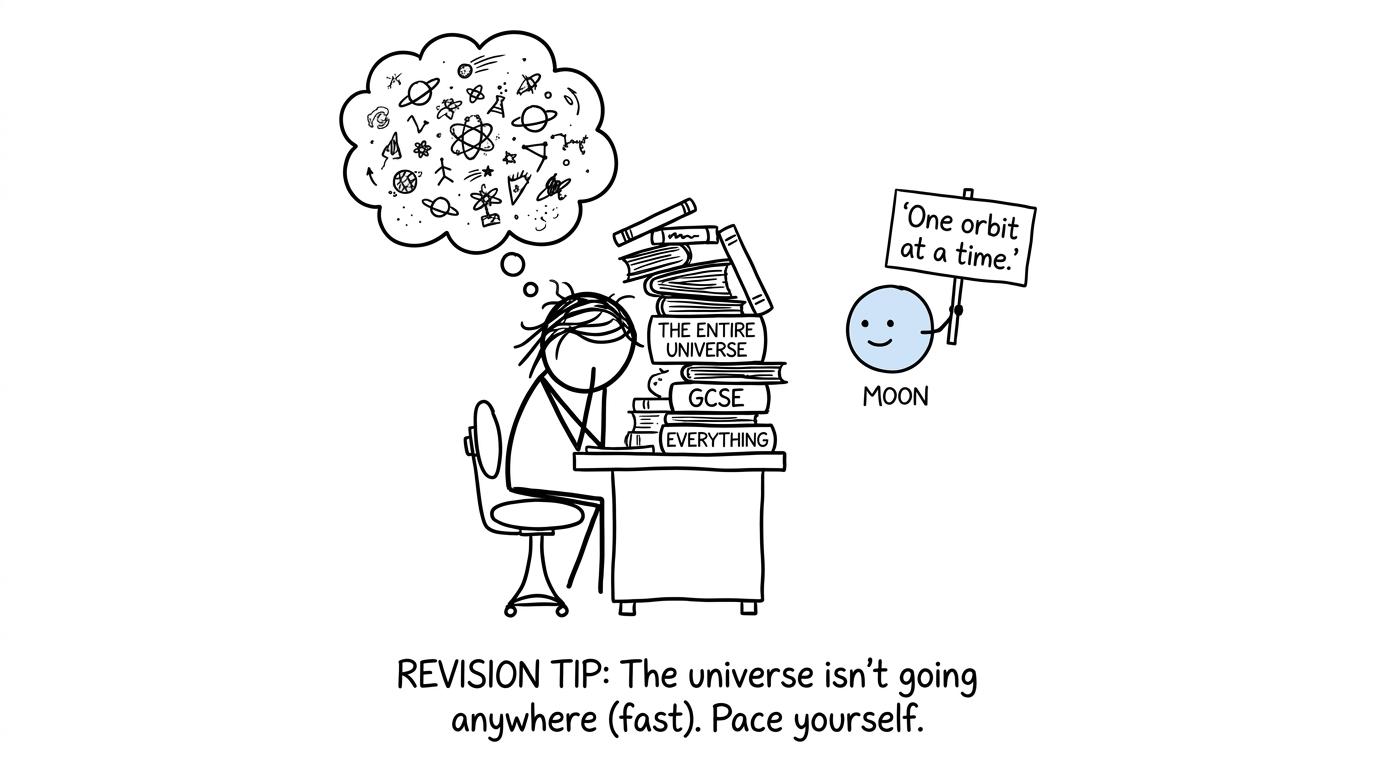 A tired student is reminded to take revision one orbit at a time
Why GCSE Astronomy can create revision overload
The current Pearson Edexcel GCSE Astronomy specification contains two equally weighted examinations: Paper 1, Naked-eye Astronomy, and Paper 2, Telescopic Astronomy. Each lasts one hour and 45 minutes, carries 100 marks and contributes 50%50\%50% of the qualification.
Across the two papers, students meet 16 broad topics. Questions can involve factual recall, calculations, graphs, data analysis and extended responses. That variety matters because revising astronomy is not one task. Learning the stages of stellar evolution, interpreting astronomical data and completing a calculation require different kinds of practice.
The overlap with maths is significant too. Standard form, rearranging formulae, proportional reasoning, graphs, angles and calculator fluency can all support astronomical problem-solving. A student who treats astronomy and maths as two completely separate revision mountains may duplicate work and exhaust themselves unnecessarily.
Use the GCSE Maths revision hub to identify mathematical skills that also support astronomy. If standard form is weak, for instance, improving it can help in both subjects. One focused session can serve two purposes.
Early signs you may be heading towards burnout
A difficult evening does not automatically mean burnout. Look for changes that continue across several days or begin interfering with school, sleep, relationships or ordinary routines.
Physical signs
Possible warning signs include persistent tiredness, headaches, stomach discomfort, tense muscles, disrupted sleep or noticeable changes in appetite. The NHS advises that most teenagers need around eight to ten hours of sleep each night. Regularly sacrificing sleep for revision can weaken the concentration you were trying to gain.
Emotional signs
You may become unusually irritable, anxious, low or hopeless about exams. Another sign is losing interest in activities you normally enjoy. Guilt during every break is also worth noticing: recovery is not wasted time, even when an examination is close.
Revision signs
Burnout often appears in the work itself. You might reread the same page without processing it, avoid starting, forget familiar ideas or spend hours making notes without testing yourself. Falling marks do not always mean you need more hours. Sometimes they mean the hours have stopped being productive.
These signs are information, not a verdict. If they are severe, persistent or making everyday life difficult, speak to a parent, carer, teacher, school pastoral team or GP. A revision timetable is useful, but it is not a substitute for proper support.
Pace GCSE Astronomy revision before May
A sustainable plan works backwards from what your mind can repeat consistently. It does not begin with the maximum number of hours you can survive on an unusually energetic Sunday.
Divide the specification into small outcomes
“Revise cosmology” is too broad for one session. A clearer target might be recalling key evidence for an expanding universe or interpreting one type of graph. The target should tell you when the session is complete.
Separate the course into three kinds of work:
- Knowledge: definitions, processes, models and sequences.
- Application: calculations, diagrams, graphs and unfamiliar contexts.
- Exam communication: command words, extended responses and evaluation.
This prevents the common mistake of revising only the most comfortable category. It also makes each session smaller and easier to begin.
Set a weekly rhythm, not a heroic daily target
Plan astronomy alongside all your subjects. Two or three focused astronomy sessions across a week may be more sustainable than a large weekend block, particularly while GCSE maths revision is also building.
The GCSE maths revision timetable guide shows how to combine topic practice, marking and timed work without filling every available hour. Use the same principle for astronomy: learn, retrieve, check, correct and return later.
Your plan also needs lighter days and genuine rest. If every free evening is allocated, one delayed task can make the whole timetable feel broken. Leave spare capacity. A robust plan bends.
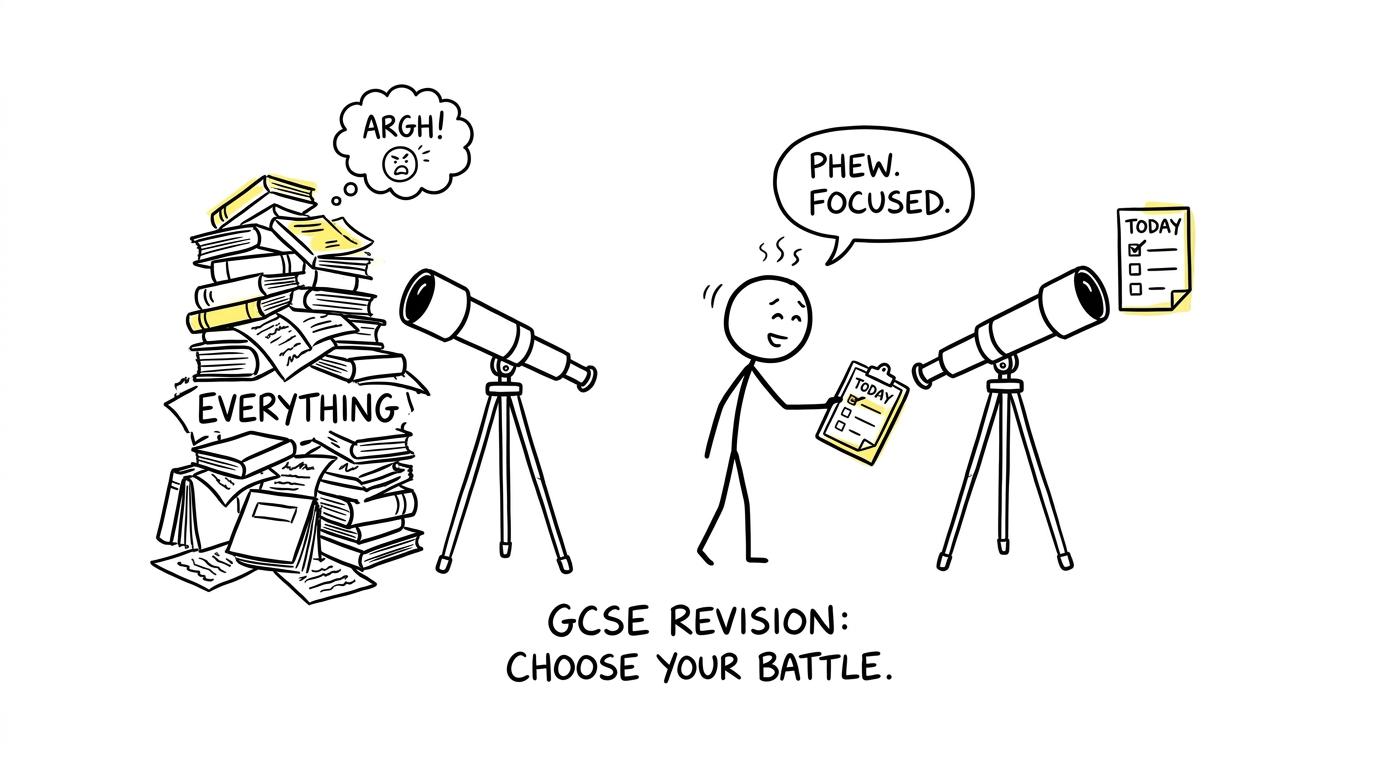 A student chooses one clear revision target instead of everything
Make shorter sessions do more work
Burnout prevention is partly about reducing unnecessary effort. Passive revision can feel gentle, but it often takes a long time to reveal what you cannot remember.
Retrieve before you reread
Close your notes and write down what you can recall. Answer a few questions, label a diagram from memory or explain a process aloud. Then check your response and correct it.
Retrieval practice is well supported by learning research, but feedback is essential. Recalling an incorrect idea repeatedly can strengthen the misconception. The sequence should be:
- attempt from memory;
- check against reliable notes or a mark scheme;
- correct the exact gap;
- return to it after a delay.
The MathsGenie guide to using active recall for GCSE revision explains how to turn notes into questions rather than producing another summary.
Stop while the session is still useful
A timer is not magical. Its value is that it creates a boundary. Choose a focus period you can sustain, take a proper break away from the desk and decide consciously whether another block is worthwhile.
Do not use the break to continue revision on your phone. Stand up, drink water, eat if needed or step outside. The aim is a change of attention, not simply a change of screen.
On lower-energy days, replace a full paper with a smaller diagnostic task. Maths students can use GCSE mini tests for this purpose. A short, marked task gives clearer information than an exhausted hour of highlighting.
Balance Astronomy with GCSE maths
May can become difficult because every subject suddenly claims to be the priority. The solution is not to give each one unlimited time. Decide what kind of work each subject needs next.
For maths, use results rather than anxiety to choose topics. A mini test, paper section or recent school assessment can reveal where marks are leaking. The GCSE one-month maths revision plan provides a calm structure for moving between targeted skills and timed practice.
For astronomy, alternate knowledge retrieval with calculations, graphical questions and longer written responses. Avoid spending a whole week on one comfortable area while difficult topics disappear from view.
As examinations approach, increase realism gradually. The MathsGenie guide to when to start GCSE past papers explains why paper practice should develop in stages. Start with sections, move towards timed papers and always review errors. Completing papers without analysing them creates fatigue more reliably than progress.
Protect sleep before you hit the May wall
Late-night revision is seductive because the cost arrives tomorrow. The extra hour feels productive now; the poor concentration is charged later.
Set a firm finishing time and allow yourself to wind down before bed. Keep your phone away from the pillow if notifications or scrolling delay sleep. If a thought about revision appears, write it on tomorrow's list rather than reopening your notes.
Movement, regular meals and time with other people are not rewards reserved for after the exams. They help maintain the routine that carries you through them. The goal is not perfect wellbeing every day. It is noticing when the basics have been repeatedly pushed aside.
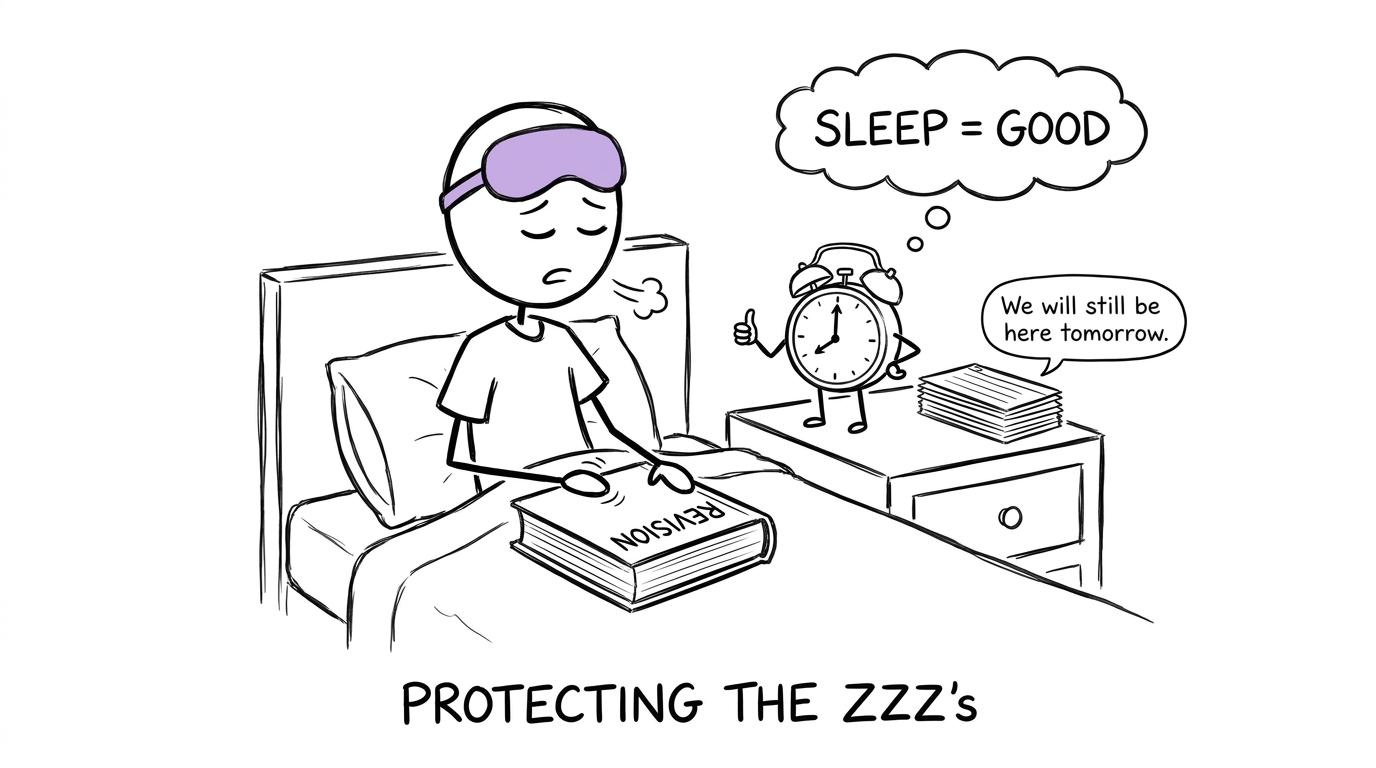 A supportive alarm clock approves of closing the revision book
Common mistakes that accelerate revision burnout
Counting hours instead of completed actions
“Four hours of revision” says little about learning. A better record is: completed one recall task, marked one question set and corrected three errors. Track useful actions, not time spent near a textbook.
Treating breaks as evidence of weakness
Breaks protect attention. Schedule them before you are exhausted rather than waiting until you can no longer continue.
Revising only by rereading
Familiar pages can create the impression that knowledge is secure. Close the book and test retrieval. Difficulty recalling something is useful evidence about what to revisit.
Taking full papers too frequently
Timed papers build stamina, but they are demanding. Use them strategically and spend time learning from the mark scheme. For maths, Edexcel GCSE predicted papers are best used after targeted revision, not as a replacement for it.
Ignoring persistent warning signs
Do not wait until you completely stop working. Reduce the load and speak to someone early. If stress is affecting sleep, eating, mood, school attendance or daily life, seek support from a trusted adult or health professional.
Arrive in May with something left
The night sky rewards patience. Revision does too. You do not need to hold the entire specification in your mind every evening; you need a process that lets you return, retrieve and improve without exhausting yourself.
Choose one astronomy target for your next session. Choose one maths weakness supported by evidence. Then stop at the planned time.
MathsGenie can remove much of the decision-making from your maths preparation. Use the free revision lessons and practice questions to repair individual topics, mini tests to check progress, and past papers, predicted papers, mark schemes and video solutions to build exam confidence. Before each paper, the GCSE maths exam-week checklist can help you keep the final days measured and calm.
The aim is not to reach May having done everything. It is to arrive able to think clearly, apply what you know and collect the marks your work deserves.