

GCSE Astronomy Mock Results: How to Use Them
GCSE astronomy mock results can guide smarter revision. Learn how to diagnose lost marks, prioritise maths skills and build an effective action plan.
A mock result can change the mood of an entire day. One number feels like proof that everything is going well or that nothing is. But GCSE astronomy mock results are most valuable when you stop treating them as a verdict and start treating them as evidence.
The practical answer is simple: review every lost mark, identify whether the cause was knowledge, application, analysis, mathematical accuracy or timing, and turn the largest recurring weaknesses into specific revision tasks. The grade tells you where one performance ended. Your marked paper tells you what to do next.
This matters particularly in astronomy because the subject combines scientific knowledge with calculations, graphs, data interpretation and observational reasoning. Improving the maths underneath those questions can strengthen both astronomy and GCSE maths performance.
Your mock-results checklist
Before beginning more revision, complete these actions:
- Record your mark, percentage and teacher feedback separately.
- Check which content and papers the mock covered.
- Review every question, including correct answers gained through guessing.
- Label each lost mark by its underlying cause.
- Group mistakes by topic, skill and assessment objective.
- Choose the three weaknesses likely to return in another paper.
- Match each weakness to a precise revision activity.
- Retest the skill with unseen questions after a short gap.
The purpose is not to spend hours admiring a spreadsheet. It is to make your next revision session easier to choose.
 A student discovers that a mock grade is not the whole universe
Understand what the astronomy mock measured
The current Pearson Edexcel GCSE Astronomy qualification has two externally examined papers. Paper 1 covers Naked-eye Astronomy and Paper 2 covers Telescopic Astronomy. Each paper is worth 100100100 marks, lasts 111 hour 454545 minutes and contributes 50%50\%50% of the qualification.
That structure matters when interpreting a school mock. A test covering only one paper, selected topics or material taught so far is not identical to the complete summer assessment. Ask your teacher exactly what was included before treating the result as a forecast.
The official assessment-objective weightings are:
| Assessment objective | What it assesses | Qualification weighting |
|---|---|---|
| AO1 | Knowledge and understanding of scientific ideas, techniques and procedures | 40%40\%40% |
| AO2 | Applying knowledge and understanding | 40%40\%40% |
| AO3 | Analysing information, evaluating observations and methods, making judgements and improving procedures | 20%20\%20% |
Ofqual also requires mathematical skills to be assessed in an astronomical context rather than as isolated maths exercises. The subject content specifies that mathematical skills must account for at least 20%20\%20% of the total marks. Observational knowledge and skills are assessed across the assessment objectives too.
This explains why knowing a definition is not enough. You may remember the relevant astronomy but still lose marks when a question asks you to apply it to unfamiliar data, justify a conclusion or process values accurately.
Read the paper before reading too much into the grade
A mock grade compresses many different events into one symbol. Perhaps you knew stellar evolution but misread a graph. Perhaps you understood an orbit calculation but rounded too early. Perhaps the final page was left unfinished.
Those are not the same problem, so they should not receive the same revision response.
Start by annotating the marked paper. For every lost mark, use one of these categories:
- Knowledge: you could not recall the relevant fact, process or definition.
- Application: you knew the content but could not use it in an unfamiliar situation.
- Analysis: you struggled to interpret data, evaluate a method or justify a conclusion.
- Mathematical method: you selected the wrong operation, formula or sequence of steps.
- Accuracy: the method was suitable, but arithmetic, units, substitution or rounding failed.
- Communication: your explanation lacked the precise scientific point required.
- Question reading: you missed a command word, condition or required number of responses.
- Timing: you did not reach the question or rushed the response.
Also mark any answer that earned marks through a guess. A lucky mark is not yet a secure skill.
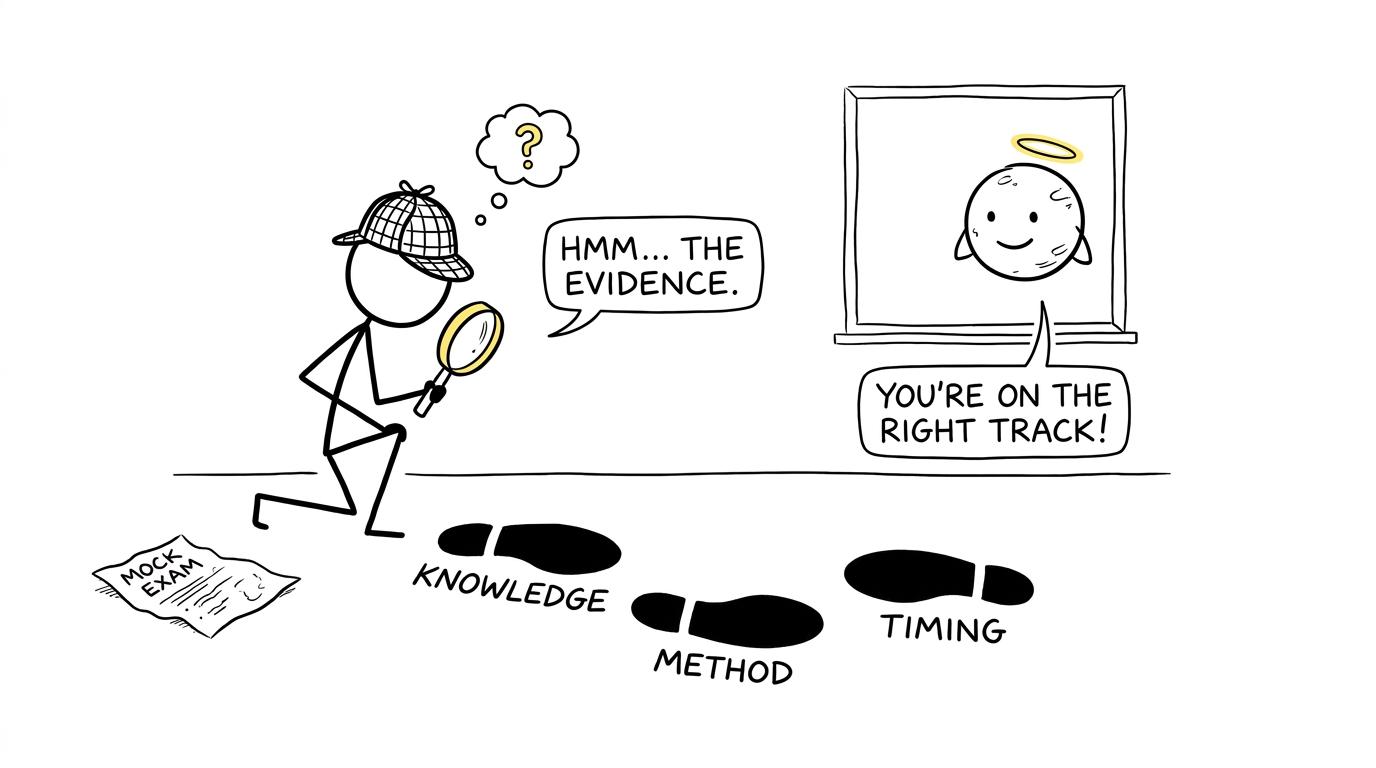 A student detective follows the evidence behind lost mock marks
Turn GCSE astronomy mock results into priorities
Once every mistake has a label, look for repetition. A single forgotten fact may need a short recall session. Five mistakes involving unit conversion or graph interpretation indicate a broader weakness.
A useful priority score can combine three factors:
priority score=marks lost×frequency×confidence gap\text{priority score}=\text{marks lost}\times\text{frequency}\times\text{confidence gap}priority score=marks lost×frequency×confidence gapThis is a planning tool rather than an exam-board formula. Give each factor a simple rating and use the result to compare weaknesses. The exact total matters less than the decision it produces.
Prioritise areas that:
- cost several marks;
- appeared more than once;
- connect to multiple astronomy topics;
- also support your GCSE maths paper;
- can realistically improve through focused practice.
Do not automatically revise the hardest-looking topic. The best next step is often the weakness leaking the most marks across several questions.
Build a marks-leak list
Keep the list short and specific. “Revise astronomy” is too broad. “Interpret gradients on observation graphs” or “convert astronomical quantities in standard form without rounding early” gives you something you can actually practise.
For each priority, record:
| Weakness | Evidence from the mock | Next action | Retest |
|---|---|---|---|
| Specific topic or skill | Question references and marks lost | Lesson, recall or question practice | Date and unseen task |
Choose no more than three main priorities at first. A long list can feel thorough while quietly preventing action.
Repair the maths behind astronomy questions
Astronomy often makes familiar maths look unfamiliar by placing it among planets, telescopes and enormous distances. If the context creates hesitation, return briefly to the underlying mathematical skill and then apply it again in astronomy.
Standard form and calculator accuracy
Large and small quantities make standard form revision especially relevant. Check whether mistakes came from entering powers of ten, comparing values, converting forms or giving a final coefficient outside the required range:
1≤a<101\leq a<101≤a<10Use the dedicated standard form question bank to isolate the skill. Return to astronomical questions only after the calculation itself feels reliable.
Graphs, scales and data
If your mock exposed weak graph reading, identify the exact issue. Was it choosing a scale, plotting accurately, describing a trend, calculating a gradient or distinguishing correlation from causation?
MathsGenie’s GCSE maths revision hub lets you choose resources for your exam board. Edexcel, AQA, OCR and Eduqas organise their maths specifications differently, so use the board and tier you actually take.
Trigonometry and angular reasoning
Some astronomy contexts involve angles, scale and spatial reasoning. If the underlying weakness is trigonometry, revise that maths directly rather than repeatedly struggling with the astronomy context. The exact trigonometric values guide can help Edexcel maths students review precise values and notation.
The purpose is not to replace astronomy revision with maths revision. It is to remove the mathematical obstacle so your astronomical understanding can earn marks.
Use the mark scheme as a map
A mark scheme shows what an answer needed to demonstrate. Compare it with your response line by line, but do not simply copy its wording and declare the topic fixed.
Ask four questions:
- What knowledge did the mark scheme require?
- Which part of my response earned credit?
- What precise idea, calculation or judgement was missing?
- Could I produce the required response to a different question?
For extended responses, note whether you made linked, relevant points rather than writing generally around the topic. For calculations, check whether working could have secured method marks even when the final answer was wrong.
The MathsGenie guide to using GCSE mark schemes explains how to classify lost marks and follow feedback with targeted practice. Although examples vary by subject, the central principle transfers: a mark scheme should change your next attempt.
Build a revision loop that closes
Revision becomes useful when it changes what you can do without support. Use this loop for each priority:
- Learn: repair the missing idea with notes, a lesson or teacher guidance.
- Practise: answer focused questions without looking at the solution.
- Mark: apply the mark scheme strictly.
- Explain: write one sentence describing the original error.
- Retest: attempt an unseen question after a gap.
- Mix: later combine the skill with other topics under timed conditions.
MathsGenie’s one-month GCSE revision plan provides a clear structure for spacing topic work, mini tests and paper practice. If you need help deciding what deserves attention, use the process in finding your weakest GCSE maths topics.
Retesting is the step students most often omit. Re-reading a corrected answer can create familiarity without independence. An unseen question reveals whether the method is now available when you need it.
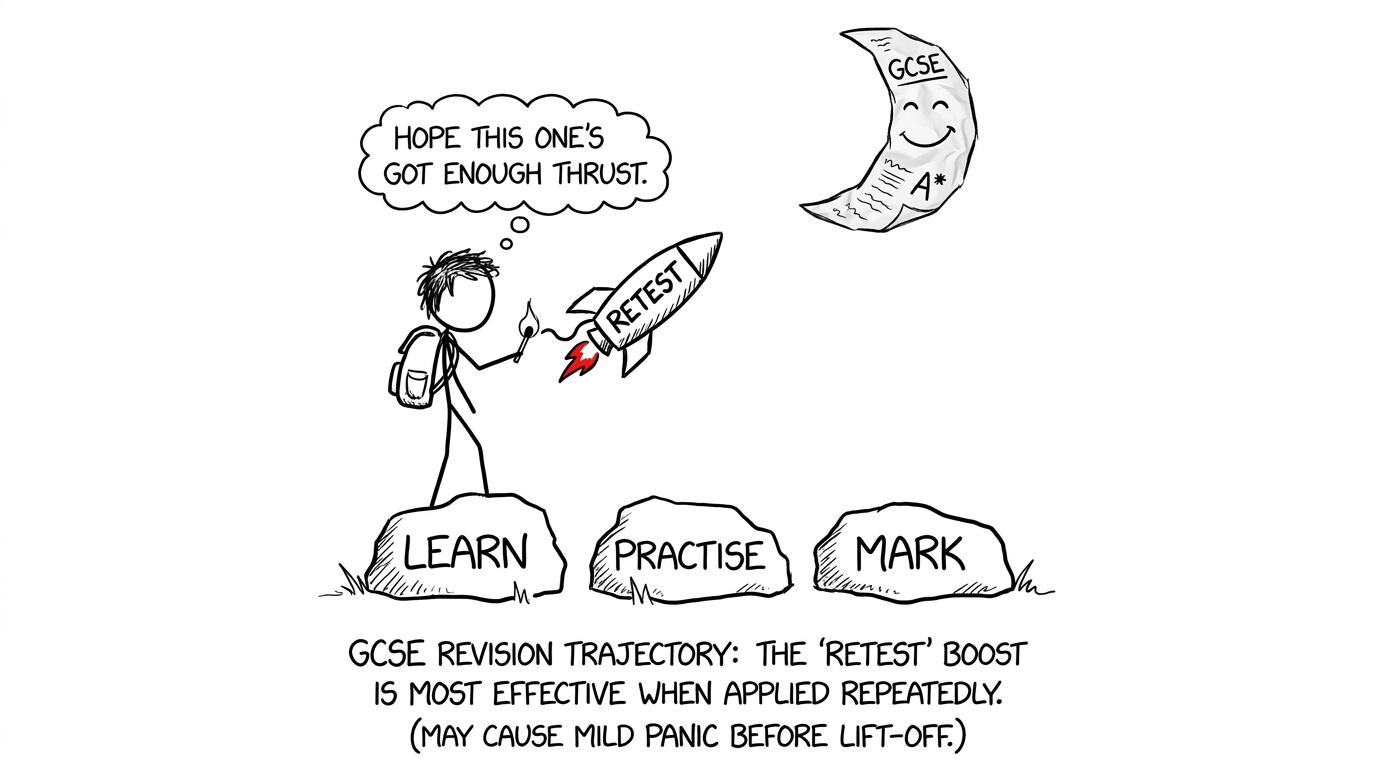 A revision rocket moves from learning and practice towards retesting
Separate subject knowledge from exam conditions
If unfinished questions caused lost marks, more notes may not solve the problem. You need timed practice.
Begin with a short section rather than repeatedly sitting full papers. Record when you hesitate, spend too long checking or abandon a question. Once the underlying topics are stronger, progress to longer mixed tasks.
For maths practice, the Edexcel GCSE maths past papers include mark schemes and worked solutions where available. Fresh Edexcel predicted papers can then supplement official past-paper practice. Predicted papers should sharpen preparation, not replace your astronomy specification or official exam-board materials.
Use the same discipline in both subjects: correct time, permitted equipment, no notes and honest marking.
Common mistakes when reviewing mock results
Revising only the lowest-scoring topic
A low topic score might actually come from one repeated maths or command-word error. Diagnose the cause beneath the topic label.
Comparing grades without comparing papers
Mocks can differ in content, difficulty, timing and grade-boundary method. Compare your skills and error patterns more confidently than two isolated grades.
Correcting the old answer but never retesting
A neat correction proves that you can follow feedback. It does not prove that you can answer a new question independently.
Treating every lost mark equally
One unusual fact and a recurring graph-reading weakness deserve different amounts of revision time. Look for frequency and transfer value.
Ignoring correct guesses
A guessed answer may add to the score while hiding uncertainty. Mark it as insecure and test the idea again.
Turning disappointment into an unrealistic timetable
A poor result can produce an ambitious plan containing every topic. A better response is smaller: select three priorities, attach clear tasks and complete the first one.
Make the result useful now
Your mock result cannot be changed, but its usefulness can. The grade is a snapshot; the paper is a set of instructions.
Take your GCSE astronomy mock results, classify the lost marks and choose the three weaknesses with the greatest effect. Repair astronomy knowledge with your course materials and teacher feedback. Where calculations, graphs, standard form or trigonometry are holding you back, use MathsGenie’s free revision lessons, practice questions, mini tests, mark schemes and video solutions to strengthen the maths underneath.
Then test yourself again. Move from focused practice to past papers and, nearer the maths exams, predicted papers. The goal is not to feel better about the old result. It is to make the next performance different.











