GCSE Astronomy: How Many Practice Papers to Do
GCSE astronomy how many practice papers: aim for four to six timed sittings, then use marking and targeted revision to fix gaps without burning out.
The difficult part of practice papers is not starting one. It is knowing when you have done enough. A growing pile can look like progress, even when the same mistakes keep returning.
For students searching gcse astronomy how many practice papers, the realistic answer is: aim for four to six complete timed sittings before the exams, divided between Paper 111 and Paper 222. If timing remains a serious weakness, extending this to six to eight sittings may help. But every paper must be marked, analysed and followed by targeted revision.
One timed sitting means one complete paper, not both papers back-to-back. The aim is not to exhaust every available question. It is to make accurate knowledge survive under exam conditions.
Your quick practice-paper checklist
A balanced target looks like this:
- Complete at least two timed sittings for Paper 111 and two for Paper 222.
- Build towards four to six full sittings overall.
- Leave several days between papers where possible.
- Use the correct time limit and permitted equipment.
- Mark every response against the official mark scheme.
- Record whether each lost mark came from knowledge, application, maths, wording or timing.
- Repair the biggest gaps before sitting another full paper.
- Stop adding papers when they no longer reveal useful weaknesses.
This is guidance rather than an official Pearson requirement. No exam board sets a compulsory number of practice papers. Your ideal total depends on your starting point, available materials and the quality of your review.
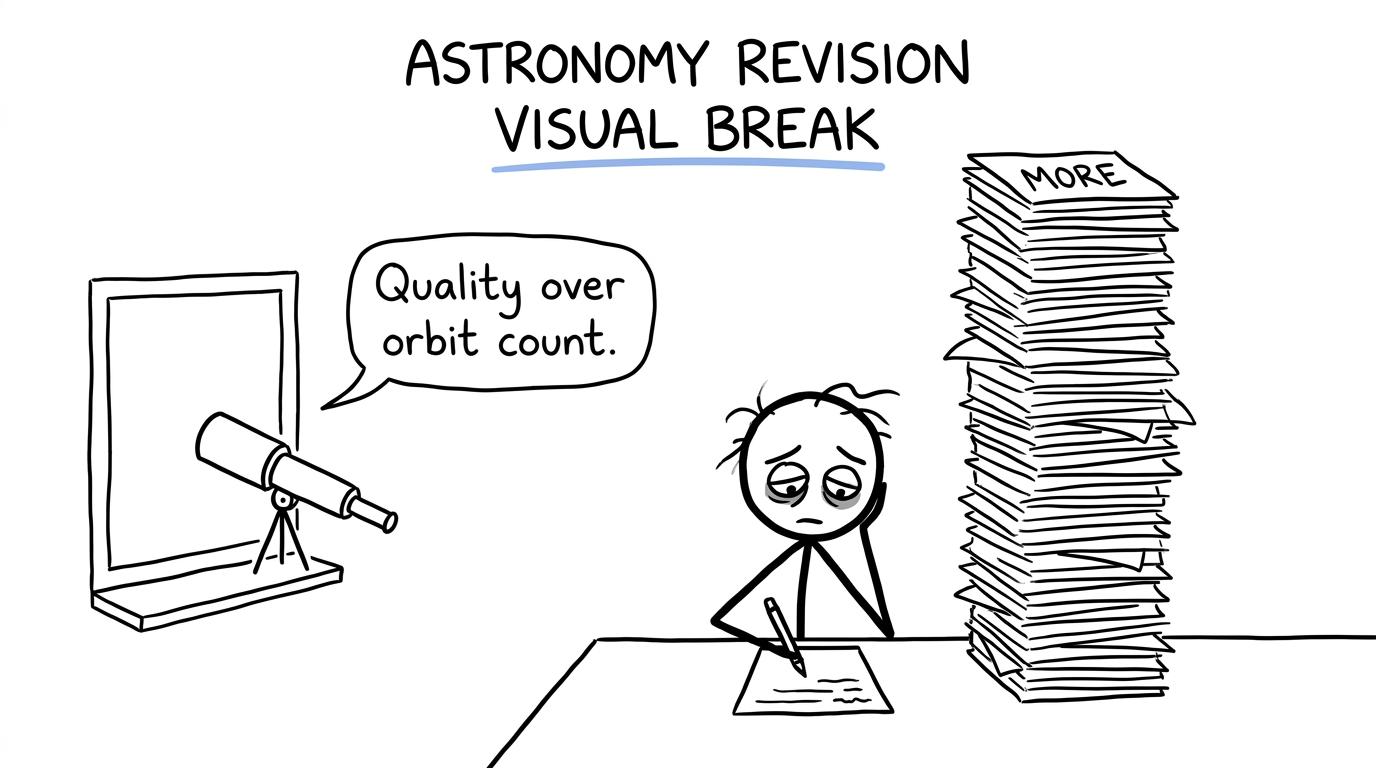 A student discovers that a taller pile of papers is not automatically better revision
Know what the GCSE Astronomy exams demand
The current Pearson Edexcel GCSE Astronomy specification, code 1AS01AS01AS0, is assessed through two externally examined papers. It is untiered, so there is no foundation or higher tier choice.
Paper 111, Naked-eye Astronomy, covers Topics 111 to 888. Paper 222, Telescopic Astronomy, covers Topics 999 to 161616. Each paper lasts 111 hour 454545 minutes, is worth 100100100 marks and contributes 50%50\%50% of the qualification.
Both papers contain a mixture of multiple-choice, short-answer, calculation, graphical and extended-open-response questions. Calculators may be used. Pearson also states that mathematical skills account for at least 20%20\%20% of the marks, while observational skills are assessed within the written examinations.
That matters because an Astronomy paper tests several performances at once. You must recall content, interpret unfamiliar information, calculate accurately, read graphs and explain ideas using precise scientific language. Full timed sittings help you practise that combination in a way that isolated questions cannot.
Why four to six timed sittings is realistic
Four to six sittings provide enough repetition to experience both papers more than once while leaving time for the revision that actually changes your performance.
A useful allocation is:
| Stage | Timed paper target | Main purpose |
|---|---|---|
| Early diagnosis | One Paper 111 and one Paper 222 | Find broad knowledge and timing gaps |
| Development | One or two further sittings | Test whether targeted revision worked |
| Final rehearsal | One Paper 111 and one Paper 222 | Confirm pacing, stamina and exam routine |
Six full sittings require 101010 hours 303030 minutes of writing time before marking and correction. Once review is included, the commitment is considerably larger. That is why a target of fifteen hurried papers is rarely sensible for a student balancing Astronomy with GCSE maths, English and science.
Research on retrieval practice supports testing yourself rather than relying only on rereading. It also suggests that retrieval is most useful when attempts are distributed over time and combined with feedback or restudy. In practical terms, the productive cycle is not paper, paper, paper. It is paper, feedback, repair, retest.
MathsGenie's guide to when to start GCSE past papers explains the same phased approach for maths: begin with diagnosis, develop through timed sections and reserve full rehearsals for when most of the content has been covered.
Match the number to your starting point
If you are still learning major topics
Do two initial full sittings, one for each paper, and treat them as diagnostics. Then step back from complete papers.
Use shorter question sets while you repair missing knowledge. Repeatedly sitting full papers when you cannot begin many questions mostly rehearses being stuck. The MathsGenie GCSE revision hub can support calculation skills that cross into Astronomy, including graph interpretation, ratios, units and formula work.
When scientific notation is costing marks, for example, use the free standard form revision lesson and questions. Then return to Astronomy calculations supplied by your teacher or Pearson to test the skill in its proper subject context.
If your knowledge is secure but timing is weak
Aim towards six timed sittings. The extra value comes from rehearsing decisions: when to move on, how much working to show and how long to leave for checking.
A simple benchmark is the average available time per mark:
105 minutes100 marks=1.05 minutes per mark\frac{105\text{ minutes}}{100\text{ marks}}=1.05\text{ minutes per mark}100 marks105 minutes=1.05 minutes per markThis is not a rigid rule. Reading, diagrams and extended responses change the pace of individual questions. It is simply a warning system. Spending fifteen minutes on a low-mark part can quietly remove your chance to attempt easier marks later.
If you are close to the exam
With less than two weeks remaining, do not try to compress six sittings into a few days. Choose one complete paper from each side of the course, mark both carefully and devote the remaining sessions to your highest-value gaps.
The GCSE one-week revision plan offers a useful structure for balancing diagnosis, focused practice and final rehearsal. Its resources are designed for maths, but the planning principle transfers well to Astronomy.
Make each timed paper produce a revision plan
A score tells you what happened. An error log tells you what to do next.
After marking, classify each lost mark under one of these headings:
- Knowledge: a fact, definition or process was missing.
- Application: you knew the topic but could not use it in the unfamiliar context.
- Mathematics: the formula, substitution, units, rearrangement or calculator work failed.
- Graphical skill: a scale, gradient, trend or plotted value was misread.
- Communication: the response lacked the scientific detail required by the mark scheme.
- Timing: the question was rushed or left untouched.
Then choose the two or three categories responsible for the most lost marks. The article on finding your weakest topics quickly shows how to turn paper evidence into a short, specific priority list.
Do not immediately sit another full paper. Relearn the content, answer focused questions and retest the same skill using unseen material. MathsGenie's approach to using past papers properly is built around this attempt, mark, repair and retest loop.
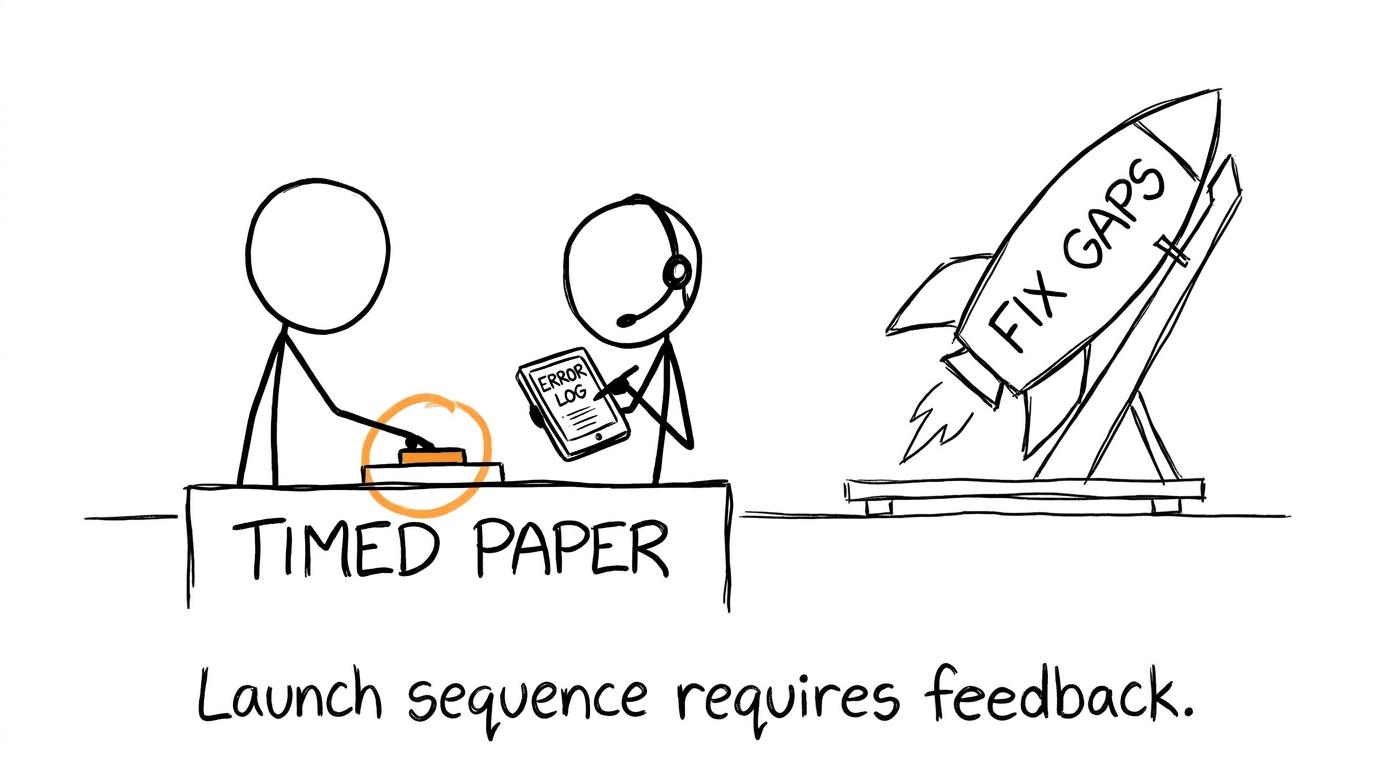 Astronomy revision mission control remembers that feedback belongs in the launch sequence
How to space your full timed sittings
If you have six weeks, one full sitting each week is usually enough. Alternate between Paper 111 and Paper 222, placing targeted revision between them.
With four weeks, one or occasionally two sittings per week can work, provided review time remains protected. A realistic GCSE maths revision timetable can help you fit paper practice around your other subjects without allowing one weekend to become an endurance test.
Use official current-specification Pearson papers and sample assessment materials for Astronomy. Confirm the paper code 1AS01AS01AS0, because legacy papers reflect an older assessment structure. Older questions may still provide topic practice, but they should not all be treated as exact rehearsals of the current exams.
MathsGenie predicted papers are written for GCSE maths rather than GCSE Astronomy. They should not replace official Astronomy papers. However, the Edexcel GCSE maths predicted papers, complete with mark schemes and solutions, can strengthen timed mathematical fluency alongside your subject-specific revision.
When more practice papers stop helping
More papers stop being the best use of time when the next sitting provides less useful information than a focused revision session would.
Look for these signs:
- You recognise answers because you have already seen the paper.
- The same knowledge gaps appear without being repaired.
- You total the mark but rarely read the mark scheme closely.
- Your recent scores and completion times are stable.
- Most remaining errors come from one or two identifiable topics.
- Fatigue is reducing concentration across your other GCSE subjects.
- You are choosing another paper because deciding what to revise feels harder.
At that point, switch to targeted questions, short timed sections, recall and corrected responses. A remembered paper measures memory of that paper, not readiness for an unseen examination.
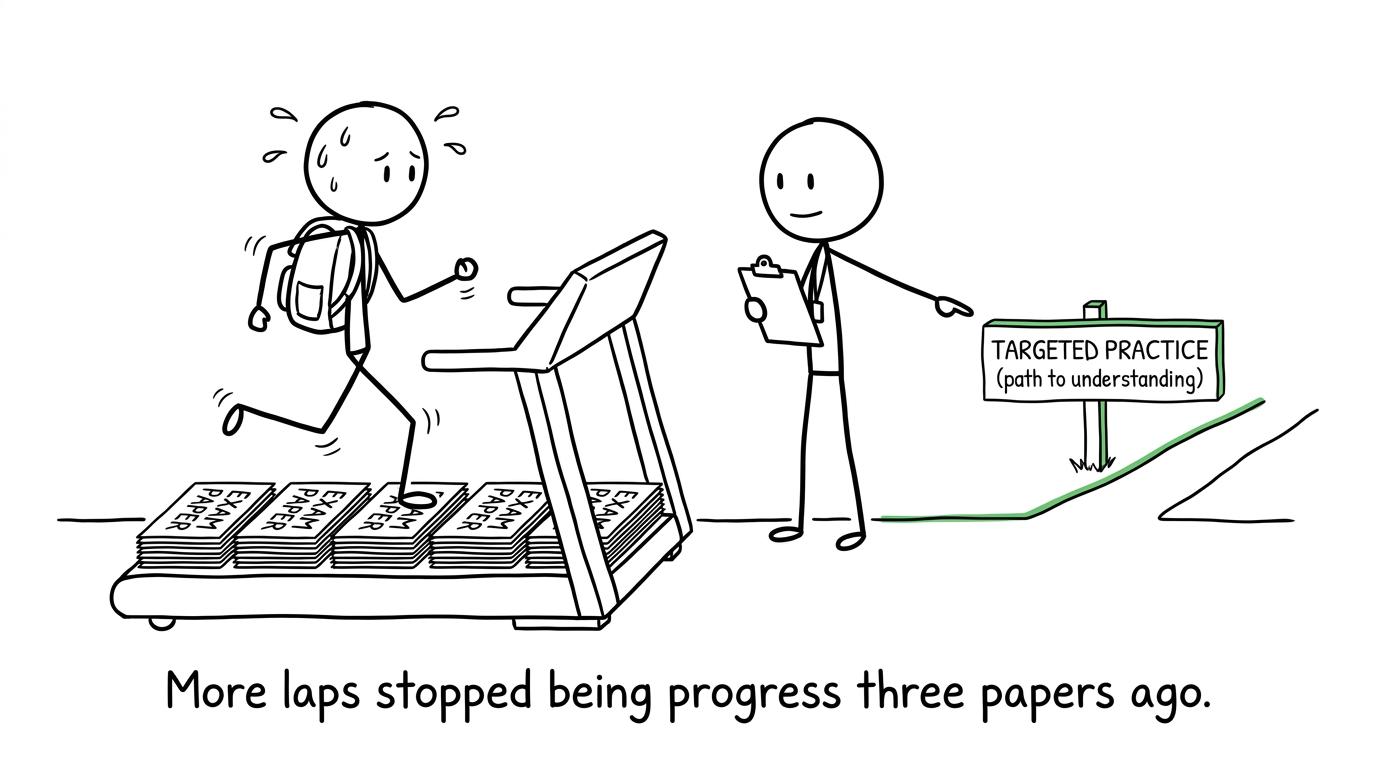 A student leaves the endless paper treadmill for targeted revision
Common mistakes with GCSE Astronomy practice papers
Counting papers instead of corrections
A completed paper is only the first half of the task. If review is skipped, the number becomes a vanity measure rather than evidence of improvement.
Using legacy papers as perfect simulations
Check that full rehearsals match the current 1AS01AS01AS0 specification. Use older material selectively for individual topics, not as your only guide to timing and paper structure.
Practising only the preferred paper
Students often return to the half of the course they enjoy. Divide your sittings between Naked-eye Astronomy and Telescopic Astronomy so confidence in one does not conceal weakness in the other.
Ignoring mathematical errors
Astronomy calculations can expose weaknesses in standard form, unit conversion, scale, graphs and rearranging formulae. Repair the underlying maths instead of memorising one Astronomy answer. The broader MathsGenie guide on how many GCSE past papers to do explains why targeted work between papers matters more than chasing a large total.
Sitting papers too close together
Back-to-back attempts leave little opportunity for learning. Space them out, revisit errors and use a fresh paper only when you are ready to test whether the repair held.
Build readiness, not just a paper count
Four to six complete timed sittings is a strong target for most GCSE Astronomy students: at least two for each paper, followed by additional rehearsals where they address a real need. Move towards six to eight only if timing or stamina remains weak and you can still review every attempt properly.
The final goal is quieter than a huge stack of papers. It is reaching the exam able to recognise the task, choose a method, manage the clock and recover when a question feels unfamiliar.
Use official Pearson materials for Astronomy, then let MathsGenie strengthen the mathematical foundations beneath them. Start with free GCSE maths revision lessons and practice questions, use mini tests to expose fragile skills, and move into past papers, predicted papers, mark schemes and video solutions when you need realistic pressure. Sit fewer papers with greater attention. That is how practice turns into marks.