

GCSE Astronomy Homework Grade Impact: Does It Matter?
GCSE astronomy homework grade impact explained: what counts towards your final result, which tasks improve exam marks, and when maths revision should win.
A homework mark can feel strangely powerful. One poor score arrives in red pen, and suddenly it seems to predict the summer. But the GCSE astronomy homework grade impact is indirect: ordinary homework marks do not form part of your final Edexcel GCSE Astronomy grade. Your result comes from two externally examined papers. Homework matters when it helps you recall knowledge, perform calculations, interpret data and explain observations more accurately in those exams.
That distinction should change how you work. Completing more homework is not automatically better. Completing the right work, checking it carefully and fixing what it reveals can make a genuine difference.
The short answer
Use this checklist before giving astronomy homework more of your revision time:
- Homework itself is not an assessed component. Your teacher's homework grades do not get added to your final GCSE result.
- Both written papers count. Paper One, Naked-eye Astronomy, and Paper Two, Telescopic Astronomy, each contribute 50%50\%50%.
- Observations are compulsory but not marked as coursework. You must complete at least one unaided and one aided observation, while the knowledge and skills developed through them are tested in writing.
- Mathematical skills matter. At least 20%20\%20% of marks across the written assessments assess maths.
- Quality beats volume. Homework is most useful when it matches the specification, requires active thinking and is followed by feedback.
- Your weakest upcoming exam may deserve the next hour. If maths is costing you more attainable marks, splitting your time can be wiser than polishing astronomy work you already understand.
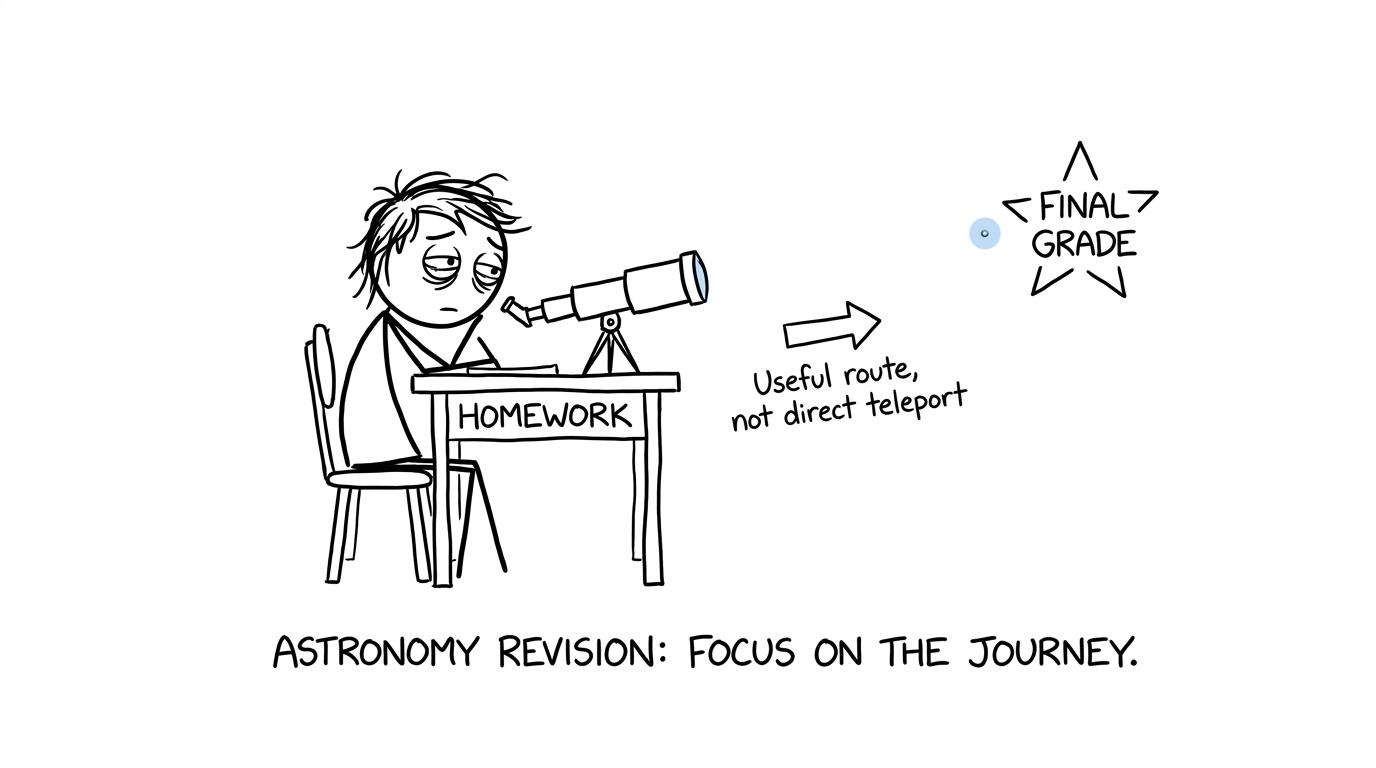 A student looks through homework towards a distant final grade
What actually determines your GCSE Astronomy grade?
The current Pearson Edexcel GCSE Astronomy qualification is linear and untiered. Unlike GCSE Maths, there is no separate foundation or higher tier. Students sit two written examinations at the end of the course, each lasting 111 hour 454545 minutes and carrying 100100100 marks.
| Assessment | Contribution to final grade |
|---|---|
| Paper One: Naked-eye Astronomy | 50%50\%50% |
| Paper Two: Telescopic Astronomy | 50%50\%50% |
| Ordinary homework marks | 0%0\%0% directly |
| Marked observational coursework | 0%0\%0% directly |
This does not make homework or observation unimportant. It means their value must travel through a longer route:
task⟶feedback⟶better understanding⟶more exam marks\text{task} \longrightarrow \text{feedback} \longrightarrow \text{better understanding} \longrightarrow \text{more exam marks}task⟶feedback⟶better understanding⟶more exam marksPearson requires students to undertake at least one unaided and one aided observation. Centres certify their completion, but the observation records do not receive marks that are added to the final grade. Instead, observational knowledge is assessed in the written papers, with at least 15%15\%15% of examination marks allocated to observational skills.
So a rushed observation write-up may earn no direct coursework percentage, yet the thinking behind it can still help you answer questions about planning, accuracy, reliability, light pollution, data analysis and improvements.
Why homework can still improve your result
The Education Endowment Foundation's evidence review reports a positive average relationship between homework and secondary-school attainment, while rating the security of the evidence as low. More importantly, it finds substantial variation: tasks linked to classroom learning and supported by feedback tend to be more effective, and quality appears more important than quantity.
That is useful because it avoids a false promise. Nobody can honestly say that another hour of homework guarantees a particular grade. Homework affects preparation, not grade boundaries.
It reveals knowledge you cannot yet retrieve
Reading a page about stellar evolution can create familiarity. Answering a closed-book question reveals whether you can actually retrieve the sequence, vocabulary and physical explanation.
Effective homework therefore begins with an attempt from memory. Notes can be used afterwards to check and improve the response. If they remain open from the first line, the task may measure copying more than learning.
It develops application, not just recall
Astronomy papers include calculations, graphical work, short answers and extended responses. Knowing a definition is only one layer. You may also need to select information, convert units, interpret evidence or evaluate an observing method.
The specification's mathematical content includes standard form, ratios, percentages, inverse-square relationships, significant figures, graphs and specialist distance units. Students who need stronger numerical foundations can use MathsGenie's free GCSE Maths revision hub and standard form revision resources. The exam board label on a maths resource matters for full-paper practice, but a correctly taught mathematical skill can still support an astronomy calculation.
Feedback turns effort into improvement
A score tells you where you landed. Feedback tells you what to change.
After receiving marked homework, classify each lost mark:
- knowledge: the fact or concept was missing;
- application: you knew the content but could not use it in context;
- calculation: the method, units, rounding or substitution failed;
- communication: the explanation lacked a required link;
- attention: you misread the command word or data.
This is the same principle behind MathsGenie's guide to finding your weakest GCSE topics. Revision becomes efficient when mistakes decide the next task.
The homework that has the greatest grade impact
Not all completed pages produce equal value. A short task that exposes a misconception can be more useful than a perfect page copied from notes.
Exam-style questions with delayed checking
Attempt questions without help, then compare your work with the mark scheme. Look beyond the total. Identify the exact idea, calculation step or explanatory link that earned each mark.
Do not memorise a particular sentence blindly. Learn what made it creditworthy. Maths students can practise this review cycle through MathsGenie's GCSE past-paper library, where papers and official mark schemes can be used together.
Observational tasks treated as exam preparation
Observation is not decorative administration. It gives concrete meaning to seeing conditions, equipment choices, variables, accuracy and reliability.
When completing an aided or unaided task, ask yourself:
- Why is this method suitable?
- What could reduce the quality of the observation?
- Is there enough evidence for the conclusion?
- How could the programme be repeated or improved?
- How should numerical or visual data be presented?
Those questions mirror the design, observation, analysis and evaluation cycle in the specification.
Short retrieval spaced across the week
One large session can create a strong feeling of effort. Several shorter returns force the brain to reconstruct the knowledge again. That reconstruction is useful.
A practical pattern is to attempt a closed-book recall task, check it, revisit the same material after a delay and then apply it to an unfamiliar question. Feedback is essential because repeatedly retrieving an incorrect idea can strengthen the misconception.
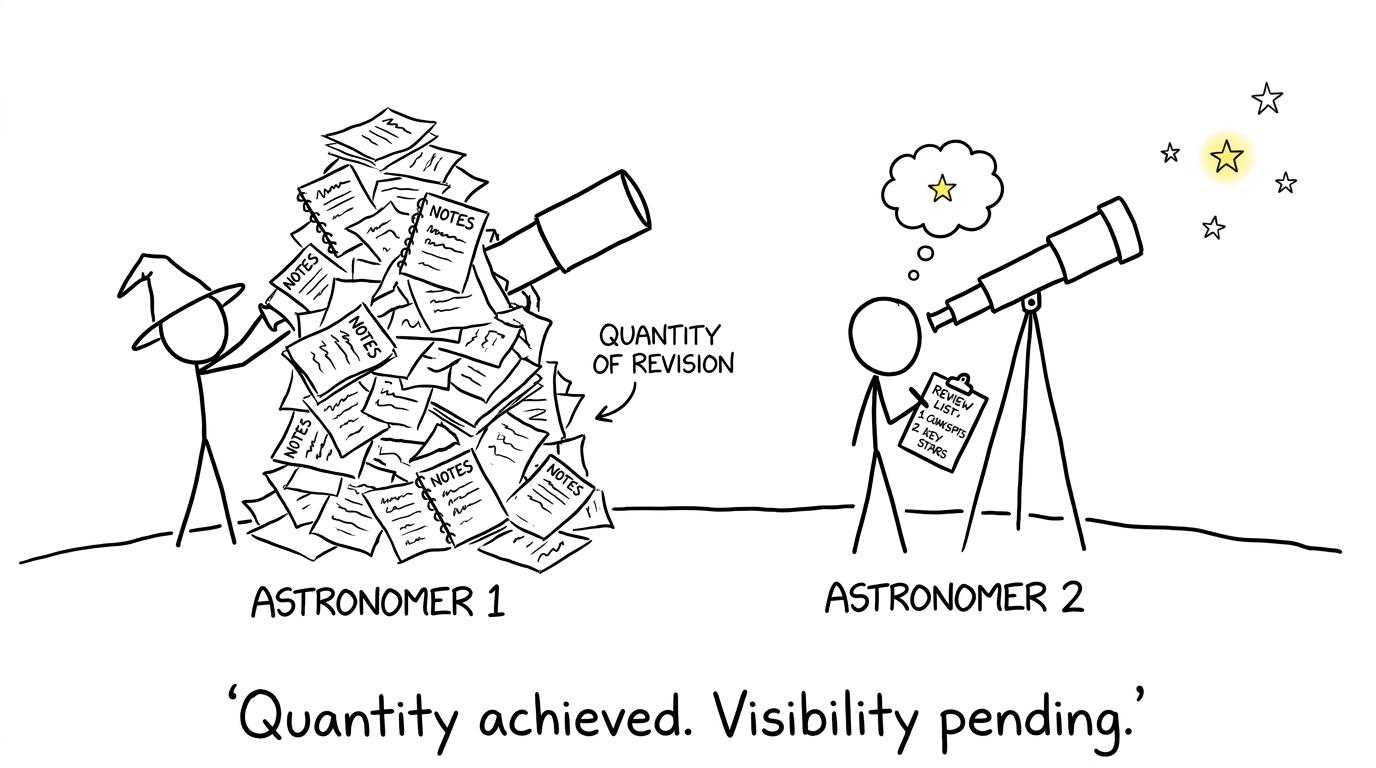 One student's copied notes block the telescope while another uses a checklist
When maths revision should take priority
Students rarely revise one subject in isolation. The real question is often not whether astronomy homework is useful, but whether it is the best use of tonight's available time.
Start with deadlines and compulsory work. Missing a required observation is different from leaving an optional extension unfinished. Then compare the likely value of your remaining tasks.
A simple decision rule is:
revision value=attainable marks addressedfocused time required\text{revision value} = \frac{\text{attainable marks addressed}}{\text{focused time required}}revision value=focused time requiredattainable marks addressedThis is not a precise prediction. It is a way to think clearly. If you already understand an astronomy topic and are merely rewriting neat notes, while algebraic manipulation is repeatedly costing marks in GCSE Maths, the maths work probably has greater immediate value. If tomorrow's astronomy homework tests an unresolved problem with inverse-square relationships, it may deserve priority because it strengthens both subjects.
Use three questions:
- Urgency: Is the task due soon or required for the course?
- Weakness: Does it address something you regularly get wrong?
- Transfer: Will it strengthen skills used in more than one paper or subject?
For a balanced week, use the structure in MathsGenie's GCSE maths revision timetable guide. Keep some sessions for targeted topic work and others for timed assessment. As maths exams approach, mini tests and phased paper practice provide better evidence than guessing which subject feels weakest.
A better astronomy homework routine
A productive session can be simple:
Begin with a clear purpose
Write down what the task is meant to improve: factual recall, calculation fluency, graph interpretation, observational evaluation or extended writing. If you cannot identify the purpose, ask your teacher.
Attempt before consulting notes
Give your memory a genuine chance. Mark uncertain answers rather than immediately searching for them. The struggle shows where revision is needed.
Check every response
Use teacher feedback, an answer sheet or a mark scheme. Correcting only the final answer is not enough; locate the first point at which the reasoning went wrong.
Record one actionable fix
Avoid vague notes such as “revise astronomy”. Write a specific instruction: learn the distinction, practise the unit conversion, state the source of error or explain why repeated observations improve reliability.
Re-test later
Try a different question on the same skill after a delay. Improvement is demonstrated by a better independent response, not by recognising yesterday's correction.
Maths students can use the same loop with MathsGenie's guide to using past papers properly: attempt, mark, diagnose, relearn and re-test.
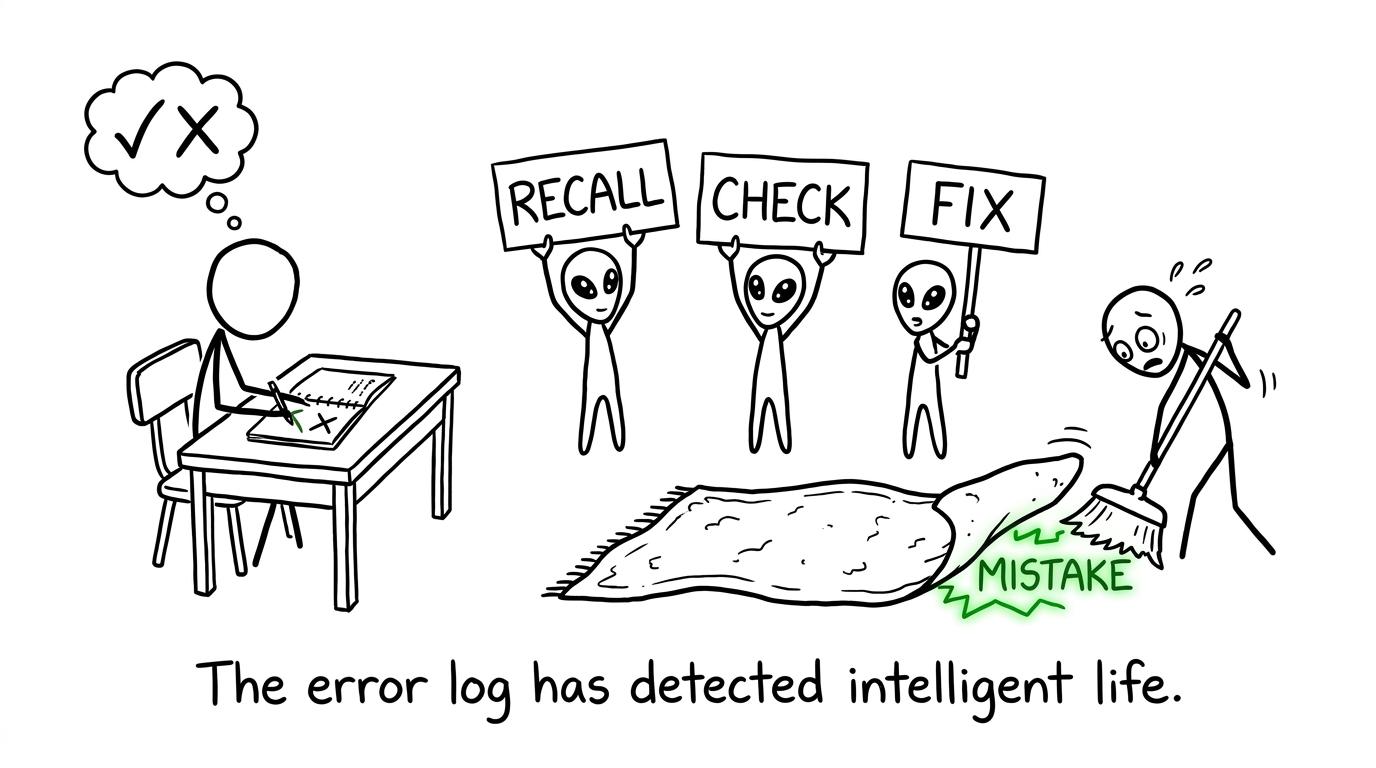 Aliens help a student find and fix revision errors
Common mistakes that reduce homework's value
Treating completion as the goal
A tick proves that work was submitted. It does not prove that the knowledge can be recalled under exam conditions. Measure success by what you can do afterwards.
Spending equal time on every task
Easy, neat work can consume time because it feels safe. Give more attention to weaknesses that are likely to cost accessible marks.
Ignoring mathematical errors
An astronomy answer can contain sound scientific understanding and still lose marks through incorrect units, premature rounding or mishandled standard form. Strengthen the underlying maths rather than labelling the whole question “astronomy”.
Looking at solutions too early
A solution often feels obvious once it is visible. That feeling is recognition, not independent recall. Attempt first, even if the first attempt is incomplete.
Never returning to corrections
Correcting work once closes the page, not necessarily the gap. Re-test after a delay. For maths, a predicted paper with worked solutions can later test whether corrected skills survive in a mixed setting, although predicted papers should never be treated as guarantees of exam content.
Make homework earn its place
Your final GCSE Astronomy grade is not an average of classroom homework scores. It is determined by performance across the two written papers. Yet homework can still matter greatly when it creates the knowledge, calculation fluency and observational judgement those papers reward.
Be selective rather than dismissive. Complete compulsory tasks, prioritise genuine weaknesses, seek feedback and re-test what you corrected. If maths is the larger marks leak, let maths revision win some evenings without guilt.
MathsGenie can provide the numerical side of that plan for free. Begin with a GCSE Maths revision lesson, move into practice questions, then use mini tests, past papers, predicted papers, mark schemes and video solutions to check whether the improvement is real. Homework is valuable when it changes what happens in the exam. Make every task prove that it has.











