GCSE Astronomy Cross Curricular Overlap: Does It Help?
GCSE astronomy cross curricular overlap explained: connect maths, physics and geography skills, avoid duplicate revision and prepare efficiently for exams.
Revision can feel strangely repetitive. On Monday, you convert units in maths. On Tuesday, the same skill appears in physics. By Wednesday, GCSE Astronomy asks you to use it with distances between stars. The setting has changed, but much of the thinking has not.
So, does gcse astronomy cross curricular overlap genuinely help? Yes, particularly across maths, physics, geography and scientific enquiry. The important distinction is that overlapping skills can be revised together, while subject-specific knowledge still needs separate attention. Used carefully, this can reduce duplicated revision and help you recognise familiar mathematics inside unfamiliar exam questions.
The official GCSE Astronomy requirements make that overlap significant. Mathematical skills account for at least 20%20\%20% of the qualification's marks, while observational knowledge and skills account for at least 15%15\%15%. Astronomy is not simply a collection of facts about space. It requires calculation, interpretation and evaluation.
A quick cross-curricular revision checklist
Before revising an astronomy topic, ask:
- Which mathematical skill does this topic require?
- Have I already met the scientific idea in GCSE Physics?
- Does geography help with coordinates, Earth systems or time?
- Am I revising transferable skills or genuinely new astronomy content?
- Can one practice session strengthen more than one subject?
- Have I checked the exact specification and terminology for each course?
That final question matters. Overlap is useful, but similar subjects do not always use an idea in precisely the same way.
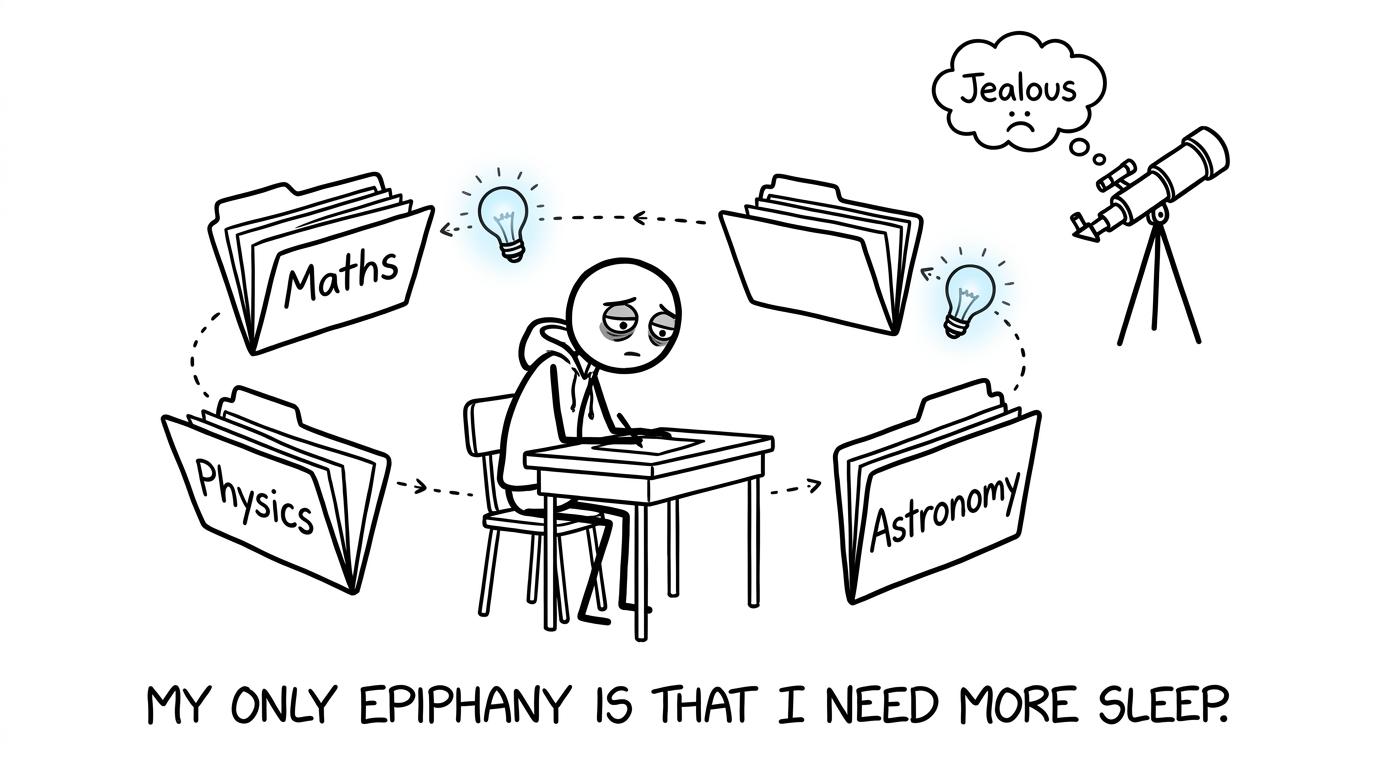 Three GCSE revision folders sharing one orbiting idea
The strongest overlap is with GCSE Maths
Pearson Edexcel's current GCSE Astronomy specification includes arithmetic, standard form, ratios, percentages, inverse-square relationships, algebra, graphs, angular measurement and data handling. These are not decorative additions. They are assessed within astronomical contexts.
This is good news for students preparing for maths exams. Astronomy gives familiar skills another place to become secure.
Standard form, scale and astronomical distance
Astronomy deals with quantities that are inconvenient to write as ordinary decimals. Standard form expresses a value as
a×10n,1≤a<10,a \times 10^n, \qquad 1 \leq a < 10,a×10n,1≤a<10,where nnn is an integer.
The underlying method is identical in GCSE Maths and Astronomy. What changes is the context: a maths question may present an abstract quantity, while astronomy might use a planetary diameter, wavelength or distance.
If powers of ten still feel fragile, use MathsGenie's Standard Form revision resources. Learn the method once, then practise recognising it when scientific units and unfamiliar wording are added.
Astronomy also uses specialised units such as astronomical units, light-years and parsecs. Knowing a conversion fact is astronomy knowledge; carrying out the conversion accurately is transferable maths.
Ratio, proportion and inverse-square relationships
Ratio and proportional reasoning appear when comparing sizes, distances, periods or observed quantities. Direct proportion can be represented as
y∝x,y \propto x,y∝x,while an inverse-square relationship has the form
y∝1x2.y \propto \frac{1}{x^2}.y∝x21.The astronomy specification expects students to use inverse-square relationships, so secure proportion skills are valuable. MathsGenie's Proportion revision page and Ratio revision guide can strengthen the mechanics without requiring you to relearn them inside every science topic.
The efficient approach is to separate the two layers:
- Mathematical layer: identify the relationship and calculate accurately.
- Astronomical layer: understand what the variables represent and why the relationship applies.
Algebra, substitution and changing the subject
GCSE Astronomy requires students to substitute values into equations, solve simple equations and change the subject of a formula. These are familiar algebraic processes, but units make them less forgiving.
A reliable structure is:
- write the equation;
- rearrange before substituting where necessary;
- convert to consistent units;
- substitute with brackets;
- calculate without rounding early;
- attach the correct unit.
This routine also helps in GCSE Physics and across foundation and higher tier maths. The context changes; the algebraic discipline does not.
Graphs, gradients and data
Astronomy students may need to plot variables, translate between numerical and graphical information, and determine the gradient or intercept of a linear graph. For a straight line,
y=mx+c,y = mx + c,y=mx+c,where mmm is the gradient and ccc is the vertical intercept.
Graph work also develops the habit of checking scales, units and trends. Those habits transfer directly into statistics and science questions. A line of best fit, however, is not automatically proof that one variable causes another. Astronomy may require you to interpret the scientific meaning as well as perform the mathematical process.
Angles and spatial thinking
Angular measurement is central to observing the sky. GCSE Astronomy includes degrees, minutes and seconds of arc, subtended angles and celestial coordinates. GCSE Maths develops the angle sense and spatial reasoning underneath these ideas.
Right-angled trigonometry is particularly useful preparation when measurements involve heights, distances or lines of sight. You can reinforce the core method through SOHCAHTOA revision, while remembering that astronomy also has its own coordinate conventions and observational vocabulary.
Where GCSE Astronomy overlaps with physics
Physics provides the closest conceptual overlap. Shared areas can include gravity, orbital motion, electromagnetic radiation, spectra, energy transfer, waves and the behaviour of light in telescopes.
But shared concepts do not mean identical courses. GCSE Astronomy extends these ideas into contexts such as planetary motion, stellar evolution, galaxies and cosmology. Your physics knowledge may explain the mechanism, while astronomy expects you to connect that mechanism to observations.
This suggests a better revision method than keeping two unrelated sets of notes. Build a shared concept sheet with three columns:
- the core scientific principle;
- its physics application;
- its astronomy application.
For gravity, for instance, the principle is shared. The particular systems, evidence and terminology may differ. This structure reveals what can be revised once and what still needs subject-specific recall.
Observational work also overlaps with scientific enquiry. Planning a method, identifying limitations, interpreting data, considering reliability and suggesting improvements are transferable science skills. Yet the practical difficulties of astronomy, weather, light pollution, visibility, equipment and timing, remain specific to the subject.
Geography overlap is smaller but still useful
Geography contributes most strongly where astronomy deals with Earth as an observing platform.
Latitude and longitude help prepare you for coordinate-based thinking. Time zones and Earth's rotation support work involving local time and astronomical cycles. Knowledge of the atmosphere can help you understand why observations are affected by cloud, turbulence and light pollution. Maps, bearings and spatial representations encourage the habit of turning a three-dimensional world into a useful diagram.
There is also a methodological connection. Geography fieldwork and astronomy observations both ask students to plan data collection, recognise limitations and evaluate whether a conclusion is justified. The equipment and subject matter differ, but the reasoning pattern is closely related.
Do not stretch this overlap too far. Celestial right ascension and declination are not simply renamed latitude and longitude. The analogy can help you begin, but the astronomical coordinate system must be learnt on its own terms.
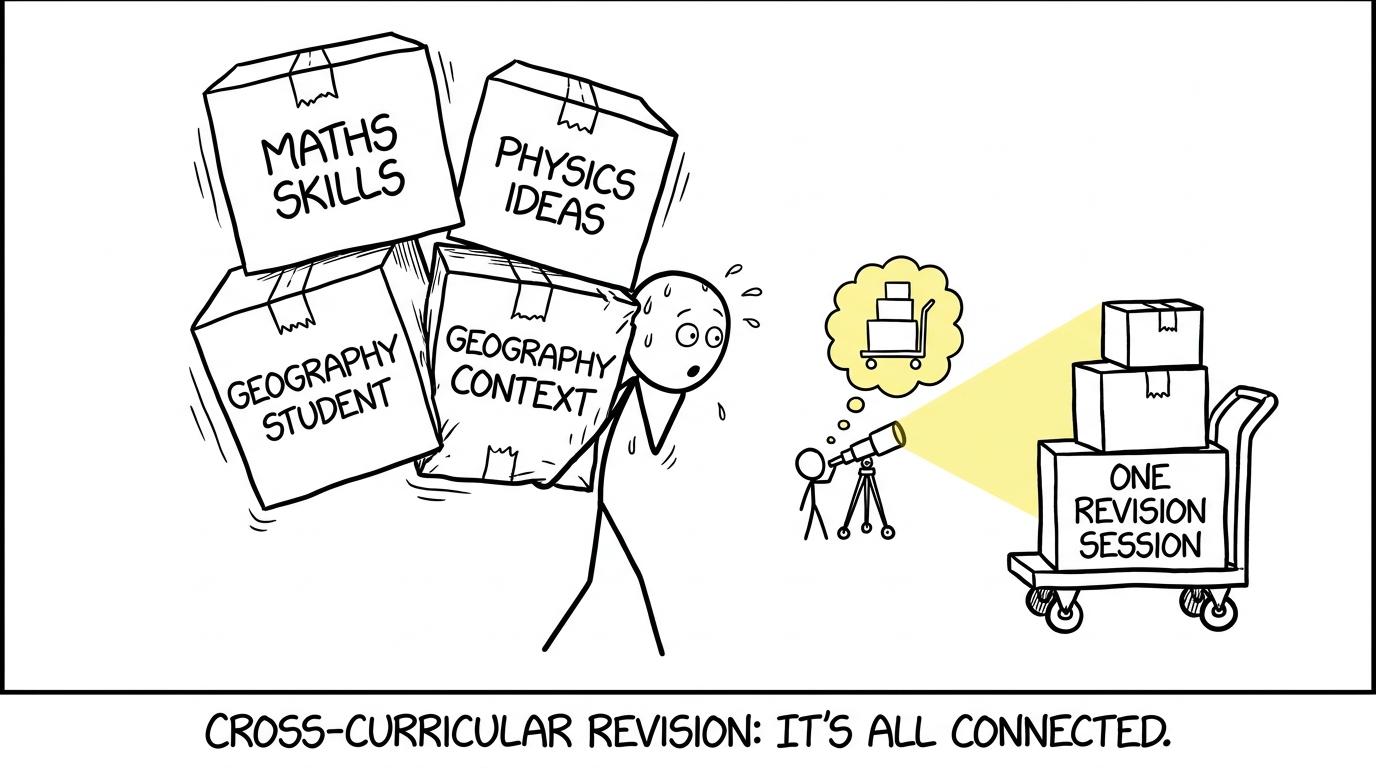 Astronomy combining maths, physics and geography into one revision trolley
Other subjects offer transferable skills, not duplicate content
Computer science can support spreadsheet use, structured data handling and logical processes. English helps with extended responses: interpreting command words, selecting evidence and expressing a conclusion clearly. History may provide useful context for changing models of the Solar System and the role of evidence in scientific progress.
These links are real, but they are weaker than the direct maths and physics overlap. Treat them as transferable habits rather than large blocks of shared specification content. Good cross-curricular revision is selective. It saves time because it identifies genuine connections, not because it forces every subject into the same folder.
How to revise overlapping content without revising twice
The most efficient system is organised by skill first and subject second.
Create an overlap map
List each recurring skill, perhaps standard form, graphs, rearranging equations, angles and evaluation. Beside each one, note where it appears in maths, astronomy and physics. This turns three vague revision lists into a smaller set of connected tasks.
Use a learn, transfer and test cycle
For each shared skill:
- Learn: repair the core method using a focused maths lesson.
- Transfer: apply it in an astronomy or physics context.
- Test: complete a mixed maths question later, without notes.
MathsGenie's free topic pages combine revision lessons, practice questions, worksheets, mark schemes and video support. Once a skill is secure, use Edexcel GCSE Maths past papers to check whether it survives outside a familiar topic heading.
Keep separate mistake labels
When an answer goes wrong, identify the cause:
- Maths error: powers, algebra, graph scale or rounding.
- Astronomy error: missing fact, wrong model or misunderstood unit.
- Exam error: command word, omitted working or unsupported conclusion.
This prevents wasted revision. A wrong astronomy answer does not always mean your astronomy knowledge is weak; sometimes the leak is standard form or proportional reasoning.
Plan by weak skill, not by favourite subject
A realistic GCSE maths revision timetable should revisit weak topics rather than repeatedly covering comfortable ones. Add astronomy transfer questions after the relevant maths session. Near the exam, use GCSE predicted papers for fresh maths practice, but keep official past papers central to your preparation.
Predicted papers are not predictions of certainty. Their value is in providing additional specification-based questions under timed conditions.
Common mistakes when using cross-curricular overlap
Assuming the specifications are identical
A concept appearing in two subjects does not mean the required depth, wording or assessment style is the same. Check your course specification and teacher guidance.
Memorising a formula without understanding the variables
A familiar equation can still be misused if you do not know what each quantity represents or whether the units are compatible.
Ignoring units and significant figures
Correct calculator input can produce a wrong final answer when units are inconsistent. Convert first where possible and round only at the end unless instructed otherwise.
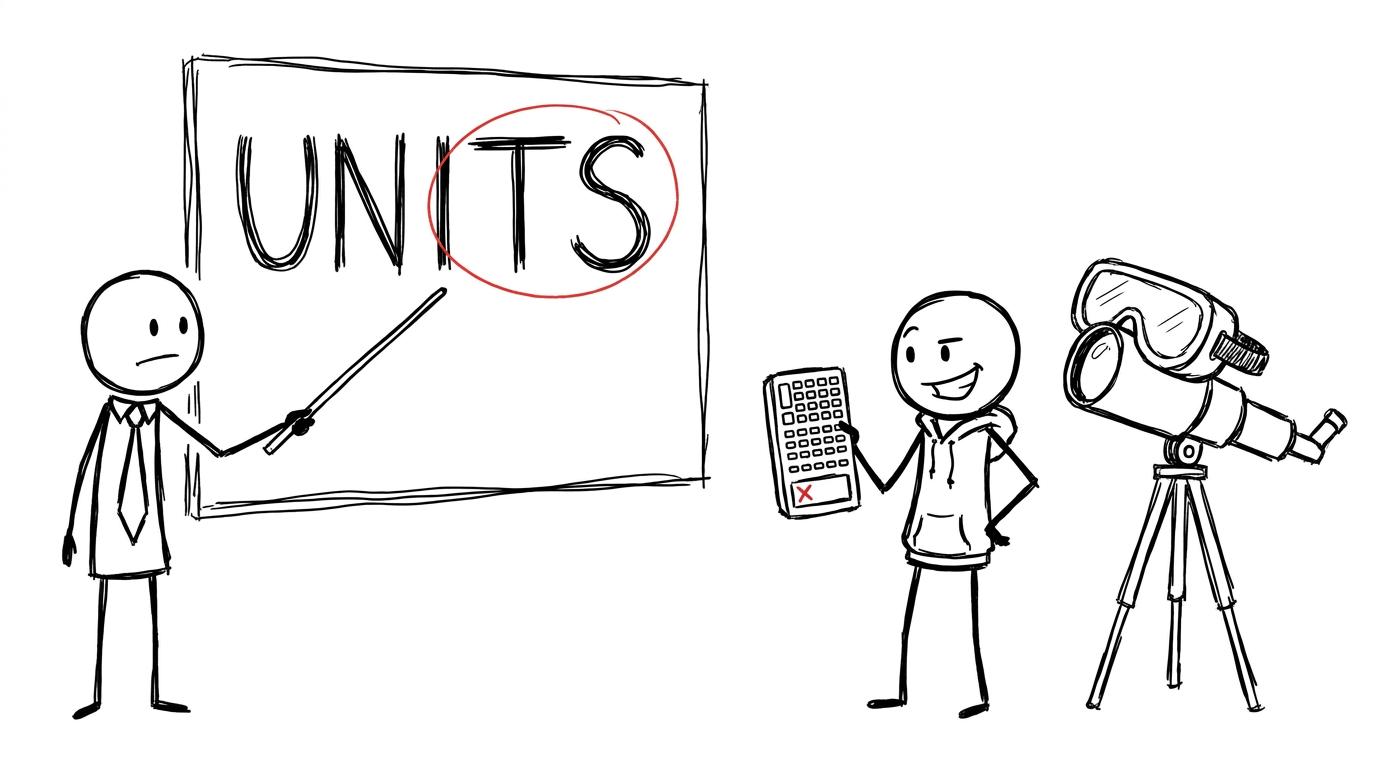 An examiner points towards the units warning while a telescope wears safety goggles
Treating all graph questions as pure maths
Calculating a gradient may be mathematical, but explaining its astronomical meaning requires subject knowledge. Always return to the context.
Counting passive reading as shared revision
Reading the same idea in two textbooks is still passive. Genuine overlap saves time only when you retrieve the method, apply it and mark the result.
Make one skill work harder
Cross-curricular overlap is not a shortcut around learning. It is a way of noticing that a skill can earn marks in more than one room. Standard form remains standard form whether it describes a tiny wavelength or a vast distance. A gradient remains a rate of change even when the graph concerns an unfamiliar object in space.
Start with one weak shared skill today. Learn it through a MathsGenie revision lesson, complete the practice questions, check the mark scheme and then find the same thinking in an astronomy question. As your confidence grows, add mini tests, past papers and predicted papers, using video solutions whenever a method needs rebuilding.
The goal is not to revise everything twice. It is to make each careful piece of revision travel further.