

Gamify Revision GCSE Dance: Does It Help?
Gamify revision GCSE Dance effectively: learn when points, streaks and rewards improve recall, when they distract, and how to build a useful routine.
A revision streak can feel wonderfully productive. The counter rises, another badge appears and your carefully coloured progress chart gains a satisfying tick. Yet none of that guarantees you could explain choreographic intent under exam pressure.
So, should you gamify revision GCSE Dance preparation? The short answer is yes, if the game rewards learning rather than activity. Points, streaks and small rewards can make it easier to begin and continue revising. They become a pleasant distraction when collecting them replaces retrieval practice, feedback and genuine improvement.
The useful question is not, “Did I earn enough points?” It is, “What can I now remember, explain or perform that I could not do before?”
A quick checklist for effective gamified revision
A useful revision game should:
- reward recalling information without notes;
- break large topics into manageable challenges;
- include feedback and correction;
- revisit content after time has passed;
- measure knowledge or performance, not screen time;
- allow missed days without destroying motivation;
- lead towards exam-style practice.
If your system does most of these things, gamification may support your revision. If it mainly involves designing trackers, protecting streaks or earning points for opening an app, simplify it.
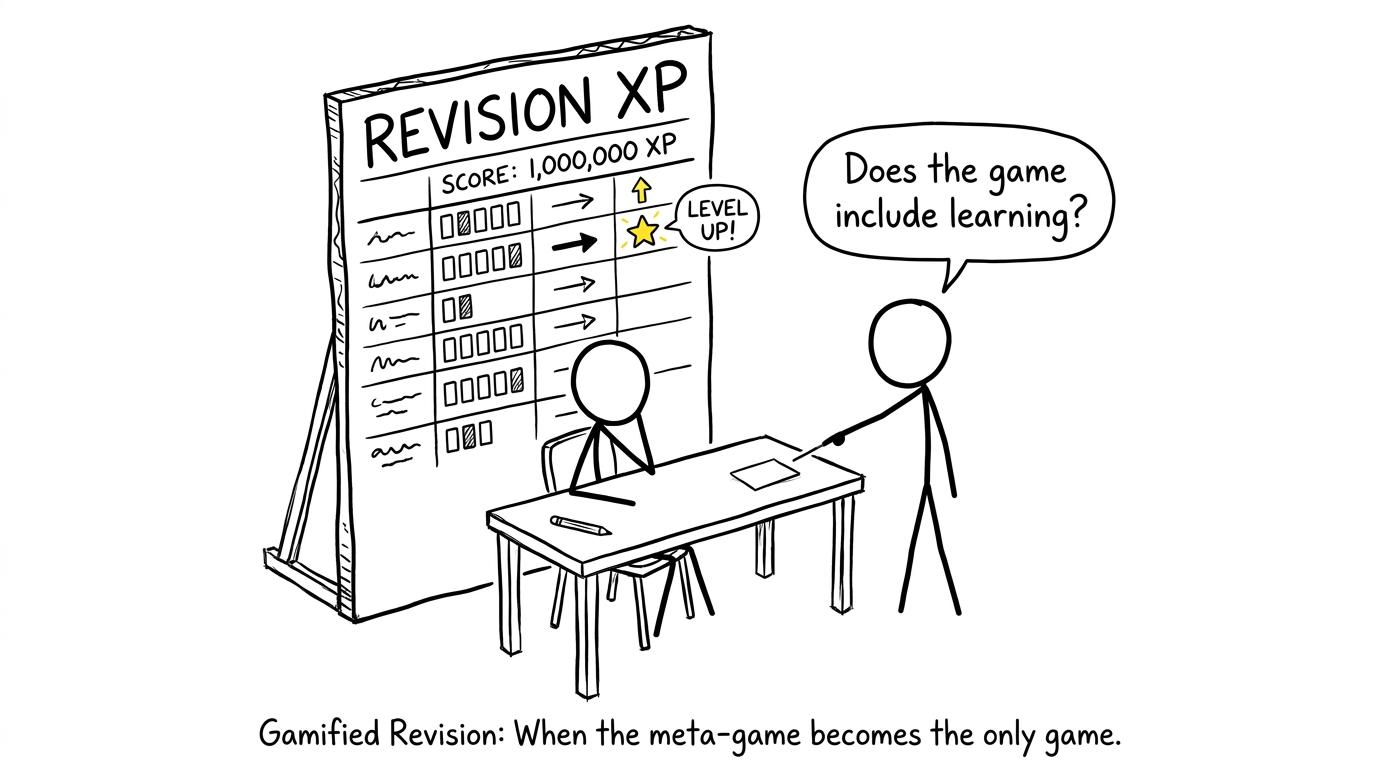 A student discovers that an enormous revision scoreboard has not completed the waiting flashcard
What gamification actually means
Gamification means adding game-like features to an activity that is not itself a game. Common features include:
- points for completed tasks;
- levels that represent increasing difficulty;
- streaks for regular participation;
- badges for milestones;
- timed challenges;
- quests or topic missions;
- visible progress bars;
- rewards after meaningful work.
Gamification is not the same as playing a revision game. You could gamify an ordinary set of flashcards by awarding points only for answers recalled accurately. You could turn an extended Dance response into a challenge with separate goals for accurate terminology, evidence and explanation.
Research into educational gamification does not support the simple claim that badges automatically create better learning. Findings vary according to the learners, subject, design and outcome being measured. Game elements can improve participation or motivation, but learning depends on what students actually do within the system.
That distinction matters. Engagement creates an opportunity to learn; it is not proof that learning happened.
Why gamification can help GCSE Dance revision
GCSE Dance asks students to move between practical and analytical thinking. Under the AQA specification, performance and choreography contribute 60%60\%60% of the qualification, while dance appreciation contributes 40%40\%40% through a written examination. Your revision therefore needs to support physical execution, creative decision-making, terminology, knowledge of professional works and written analysis.
It reduces the difficulty of starting
“Revise Dance” is vague and psychologically heavy. “Complete one five-minute terminology quest” is concrete. A small entry task lowers the barrier to beginning, particularly on days when motivation is weak.
Once you have started, continuing often feels easier. That is where a point or quest system is most useful: not as a substitute for discipline, but as a prompt into worthwhile work.
It makes progress visible
Improvement in analysis can be difficult to notice from one session to the next. A carefully designed tracker can show which areas you have retrieved successfully and which still need attention.
For example, categories might include:
- performance skills;
- choreographic processes;
- production features;
- relationships between movement and meaning;
- accurate knowledge of professional works;
- extended written responses.
Visibility helps when it directs your next decision. A progress chart should tell you what to practise, not merely reassure you that you have been busy.
It can encourage retrieval and spacing
Retrieval practice means bringing knowledge to mind without first looking at the answer. Spacing means returning to learning across separate sessions rather than compressing everything into one long evening.
A game can support both. You might unlock a level only after recalling key ideas without notes, then schedule a later “rematch” to check whether the knowledge remains accessible. Immediate checking matters because confident mistakes can otherwise become familiar mistakes.
These principles transfer directly to maths revision. On the MathsGenie GCSE revision page, topic videos and practice questions can become short quests, but the reward should follow an honest attempt and careful correction. Students working beyond GCSE can apply the same structure through MathsGenie A Level revision.
When streaks, points and rewards become distractions
Gamification tends to fail when its easiest visible measure becomes the goal.
Streaks can reward attendance instead of learning
A streak proves that you completed whatever action the system counts. That might be a demanding recall session, or it might be opening an app for a few seconds.
There is also a danger in making the streak emotionally expensive. One missed day can feel like losing weeks of progress, even though the knowledge you gained has not vanished. A better rule is to count successful revision sessions across a week and include planned rest.
Points can encourage easy tasks
If every flashcard earns the same points, you may repeatedly choose familiar cards because they produce quick success. The system then rewards comfort rather than improvement.
Award more credit for challenging, high-value actions: answering without notes, correcting a misconception, revisiting a weak topic or completing an exam-style response. In maths, that means moving from watching a solution to attempting questions independently and checking them against a mark scheme.
Rewards can crowd out the purpose
A small reward can help you begin. But if revision feels valuable only when a prize follows, the reward has become too central.
Keep rewards proportionate and delayed until meaningful work is complete. The lasting satisfaction should increasingly come from clearer understanding, stronger performance and greater control under timed conditions.
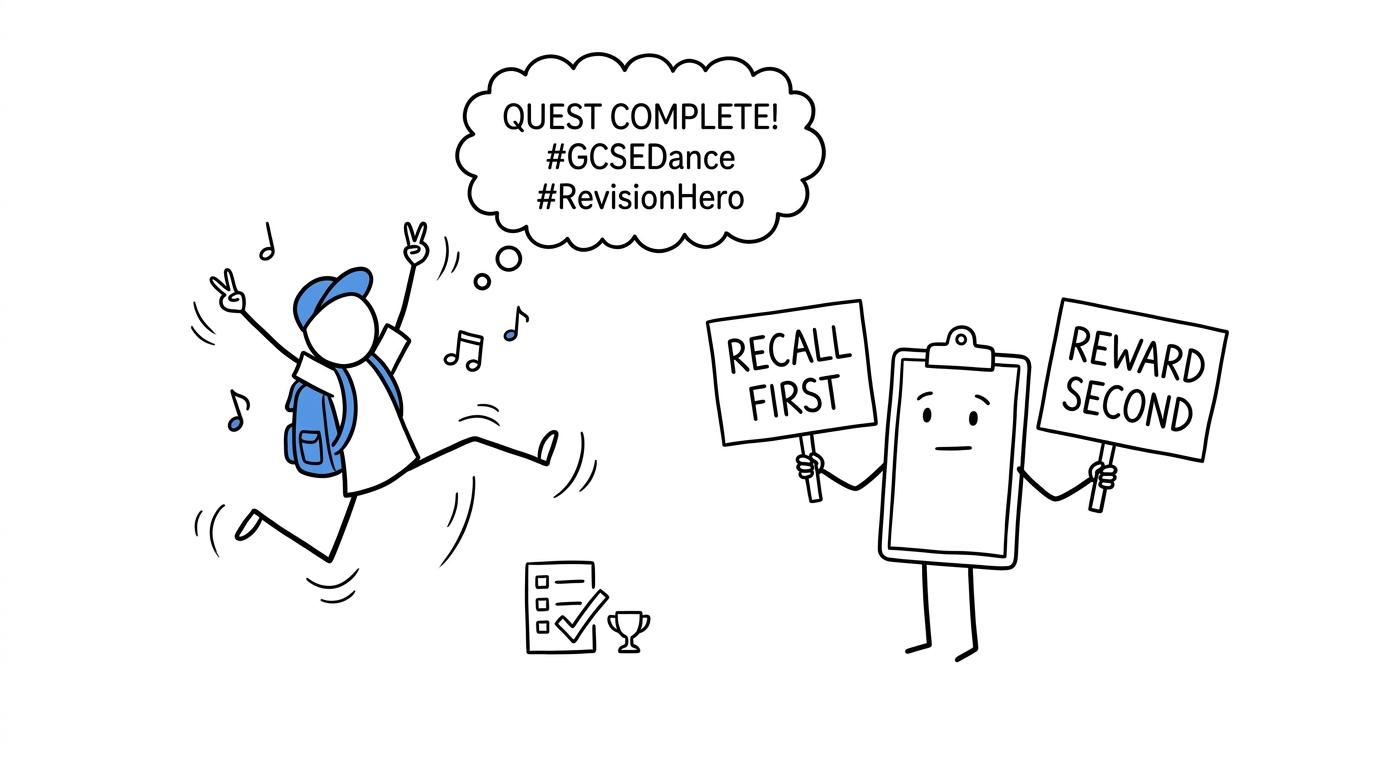 A dancing student celebrates a completed quest while a checklist insists that recall comes before reward
How to gamify GCSE Dance revision properly
The best system is usually simple enough to maintain in a notebook. It does not need elaborate software.
Define actions that represent learning
Choose actions you would still consider worthwhile if no points existed. Suitable tasks include:
- recalling terminology before checking definitions;
- identifying features of a professional work from memory;
- recording and evaluating a performance section;
- planning a response to an exam question;
- improving an answer after feedback;
- explaining how a movement or production feature communicates meaning.
Avoid awarding points merely for reading, highlighting or keeping a revision tab open.
Use a small scoring system
A restrained system prevents scorekeeping from becoming another subject to revise. You could distinguish between a short retrieval task, an independent exam-style task and a later successful review. The exact values matter less than the principle: harder and more useful learning should earn greater recognition.
Set a modest weekly target rather than an endless daily streak. This provides consistency while leaving room for rehearsals, schoolwork, illness and rest.
Build feedback into every challenge
A task is incomplete until you know what was accurate and what needs changing. Check terminology against reliable class materials, use teacher feedback for analytical writing and review recordings against the assessment criteria your school is following.
For maths, GCSE past papers and mark schemes provide the same reality check. A score alone is not the lesson. The useful part is identifying why marks were lost and selecting the next topic to revisit.
Separate practice mode from test mode
In practice mode, notes, demonstrations and video explanations can help you understand. In test mode, remove those supports and retrieve independently. Mixing the two can create an illusion of fluency: an answer looks obvious while it is visible, then disappears when the page is closed.
MathsGenie’s topic resources work well with this distinction. Learn through the free GCSE maths revision lessons, then test independence with GCSE mini tests and full papers.
Make the final level resemble the assessment
Games are most useful when their final challenges move closer to the real task. For Dance, that may mean timed written planning, complete analytical responses or performing and evaluating sustained material. For maths, it means progressing from individual topics to mixed, timed papers.
MathsGenie predicted papers can support that later stage of maths preparation. They should complement, rather than replace, official-style past-paper practice, because broad specification coverage matters more than guessing particular questions.
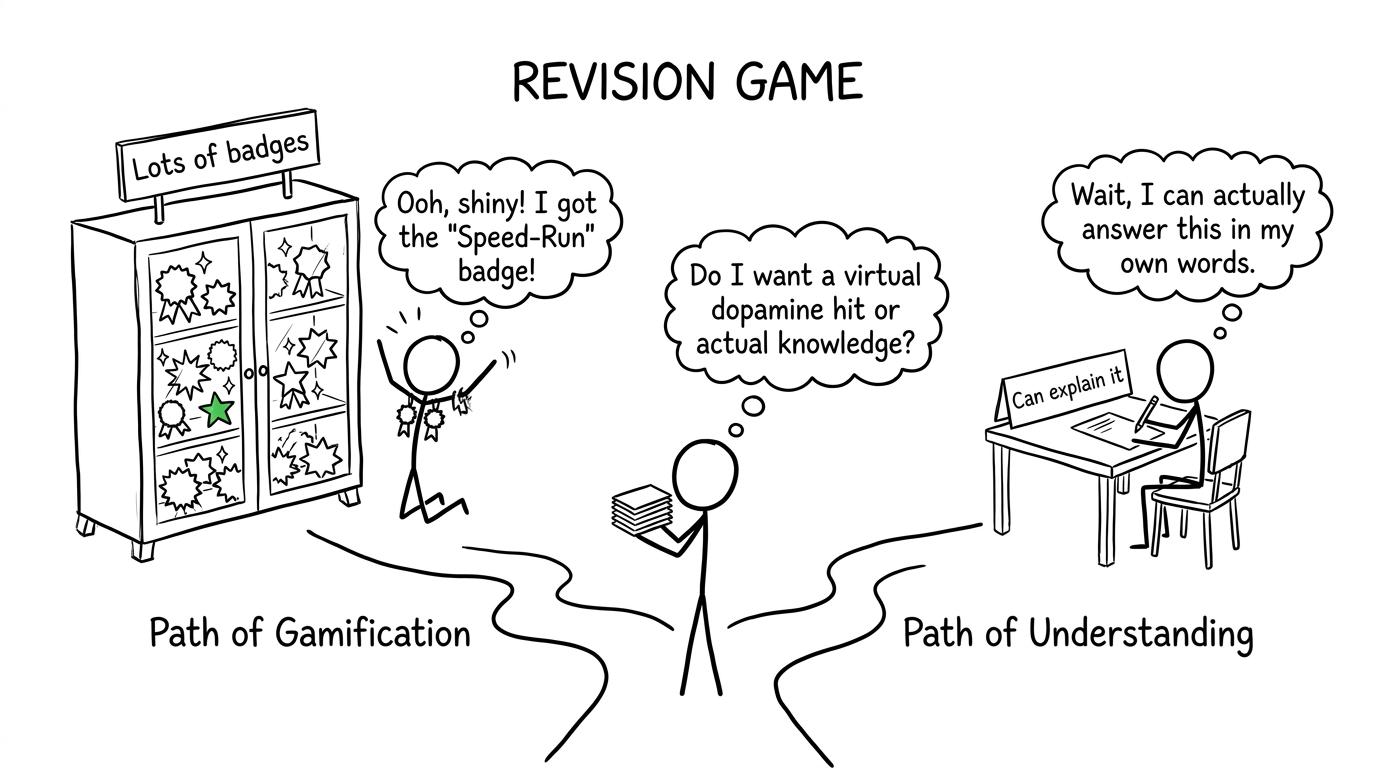 A revision gamer chooses between collecting more badges and reaching the calmer goal of being able to explain the answer
A balanced weekly revision loop
A reliable gamified routine has four parts:
- Choose: select a weak or important area rather than the easiest available task.
- Retrieve: answer, explain or perform without unnecessary support.
- Check: use feedback, criteria or a mark scheme to identify gaps.
- Return: revisit the same learning later to test retention.
Only then should you record the points, tick the quest or claim the reward.
This loop also prevents gamification from taking over your timetable. Dance revision must coexist with maths, English and other GCSE subjects. For maths, you can use the MathsGenie GCSE resources to identify a topic, attempt its practice questions and return later through a mixed paper. If you are taking a resit, the dedicated GCSE resit resources can help you build a similarly focused sequence.
Common mistakes when gamifying revision
Designing the system for longer than you use it
Colour schemes, avatars and reward menus can become sophisticated forms of avoidance. Give yourself a short setup limit, then begin the first learning task immediately.
Awarding points for passive activity
Reading can introduce material, but rereading alone does not show that you can retrieve or apply it. Reserve the strongest rewards for independent recall, performance, explanation and correction.
Choosing quantity over quality
Twenty rushed questions are not necessarily better than a smaller set reviewed carefully. Count corrected misunderstandings and successful later recall, not just completed items.
Ignoring weaker topics
A game that lets you repeat favourite tasks will produce an impressive score and uneven preparation. Add rules that direct you towards neglected material and make weak areas worth more.
Treating a broken streak as failure
Missing a day does not erase learning. Restart at the next sensible opportunity and judge progress over weeks. Consistency matters, but flexibility protects consistency over the longer term.
Never progressing to exam conditions
Flashcards and quick quizzes are useful early steps. They are not substitutes for sustained responses, performance evaluation or timed papers. The game should eventually lead beyond itself.
The verdict: use the game, but measure the learning
Gamifying GCSE Dance revision can help when it makes strong revision habits easier to start, repeat and monitor. Streaks can prompt consistency. Points can make progress visible. Rewards can provide a small push on difficult days.
But none of these features has educational value on its own. The system works only when it rewards retrieval, useful practice, feedback and spaced return. If you spend more time managing the game than confronting what you do not yet know, the game has become the obstacle.
Keep it light. Keep it honest. Let the badge celebrate the learning rather than impersonate it.
Then apply the same principle across your GCSE preparation. Use MathsGenie’s free GCSE revision lessons to strengthen individual topics, practise with questions and video solutions, check your work carefully, and build towards past papers and predicted papers. Your points can make the journey more inviting, but accurate, independent answers are what improve your grades.











