

GCSE Computer Science Exam Clash Same Week: A Plan
GCSE computer science exam clash same week? Build a calm revision plan that protects maths, targets weak topics and prevents last-minute cramming.

Exam timetables have a strange way of making every subject feel urgent at once. Computer Science may need precise definitions and code tracing, while maths demands methods that survive under pressure. When both arrive beside several other papers, the instinct is often to revise whichever subject feels most frightening.
If you are searching for gcse computer science exam clash same week advice, the short answer is this: map the exact papers, protect short daily contact with both Computer Science and maths, then give the next exam and your weakest topics the largest blocks. Do not divide every evening equally. Divide it according to urgency, weakness and the kind of practice each subject requires.
A crowded week is a planning problem, not proof that you are behind.
Your same-week revision checklist
Before building a detailed plan, do these things:
- Confirm every paper's date, session, exam board and duration using your school timetable.
- Ask your exams officer about any genuine timetable clash.
- List specific weak areas rather than whole subjects.
- Keep a small daily maintenance block for maths.
- Use active recall, code tracing and exam questions for Computer Science.
- Move the largest revision block towards the nearest exam.
- Mark practice immediately and let mistakes choose the next task.
- Set a stopping time so that revision does not consume your sleep.
MathsGenie's GCSE maths revision hub helps remove one decision immediately: choose your exam board and tier, then move between revision lessons, questions and papers without searching across different resources.
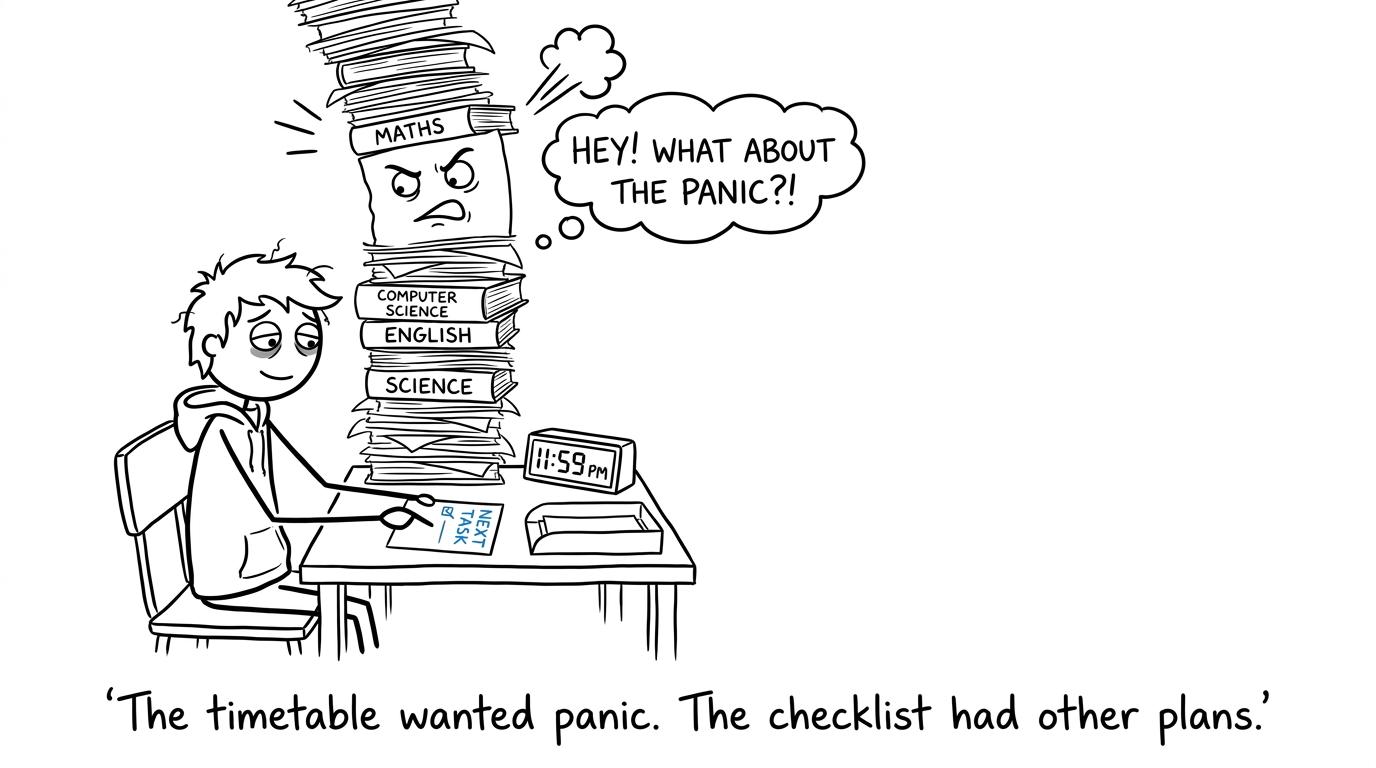 A calm checklist defeating a frightening stack of GCSE papers
Is it an exam clash or simply a crowded week?
These are not quite the same problem.
Under current JCQ guidance, a timetable clash means that two or more examinations are scheduled at the same time on the same day. Several exams taking place within one week may feel like a clash, but it is normally a revision-pressure problem rather than a formal timetable clash.
If two papers appear in the same session, tell your school's exams officer immediately. Do not try to decide for yourself which examination to attend. Your centre is responsible for arranging consecutive papers, supervision or another permitted solution under the current regulations. If arrangements change, follow the written instructions from your school, including restrictions on phones, internet access and contact with other candidates during supervision.
For an ordinary crowded week, the timetable usually remains fixed. Your control lies in how you use the days around it.
Split attention by urgency, weakness and task type
Equal time sounds fair. It is not always sensible.
Imagine that maths is tomorrow, Computer Science is three days away and another subject follows afterwards. Giving every subject exactly one-third of tonight ignores the fact that tomorrow's paper has no later revision opportunity. Equally, giving the whole evening to maths may leave Computer Science untouched until panic takes over.
Use three questions:
- Urgency: Which paper comes first?
- Weakness: Where are you currently losing marks?
- Task type: Does the subject need recall, problem-solving, extended answers or timed practice?
A useful planning model is:
priority=urgency+weakness+value of the next task\text{priority} = \text{urgency} + \text{weakness} + \text{value of the next task}priority=urgency+weakness+value of the next taskThis is not a grade calculation. It is a decision filter. A focused task such as tracing an algorithm or correcting simultaneous equations has greater immediate value than vaguely “doing Computer Science” or “looking over maths”.
Use roughly half of the available revision time for the nearest paper, then divide the remainder between maintenance of the following subject and one other urgent need. Adjust that balance when the first exam is finished. The plan should move with the timetable.
Keep maths alive with short, deliberate contact
Maths is unusually sensitive to long gaps because knowing a method is different from retrieving it quickly and accurately. During a Computer Science-heavy week, you do not necessarily need a complete maths paper every evening. You do need regular contact with mathematical thinking.
A compact maths block can contain:
- 555 minutes recalling formulae or methods without notes
- 151515 minutes answering questions on one weak topic
- 555 minutes marking and recording the exact error
The MathsGenie twenty-minute maths routine is useful when several subjects are competing for attention. For a clearer view of what actually needs work, use the GCSE maths self-assessment resources or follow the process for finding your weakest GCSE topics.
Foundation and higher tier students should both target specific gaps. “Algebra” is too broad. “Expanding double brackets” or “forming an equation from a worded problem” gives you something that can be practised, marked and retested.
Revise Computer Science differently from maths
Computer Science combines knowledge with application. The exact paper structure and content depend on your exam board and specification, whether you take AQA, OCR, Pearson Edexcel or Eduqas. Check your board's current specification, your teacher's topic list and the paper named on your timetable rather than assuming every board assesses identical content in the same place.
For knowledge-heavy content
Close the book and retrieve ideas from memory. You might use short prompts covering networks, cyber security, data representation, hardware, software or ethical and legal issues, where these appear in your specification.
Then check your answer against trusted course materials. A flashcard is useful only if you attempt the answer before turning it over.
For algorithms and programming
Reading code can create false confidence. Trace it line by line. Predict outputs, identify errors, explain an algorithm and write short sections of pseudocode or your required programming language without copying.
For longer responses
Practise building a clear chain of reasoning. State the relevant point, apply it to the situation in the question and explain the consequence. Afterwards, compare your response with the mark scheme or teacher guidance. The goal is not to memorise an entire paragraph but to recognise what a developed explanation contains.
The same principle works in maths: watching a solution is the beginning, not the proof. The proof comes when you can complete a new question independently.
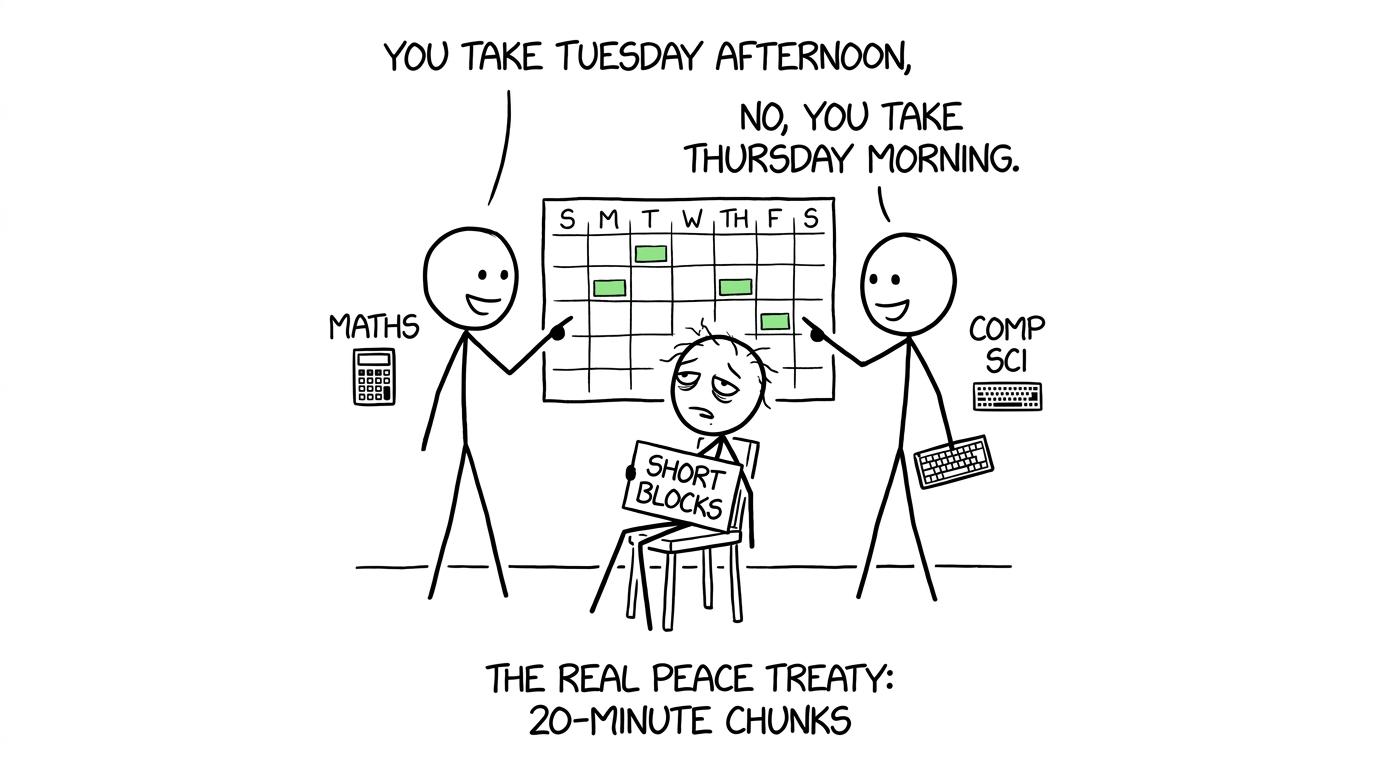 Maths and Computer Science sharing a revision calendar
Build a plan that changes after each exam
A revision timetable should not be a museum exhibit. It should change when the evidence changes.
Several days before the crowded week
Complete short diagnostic tasks in both subjects. Mark them and create two small lists:
- Computer Science facts or skills you could not retrieve
- maths topics where you lost marks or could not begin
Use the GCSE maths revision timetable guide to place these tasks around your actual papers. Keep blocks short enough to finish properly, including marking.
The evening before a maths paper
Maths should receive the main block, but avoid trying to relearn the entire course. Complete a short set matching your tier and calculator rules, correct a few recurring errors, prepare your equipment and stop at a planned time.
The GCSE maths night-before plan provides a focused alternative to random last-minute revision.
The evening before Computer Science
Prioritise retrieval and a small amount of exam-style application. Test key terms, trace code, revisit recurring mistakes and review how longer questions are marked. Avoid spending the whole evening producing attractive notes that you never test.
Immediately after an exam
Do not conduct a lengthy post-mortem with friends. You cannot change the paper you have finished, and comparing answers can drain attention from the next one. Eat, reset and move the largest revision block towards the next exam.
Use papers without letting them consume the week
A full paper gives valuable information, but it also takes time to complete and review. In a crowded week, a carefully selected section may be more useful than an unmarked full paper.
Use full papers when you need timing and stamina. Use mini tests or topic questions when you already know the weakness. If you take Edexcel, the Edexcel GCSE maths past papers include papers and mark schemes, with worked solutions where available. MathsGenie's wider GCSE predicted papers provide fresh exam-style practice, but predicted papers should complement official past papers rather than be treated as a promise about what will appear.
After any practice, classify mistakes:
- knowledge gap
- wrong method
- accuracy error
- misread question
- time pressure
Then repair the largest leak. Marks improve through correction, not through collecting completed papers.
Protect sleep and reduce decision fatigue
Late-night revision feels productive because it is visible. The cost appears the next morning, when attention, recall and patience matter inside the examination room.
Research-informed revision guidance consistently favours spaced practice and active retrieval over a single cram. Sleep also supports concentration and memory. That does not mean every evening must be perfect. It means “one more hour” is not automatically more valuable than stopping.
Prepare tomorrow's resources before finishing. Write the first task on a card, close unnecessary tabs and put your equipment together. A clear starting point saves the mental energy otherwise spent deciding what to do.
 A cartoon brain filing revision memories during sleep
Common mistakes when exams fall in the same week
Revising every subject equally
Equal allocation ignores exam order and personal weakness. Keep every important subject active, but give the largest block to the nearest high-priority paper.
Dropping maths completely for several days
A short question set preserves retrieval and accuracy. Restarting after a long gap often costs more time than maintaining the skill.
Calling a crowded week a formal clash
A genuine clash concerns papers scheduled at the same time. Check your timetable and speak to the exams officer rather than relying on assumptions or a friend's schedule.
Completing work without marking it
Unmarked questions create activity without feedback. Mark schemes and video solutions reveal whether the problem was knowledge, method or communication.
Using the wrong specification or paper
Computer Science content and assessment arrangements differ between exam boards. Maths practice must also match your board, foundation or higher tier, and calculator requirements.
Sacrificing sleep to finish the timetable
A plan is a tool, not a debt. If the evening runs late, shorten the lowest-priority task rather than borrowing indefinitely from sleep.
Turn a crowded week into a sequence of next steps
The hardest part of a busy exam week is seeing every paper at once. The calmer approach is to see one next action: one code trace, one retrieval set, one maths topic, one marked correction.
Confirm genuine clashes with your exams officer. Then split revision according to urgency, weakness and task type. Keep maths in daily contact, move the main block as each exam passes and stop treating exhaustion as evidence of commitment.
MathsGenie can carry the maths side of that plan. Start at the free GCSE revision hub, use revision lessons to rebuild a method, practise with topic questions and mini tests, and then test your progress through past papers, predicted papers, mark schemes and video solutions. Choose the next small task now; then let the timetable become a series of manageable decisions.










