

GCSE Astronomy Cram Guide: A 1-Week Plan
GCSE astronomy cram guide 1 week plan covering both Edexcel papers, calculations, recall, past-paper practice and calm exam preparation.
Seven days is not enough time to learn the universe perfectly. It is enough time to make your revision far more useful.
If your search was “gcse astronomy cram guide 1 week”, the honest answer is simple: divide the specification by paper, prioritise active recall and exam questions, repair the maths skills that astronomy repeatedly uses, and finish with timed practice rather than another round of rereading.
This guide gives you that plan. It is written for Pearson Edexcel GCSE Astronomy, currently the GCSE Astronomy qualification available in England. The course is not divided into foundation and higher tiers. Every student sits two externally examined papers, so your task this week is coverage first, then accuracy, then timing.
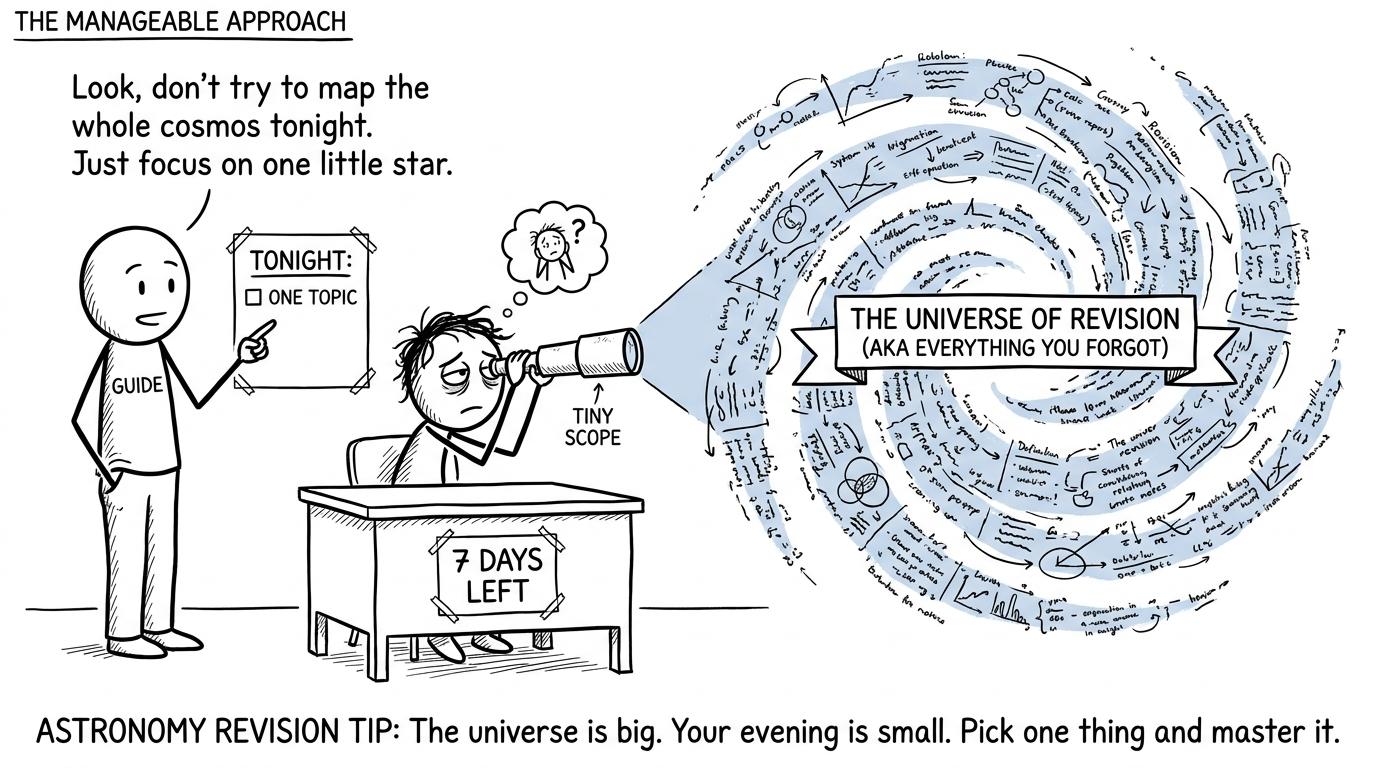 A tired student turns an overwhelming astronomy revision galaxy into one manageable task
Your one-week astronomy revision checklist
Before the daily plan, gather everything you need:
- the current Pearson Edexcel GCSE Astronomy specification, code 1AS0
- your class notes and required observation records
- official past papers, mark schemes and examiner reports
- the formulae and data sheet used in the examination
- a calculator, ruler, pencil and protractor
- one notebook page for a running mistake log
- the MathsGenie GCSE Maths revision hub for calculation skills
The qualification has two papers. Each lasts 111 hour 454545 minutes, carries 100100100 marks and contributes 50%50\%50% of the qualification.
| Paper | Specification content | Main focus |
|---|---|---|
| Paper 1: Naked-eye Astronomy | Topics 111 to 888 | Earth, Moon, Sun, time, observations, celestial coordinates, early models, planetary motion and gravity |
| Paper 2: Telescopic Astronomy | Topics 999 to 161616 | Moon and Sun exploration, Solar System science, planetary systems, starlight, stars, galaxies and cosmology |
Both papers can include multiple-choice, short-answer, calculation, graphical and extended open-response questions. That variety matters. Knowing a fact is only the beginning; you must also recognise it in a diagram, use it in a calculation or explain it precisely.
The daily method that keeps this plan realistic
Use three focused blocks each day rather than one exhausting session:
- Recall for 252525 minutes: write or say what you know without notes.
- Repair for 353535 minutes: check the specification and relearn missing ideas.
- Apply for 404040 minutes: answer questions and mark them immediately.
Take short breaks between blocks. If you have less time, preserve the order and shorten each block. A 454545-minute session containing recall, questions and marking is more valuable than 454545 minutes spent highlighting a textbook.
Keep a mistake log with four labels: knowledge, maths, question reading and written explanation. Each entry needs a next action. “Bad at stars” is too vague; “confused the end stages of low-mass and high-mass stars” can be fixed.
Day 1: Diagnose before you revise
Start with a mixed set of questions from both papers under timed, closed-book conditions. You are not trying to produce an impressive mark. You are finding where marks currently leak away.
Mark the set carefully. Build two topic lists:
- Red: you could not begin or your understanding was wrong
- Amber: you knew the idea but lost marks through detail, maths or wording
Then map those gaps against all 161616 specification topics. Do not revise only memorable subjects such as black holes and eclipses. Less dramatic areas time systems, coordinates, telescope calculations and observational evaluation: still matter.
Finish by reviewing the examination formulae and data sheet. Pearson states that students are not required to recall the listed astronomical equations because the sheet is supplied in each examination. You must, however, know what each quantity means, choose the correct relationship, rearrange it and use the units accurately.
If algebra is slowing you down, use MathsGenie’s rearranging formulae revision resources. The mathematical method transfers even though the astronomy qualification itself is Edexcel.
Day 2: Secure Paper 1 foundations
Concentrate on Topics 111 to 444:
- Earth’s shape, structure, reference points and atmosphere
- lunar surface features, rotation, revolution and libration
- relative sizes and distances in the Earth-Moon-Sun system
- tides, eclipses and precession
- solar and sidereal time, lunar cycles, solstices and equinoxes
- time zones, longitude and the Equation of Time
Your aim is to connect causes with observations. Do not merely memorise that eclipses occur. Be able to identify the alignment, distinguish lunar and solar eclipses, and describe the roles of the umbra and penumbra.
Practise drawing clean, labelled diagrams from memory. Diagrams expose uncertainty quickly: if you cannot decide where a label belongs, the idea is not secure yet.
Time questions also demand careful arithmetic. Write conversions explicitly and keep units visible. Revise calculator accuracy, rounding and significant figures through the full GCSE maths topic guide if these details routinely cost you marks.
Day 3: Complete Paper 1
Move to Topics 555 to 888:
- safe solar observation and Solar System configurations
- meteors, meteor showers and planetary motion
- the celestial sphere, altitude, azimuth, right ascension and declination
- circumpolar stars and apparent daily motion
- geocentric and heliocentric models
- astronomical distance units
- Kepler, Newton, gravity and orbital motion
Coordinate systems deserve active practice. Cover your notes and explain which reference points each system uses, whether coordinates change with the observer, and how stars appear to move during the night.
For planetary motion, understand the relationships as well as their names. Kepler’s third law appears on the formula sheet in the form
r3T2=constant.\frac{r^3}{T^2}=\text{constant}.T2r3=constant.You should be ready to identify rrr and TTT, rearrange the relationship and compare orbiting bodies. Use direct and inverse proportion revision to strengthen the underlying mathematical thinking.
End the day with a timed Paper 1 section. Mark it while the reasoning is still fresh, then add only specific errors to your log.
 A cat creates an unexpected obstruction at astronomy revision mission control
Day 4: Build the Solar System half of Paper 2
Study Topics 999 to 121212:
- the Moon’s structure, near and far sides, exploration and origin theories
- the Sun’s internal structure, atmosphere, fusion and solar activity
- Solar System bodies, telescopes, probes and crewed missions
- gravitational and tidal effects
- formation of planetary systems
- exoplanet detection, conditions for life and SETI
Make comparison grids rather than long notes. Compare near and far sides of the Moon, refracting and reflecting telescopes, rocky and giant planets, and different exoplanet detection methods. For every method, know what is observed, what can be inferred and what its limitations are.
Safety language must be exact. Never describe direct naked-eye observation of the Sun as safe. Learn the approved methods specified in your course, such as projection, and follow the wording used in official guidance.
This is also a good day to review magnification:
magnification=fofe,\text{magnification}=\frac{f_o}{f_e},magnification=fefo,where fof_ofo and fef_efe are the focal lengths of the objective and eyepiece. Do not round intermediate calculator values unless the question instructs you to do so.
Day 5: Stars, galaxies and cosmology
Complete Topics 131313 to 161616:
- telescopes and the electromagnetic spectrum
- apparent and absolute magnitude
- spectra, stellar classification and the Hertzsprung-Russell diagram
- parallax, Cepheid variables and stellar distances
- stellar evolution for different initial masses
- the Milky Way, galaxy types and the Local Group
- redshift, Hubble’s law and evidence for an expanding universe
- Big Bang evidence, dark matter and dark energy
These topics contain several linked chains. Build them from causes rather than isolated facts. Initial stellar mass influences the life cycle; spectral lines reveal information about composition and movement; redshift supports expansion; several independent observations support modern cosmological models.
Astronomical values are commonly written in standard form. Refresh the rules using the MathsGenie standard form revision guide, then test yourself with standard form exam questions.
Know how to select relationships such as
λ−λ0λ0=vc\frac{\lambda-\lambda_0}{\lambda_0}=\frac{v}{c}λ0λ−λ0=cvand
v=H0d.v=H_0d.v=H0d.The formulae are supplied, but the paper can still test substitution, rearrangement, graph interpretation, units and conclusions.
Day 6: Sit papers and repair the evidence
Today is about performance. Sit one complete paper under examination conditions, or two substantial timed sections if your timetable makes a full paper impossible.
Use the real duration, allowed equipment and no notes. Move on when a question stalls you, leaving enough working to restart later. Then mark with the official mark scheme.
For every lost mark, decide whether you need to:
- retrieve a missing fact
- correct a misconception
- practise a calculation skill
- include a required comparison or causal link
- improve timing
Do not spend the evening copying the mark scheme. Reattempt the questions without looking, then answer fresh questions on the same weak areas. MathsGenie’s guide to using past papers properly explains why a paper only becomes useful when its mistakes change your next action.
If graphs caused trouble, revisit scales, gradients, interpolation and conclusions. The scatter graphs revision guide can reinforce careful graph reading, although astronomy may use several other graph types too.
Day 7: Consolidate without cramming all night
The final day should feel narrower than the first. Start with your red and amber lists, not the entire textbook.
Complete this sequence:
- retrieve the weakest facts without notes
- redraw essential diagrams and cycles
- review formula selection, units and standard form
- answer a short mixed question set
- reattempt selected mistakes from Day 111 and Day 666
- check your equipment and examination arrangements
Review observational skills too. The specification requires astronomical observations as part of the course, including unaided and aided work that the centre certifies. These are not tasks to improvise in the final revision week. If you are uncertain whether your requirements have been completed, speak to your teacher immediately.
Stop heavy revision at a sensible time. The final evening is for making recall accessible, not trying to force all 161616 topics into short-term memory.
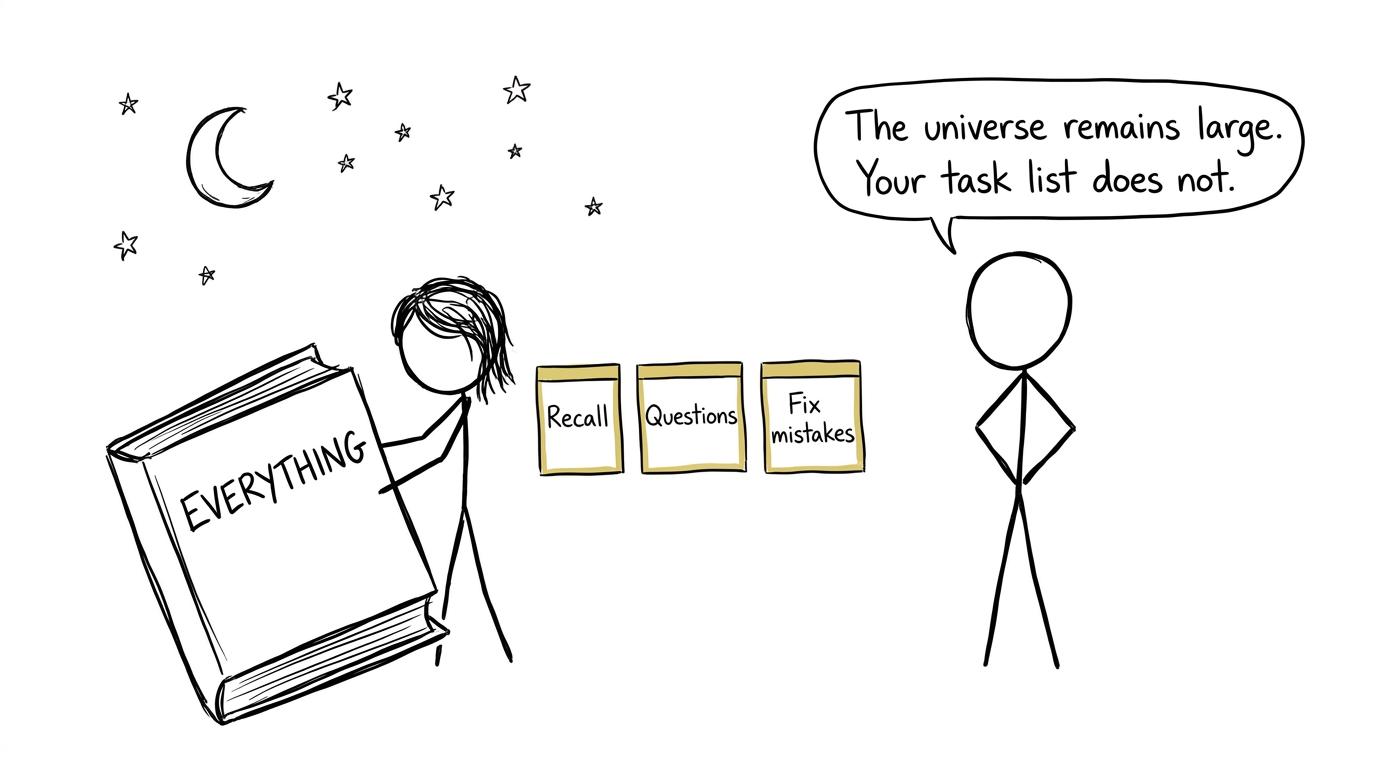 A student chooses recall, questions and mistake fixing instead of trying to revise everything
Common mistakes in a one-week astronomy cram
Revising favourite topics first
Interest is not the same as examination priority. Use your diagnostic results and the specification, even when they direct you towards less exciting material.
Reading instead of retrieving
Familiar-looking notes create confidence without proving recall. Close the page, write what you know, check it, then answer a question.
Ignoring mathematical marks
Official subject requirements mean mathematical skills account for at least 20%20\%20% of marks in the written papers. Standard form, logarithms, proportion, graphs, significant figures, units and rearranging formulae are not optional extras.
Memorising equations but not meanings
The formulae and data sheet is supplied. Spend your limited time learning how to choose and use the equations rather than repeatedly copying them.
Treating explanations as lists
For extended responses, connect each claim to a reason, observation or consequence. Use the mark allocation as a guide to the depth required.
Marking without repairing
A score tells you where you are. A corrected method changes where you will be tomorrow. Reattempt mistakes after marking and test the same idea in a fresh question.
Make the final week count
A late start is uncomfortable because it removes the illusion of unlimited time. It also forces a useful decision: you must choose actions that produce evidence of learning.
Follow the seven-day sequence, keep your mistake log specific and use official Astronomy papers for subject practice. When calculations become the barrier, return to MathsGenie. Its free revision lessons, practice questions, mark schemes, mini tests and video solutions can rebuild the GCSE maths behind astronomical questions. The MathsGenie revision timetable guide can also help you balance Astronomy with your remaining GCSE exams.
Start now with one diagnostic set. You do not need to master the whole universe tonight. You need to discover the next mark you can realistically secure.











