

GCSE Art and Design Revision: Silence or Noise?
GCSE art and design revision silence or noise? Explore the evidence, match sound to each task and protect your focus while preparing for maths exams.
Revision soundtracks can become surprisingly personal. One student needs complete quiet. Another insists that a playlist helps ideas flow. Both may feel certain, but feeling focused and performing well are not always the same thing.
So, for GCSE art and design revision silence or noise, the practical answer is this: use silence for reading, annotation, remembering information and difficult decisions; consider quiet instrumental sound for familiar, repetitive practical work; avoid music with lyrics when language or memory matters.
There is no single soundtrack that suits every student or every task. The most useful question is not simply, “Do I like music?” It is, “What does this task require my brain to do?” That distinction matters for Art and Design, but it matters even more when you return to GCSE maths revision.
The quick sound checklist
Before beginning a revision block, decide which of these descriptions fits your task:
- Reading, researching or annotating: choose silence or the quietest available environment.
- Remembering artists, processes or intentions: use silence.
- Making a difficult creative decision: begin in silence.
- Completing familiar practical work: low-volume instrumental music may be reasonable if it does not reduce accuracy.
- Attempting maths questions or a timed paper: use quiet conditions without music.
- Working in an unpredictable household: steady non-speech sound may be less distracting than conversations, television or changing noises.
- Unsure what works: test both conditions using completed work rather than mood as your evidence.
The important principle is simple: sound should serve the task. The task should never become an excuse to serve the playlist.
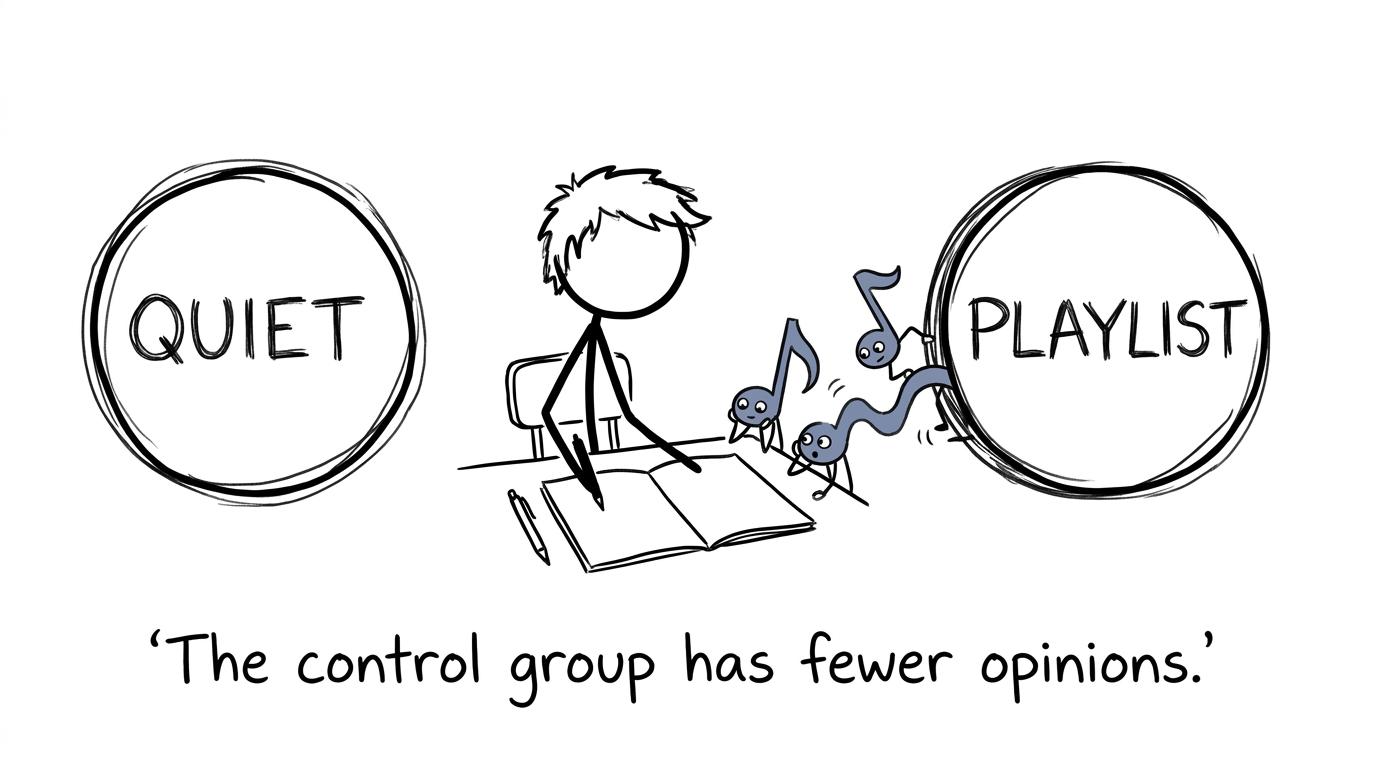 A student choosing between quiet and a revision playlist
What the evidence actually says about silence and background noise
Research does not support the sweeping claim that everyone must revise in absolute silence. It also does not show that background music reliably improves learning.
A systematic review published in 2022 examined research covering memory, language, reasoning, attention and other cognitive tasks. Its broad conclusion was nuanced: background music often made no measurable difference, but negative effects appeared more consistently for memory, language-based work and difficult tasks. Music containing lyrics was more likely to be harmful than instrumental music.
A controlled study published in 2023 compared silence, instrumental lo-fi music and music with lyrics. Verbal memory, visual memory and reading comprehension were generally worse with lyrical music than in silence. Instrumental music did not produce a credible improvement or decline across the tasks overall. Arithmetic performance did not show a credible difference between the conditions in that particular study.
That final result should not be interpreted as proof that music improves maths. It means that this study did not find convincing evidence of an effect on its arithmetic task. GCSE maths includes multi-step reasoning, interpreting language, recalling methods and checking working: demands that can be more complicated than short arithmetic questions.
Research published in 2024 also found that preferred music could reduce mind-wandering during a repetitive sustained-attention task. However, it increased some forms of external distraction too. This helps explain why music can feel useful during monotonous work without necessarily improving reading, memory or reasoning.
The honest summary is therefore:
- silence is the safest default for demanding cognitive work;
- lyrics are the clearest avoidable risk;
- instrumental music is usually less disruptive, but is not a proven revision enhancer;
- task difficulty, sound type and individual differences all matter;
- enjoyment and performance are separate outcomes.
Why GCSE Art and Design needs more than one answer
“Revising art” can describe several completely different activities. You might analyse an artist, record observations, experiment with materials, refine an idea or produce a personal response.
Across GCSE Art and Design specifications, the familiar assessment objectives cover developing ideas through investigations, refining work through experimentation, recording ideas and observations, and presenting a personal and meaningful response. The precise component rules should always be checked with your teacher and exam board, whether you follow AQA, Edexcel, OCR or Eduqas.
Each part creates a different attentional demand.
Artist research and written annotation
Silence is the strongest default here. Reading about an artist while processing song lyrics asks two streams of language to compete for attention. You may still finish the paragraph, but finishing is not the same as understanding it.
The same applies when explaining why you selected a material or how an experiment changed your intentions. Good annotation involves judgement. If you repeatedly reread sentences, lose your place or accidentally write fragments of a lyric, the music is not staying in the background.
Observational recording and careful experimentation
For detailed drawing, photography decisions, unfamiliar software or a new material process, begin quietly. These tasks require visual attention, planning and error monitoring.
Once the process becomes familiar, quiet instrumental music may be acceptable. Keep it predictable and low enough that you do not consciously follow changes in the track. If you start choosing songs, skipping tracks or reaching for your phone, the soundtrack has become a second task.
Repetitive practical work
Mounting studies, applying a familiar process or completing a repeated pattern can feel monotonous. This is where preferred instrumental music may help some students remain engaged.
But judge it by the work. If edges become less precise, decisions become hurried or you forget to document development, switch it off. Music that makes time pass quickly is not automatically music that helps you work well.
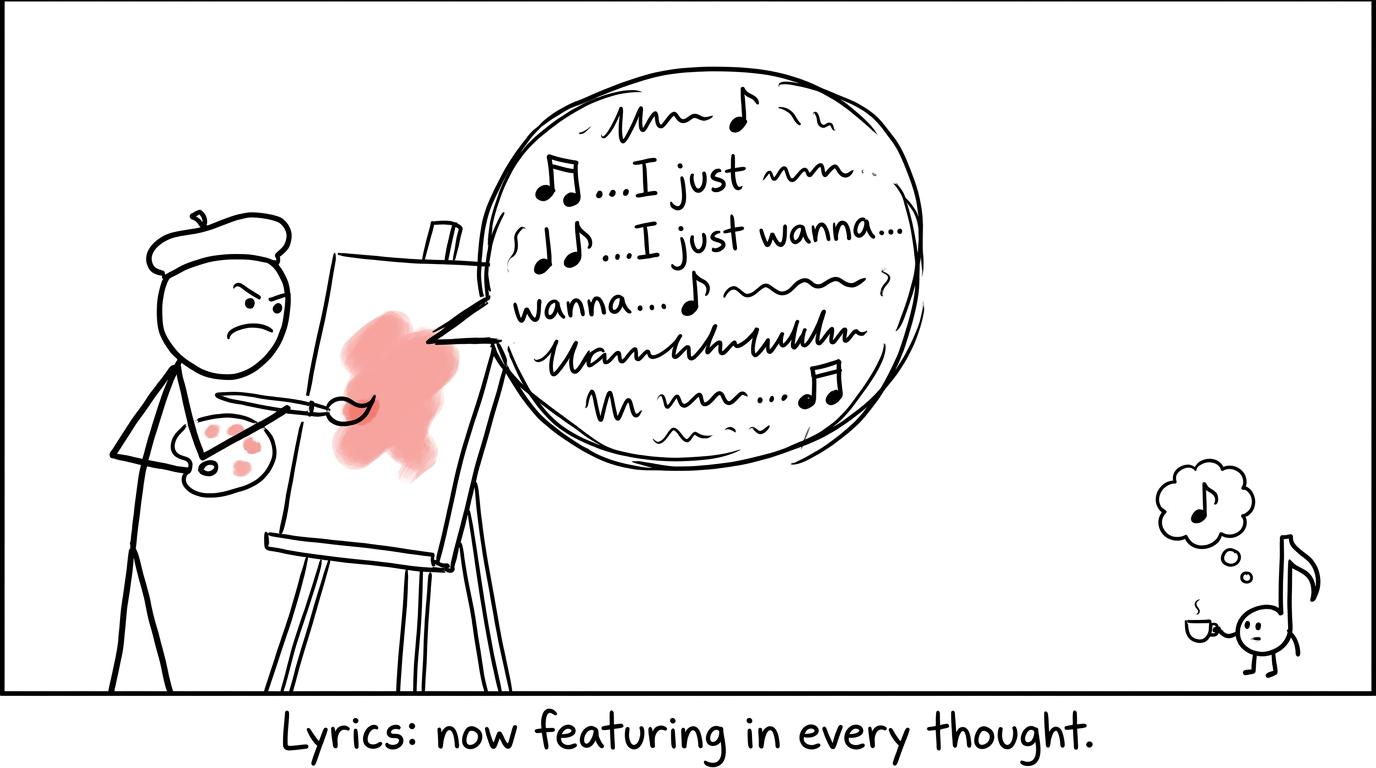 Song lyrics attempting to take over an art revision session
Match the sound to the stage of your session
A flexible routine is more useful than declaring yourself a “music person” or a “silence person”. Try dividing one Art and Design session into three stages.
Plan in silence
Spend the opening minutes identifying one concrete outcome. It could be completing an annotation, testing a material or selecting the strongest composition. Quiet planning prevents an enjoyable playlist from disguising a vague session.
Work in the least distracting condition
Keep silence for reading, writing and demanding decisions. If you move into familiar making, introduce low-volume instrumental sound only if it genuinely helps you remain at the desk.
Review in silence
End by asking:
- What did I complete?
- What changed in my idea?
- What evidence should I record?
- What is the next action?
That review matters because Art and Design rewards a visible journey, not merely time spent producing objects.
Run your own fair revision test
Personal preference matters, but it should be tested rather than assumed. Complete two comparable sessions: one in silence and one with your usual background sound.
Keep the length, time of day, phone access and task type as similar as possible. Afterwards, record:
- how much useful work you completed;
- how many avoidable errors or interruptions occurred;
- whether you remembered your intentions without rereading;
- whether you reached for your phone;
- how mentally tired you felt.
Repeat the comparison before drawing a conclusion. One unusually good or bad session proves little. You may discover that instrumental music helps with practical repetition but harms annotation. That is not inconsistency; it is a sensible response to different tasks.
What this means for GCSE maths revision
Art and Design may involve stretches of practical making. Maths revision is different: the valuable part is usually active problem-solving, followed by checking and correcting.
When using the GCSE Maths revision hub, silence should be your default for learning a method and answering practice questions. Even if music does not affect simple calculations, lyrics can compete with reading a worded problem, holding steps in memory and checking whether you answered the question asked.
Short practice makes experimentation manageable. Choose a focused set from the Edexcel GCSE Maths mini tests, attempt it quietly, mark it and log the errors. The 20-minute maths revision routine offers a repeatable structure when several subjects are competing for your evening.
Most importantly, practise full papers without a soundtrack. The real paper will not supply your familiar playlist, so timed revision should resemble the conditions in which you need the skill. MathsGenie’s guide to using GCSE past papers properly explains the useful cycle: attempt, mark, fix and retest.
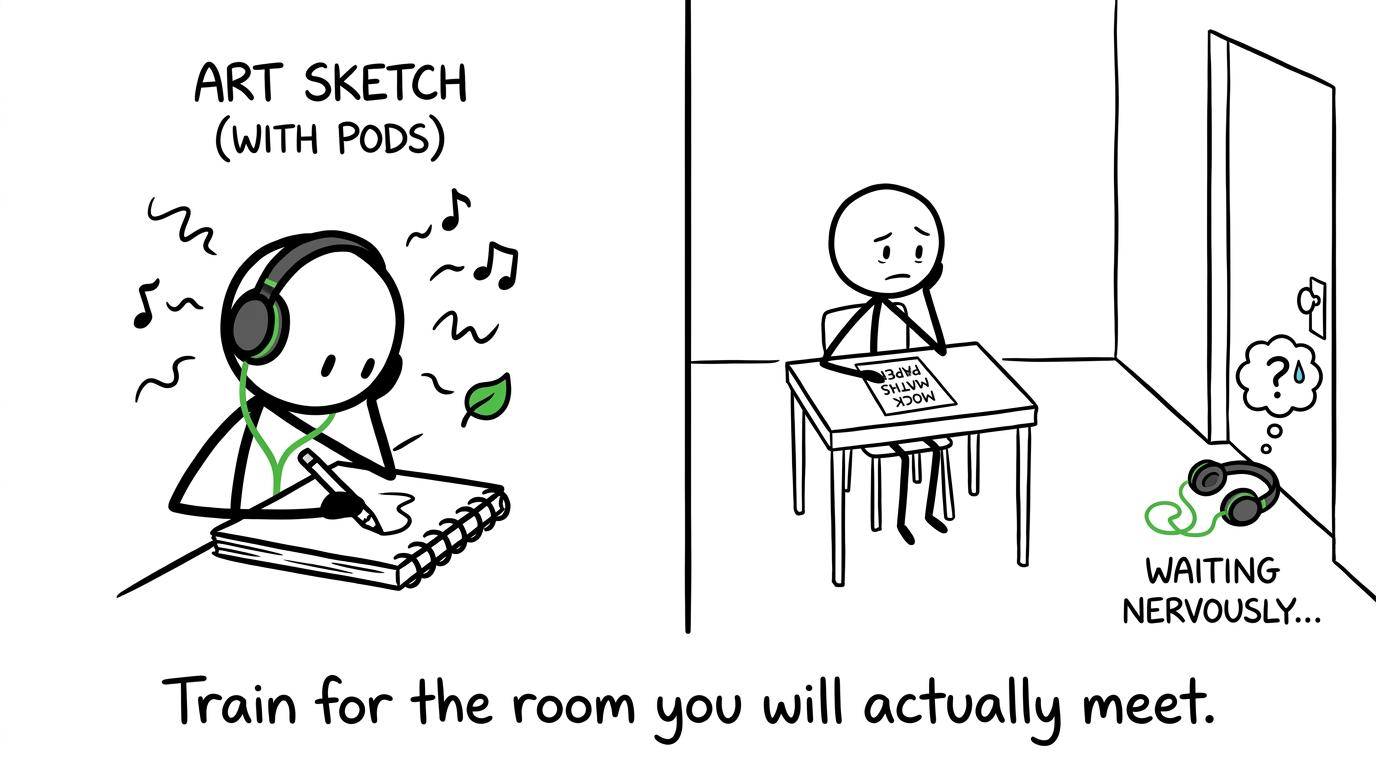 A student saving headphones for after a silent maths mock
Protect focus when silence is impossible
Not every student has access to a silent room. The goal is not perfect acoustic conditions; it is reducing unpredictable, meaningful sound.
Background speech is particularly difficult to ignore because your attention can follow its meaning. If possible, move away from television and conversation. Close the door, tell people when your revision block ends, or use headphones to reduce surrounding speech.
Steady non-speech sound may be preferable to an environment containing sudden voices and interruptions. Keep the volume comfortable, however. Turning music up to cover household noise can simply replace one distraction with another.
Planning also reduces the time available for distraction. A realistic GCSE maths revision timetable lets you reserve quieter periods for timed papers and use noisier periods for organising materials or reviewing an error log.
Common mistakes when choosing revision sound
Confusing comfort with learning
A playlist may make revision feel easier because it improves mood or makes time pass faster. That does not prove that recall, comprehension or accuracy improved. Check the quality of the finished work.
Using lyrical music for language-heavy tasks
Artist analysis, annotation and maths word problems all involve language. Lyrics create avoidable competition. Familiar songs are not necessarily safe; familiarity may make it easier to anticipate and mentally follow the words.
Changing tracks repeatedly
Searching for the perfect song fragments attention and often leads towards messages or social media. If you use instrumental sound, choose it before the session and leave the device out of reach.
Practising maths in conditions unlike the exam
Music can become a cue you expect before concentrating. Use quiet conditions for Edexcel GCSE Maths predicted papers and past papers so your concentration is portable.
Treating noise as the main revision method
The environment cannot rescue passive revision. Progress comes from producing work, answering questions, using feedback and returning to weaknesses. If maths content keeps disappearing from memory, use the strategies in how to stop forgetting GCSE maths rather than searching endlessly for a better playlist.
Choose evidence over identity
Silence versus noise is not a personality test. It is a practical decision that can change from one task to the next.
For GCSE Art and Design, choose silence for research, annotation, reflection and demanding creative decisions. Quiet instrumental music can be tested during familiar practical work, but lyrics are best avoided when memory or language matters. For GCSE maths, make quiet practice your normal condition, especially for multi-step questions, mini tests and full papers.
Then make the session count. Open MathsGenie, choose a focused revision lesson, answer practice questions and check your work against the mark scheme or video solution. Build towards mini tests, past papers and predicted papers. Whether you are working at foundation or higher tier, the useful rhythm remains the same: concentrate, attempt, mark, repair and repeat.










