GCSE Art and Design Exam Clash Same Week: Plan
GCSE art and design exam clash same week? Build a balanced revision plan that protects your art preparation, maths practice, sleep and exam focus.
When your art room is full of preparatory sheets, your maths paper is approaching and two other subjects appear on the same timetable, every task can feel urgent. If you are facing a GCSE art and design exam clash same week, the practical answer is to plan backwards from each fixed exam, finish uncertain art decisions early and keep maths alive through short, marked practice sessions.
Do not divide your time equally. Divide it according to urgency, readiness and the marks you can realistically gain. Your school sets the dates of the supervised Art and Design sessions, so confirm those first. Then place focused maths blocks around them rather than hoping revision will fit into whatever energy remains.
Your same-week checklist
Before deciding what to revise, complete these actions:
- Get your personalised exam timetable and the exact Art and Design supervised-session times.
- Tell your exams officer or teacher immediately if two activities appear to overlap.
- Confirm your maths exam board, tier and calculator requirements.
- List no more than three maths weaknesses to repair that week.
- Complete important art experiments and decisions before supervised time begins.
- Prepare separate art and written-exam equipment.
- Protect meals, breaks and sleep as fixed commitments.
- Replace marathon revision with short attempts followed by marking.
The aim is not to make the week easy. It is to remove unnecessary decisions from a week that is already demanding.
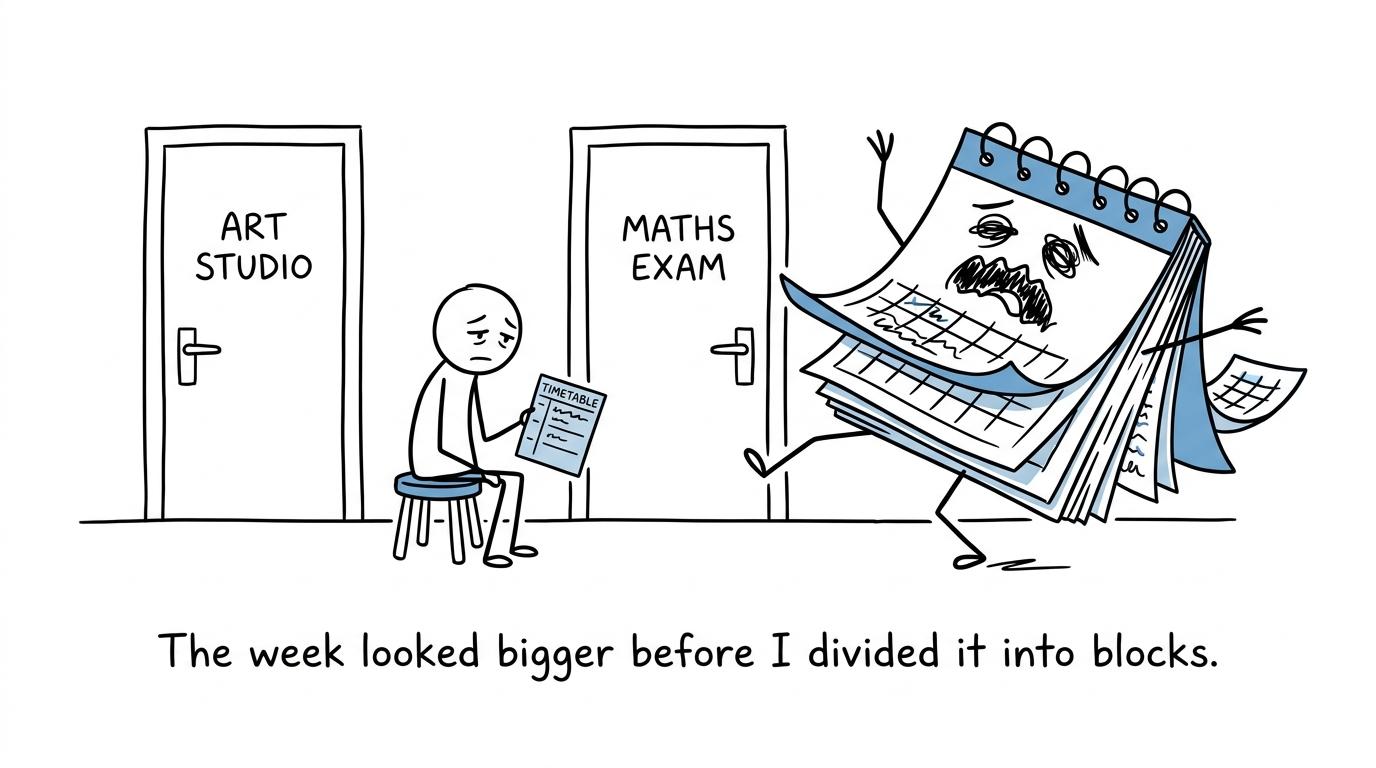 A student divides an intimidating exam week into manageable blocks
Is an Art and Design exam in the same week a timetable clash?
Not necessarily. JCQ defines a timetable clash as two or more examinations scheduled at the same time on the same day. Having Art and Design on Monday and maths on Thursday is a heavy week, but it is not formally a clash.
GCSE Art and Design is also structured differently from an ordinary written paper. Under Ofqual's subject requirements, the portfolio contributes 60%60\%60% and the externally set assignment contributes 40%40\%40%. The externally set assignment includes preparatory work followed by 101010 hours under supervised conditions. This broad structure applies across specifications from AQA, Pearson Edexcel, OCR and Eduqas, although administrative details and session arrangements vary.
The school or college schedules those supervised hours. Depending on the specification and centre arrangements, they may be split across sessions. That flexibility is helpful, but it means a general online timetable cannot tell you when your art sessions will occur. Your personalised school timetable is the authority.
If an art session appears to overlap with a written examination, do not try to solve it privately or decide which one to attend. Speak to your exams officer, art teacher or head of year immediately. Formal timetable variations and supervision are managed by the centre under JCQ rules.
Plan backwards from fixed commitments
A crowded week becomes clearer when you separate fixed time from flexible time.
Write down:
- every examination and supervised art session;
- travel, registration and equipment collection time;
- meals and a realistic bedtime;
- the remaining revision windows.
Now label the flexible windows as high-energy, medium-energy or low-energy. Put demanding maths questions into high-energy periods. Use medium-energy time for shorter topic practice. Reserve low-energy periods for checking an error log, packing equipment or reviewing a compact formula list.
Do not expect a full past paper after a long supervised art day. A focused 202020-minute session completed and marked is more valuable than a nominal two-hour session spent rereading notes. The MathsGenie 20-minute maths revision routine provides a useful structure for these narrow gaps.
A revision planner should show outcomes, not vague subject names. Replace “maths” with “complete a mini test and correct two errors”. Replace “art” with “check materials and final composition plan with teacher-approved access”. Specific tasks are easier to begin and easier to finish.
Split attention according to risk, not guilt
Equal time can feel fair while producing poor decisions. Instead, ask three questions about each subject:
- How soon is the assessment? Tomorrow normally deserves more immediate attention than next week.
- How prepared am I already? A fragile topic may offer more improvement than another hour on familiar material.
- What can still be changed? Art decisions and practical testing often need resolving before supervised time, while maths accuracy can improve through short, repeated practice.
For maths, use evidence rather than anxiety. A mini test or short paper section can reveal whether algebra, ratio, geometry or probability is actually losing marks. The guide to finding your weakest GCSE topics explains how to turn errors into a small repair list.
Keep that list narrow. During a congested week, three precise weaknesses are more useful than an entire specification highlighted in five colours. If you are unsure what belongs on your tier, check the GCSE maths topics by exam board and tier.
Prepare Art and Design before the supervised hours
The supervised period should not be the first time you make major decisions about your outcome. Official specifications assess four shared objectives: developing ideas through investigations, refining work through experimentation, recording relevant ideas and observations, and presenting a personal, meaningful response.
Use the preparation period to make your intentions visible and practical. Confirm that you have:
- connected your final intention to your investigations and sources;
- tested the media, materials and techniques you plan to use;
- recorded useful observations and development;
- considered composition, scale and sequence;
- checked what materials your centre will provide;
- understood what can and cannot be accessed during supervised sessions.
Rules around preparatory work, internet access, storage and session structure must be followed exactly. Ask your teacher about your board and centre arrangements rather than relying on advice from another school.
The calmer principle is simple: supervised time is for carrying out a developed response, not rescuing an idea that has never been tested.
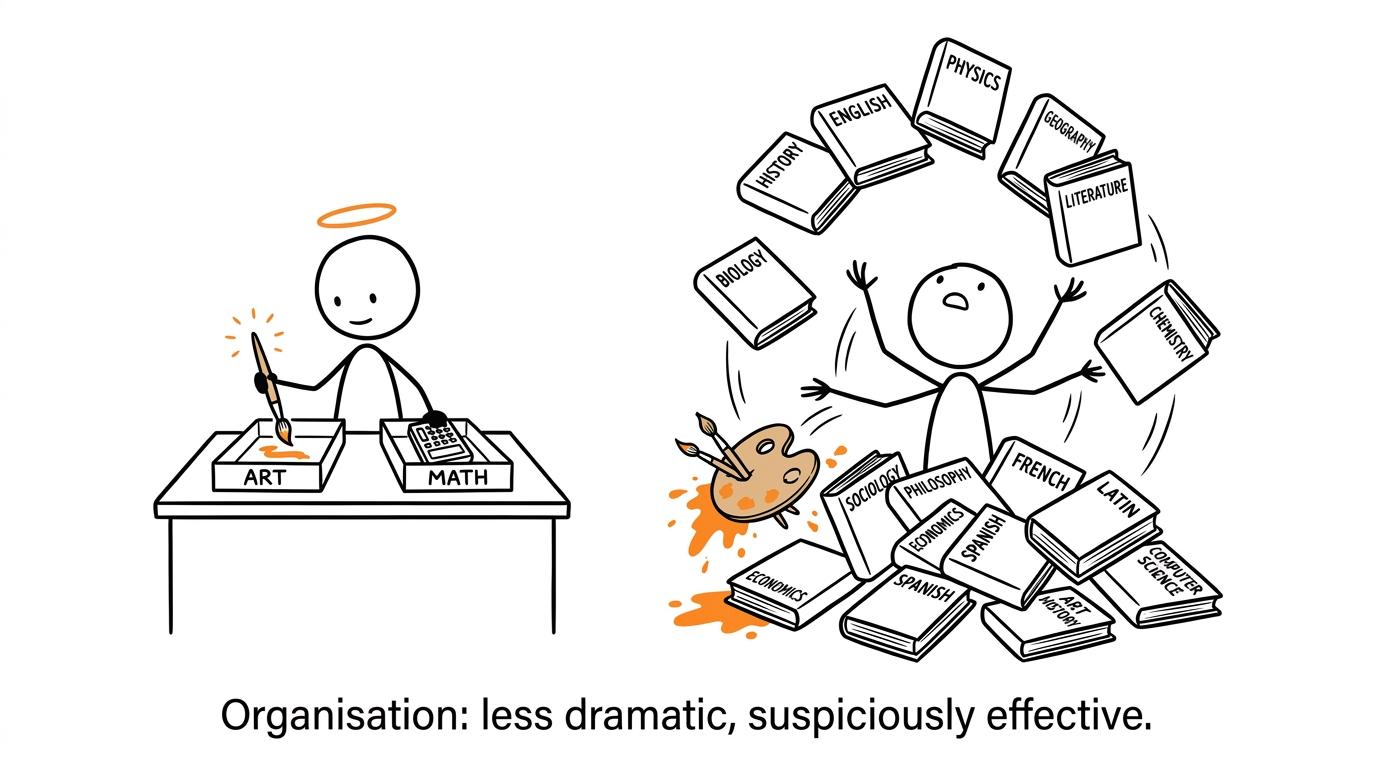 One organised student separates art and maths equipment while another attempts to juggle everything
Keep maths revision short, active and marked
Maths can disappear from the week because art occupies visible physical space. Sketchbooks, materials and unfinished work are hard to ignore. Maths weaknesses are quieter. They remain hidden until a question exposes them.
Use a repeatable cycle:
- recall one method without notes;
- complete a small set of exam-style questions;
- mark the attempt immediately;
- write one precise correction;
- retest that skill later in the week.
The free GCSE Maths revision hub brings together revision lessons, practice questions, mini tests, past papers and predicted papers for Edexcel, AQA, OCR and Eduqas. If you need a quick method reminder, use the GCSE revision guides, then move promptly into questions.
Marking matters because completing questions only measures effort. Mark schemes show whether you selected a valid method, communicated enough working and reached the required accuracy. Keep an error log with the topic, the reason for the lost mark and a brief “next time” instruction.
When time permits, use a section of a paper rather than forcing a complete one. The guide to using GCSE past papers properly explains the useful rhythm: attempt, mark, repair and retest. Edexcel students can also select the correct tier from the Edexcel GCSE Maths past papers, with mark schemes and worked support where available.
Adjust the plan around the art sessions
The day before supervised art
Prioritise practical certainty. Check materials, clothing requirements, arrival time and the centre's rules. Do one short maths maintenance session on a familiar or recently repaired skill. This is not the evening for beginning a difficult new chapter.
After a full art session
Expect mental and physical tiredness. Eat, pause and reassess. If you can concentrate, complete a mini test or several focused questions. If concentration is poor, review yesterday's corrections and stop at the planned time.
The day before maths
Maths becomes the immediate priority. Use the GCSE maths night-before plan to choose one short exam-style set, correct your main mistakes and pack your equipment. Avoid reopening the whole course.
For a broader crowded-week structure, adapt the one-week GCSE maths revision plan by shortening its sessions around your supervised art hours.
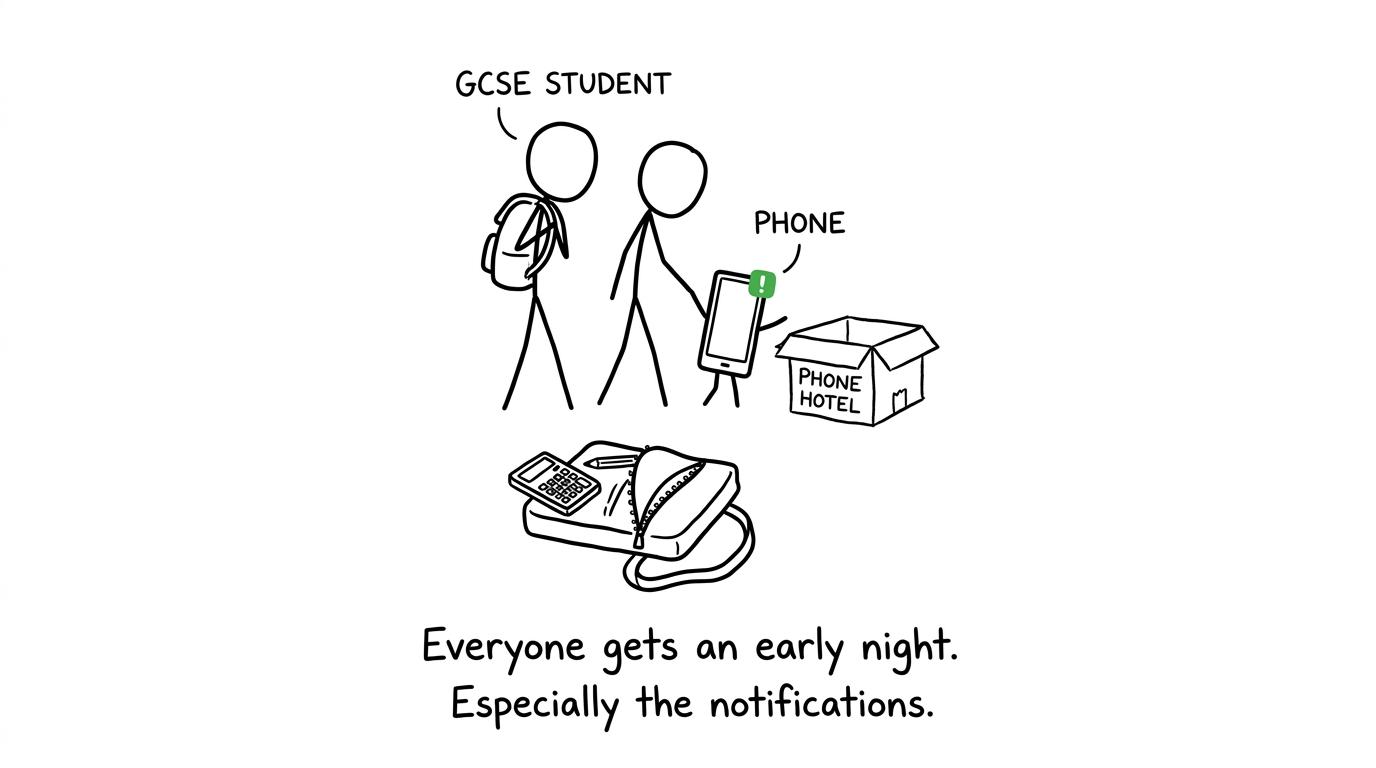 A student gives their phone an early night before an exam
Common mistakes when exams crowd the same week
Treating the situation as a private problem
Students sometimes worry about an apparent overlap without telling anyone. Exam arrangements are the centre's responsibility. Raise the issue early and ask for written confirmation of where you must be and when.
Giving every subject equal time
Equal blocks ignore exam order and existing readiness. Allocate attention according to the next assessment, your evidence of weakness and the work that can still improve.
Leaving art decisions until supervised time
Untested materials or an uncertain composition consume valuable time. Develop and refine the response during the permitted preparation period, following your teacher's guidance.
Revising maths by reading alone
Recognition is not the same as recall. Close the notes, answer questions and use the mark scheme. Maths performance grows through retrieval and correction.
Completing papers without reviewing them
A paper produces a score; the review produces improvement. Identify the exact topics and habits behind lost marks, then practise them separately.
Sacrificing sleep to create extra hours
Late-night work can make the timetable appear larger while reducing the quality of the following day. Set a stopping time, prepare your equipment and let the remaining work wait.
A calm finish to a demanding week
An Art and Design assessment beside several written exams asks you to switch between different kinds of concentration. That is difficult, but the solution is not to work continuously. It is to make fewer, better decisions.
Confirm the official schedule. Resolve art choices while preparation is permitted. Keep maths active with short, marked questions. Increase maths attention as its paper approaches, then stop early enough to arrive rested and properly equipped.
Make MathsGenie GCSE Maths revision your free revision base. Choose your board and tier, repair weak skills with revision lessons and practice questions, check progress through mini tests, and build exam readiness with past papers, predicted papers, mark schemes and video solutions. Your week may remain busy, but your next action will be clear.