GCSE Art and Design Cross Curricular Overlap
GCSE art and design cross curricular overlap explained: connect art with maths, science, English and humanities without revising every skill twice.
A sketchbook deadline is approaching. Your maths mock is not far behind it. Both subjects want your time, and it can feel as though every hour spent on one must be stolen from the other.
The reality is more useful. GCSE art and design cross curricular overlap can strengthen skills in maths and several other subjects, particularly through scale, proportion, geometry, visual communication, research and critical reflection. But overlap is not replacement. Designing a symmetrical pattern may make transformations more intuitive; it does not replace answering transformation questions under exam conditions.
The aim, then, is not to count the same hour twice. It is to notice where one subject is already giving you meaningful practice, then use a shorter, focused session to convert that experience into exam marks.
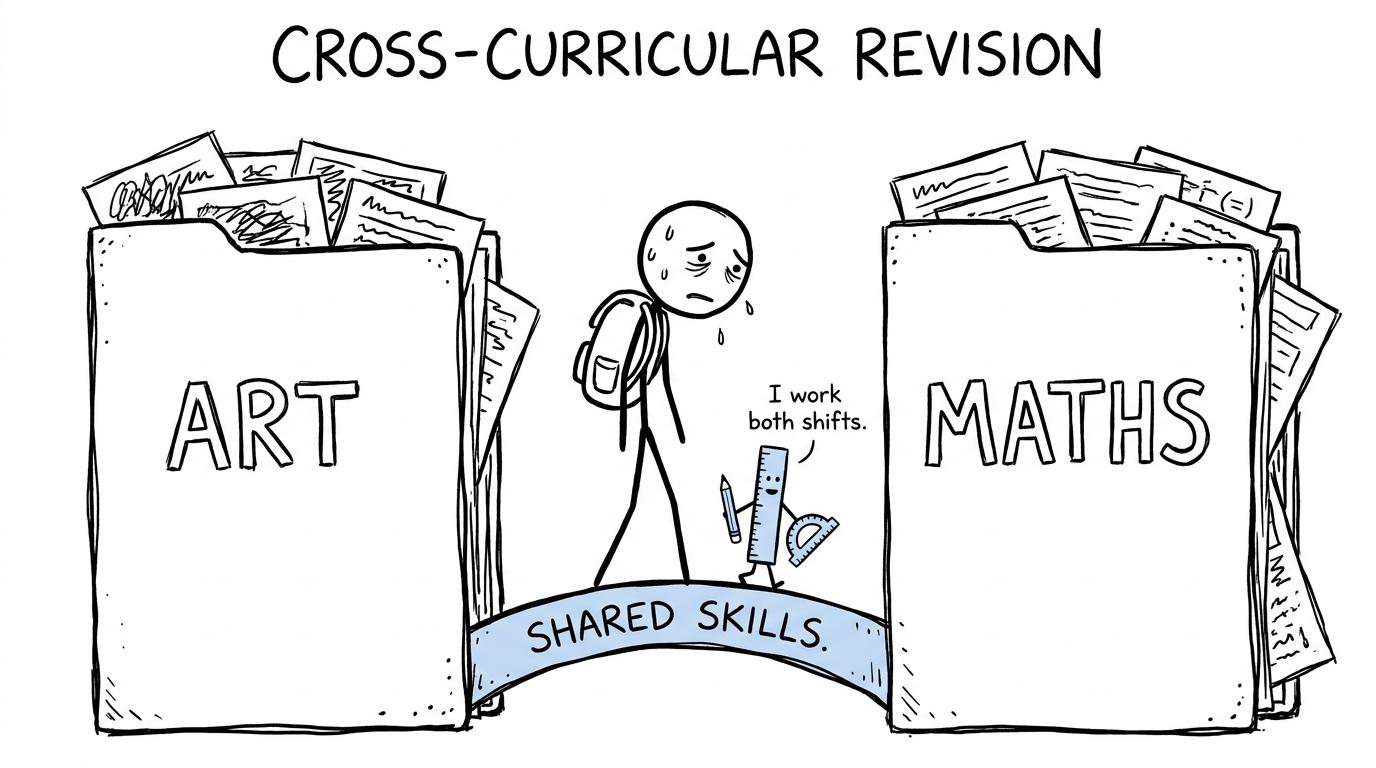 A student discovers a bridge of shared skills between art and maths revision
The quick cross-curricular checklist
Here is the practical answer before we explore the detail:
- Maths: proportion, scale, measurement, geometry, transformations, coordinates, area and data presentation.
- English: annotation, analysis, comparison, vocabulary and communicating an interpretation.
- Science: observation, material properties, light, colour and recording change.
- History: context, chronology, evidence and the influence of events on artists and designers.
- Geography: place, environment, field observation, maps and visual data.
- Design and technology: iteration, materials, function, accuracy and evaluation.
- Computing: digital image construction, coordinates, layers and systematic processes.
Use the overlap when the underlying skill is genuinely the same. Keep separate revision where the assessment method, terminology or required knowledge changes.
What GCSE Art and Design actually assesses
Across GCSE Art and Design specifications, the four assessment objectives are set nationally and carry equal weighting. In broad terms, students must develop ideas through investigation, refine work through experimentation, record relevant observations and present a personal response that realises their intentions.
That matters because the qualification is not assessed simply by asking, “Does this look good?” It rewards a visible process of research, decision-making, testing, recording and refinement. Those habits travel well between subjects.
Still, the destination changes. In art, experimentation might help you select a process or material. In maths, a valid solution must follow mathematical rules and answer the stated problem. Creative thinking helps you find a route, but accuracy decides whether that route earns marks.
Portfolio and externally set assignment arrangements vary by specification, so check the current information from your school and exam board, whether you take AQA, Edexcel, OCR or Eduqas. The safest principle is to build your art evidence around your own specification rather than assuming another board follows an identical structure.
Where art and GCSE maths genuinely overlap
GCSE maths includes number, algebra, ratio and proportion, geometry and measures, probability, and statistics. Art connects most directly with ratio, geometry and visual representation. These links appear at both foundation and higher tier, although the depth of the mathematics differs.
Scale, proportion and similarity
Artists and designers regularly change the size of references, plans, photographs, grids and prototypes. This builds an intuitive sense that corresponding lengths must change consistently.
A scale written as 1:n1:n1:n compares a drawing length with the corresponding real length. If every length changes by a scale factor kkk, area changes by k2k^2k2. For similar three-dimensional forms, volume changes by k3k^3k3.
Those distinctions matter. A student may be comfortable enlarging an image visually but still confuse length, area and volume scale factors in an exam. Use the visual experience as a memory anchor, then complete dedicated scale drawings revision and practice to learn the notation, unit conversions and question formats.
Proportion also appears in composition, figure drawing, typography, photography and mixing materials. However, an artistic judgement that something “looks balanced” is not enough for a ratio question. Maths needs quantities, a stated relationship and working that another person can follow.
Geometry, measurement and area
Frames, layouts, repeating motifs, packaging and constructed forms all involve shape. Art can therefore reinforce:
- angle awareness;
- parallel and perpendicular lines;
- polygons and circles;
- perimeter and area;
- surface area and volume;
- plans and elevations;
- accuracy with rulers, compasses and protractors.
The formulas still need independent recall and application. For example, the area of a circle is
A=πr2,A=\pi r^2,A=πr2,while its circumference is
C=2πr.C=2\pi r.C=2πr.Visual familiarity with circles does not prevent these formulas being confused. If measurement is costing you marks, use MathsGenie’s shape and geometry revision pathway and area and perimeter exam booklet.
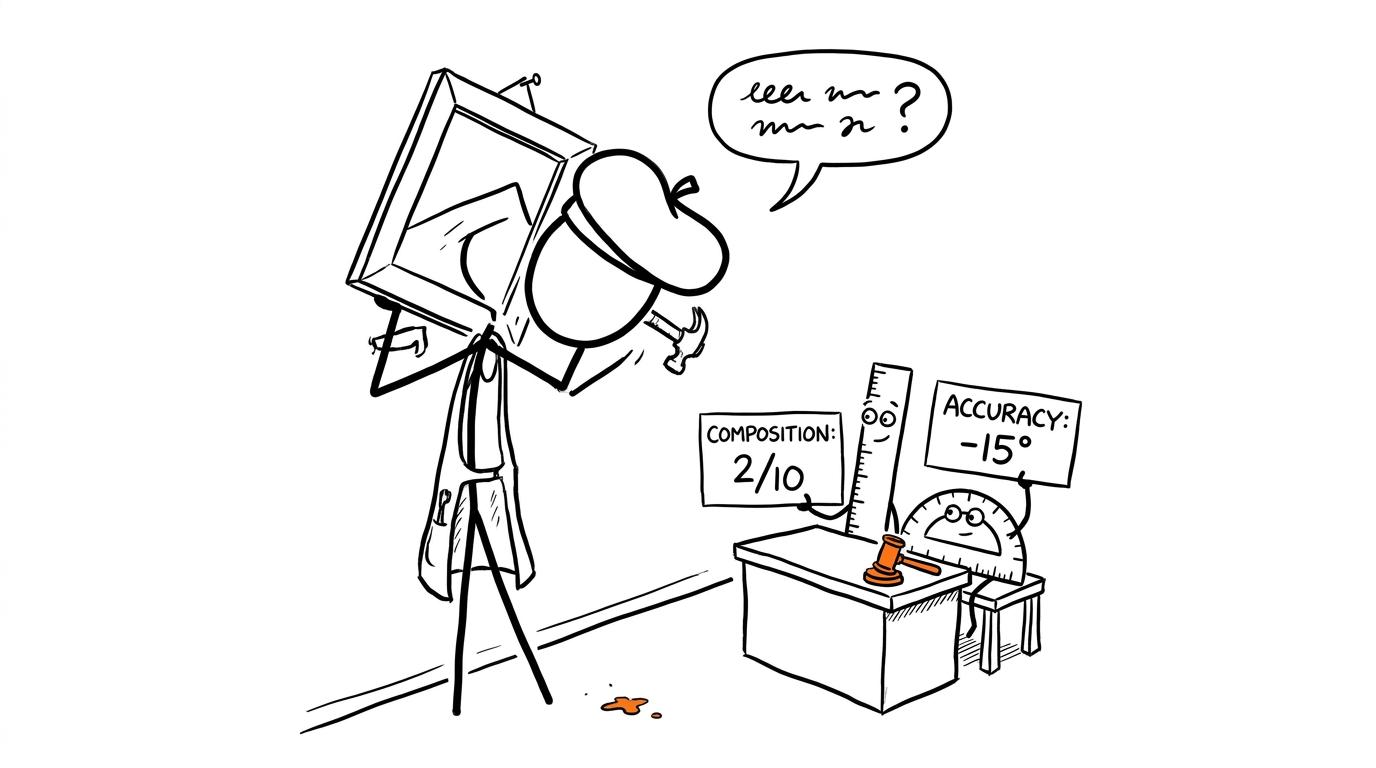 A ruler and protractor judge a deliberately crooked art frame
Transformations, symmetry and coordinates
Pattern design, printmaking, photography and digital composition often use reflection, rotation, translation and enlargement. These are also named GCSE transformations.
The overlap is especially valuable because art makes each movement visible. Maths then adds precise language. A reflection needs its mirror line. A rotation needs its centre, angle and direction. A translation is described by a vector, and an enlargement requires a centre and scale factor.
“Moved it to the left” may communicate an artistic decision, but it is not a complete mathematical description. Use the visual intuition developed in art, then sharpen the formal language with the GCSE transformations topic page and its transformations revision guide.
Digital art can also support coordinate awareness. Placing, cropping and moving elements encourages attention to position and direction. Yet coordinate questions require ordered pairs in the form (x,y)(x,y)(x,y), with horizontal movement considered before vertical movement.
Statistics and visual communication
Artists research audiences, themes, materials and contexts. If that work includes surveys or recorded observations, it may touch on sampling, categorisation and data display.
The useful transfer is not merely the ability to make a chart attractive. GCSE statistics asks whether the representation suits the data, whether a sample could be biased and what conclusions the evidence supports. Decoration must never make a scale unclear or distort comparisons.
This is a broader lesson shared by art and maths: presentation has power, so presentation must be honest.
How art overlaps with your other GCSE subjects
English language and literature
Sketchbook annotation can strengthen concise explanation. When you describe a source, compare approaches and justify a decision, you practise selecting evidence and communicating an interpretation.
The limits are important. Art annotation is usually tied to visual intentions and development. English responses require close attention to language, structure, context and the wording of the question. Reuse the habit of evidence-based explanation, not a memorised paragraph.
Science
Observation is shared territory. Art may sharpen your attention to tone, texture, structure, light and change. Science also values careful observation, but it requires controlled methods, measurements, variables and conclusions supported by evidence.
Material experimentation may help you remember that substances possess different properties. It does not replace learning the scientific model that explains those properties. Treat art as sensory reinforcement, then revise the required scientific terminology separately.
History and geography
Researching an artist or movement can reveal links to politics, technology, identity, migration, industrialisation or the environment. Visual sources can make a historical period or geographical place more memorable.
However, an artwork is a source rather than a complete record. In history, you must consider provenance, purpose and context. In geography, an image of a landscape cannot replace fieldwork methods, processes or data analysis. The overlap helps you ask better questions; the subject specification tells you which answers matter.
Design and technology and computing
The strongest procedural overlap may be with design and technology. Both subjects involve developing ideas, testing possibilities, selecting materials and evaluating outcomes. Computing joins this conversation through digital tools, ordered processes, coordinates and iterative improvement.
Iteration is the shared habit: create, inspect, alter and test again. In maths revision, the equivalent is attempting a question, checking the mark scheme, identifying the exact error and trying the skill again.
How to use overlap without revising everything twice
The best system has three stages: notice, translate, test.
Notice the shared skill
After an art session, write down any maths you genuinely used: measurement, scale, ratio, symmetry, coordinates or area. Be specific. “Geometry” is too broad; “describing a rotation accurately” is useful.
Translate it into exam language
Open the relevant page in the GCSE Maths revision hub. Check the definition, notation and method expected for your exam board and tier. This translation stage can be brief because the practical experience has already supplied context.
Test it with unseen questions
Attempt practice questions without your art notes. Mark them and classify each lost mark:
- missing mathematical knowledge;
- inaccurate calculation;
- incomplete terminology;
- unit or scale error;
- misreading the question.
A skill only counts as maths revision once you can retrieve and apply it in a mathematical question. Use the GCSE Maths self-assessment sheet to identify gaps rather than assuming that familiarity means mastery.
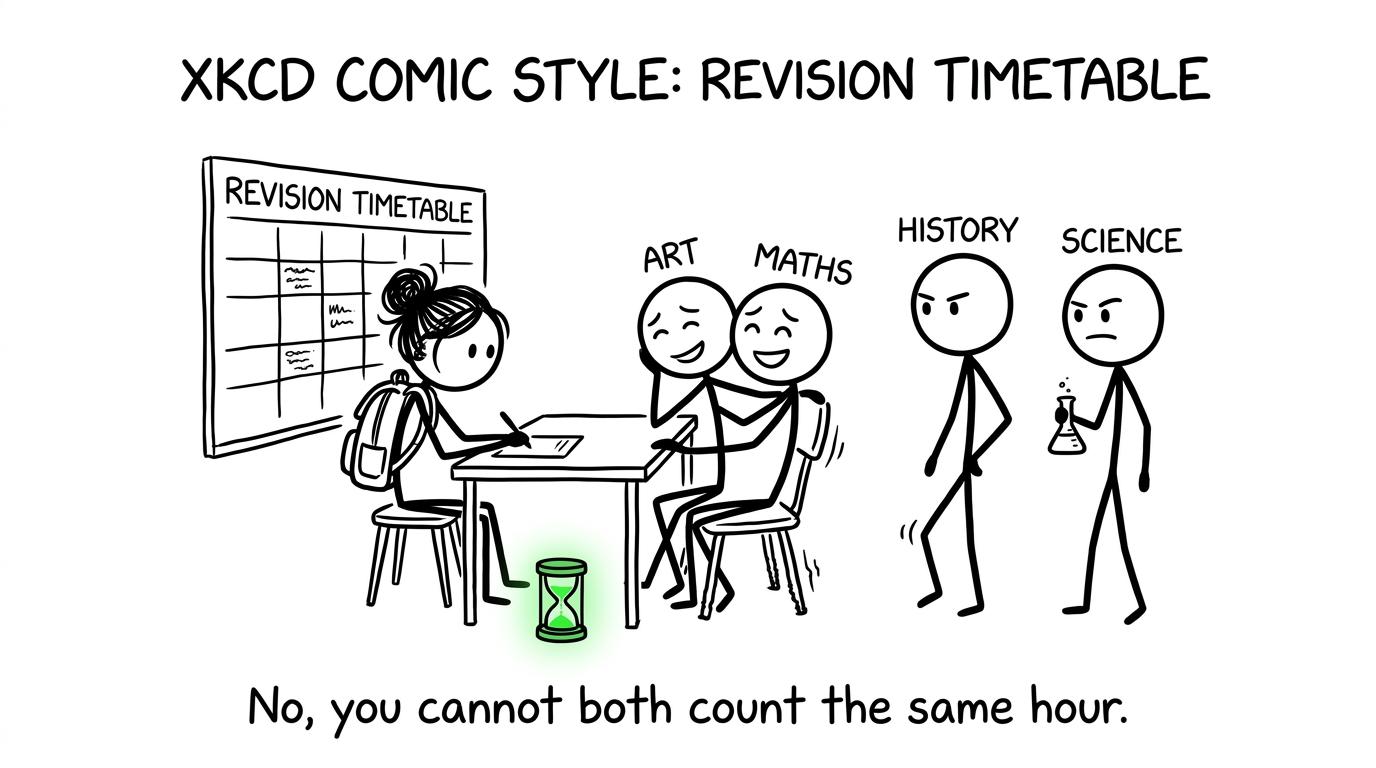 Art and maths attempt to claim the same hour on a revision timetable
Build an efficient cross-curricular revision routine
Keep one small “shared skills” list in your revision planner. It might include scale, transformations, visual evidence and evaluation. Each entry should show three things:
| Shared experience | Subject-specific follow-up | Proof of progress |
|---|---|---|
| Enlarging or reducing an image | Scale factors and unit conversions | Unseen scale questions |
| Developing a repeated pattern | Full transformation descriptions | Marked geometry practice |
| Recording visual research | Evidence-based written explanation | Response checked against criteria |
| Reviewing design changes | Error analysis after maths practice | Correct reattempt without notes |
Do not allocate an art session and a maths session to the same clock time. Instead, let the art experience shorten the time needed to understand a related maths idea. Your timetable remains honest while your revision becomes more connected.
For a wider structure, adapt the GCSE maths revision timetable to your actual deadlines. During heavy portfolio weeks, use shorter maths mini tests. When art pressure eases, return to longer timed papers.
Common mistakes when combining art and revision
Assuming visual confidence equals exam readiness
Recognising symmetry or proportion is not the same as describing it with correct notation. Always finish with exam-style questions.
Forcing a link that is not there
Not every artwork needs algebra, and not every maths topic has a helpful artistic connection. Quadratic equations should not be squeezed into a project merely to make revision appear efficient.
Using maths to restrict creative decisions
Mathematical structure can support a composition, but art assessment also values investigation, refinement and a meaningful response. A technically precise outcome is not automatically a developed artistic one.
Treating annotation as decoration
Lists of facts do little unless they explain how a source informed your choices. Record decisions, experiments and changes with relevant subject vocabulary.
Revising only the comfortable overlap
Students naturally return to attractive topics such as symmetry and pattern. Your paper will also test algebra, number, probability and other areas that may have no direct art connection. Check the full GCSE topic list by exam board and tier so the overlap does not create blind spots.
Turn shared skills into separate marks
Cross-curricular learning works best as a bridge, not a shortcut. Art can make scale visible, geometry tangible and evaluation habitual. Maths supplies precise notation, logical constraints and answers that must survive checking. English, science and the humanities each add their own rules for evidence.
Start with one genuine connection from your current art project. Translate it into the language of your maths specification, complete a focused set of questions and mark it honestly. Then move on to the gaps that art cannot cover.
MathsGenie gives you the free structure to do that: revision lessons for understanding, practice questions for fluency, mini tests for quick checks, and past papers or predicted papers for timed preparation. Use mark schemes and video solutions to find exactly where an intuitive idea needs a more precise mathematical method. One connected insight can save time. Consistent exam practice turns it into marks.