

GCSE Dance Exam Conditions Practice at Home
GCSE dance exam conditions practice: build a realistic 90-minute home session, improve timing, manage nerves and review answers without a classroom nearby.
The hardest part of a home practice paper is rarely finding the correct notes. It is recreating the moment when the clock starts, nobody can help and every answer must come from you. Effective GCSE dance exam conditions practice means completing a full, unseen Dance appreciation paper in one uninterrupted sitting, using only permitted materials and following the real time limit.
For the current AQA GCSE Dance specification, the written Dance appreciation exam lasts 909090 minutes, carries 808080 marks and contributes 40%40\%40% of the qualification. The practical performance and choreography component contributes the remaining 60%60\%60%. This guide focuses on realistically rehearsing the written exam at home. Your school must manage the official practical assessment, including its safety and assessment requirements.
Your realistic practice checklist
Before starting, make sure you can tick every item:
- Use a complete, unseen paper that matches your specification.
- Read the front-cover instructions before beginning.
- Allow exactly 909090 minutes unless your approved access arrangements specify otherwise.
- Print the paper if possible and use the same writing equipment you expect in the exam.
- Remove notes, textbooks, headphones and internet access.
- Put your phone in another room, not merely face down.
- Tell other people at home when you must not be disturbed.
- Answer every required question without checking your notes.
- Mark and analyse the paper only after time has expired.
The principle is the same one used in effective GCSE maths past-paper practice: the paper measures your current performance, while the review afterwards creates the improvement.
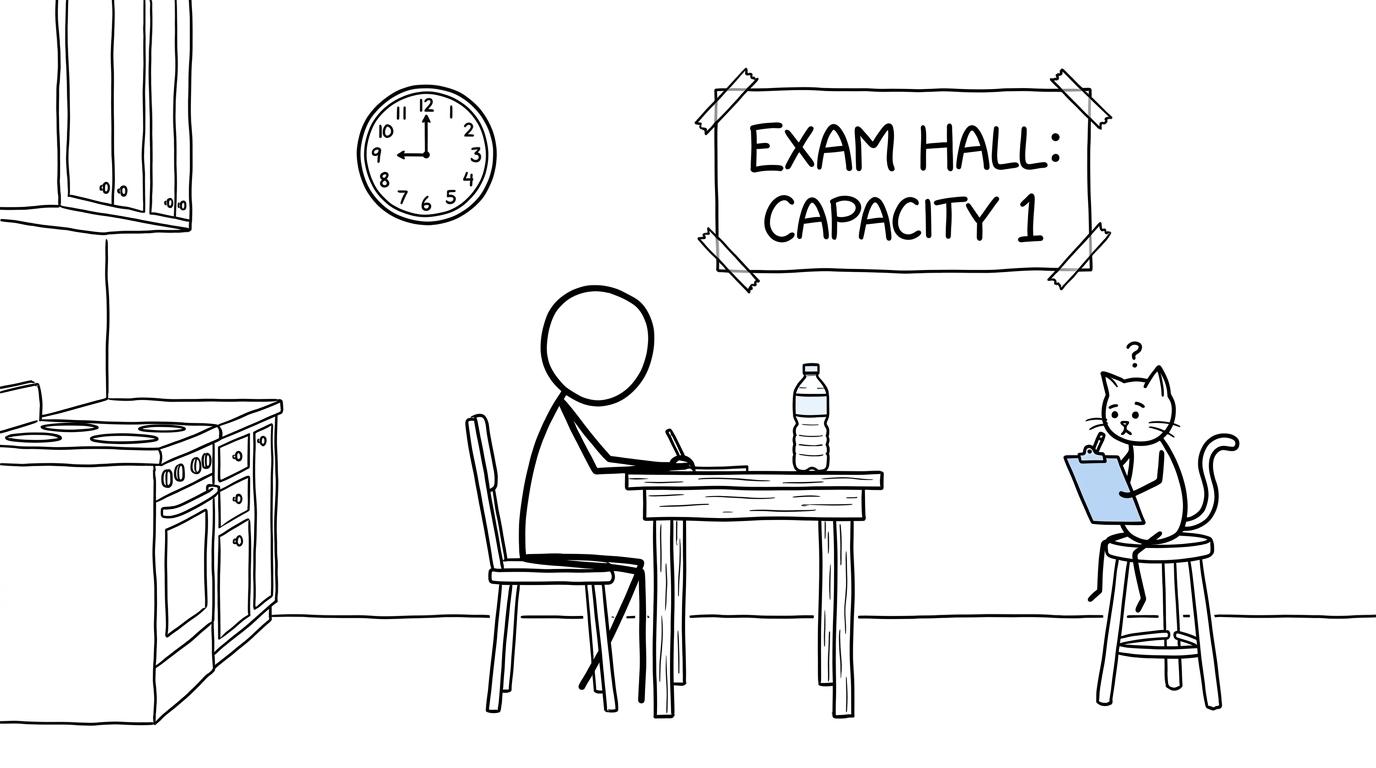 A student has turned a kitchen table into a one-person exam hall while a cat invigilates
Know which part of GCSE Dance you are simulating
Home practice becomes realistic only when it reflects the correct assessment. Under the current AQA specification, Dance appreciation contains three sections covering:
- choreographic processes and performing skills;
- critical appreciation of your own performance or choreography;
- critical appreciation of professional works from the GCSE Dance anthology.
The paper includes different question styles, from short responses to extended analytical answers. All required questions should be attempted. That mixture matters because the examination tests more than memory. You must retrieve accurate knowledge, select relevant examples and shape the material around command words such as describe, explain, analyse, compare and evaluate.
Do not try to turn an unsupervised bedroom rehearsal into a replica of the practical assessment. Solo performance, duet or trio work, recording, safe working practice and assessment administration belong within your school's arrangements. At home, physical rehearsal should only take place where the space is safe and in line with your teacher's guidance. A timed written paper is the part you can reproduce much more faithfully.
Build a one-person exam room
A real exam hall is deliberately uneventful. That is useful. Your aim is not to make home feel intimidating; it is to remove the small comforts that quietly change how you perform.
Choose the right place
Use a table or desk with enough room for the paper and your writing equipment. Sit somewhere with reasonable lighting and a supportive chair. Clear away revision cards, anthology notes, posters containing useful material and any second screen.
A shared kitchen can work if everyone knows the session is protected. A bedroom can work if the desk is clear. The best room is not the most impressive one. It is the place where you can work for 909090 minutes without conversation, music or avoidable interruption.
Prepare only permitted materials
Check the current paper's instructions and your teacher's guidance rather than assuming that the rules never change. As a basic practice setup, prepare:
- the question paper and answer booklet arrangement used by your board;
- black pens and a spare;
- a simple clock or timer that will not provide notifications;
- any other item specifically permitted by the paper.
Do not keep notes nearby “just in case”. The knowledge gap revealed when you cannot check something is valuable information. It tells you what to revise next.
Remove the phone completely
A phone on silent still changes the session because you know it is available. Place it outside the room before reading the paper. If you need a timer, use a clock, watch or basic kitchen timer instead.
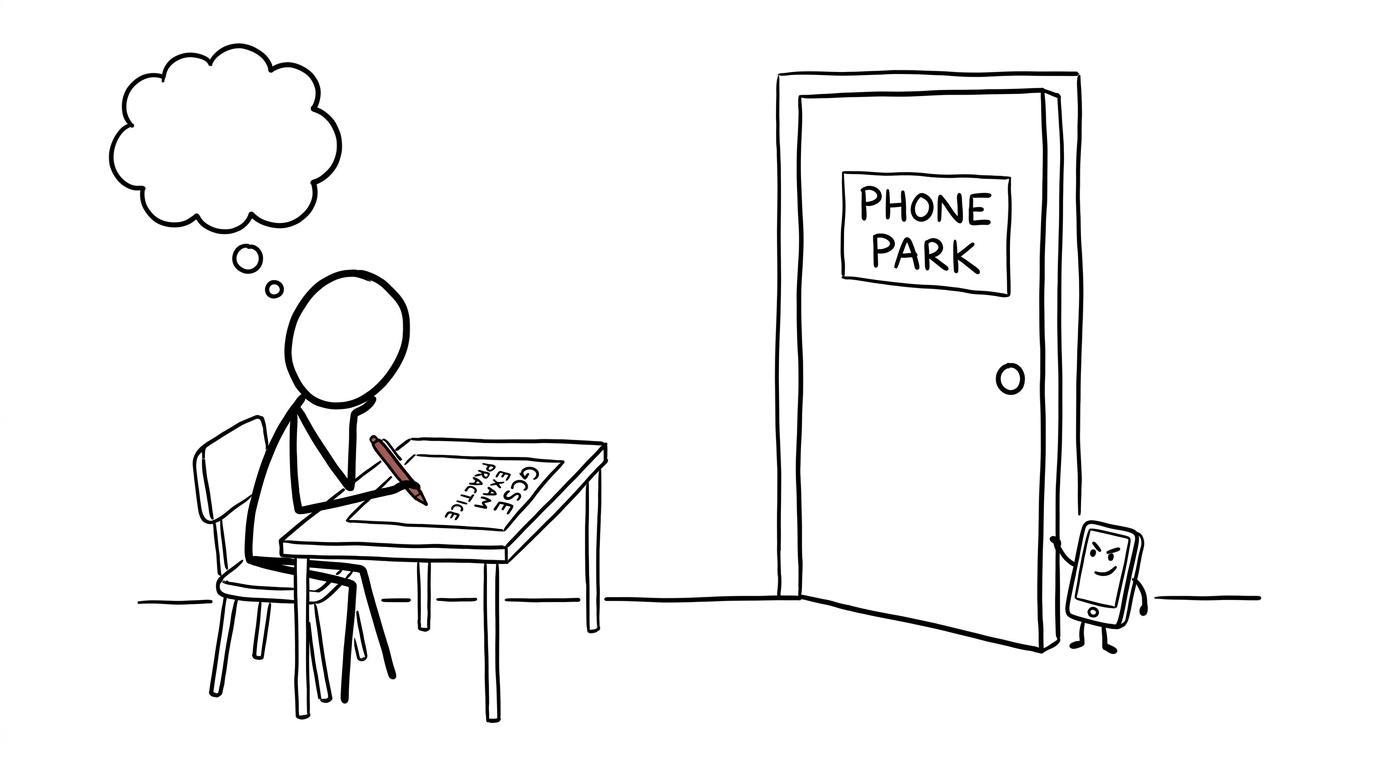 A determined phone tries to escape from phone park and interrupt an exam session
Run your GCSE dance exam conditions practice properly
The session should have a clear beginning and end. Do not start answering while arranging pens or finish the final question after the timer because you were “nearly there”. Those small exceptions make the result less informative.
Use a short pre-exam routine
Arrive at your desk around 101010 minutes before the planned start. Use that time to visit the toilet, organise equipment and settle your breathing. Do not use it for frantic last-minute reading.
At the start time:
- turn over or open the paper;
- read the instructions carefully;
- write down your official finishing time;
- start the timer;
- work without pausing it.
This routine removes decisions. Repeating it also makes the beginning of the real examination feel more familiar.
Rehearse sensible time control
AQA's written paper provides 909090 minutes for 808080 marks. As a broad calculation, that is:
9080=1.125\frac{90}{80}=1.1258090=1.125minutes per mark, or 67.567.567.5 seconds per mark. This is a guide, not a command to spend exactly the same time on every mark. Reading, planning and checking also consume time, while extended responses require sustained development.
A previous AQA paper suggested approximately 303030 minutes for Section A, 252525 minutes for Section B and 353535 minutes for Section C. This is a useful rehearsal structure, but always follow the instructions and mark allocations on the current paper you are using.
Write a few time checkpoints on scrap-free space before answering. When a checkpoint arrives, make a deliberate decision: continue briefly because the answer is nearly complete, or move on and return later. An unfinished low-mark response should not consume the time needed for a substantial analytical question.
For students balancing Dance with maths revision, shorter timed sets can build concentration before a full paper. MathsGenie's GCSE mini tests and Edexcel GCSE 454545-minute tests use the same progression: establish discipline in a smaller block, then extend your stamina.
Answer the command word, not the topic in general
Under pressure, it is easy to write everything remembered about an anthology work. That can feel productive while failing to address the question.
Pause over the command word and identify the precise focus. An analytical answer should connect a relevant feature to its meaning, effect or contribution to choreographic intent. An evaluative answer needs a supported judgement. A comparison must keep both works or ideas connected rather than presenting two unrelated descriptions.
Use examples where appropriate, but choose them for relevance. Specific knowledge earns its place by helping you answer the question, not simply by proving that you memorised it.
Make interruptions part of the plan
A perfect home is not required. A plan is.
Tell other people the exact start and finish times. Close the door where possible and leave a note outside. Deal with food, drinks and pets beforehand. If unavoidable noise occurs, continue working as you would through a minor distraction in an exam hall.
If there is a genuine emergency, stop. Record what happened and do not treat the resulting mark as directly comparable with an uninterrupted attempt. Do not restart casually after an ordinary notification, snack break or conversation. Realism depends on distinguishing a true interruption from discomfort.
Mark the paper without protecting your confidence
Finishing is only the midpoint. Once time expires, put down your pen and note any questions you did not complete. Take a short break before marking so that you can review the work more objectively.
Use the official mark scheme that belongs to that exact paper. Apply it carefully rather than awarding marks because an answer feels close. For longer responses, study the level descriptors and compare their language with the qualities demonstrated in your answer. Ask your Dance teacher to review extended writing when the judgement is uncertain.
For each lost mark, classify the cause:
- Knowledge: the relevant fact, terminology or work was not recalled accurately.
- Selection: you knew useful material but chose an irrelevant example.
- Development: the idea was stated but not explained or analysed.
- Command word: the response described when it needed to evaluate or compare.
- Timing: the answer was rushed, abandoned or never attempted.
Then write one action beside it. “Revise Dance” is too vague. “Practise comparing aural setting in two anthology works” gives you something you can actually do.
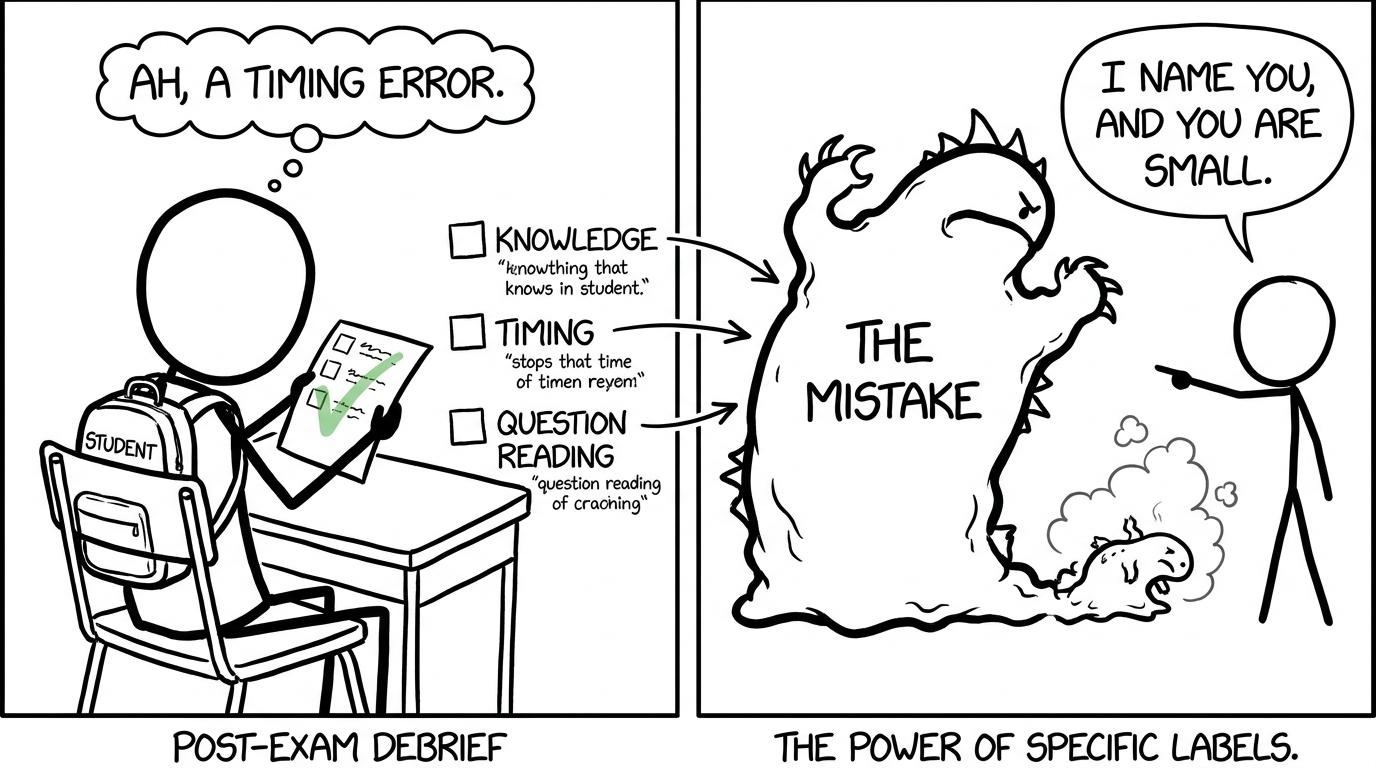 A labelled mistake shrinks from a monster into a harmless creature during paper review
Turn one practice paper into a repeatable cycle
A single realistic sitting reveals where pressure changes your performance. The next step is targeted repair, not immediately completing another full paper.
Use this sequence:
- sit the paper under strict conditions;
- mark it using the correct mark scheme;
- identify the two or three biggest weaknesses;
- revise those areas from your course materials;
- practise focused questions without full-paper pressure;
- retest them in a later timed session.
This is also the revision loop behind MathsGenie's GCSE maths revision hub, where revision lessons and practice questions lead into timed assessment. Maths students can select the correct board and tier, including Edexcel, AQA, OCR and Eduqas. The past-papers library then supports timed attempts, marking and review.
If you take Edexcel maths, for example, the Edexcel GCSE maths papers provide official mark schemes and worked solutions where available. Nearer the examination, Edexcel predicted papers can supply fresh questions. Predicted papers should complement official past papers rather than replace them.
Common mistakes when practising at home
Revising during the paper
Looking up an anthology detail turns an assessment into an open-book worksheet. Put a question mark beside uncertain work and investigate it afterwards.
Using a familiar paper
A paper already discussed in class may test memory of the answers rather than independent performance. Save at least some unseen material for strict sessions.
Pausing the timer
Stopping for a drink, message or difficult question removes the pressure you intended to rehearse. Prepare first, then keep the clock running.
Ignoring the final questions
Starting slowly can leave too little time for demanding extended responses. Practise section checkpoints and move on when an answer is consuming disproportionate time.
Recording only the total mark
A total tells you where you finished, not why. Separate knowledge, analysis, command-word and timing problems so that the next revision session has a clear purpose.
Completing too many full papers
Full papers diagnose weaknesses but do not automatically repair them. Alternate exam simulation with focused revision, just as a strong GCSE maths revision timetable alternates topic work, timed sections and careful review.
Make the real exam feel like the familiar one
A good home simulation cannot reproduce the desks, invigilators or atmosphere of your school. It can reproduce the decisions that matter: beginning on time, working without help, interpreting command words, managing sections and stopping when instructed.
Schedule your next uninterrupted 909090-minute Dance appreciation paper and tell someone at home when the room must stay quiet. Afterwards, mark it honestly and repair the weaknesses it exposes.
Then bring the same discipline to maths. Use MathsGenie's free revision lessons and practice questions to strengthen weak topics, mini tests to build speed, and past papers or predicted papers to rehearse the full examination. Mark schemes, worked solutions and video solutions turn every lost mark into a specific next step. That is how exam conditions become less mysterious: not through one heroic session, but through a calm routine repeated until it feels normal.











