GCSE Art and Design Tutoring Cost: UK Guide
GCSE art and design tutoring cost usually ranges from £25 to £45 an hour. Compare prices, hidden extras and signs that private tuition is worthwhile.
Private tuition can look reassuring from a distance. There is a specialist, a regular appointment and the feeling that someone has taken responsibility for an uncertain grade. But the invoice arrives whether the student improves or not.
A realistic GCSE art and design tutoring cost is usually around £25\pounds 25£25 to £45\pounds 45£45 per hour in the UK. A student tutor or small group may cost less, while an experienced teacher, examiner or specialist in London may charge £45\pounds 45£45 to £70\pounds 70£70 or more. There is no national tariff, so the important question is not simply what a tutor charges. It is what their support changes.
For a GCSE student also preparing for maths exams, that distinction matters. Money spent on art tuition should buy focused guidance without consuming the time needed for GCSE maths revision, schoolwork and rest.
GCSE art tutoring cost at a glance
Use these figures as a comparison guide rather than a fixed price list. Advertised rates vary between platforms, regions and individual tutors.
| Type of tuition | Typical UK price |
|---|---|
| Student tutor or general creative support | £15\pounds 15£15 to £25\pounds 25£25 per hour |
| Established online GCSE art tutor | £25\pounds 25£25 to £40\pounds 40£40 per hour |
| Established in-person GCSE art tutor | £30\pounds 30£30 to £50\pounds 50£50 per hour |
| Qualified teacher or experienced subject specialist | £40\pounds 40£40 to £60\pounds 60£60 per hour |
| Premium examiner-level or London-based specialist | £50\pounds 50£50 to £70+\pounds 70+£70+ per hour |
| Small-group tuition | Often £10\pounds 10£10 to £25\pounds 25£25 per student per hour |
Before booking, check:
- whether lessons are online or in person;
- whether materials, travel and platform fees are included;
- the tutor's knowledge of your exam board and chosen art title;
- whether they teach planning and reflection rather than altering assessed work;
- the cancellation policy and minimum booking period;
- safeguarding arrangements for online and face-to-face sessions;
- how progress will be reviewed.
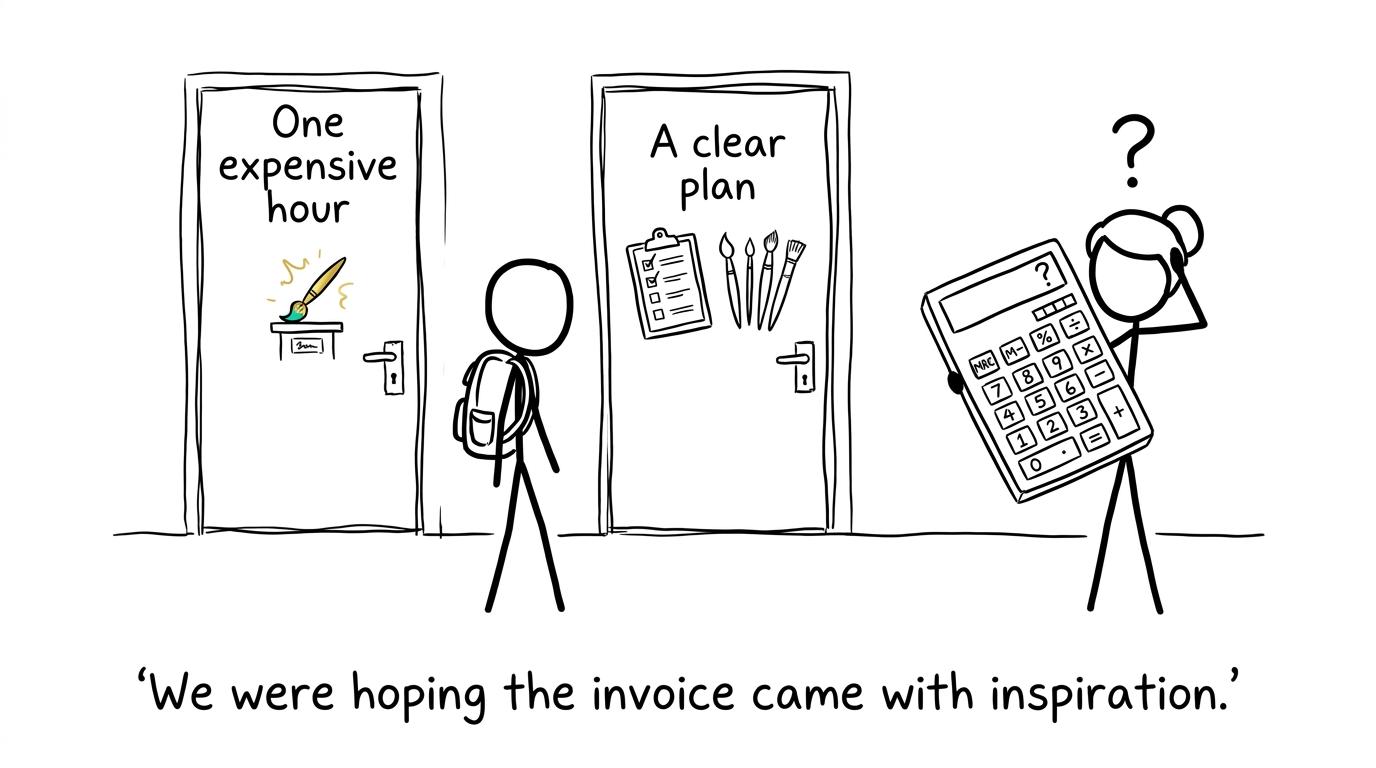 A parent calculates the value of one expensive art lesson while a student considers the value of a clear plan
Why prices differ so much
An hourly rate is a compressed description of several things. Some are valuable. Others are merely expensive.
Experience and GCSE specification knowledge
A practising artist may be excellent at technique but unfamiliar with GCSE assessment. A qualified teacher may understand how portfolios are moderated, how annotations support visual evidence and what each assessment objective requires.
Across the main English and Welsh exam boards, including AQA, Edexcel, OCR and Eduqas, GCSE Art and Design is built around four assessment objectives. In broad terms, students must develop ideas, refine work, record observations and present a personal response. Each objective contributes 25%25\%25% overall. Current specifications normally allocate 60%60\%60% to the portfolio and 40%40\%40% to the externally set assignment, although students should always confirm the details with their school and exam-board specification.
A tutor who can diagnose which objective is underdeveloped may offer more value than someone who simply demonstrates better drawing. Ask the tutor to explain the assessment structure before paying a premium for “exam expertise”.
Online, in-person and studio tuition
Online lessons remove travel and can widen the choice of tutors. They work particularly well for portfolio organisation, artist research, annotation and reviewing photographs of work. However, recent UK price guides do not agree that online tuition is always cheaper. Popular specialists can charge the same online and in person.
Face-to-face support may be more useful when the student needs help handling unfamiliar media or observing technique closely. The rate may also include travel, studio space or equipment. Ask what is included rather than assuming the higher fee covers materials.
Location and availability
Rates tend to be higher in London and other expensive areas. Prices can also rise near portfolio deadlines because specialist availability becomes limited. Urgency is costly in tutoring for the same reason it is costly elsewhere: fewer choices remain.
Starting with a short review session earlier can therefore be better than booking several rushed sessions near the deadline.
The tutor's role
The best tutor does not “improve” a student's assessed piece for them. GCSE artwork must remain the student's own, and schools need to authenticate submitted work. Useful tuition teaches the student how to investigate, experiment, make decisions, record development and evaluate outcomes.
Be cautious if a tutor offers to redraw work, rewrite annotations or prescribe a final response in detail. That is not high-value support. It risks weakening the personal journey that the qualification is intended to assess.
What will private art tuition cost overall?
The hourly price is only the first number. The meaningful figure is the full commitment.
A simple budget relationship is:
Total tuition cost=hourly rate×number of sessions+additional costs\text{Total tuition cost}=\text{hourly rate}\times\text{number of sessions}+\text{additional costs}Total tuition cost=hourly rate×number of sessions+additional costsFor a typical rate of £25\pounds 25£25 to £45\pounds 45£45, four weekly sessions would cost approximately £100\pounds 100£100 to £180\pounds 180£180 before materials, travel or booking fees. A twelve-session term would be around £300\pounds 300£300 to £540\pounds 540£540.
Those totals make lesson frequency worth considering carefully. Weekly tuition is not automatically better. A student who needs help choosing a direction might benefit from one diagnostic session, independent work and a later review. Someone struggling with sustained organisation may need shorter, regular appointments.
Ask whether the tutor offers:
- a paid or free initial consultation;
- shorter portfolio-review sessions;
- fortnightly rather than weekly appointments;
- small-group tuition;
- a fixed-price package with clear limits;
- feedback between lessons, and whether it costs extra.
Avoid buying a large package until the first session has shown that the tutor understands the student's actual difficulty.
How to judge whether tutoring is worth it
Value is not the same as comfort. A pleasant lesson can still leave the portfolio unchanged.
Start with a specific problem
“Get better at art” is too broad. A useful goal is more precise, such as organising development pages, making artist research influence practical experiments, recording decisions or planning time for the externally set assignment.
The same principle improves maths revision. A student makes faster progress when they identify the exact topics losing marks, rather than revising everything vaguely. MathsGenie's guide to finding your weakest GCSE topics explains how to turn evidence into a focused plan.
Ask what will happen between sessions
Most improvement occurs when the student works independently. A strong tutor should leave a manageable action plan, not create dependence on the next appointment.
Before booking, ask:
- What should the student produce before the next lesson?
- How will the tutor tell whether the support worked?
- How do they protect the student's independent authorship?
- Can they work with feedback already given by the school teacher?
- Do they understand the student's specific exam board and art title?
Clear answers are a better signal than an impressive portfolio alone.
Review the arrangement early
After two or three sessions, look for observable changes. The student might be making decisions more independently, managing deadlines better or explaining how experiments connect to their intentions.
If the only evidence is that they “feel more confident”, ask what that confidence now allows them to do. Confidence matters, but it should eventually become action.
Balance art tuition with maths revision
Art coursework can expand to fill every available evening. Maths has the opposite problem: because there is no physical portfolio on the desk, revision can be postponed until it becomes urgent.
A weekly plan should protect time for both. Students can use the GCSE one-month maths revision plan to create short, repeatable sessions around art commitments. Those following AQA can also open the AQA GCSE Maths revision hub for tier-appropriate lessons, questions and papers.
The useful rhythm is similar in both subjects: diagnose, practise, receive feedback and revisit. In maths, that means using mark schemes after practice rather than treating completed pages as proof of learning. The guide to using GCSE past papers properly shows how to build that feedback loop.
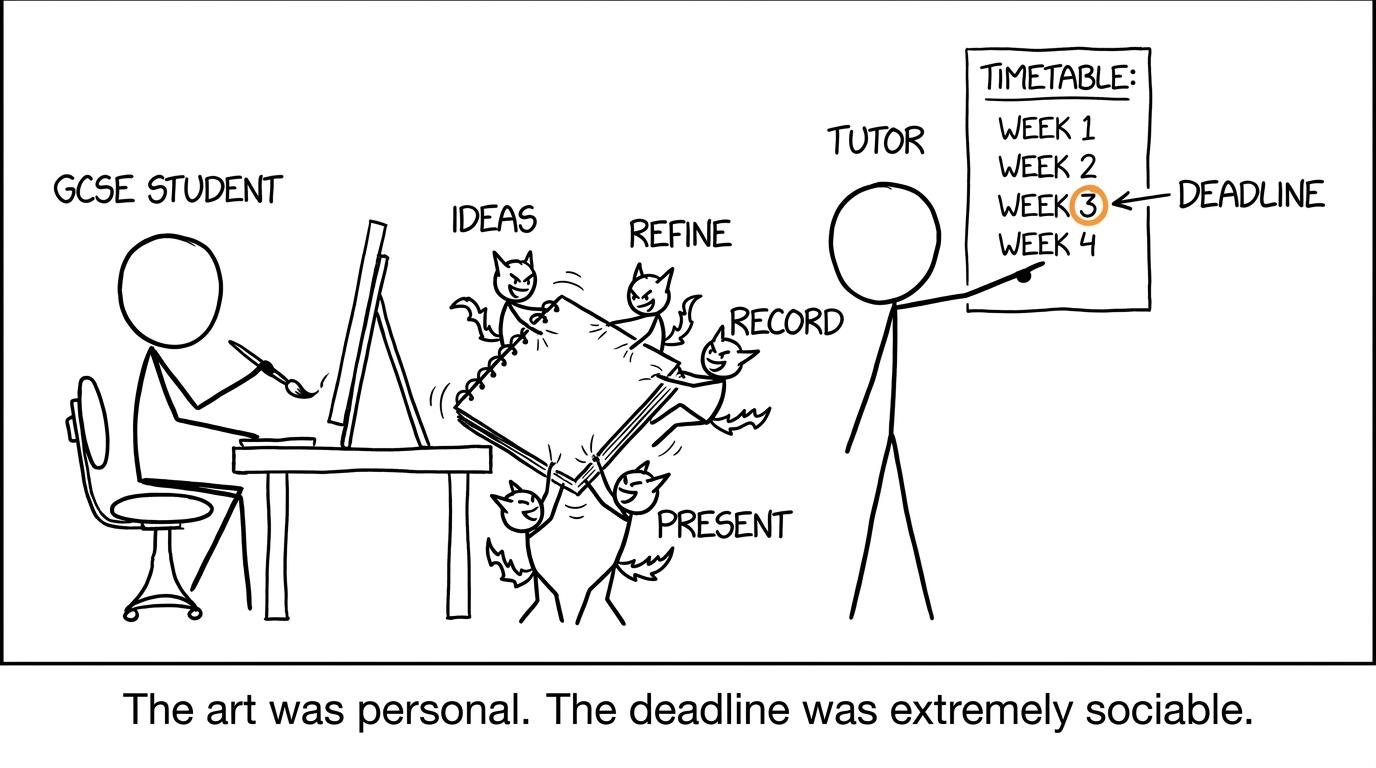 A GCSE art student manages four assessment demands while a tutor points to a timetable
Lower-cost alternatives to weekly private tuition
Private tutoring is one tool, not the default solution to every problem.
First, ask the school teacher for precise feedback against the assessment objectives. Attend supervised studio sessions if they are available. Use museums, galleries and first-hand observation where appropriate, and photograph the development of practical work so decisions are easier to explain.
A single specialist portfolio review may be enough when the student is generally independent but uncertain about priorities. Group sessions can reduce the cost, although feedback will be less individual. Online tuition can also make it easier to compare specialists beyond the local area.
Saving money on one subject can protect resources for another. MathsGenie provides free revision lessons, practice questions, mini tests, past papers, predicted papers, mark schemes and video solutions. Students who struggle to retain methods can use the guide to remembering GCSE maths content, while the GCSE maths topic list by board and tier helps them decide what actually needs attention.
Common mistakes when choosing an art tutor
Paying for status rather than relevance
A successful artist is not automatically a strong GCSE tutor. Look for teaching skill, specification knowledge and an ability to give feedback without taking over.
Booking too many sessions immediately
A discounted package is still wasted money if the tutor is a poor fit. Begin with a consultation or one lesson and agree on a review point.
Ignoring additional costs
Travel, specialist materials, platform charges, cancellation fees and longer “portfolio intensive” sessions can change the real price. Request the full terms in writing.
Treating tuition as outsourced motivation
A tutor can provide structure, but cannot replace independent work. If the student consistently avoids agreed tasks, first investigate workload, uncertainty, wellbeing or unrealistic expectations.
Forgetting safeguarding
Parents and carers should ask how sessions are conducted, who can contact the student and what safeguarding procedures apply. For eligible work, self-employed tutors can access enhanced DBS checks through the appropriate process, but a certificate should sit alongside references, clear boundaries and sensible supervision rather than replacing them.
Allowing one subject to consume the timetable
An unfinished portfolio feels visible, so it can dominate revision. Protect scheduled maths sessions and use short, focused resources rather than waiting for a free afternoon that may never arrive.
Make the cost buy clarity
For most families, a sensible starting expectation is £25\pounds 25£25 to £45\pounds 45£45 per hour, with higher rates for experienced teachers, specialist support and expensive locations. But price alone cannot tell you whether tuition is worthwhile.
Good support makes the student more independent. It identifies a specific barrier, respects assessment rules and leaves behind a plan the student can follow without the tutor in the room.
Keep the wider exam season manageable too. Start with MathsGenie's free GCSE maths revision resources, then combine revision lessons with practice questions, mini tests, past papers, predicted papers, mark schemes and video solutions. Spend money where individual help is genuinely needed, and use strong free resources everywhere else.