

GCSE Art and Design 3 to 5: A Practical Guide
GCSE art and design 3 to 5: learn how investigation, experimentation, recording and refinement can turn basic work into consistent evidence.
A sketchbook can look busy and still leave important questions unanswered. Why was this artist chosen? What changed after the first experiment? How did the final piece grow from the investigation?
That is often the central challenge when working towards GCSE art and design 3 to 5. The aim is not simply to produce more pages or make one polished final piece. It is to create clearer, more consistent evidence across the four assessment objectives: investigating sources, refining ideas, recording observations and presenting a personal response.
A grade cannot be guaranteed by any checklist. Grade boundaries vary between exam series, while teachers assess the complete body of work using the relevant exam board criteria. But the direction of improvement is clear: move from isolated activities towards a connected creative journey in which decisions are visible, purposeful and increasingly independent.
The grade 3 to grade 5 checklist
Focus on these changes first:
- Investigate artists and sources to develop your own ideas, not merely to collect facts.
- Record from relevant first-hand sources wherever possible.
- Experiment with materials for a clear purpose.
- Show how you reviewed, changed and improved your work.
- Connect each sketchbook stage to your intentions.
- Develop a final response from earlier evidence rather than introducing it suddenly.
- Ask your teacher which assessment objective is currently weakest.
- Complete unfinished or underdeveloped evidence before decorating pages.
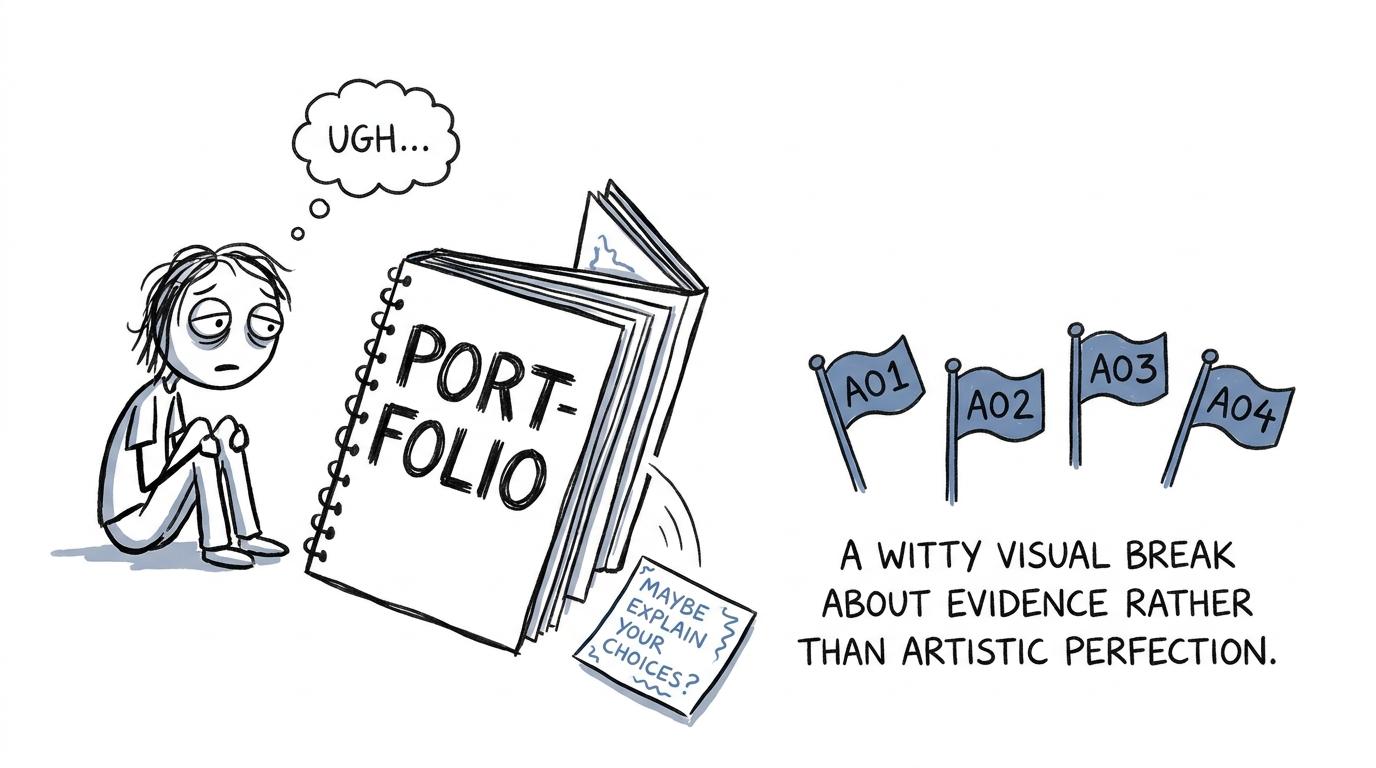 A student discovers that explaining creative choices matters as much as filling a portfolio
What separates a grade 3 from a grade 5 in GCSE Art and Design?
There is no universal rule saying that one particular sketchbook page equals a grade. Nor should exam-board performance levels be treated as direct grade predictions. The final GCSE grade depends on the total assessed mark and the grade boundaries for that series.
However, official assessment language helps reveal the broad difference. Work in lower performance bands may show some knowledge and skill but remain simplistic, repetitive or insufficiently developed. Stronger middle-band work is more likely to be described as competent, consistent, secure and cohesive.
In practice, the movement often looks like this:
- From description to critical understanding: you explain what you learned from a source and how it affected your work.
- From trying materials to refining them: experiments lead to informed choices and visible improvements.
- From occasional observation to purposeful recording: drawings, photographs and notes relate directly to your intentions.
- From a separate final piece to a meaningful response: the outcome grows logically from investigation and development.
- From uneven evidence to consistency: all four assessment objectives receive sustained attention.
A beautiful final outcome cannot fully compensate for missing development. Equally, a thick sketchbook does not automatically earn a higher mark if its pages repeat the same idea without progression.
Understand the four assessment objectives
Across GCSE Art and Design specifications, the four assessment objectives are equally weighted at 25%25\%25% each. Students normally complete a portfolio component and an externally set assignment, although exact requirements and administrative arrangements should always be checked against the current specification for AQA, Edexcel, OCR or Eduqas.
AO1: Develop ideas through investigations
AO1 concerns sources, critical understanding and the development of ideas. Artist research should therefore do more than provide a biography or a collection of images.
Ask:
- Which features of the artist's work are relevant to my theme?
- What do I notice about composition, colour, texture, scale or meaning?
- Which ideas could I adapt rather than copy?
- How has this investigation changed my next decision?
A grade 3 portfolio may contain relevant research but make weak connections to the student's own work. To move towards grade 5, select sources carefully, give personal judgements and demonstrate their influence through visual development.
AO2: Refine work through experimentation
AO2 rewards exploration, selection and refinement using appropriate media, materials, techniques and processes. The important word is not simply experimenting. It is refining.
A collection of unrelated material tests shows activity. Stronger evidence shows learning: a student tries a process, evaluates what happened, changes a variable and chooses what deserves further development.
Label experiments with concise reflections. Explain what succeeded, what was unsuitable and what you will change next. The written comment need not be long, but the practical consequence should be visible.
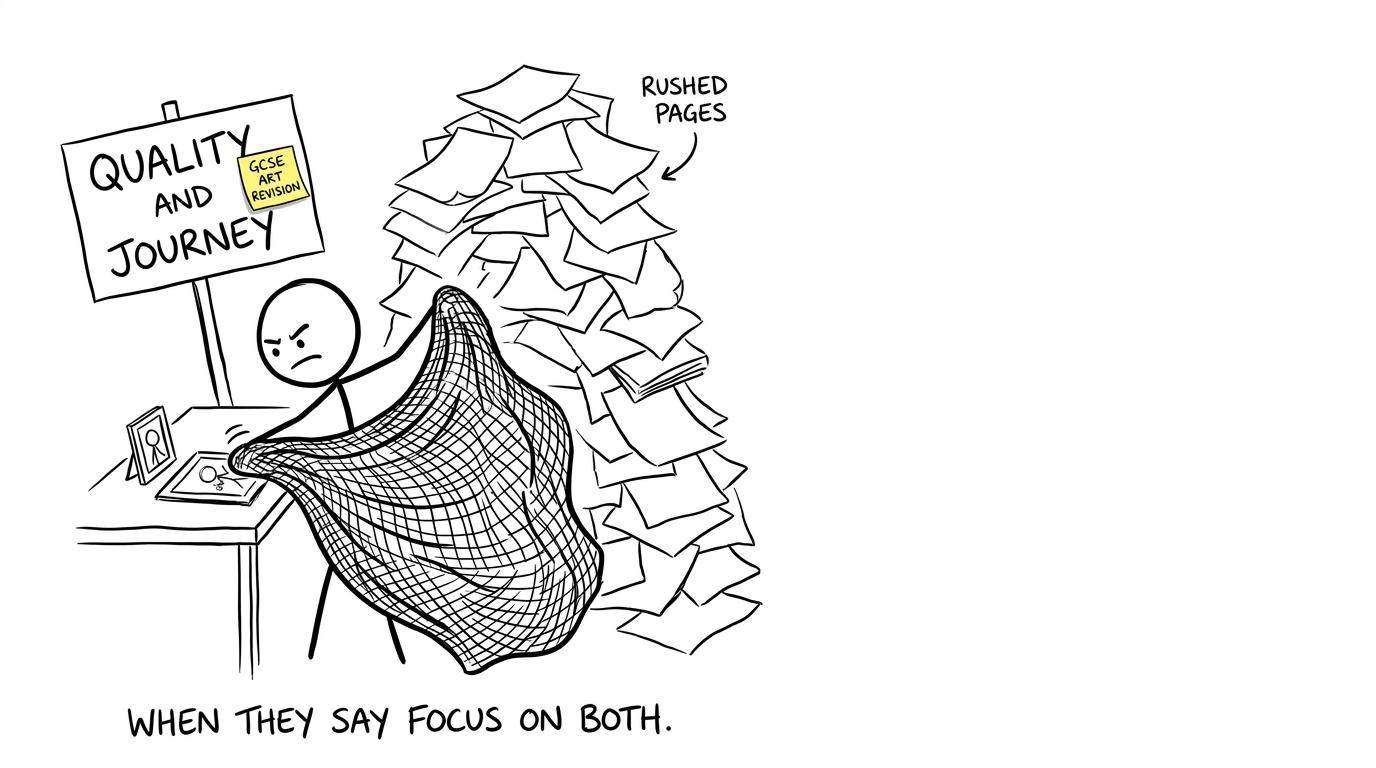 A student learns that one polished outcome cannot replace an evidenced creative journey
AO3: Record ideas, observations and insights
AO3 is broader than observational drawing. Depending on the specialism, evidence might include drawings, photographs, studies, samples, plans, written reflections or other appropriate forms of recording.
The key is relevance. Generic photographs gathered from the internet may offer less personal evidence than images you have composed, cropped and taken for your own project. First-hand recording can give you control over viewpoint, lighting, texture and arrangement.
To strengthen AO3:
- record subjects that genuinely support the project;
- vary viewpoint, scale and composition where appropriate;
- annotate decisions while the work is developing;
- explain how recorded observations inform later ideas;
- organise the journey so a moderator can follow it.
AO4: Present a personal and meaningful response
AO4 is sometimes mistaken for "the final piece mark". The response matters, but so does the body of work through which the intentions are realised.
A stronger response feels earned. Its imagery, materials, composition and meaning connect to earlier research, recording and refinement. It should also demonstrate an understanding of visual language appropriate to the chosen title, whether that is fine art, photography, graphic communication, textile design, three-dimensional design or another endorsed route.
Before beginning the outcome, identify which earlier decisions it will bring together. If its central idea appears nowhere else in the project, the development may need strengthening first.
Make the creative journey easier to follow
Moderators can only assess the evidence presented. They should not have to guess that a decision was thoughtful or that an experiment changed your direction.
Use short annotations to answer four useful questions:
- What was I trying to investigate?
- What did I discover?
- What did I change because of it?
- What will I develop next?
This is not an invitation to fill every empty space with writing. Annotation should reveal judgement. A sentence explaining a compositional change is more valuable than a paragraph saying that you enjoyed using paint.
Presentation should support this clarity. Date work where helpful, photograph three-dimensional or temporary work properly, and place connected developments in a sequence that makes sense. Decorative backgrounds cannot replace assessment evidence.
Use feedback as a map, not a verdict
A predicted grade can feel like a label. It is more useful when converted into specific actions.
Ask your teacher for your current position in each assessment objective rather than asking only, "What grade is this?" One weak objective can limit an otherwise promising portfolio because each AO contributes equally.
Turn feedback into a short action list. For example, the instruction to "develop ideas further" should become concrete tasks such as adding relevant primary recording, comparing alternative compositions or showing how an artist investigation informed a new experiment.
This diagnostic approach is familiar to students using the MathsGenie GCSE Maths revision hub: identify the gap, revisit the skill, practise it and check again. Art is not revised through exam questions in the same way, but the habit of responding to precise evidence transfers well.
The guide to moving on from a grade 3 also reinforces a useful principle across subjects: a grade becomes actionable only when you identify what produced it.
Build a realistic weekly improvement routine
Art improvement requires making, reviewing and returning. One exhausted evening spent filling pages is usually less useful than several focused sessions with clear purposes.
Plan sessions around outputs rather than vague amounts of time:
- complete one relevant observational study;
- test and compare two material choices;
- improve one composition using teacher feedback;
- photograph a process or three-dimensional outcome clearly;
- add concise evaluation to existing experiments;
- trace the connection between research and the planned response.
Start each session by choosing the assessment objective it will strengthen. End by recording the next decision. That prevents the project becoming a collection of disconnected tasks.
If managing several GCSEs is becoming difficult, MathsGenie's advice on the best order for learning GCSE maths topics offers a transferable planning idea: sequence work, address foundations first and revisit skills rather than attempting everything at once. The short GCSE revision loop can also help you organise maths around portfolio deadlines without relying on revision marathons.
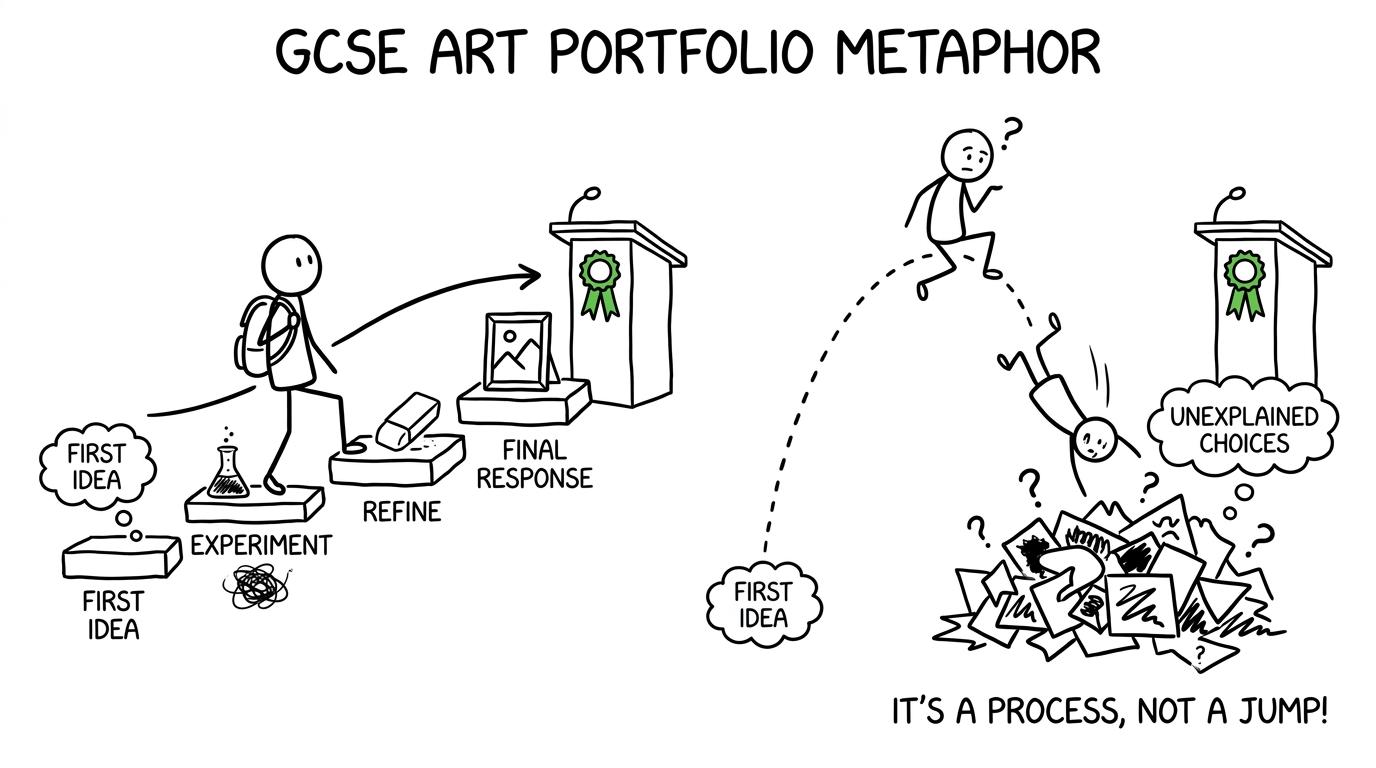 A creative journey works better as connected stepping stones than one desperate leap
Balance art coursework with maths revision
The target audience for this guide may be preparing for maths examinations while also completing an Art and Design portfolio. These demands are different, so they need different forms of practice.
For art, schedule access to specialist materials, teacher feedback and sustained practical work. For maths, use shorter independent sessions built around retrieval and exam questions. The GCSE revision guide for students around a pass grade explains how to diagnose weak topics and practise them in manageable bursts.
As the exam period approaches, use GCSE past-paper timing guidance to plan maths practice without allowing it to consume every portfolio session. Edexcel students can later use GCSE Maths predicted papers for fresh timed practice, while remembering that predicted papers support rather than replace past papers and targeted revision.
Common mistakes that hold portfolios back
Producing more work without improving its purpose
Quantity matters only when it broadens, deepens or refines the evidence. Before adding a page, decide which AO it supports and what new information it contributes.
Copying an artist's work without developing a response
A copy may demonstrate a technique, but AO1 requires critical understanding and idea development. Show what you extracted from the source and how you transformed it for your intentions.
Treating every experiment as equally successful
Refinement requires selection. Identify why one process communicates the idea more effectively and develop that choice further.
Leaving annotation until the end
Retrospective writing can become vague because the decisions have been forgotten. Record brief reflections while work progresses.
Rushing the final response
A strong outcome needs preparation, but starting too late can prevent intentions from being realised. Agree a timetable with your teacher and test important materials or processes beforehand.
Ignoring the weakest assessment objective
Repeatedly polishing your strongest area may feel productive, yet each AO carries 25%25\%25% of the qualification. Use teacher feedback to direct effort towards missing or inconsistent evidence.
Turn the grade target into visible evidence
The most useful answer to the GCSE art and design 3 to 5 question is not "make better art". It is to make the thinking clearer and the evidence more consistent.
Investigate sources with purpose. Record what matters. Experiment, evaluate and refine. Then create a response that brings those decisions together. Ask your teacher to assess the work against the current specification and tell you exactly where the evidence remains thin.
At the same time, protect your maths preparation. Use MathsGenie's free GCSE Maths resources for revision lessons, practice questions, mini tests, past papers, predicted papers, mark schemes and video solutions. A calm plan for maths leaves more attention for meaningful art development, and turns two large subjects into a series of manageable next steps.











