

GCSE Arabic Speaking Exam: What to Actually Expect
GCSE Arabic speaking exam explained: understand the role-play, picture task, conversation, timings, preparation rules and smart revision priorities.
The door closes, the recording begins, and suddenly every Arabic phrase you know seems to have left the room. Speaking exams can feel unusually exposed because you cannot quietly reconsider an answer as you might on a written paper.
The reassuring truth is that the GCSE Arabic speaking exam follows a predictable structure. For the current Pearson Edexcel GCSE Arabic specification, you complete three tasks in this order: a role-play, a picture-based task and a conversation. You receive supervised preparation time before the assessment, and each task tests a slightly different kind of communication.
Once you understand those differences, the exam becomes less like one long performance and more like three manageable conversations.
GCSE Arabic speaking exam checklist
Before revising, make sure you know these essentials:
- The current UK GCSE Arabic qualification discussed here is Pearson Edexcel GCSE Arabic, specification code
1AA0. - Paper Two is internally conducted by your teacher-examiner and externally marked by Pearson.
- Speaking contributes 25%25\%25% of the qualification and is worth 707070 marks.
- You complete a role-play, a picture-based task and a conversation in one continuous session.
- You receive 121212 minutes of supervised preparation for the first two tasks.
- Foundation and higher tier have different assessment timings.
- The assessment is conducted in Arabic.
- Dictionaries and other resources are not permitted, including during preparation.
Check your statement of entry and ask your teacher to confirm your board and tier. International GCSE Arabic has a different assessment structure, so do not revise from materials merely because they have “Arabic GCSE” in the title.
| Part | Foundation tier | Higher tier | Marks |
|---|---|---|---|
| Preparation | 121212 minutes | 121212 minutes | Not separately marked |
| Role-play | 111 to 1.51.51.5 minutes | 222 to 2.52.52.5 minutes | 101010 |
| Picture-based task | 2.52.52.5 to 333 minutes | 333 to 3.53.53.5 minutes | 242424 |
| Conversation | 3.53.53.5 to 4.54.54.5 minutes | 555 to 666 minutes | 363636 |
| Total speaking time | 777 to 999 minutes | 101010 to 121212 minutes | 707070 |
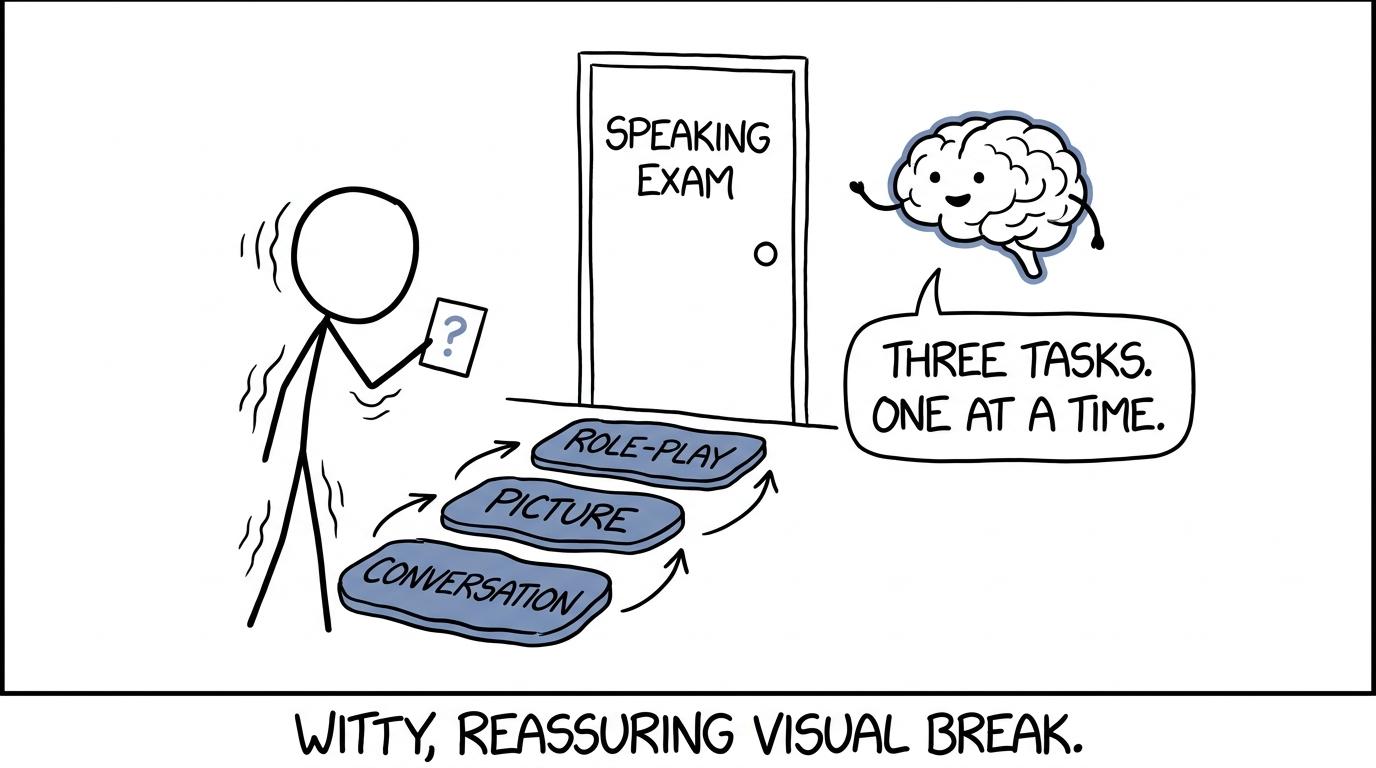 A student approaching the three stages of a speaking exam one at a time
What happens during the preparation time?
Immediately before the assessment, you receive the role-play and picture-based materials allocated by Pearson. You have 121212 minutes under supervised conditions to prepare both tasks.
You may make notes covering up to one side of A4, but you cannot write on the stimulus cards. Your notes can accompany you during the role-play and picture task. They must then be handed in before the conversation begins.
This is planning time, not script-writing time. Use it to:
- identify the situation, audience and required register in the role-play;
- mark the prompt where you must ask a question;
- anticipate the unpredictable element;
- note useful details visible in the picture;
- prepare opinions, reasons and links to different time frames;
- write keywords rather than complete paragraphs.
The candidate instructions warn against reading out whole prepared sentences. Compact notes are more useful because they keep your attention on the teacher and help your speech sound responsive.
The role-play: precise communication matters
The role-play contains five prompts. It places you in a practical situation and tells you what information you need to communicate. You may need to give a detail, respond to an unexpected question or ask the teacher-examiner a question of your own.
At foundation tier, you must ask one question and respond to one unpredictable question. At higher tier, you must ask two questions and respond to one unpredictable question. Higher-tier prompts also require a wider handling of time, including a response in a past tense.
Each prompt is marked for communication, with a maximum of two marks available. The complete task is therefore worth 101010 marks. The priority is not an elaborate speech. It is a clear, relevant and unambiguous response that fits the situation.
Listen carefully because your teacher must follow Pearson's wording and sequence. Questions can be repeated within the permitted rules, but they cannot be freely rephrased or supplemented. If you do not understand, asking for a repetition is usually better than answering a different question.
How to prepare for the role-play
Build flexible language for common functions rather than memorising one script for every topic. Practise how to:
- state a preference;
- give a reason;
- request information;
- ask an appropriate question;
- describe a past event;
- say what you intend to do;
- respond politely in formal and informal situations.
This is similar to effective maths revision: knowing why a method works is safer than memorising one answer. Maths students can apply the same active-practice habit through the GCSE Maths revision hub, where lessons lead into questions rather than passive rereading.
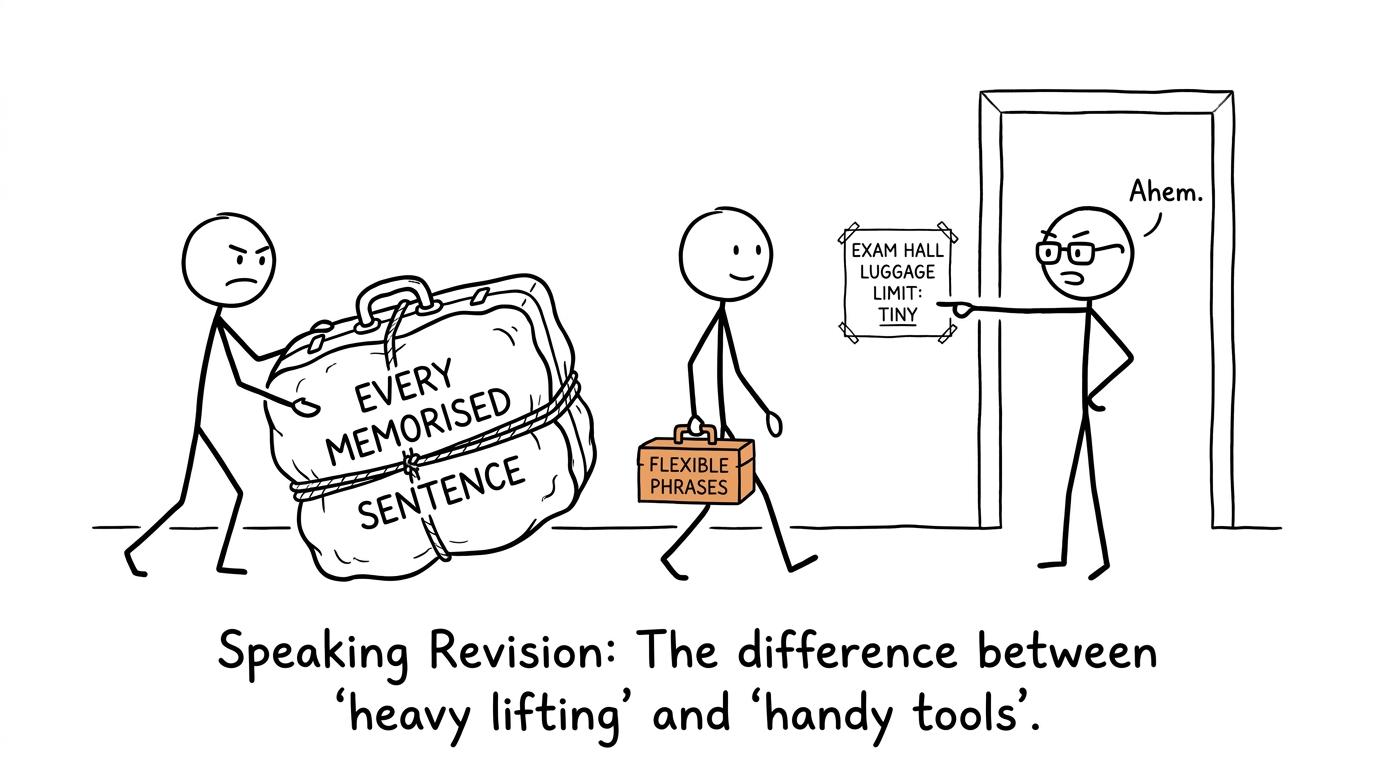 A huge suitcase of memorised sentences beside a small toolbox of flexible phrases
The picture-based task: move beyond naming objects
The second task begins with a question directly related to the picture. The remaining questions develop the wider topic, inviting descriptions, opinions and accounts of events. There are five predetermined questions.
This task is worth 242424 marks. Unlike the role-play, it rewards developed communication and content as well as linguistic knowledge and accuracy. A list of visible objects is therefore not enough. You need to connect observation with interpretation: what appears to be happening, what you think about the topic and why.
Useful preparation should cover three layers:
- Evidence: people, place, activity, mood and relevant details in the image.
- Development: an opinion followed by a reason or explanation.
- Range: appropriate references to past, present or future where the question allows them.
Your first response must remain rooted in the image. Pearson examiner reports have repeatedly highlighted the importance of referring to the visual stimulus when answering that opening question.
Accuracy matters, but communication comes first. If one ambitious structure makes your meaning uncertain, choose language you can control. Clear Arabic with genuine development is stronger than a complicated sentence that collapses halfway through.
The general conversation: two themes, real interaction
The final part is the longest and most heavily weighted section. It is worth 363636 marks and covers two different themes.
For the first part, you select a topic from one theme before the assessment. You may introduce the aspect you want to discuss for up to one minute, after which your teacher continues the conversation. For the second part, Pearson's allocation determines a separate theme. Roughly equal time should be given to the two themes.
The specification organises content around five broad themes:
- identity and culture;
- local area, holiday and travel;
- school;
- future aspirations, study and work;
- international and global dimension.
The conversation assesses communication and content, interaction and spontaneity, and linguistic knowledge and accuracy. That word interaction matters. A polished monologue cannot demonstrate everything that a responsive exchange can.
Listen to the tense and focus of each question. Answer it directly, develop the answer, and remain ready for the next turn. You should also be prepared to initiate conversation rather than waiting passively for every contribution to come from the teacher.
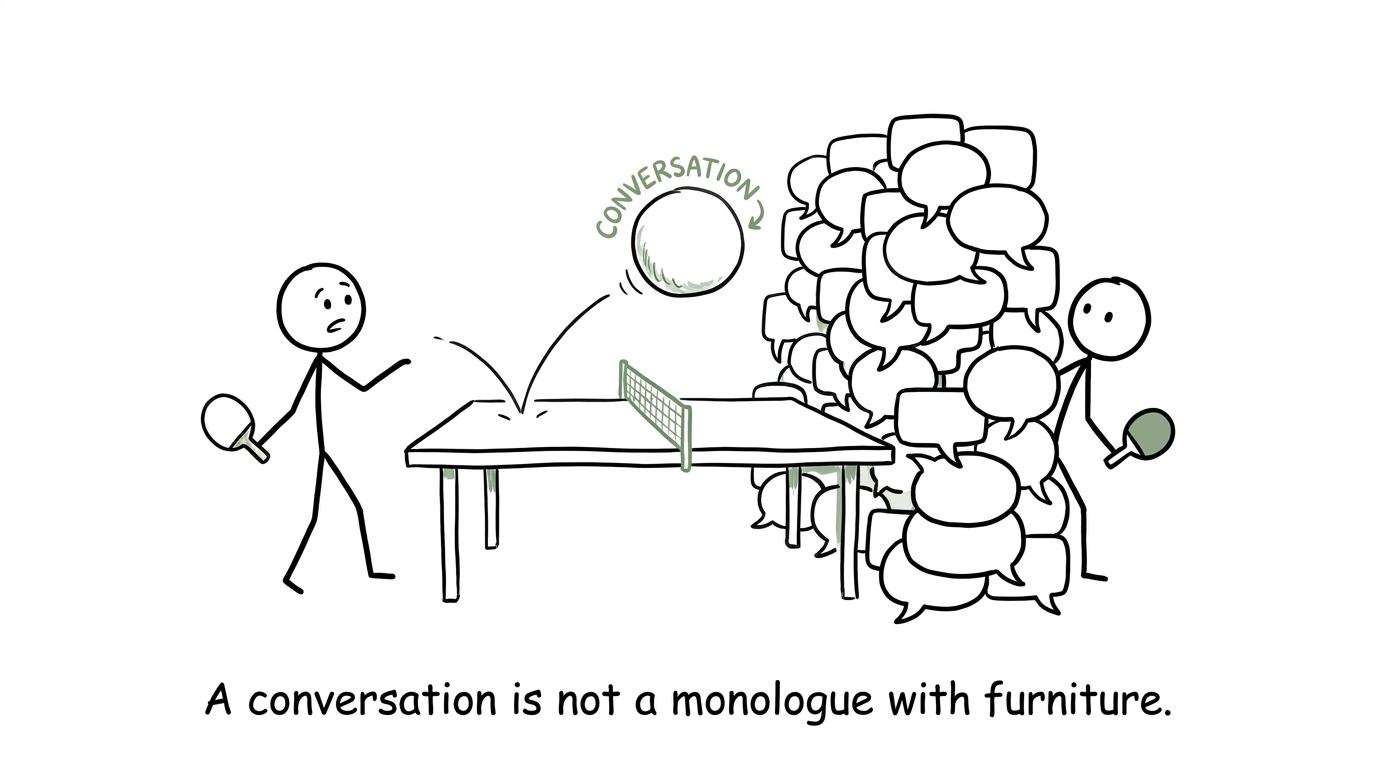 A speaking conversation imagined as a game of table tennis rather than a wall of speech
A practical revision plan for speaking Arabic
Speaking improves through retrieval, not recognition. Reading a model response can create familiarity, but closing the book and producing your own answer reveals what you can actually say.
Use this repeatable routine:
- Choose one specification topic.
- Record a short answer without notes.
- Listen back and identify one communication gap and one language error.
- Repeat the answer using keywords only.
- Ask somebody to change the follow-up question.
- Return to the same topic several days later.
Alternate between short role-play responses and longer conversation practice. Include timed mock sections so that you become accustomed to moving forward without endlessly correcting yourself.
If Arabic and maths exams are competing for the same evenings, plan them rather than letting the nearest deadline take over. The free MathsGenie revision planner can organise your maths workload, while the one-month GCSE maths revision plan offers a repeatable weekly structure. That leaves deliberate, protected time for speaking practice.
For maths, keep paper practice aligned with your actual board. MathsGenie provides Edexcel GCSE Maths past papers, AQA GCSE Maths past papers and an OCR GCSE Maths revision hub. The same basic feedback loop works in both subjects: attempt, check, identify the weakness and try again.
Common mistakes in the GCSE Arabic speaking exam
Memorising answers that do not fit the question
A prepared paragraph is only useful if it answers what was asked. Learn adaptable structures, topic vocabulary and ways to justify an opinion instead of forcing every question towards one script.
Giving long answers in the role-play
The role-play rewards successful communication across five individual prompts. A concise, accurate response can earn full marks. Save fuller development for the picture task and conversation.
Forgetting to ask the required question
The question mark on the candidate card signals a task you must complete. Highlight it during preparation and confirm that your wording suits the situation.
Describing the picture but offering no development
The first response should refer to the image, but the task extends beyond object naming. Add actions, reasonable interpretation, opinions and reasons when relevant.
Turning the conversation into a speech
Over-rehearsed answers can weaken spontaneity and interaction. Practise interruptions, unfamiliar follow-ups and changes of tense so that you can respond rather than recite.
Ignoring the official timings
Answers that are too brief may not provide enough evidence, while material beyond the maximum task time may not be assessed. Practise within your tier's limits and learn what an appropriately developed response feels like.
Walk in knowing the shape of the exam
The speaking assessment is not a mystery test of whether you can sound perfect. It is a structured opportunity to communicate: first precisely in a role-play, then with development around a picture, and finally through a sustained conversation.
Prepare for those jobs separately. Use the 121212 minutes carefully, answer what you hear and keep the exchange moving when a sentence is not perfect.
Then protect the rest of your GCSE revision. MathsGenie gives you free revision lessons, practice questions, mini tests, mark schemes, video solutions, past papers and predicted papers in one place. Start with the GCSE Maths revision area, or read when to begin GCSE past papers and build a plan that leaves room for both confident Arabic speaking and stronger maths marks.











