

GCSE Arabic Part Time Job Balance: A Realistic Plan
GCSE Arabic part time job balance made realistic: protect Arabic, maths and sleep with a flexible revision plan for shifts, exams and busy school days.
A work rota can change with a few days’ notice. GCSE exams do not. That is the central problem behind GCSE Arabic part time job balance: you need enough flexibility to handle shifts, but enough structure to keep Arabic and maths moving forward.
The practical answer is not to revise every subject every night. Build a weekly minimum for Arabic and maths, place demanding sessions away from shifts, use short tasks on workdays, and speak to your manager before the exam period. Your plan should survive a tiring week, not merely look impressive on Sunday evening.
Your quick balance checklist
Before building a detailed timetable, make these decisions:
- Put school, confirmed shifts and exam dates into one calendar.
- Protect sleep, meals and travel time before allocating revision.
- Give Arabic separate slots for listening, speaking, reading and writing.
- Give maths short topic sessions plus regular mixed or paper practice.
- Create a small workday task that still feels possible after a shift.
- Ask about rota changes and exam leave early.
- Review the plan weekly rather than rewriting it every evening.
- Tell a parent, carer or teacher if work is interfering with education or wellbeing.
The MathsGenie GCSE maths revision hub is useful here because lessons, questions and papers are organised by board and topic. Less time searching means more time actually practising.
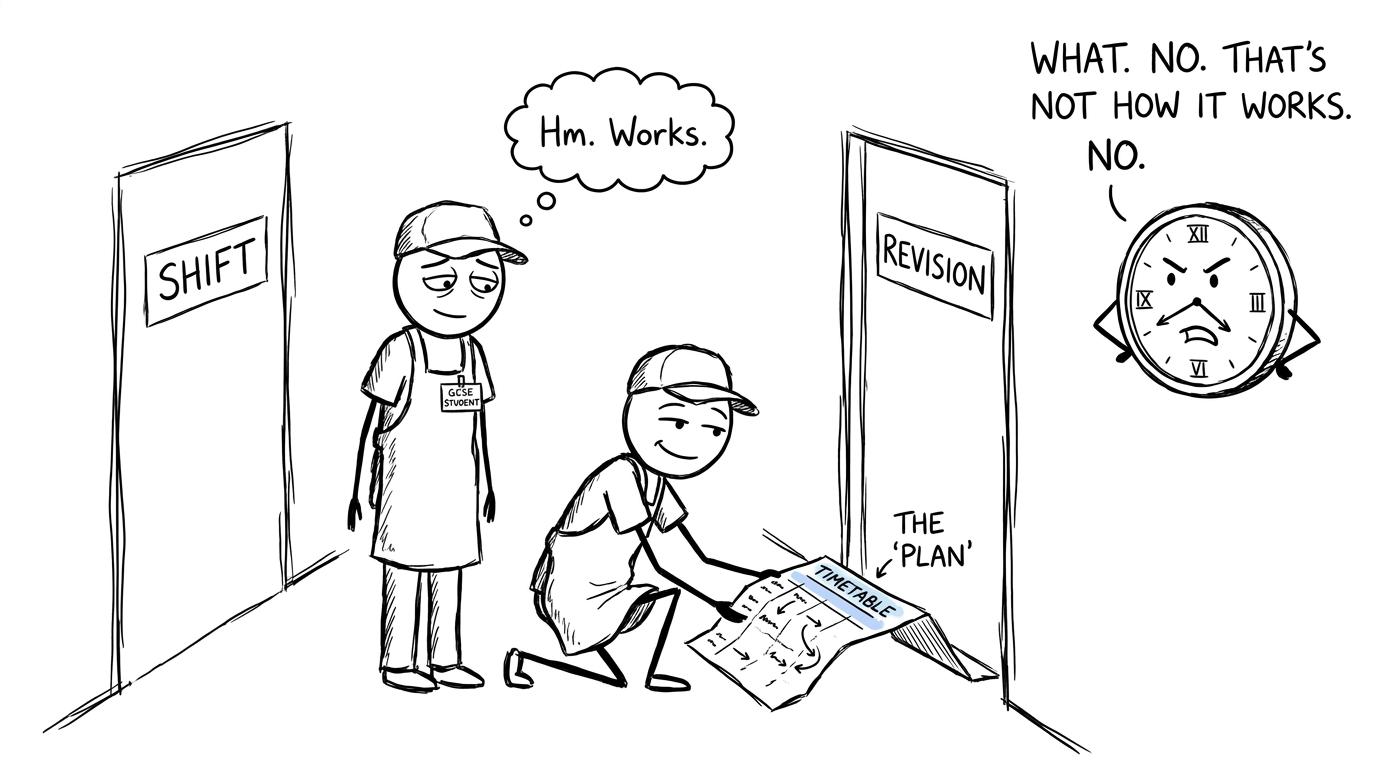 A GCSE student uses a small timetable as a bridge between work and revision
Start with fixed commitments, not ambitious revision hours
Many timetables fail because revision is added first and real life is squeezed around it. Reverse that order.
Begin with the things that cannot easily move:
- school and homework deadlines
- work shifts and travel
- Arabic lessons or speaking practice
- maths support sessions
- meals, sleep and family commitments
- confirmed examinations and assessments
Only then identify the remaining revision windows. This reveals your actual capacity rather than the amount of time you wish you had.
A useful planning idea is:
available time=week−fixed commitments−rest\text{available time}=\text{week}-\text{fixed commitments}-\text{rest}available time=week−fixed commitments−restRest belongs in the calculation. It is not unused space. A plan that depends on repeatedly revising late after work will eventually lose to tiredness.
If creating the week feels difficult, adapt the structure in MathsGenie’s realistic GCSE maths revision timetable. Keep the framework, but add Arabic and work as fixed commitments.
Give GCSE Arabic the right kind of revision
For the current Pearson Edexcel GCSE Arabic qualification, listening, speaking, reading and writing are separately assessed, with each skill contributing 25%25\%25% of the qualification. Students enter Foundation or Higher tier across all four papers. That means Arabic revision should not become a single vague block labelled “vocabulary”.
Match each Arabic skill to your energy
Use higher-energy periods for tasks that require concentration or performance:
- extended writing
- translation
- timed reading
- recorded speaking responses
- listening under exam conditions
Save lighter periods for smaller maintenance tasks:
- retrieving vocabulary from memory
- reviewing verb forms
- reading a short passage aloud
- correcting yesterday’s writing
- rehearsing answers to familiar speaking themes
Speaking and listening need repeated contact with the language. One long weekend session cannot fully replace that frequency. A short speaking rehearsal before school or vocabulary retrieval during a journey may be more sustainable than trying to complete a full paper after a demanding shift.
Keep the sessions active. Cover the answer, retrieve it, say it, write it or apply it. Simply rereading vocabulary can feel smooth without proving that you can recall it in an examination.
Keep maths alive during a busy working week
Maths has a similar problem: recognising a method is not the same as producing it independently. You need regular contact with questions, even when your available time is limited.
On a non-work evening, use a fuller cycle:
- learn or revisit one weak method
- answer exam-style questions
- mark them immediately
- record the precise mistake
- return to the skill later in the week
On a shift day, use a smaller version. The MathsGenie twenty-minute maths routine is designed for busy school days: choose one micro-topic, practise a few questions, mark them and identify the next action.
The important distinction is between a reduced session and an abandoned session. A short, purposeful task preserves continuity. It also prevents one busy day from becoming an unplanned week without maths.
Choose resources that match your board and tier. Edexcel, AQA, OCR and Eduqas cover the national GCSE maths content, but their paper structures and question styles differ. Confirm whether you take Foundation or Higher tier, then use the appropriate material from the main revision hub.
Build a timetable that bends without breaking
A rigid timetable assumes every shift finishes on time and every day brings equal energy. A better system uses three levels.
Your minimum day
This is what you do after a tiring shift. It might include a brief Arabic vocabulary retrieval task and one small maths activity. The goal is continuity, not volume.
Your standard day
Use a normal school day without work for one substantial subject block and one shorter maintenance block. For example, Arabic writing could be the main task while maths receives a short question set. On another day, reverse them.
Your deep-work day
Reserve a weekend period or a reliable non-work evening for timed Arabic practice, a maths mini test or part of a past paper. This is where you develop stamina and expose gaps that short sessions may miss.
Avoid automatically placing every long task at the weekend. If you work Saturdays, your best revision window may be an early weekday evening. Your timetable should reflect your rota, not somebody else’s ideal week.
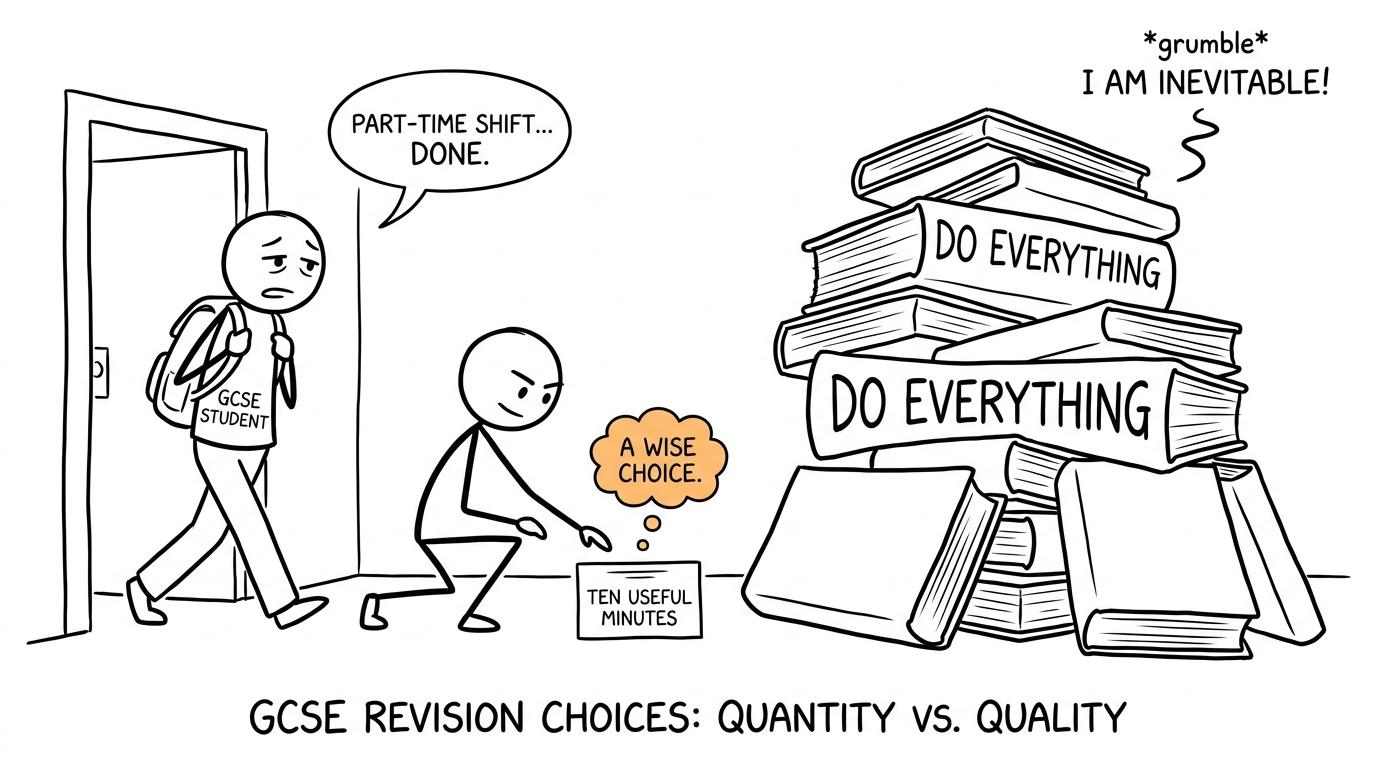 A tired student sensibly chooses one useful flashcard over an impossible mountain of revision
Plan around shifts using tasks, not hopeful intentions
Writing “revise Arabic” or “do maths” creates another decision when you are already tired. Decide the exact task in advance.
A clear task might be:
- retrieve vocabulary from one Arabic theme
- record and review one speaking response
- correct one previously completed translation
- complete one MathsGenie topic question set
- redo questions missed in a mini test
- mark one section of a paper and update an error log
If you do not know which maths topics deserve priority, use the process in finding your weakest GCSE topics. Evidence from questions is more reliable than choosing whatever feels comfortable.
Keep a backup list of tasks requiring little setup. This matters when a shift changes unexpectedly. You may not have time for a complete paper, but you can still correct earlier work or review one method.
Speak to your employer before the pressure peaks
Your manager cannot plan around dates they do not know. Share important mock, speaking assessment and written examination dates as early as possible. Ask how far ahead rotas are prepared and what process is used for requesting fewer shifts.
Be specific. “I am busy with exams” is less actionable than identifying the weeks in which you have several papers or an Arabic speaking assessment. You can ask whether shifts may be reduced, moved or made more predictable during that period. This is a request, not a guarantee, but early notice gives everyone more options.
Employment protections also matter. In England, children below school-leaving age are currently limited during term time to 121212 hours of work a week, including no more than 222 hours on a school day or Sunday. Local council bylaws and permit requirements can apply. Rules differ across the UK, so check the current guidance for your nation and local authority with a parent or carer.
Young workers above school-leaving age but under 181818 are generally subject to limits of 888 hours a day and 404040 hours a week, with additional rights concerning breaks and rest. These are legal maximums, not recommended targets for a student preparing for GCSEs. If work is harming your attendance, sleep or ability to prepare, involve a trusted adult and your school.
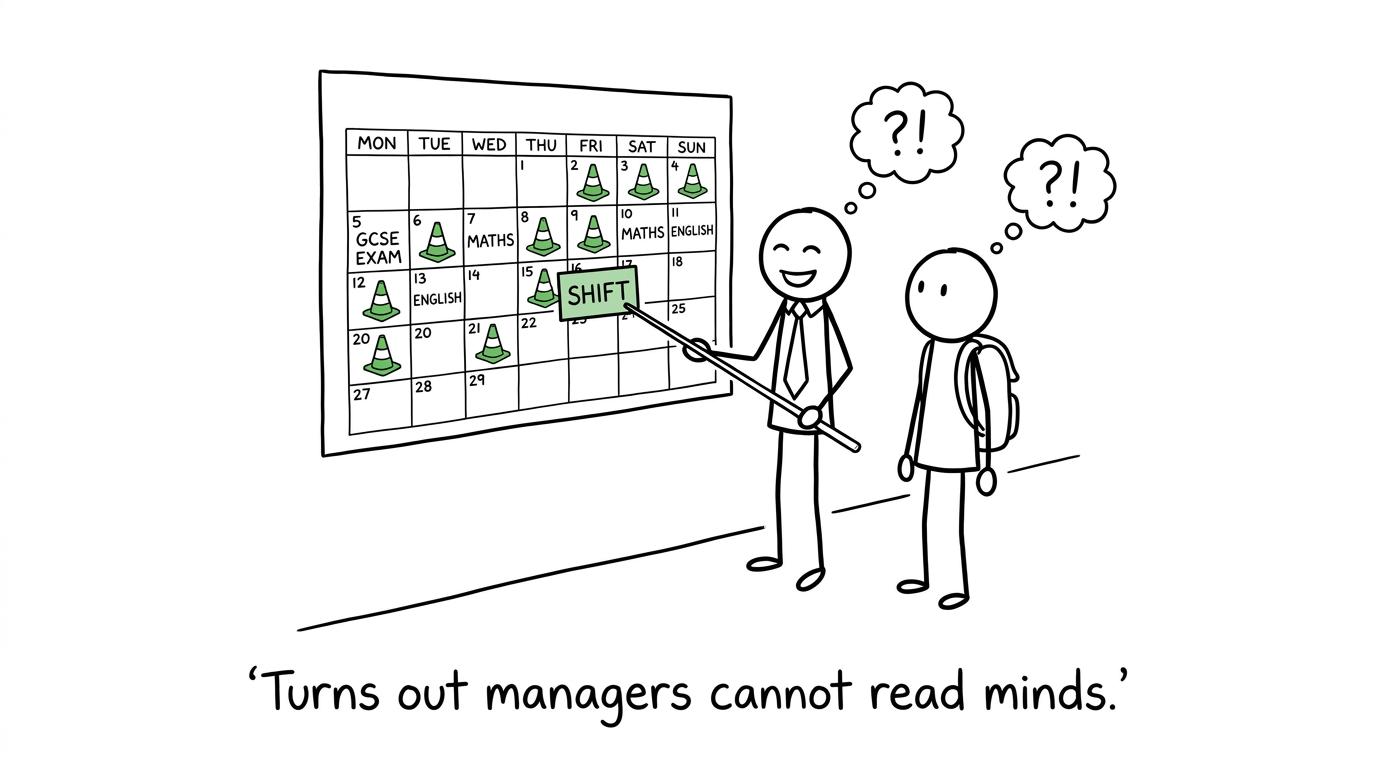 A student and manager move a shift away from exam dates on a rota
Adjust the balance as exams approach
The right balance in autumn may be wrong during the final examination period. Revision should become more exam-specific as assessments approach.
For Arabic, increase timed work across all four skills rather than concentrating only on your favourite area. Ask your teacher which specification materials and speaking tasks apply to your entry.
For maths, move gradually from individual topics to mixed, timed questions. The MathsGenie guide to starting GCSE past papers explains how to build from shorter diagnostic work towards full papers. Edexcel students can use the Edexcel GCSE maths past paper collection, while students taking another board should select that board through the main hub.
Do not merely total your marks. Use the mark scheme, classify each error and revisit the responsible topic. If forgetting is the main problem, follow a spaced pattern using the advice in how to stop forgetting GCSE maths content.
During exam week itself, reduce unnecessary decisions. The GCSE maths exam-week checklist helps you choose a targeted task, mark it and protect your sleep rather than attempting a last-minute marathon.
Common mistakes when balancing Arabic, maths and work
Treating every free hour as available revision time
Travel, food, sleep and recovery are real commitments. Ignoring them produces a timetable that fails immediately.
Saving every difficult task for after a shift
Workdays are better suited to maintenance tasks. Put timed writing, challenging maths and full listening practice into your stronger periods.
Revising Arabic as vocabulary alone
Vocabulary supports the course, but it does not replace listening, speaking, reading and writing practice. Track all four skills.
Dropping maths until the weekend
A weekly paper may build stamina, but shorter topic practice keeps methods accessible. Use both.
Completing work without marking it
Unmarked questions create activity without feedback. Mark schemes and video solutions show where marks are awarded and what must change.
Waiting until the rota is published to mention exams
Ask early. A manager may have much less flexibility after shifts have been allocated.
Responding to one missed session by abandoning the week
Move the essential task to the next suitable slot. Do not double every later session as punishment. A resilient plan expects disruption.
A balance that can last
Balancing GCSE Arabic with a part-time job is not about fitting endless work into every gap. It is about protecting the few actions that matter: frequent contact with Arabic, active maths practice, honest marking, sufficient rest and early communication about shifts.
Start by mapping one realistic week. Give Arabic all four skills, give maths a repeatable learn-practise-mark-fix cycle, and create a minimum task for workdays. Then review what actually happened.
MathsGenie can remove much of the planning friction. Begin with the free GCSE maths revision hub, choose your board and tier, and combine revision lessons with practice questions, mini tests, past papers, predicted papers, mark schemes and video solutions. Your job may make time scarce. It does not have to make your revision directionless.










