

GCSE Arabic Flashcards: The Best Quizlet Decks
GCSE Arabic flashcards Quizlet guide: choose reliable Edexcel decks, check vocabulary accuracy, and build focused revision sets quickly for exam day.
Revision often goes wrong before the first card is turned over. A student searches for gcse arabic flashcards quizlet, opens the largest set available and assumes that hundreds of terms must mean complete coverage. Two evenings later, they have recognised plenty of words but cannot recall them independently or use them in a sentence.
The short answer is this: the best GCSE Arabic Quizlet decks are aligned with the current Pearson Edexcel specification, divided into manageable themes, accurate in both Arabic and English, and designed for active recall rather than passive clicking. A teacher-approved class set is usually the safest ready-made choice. After that, carefully checked theme decks and a personal set built from the official vocabulary list are the most useful options.
This guide explains which public sets are worth investigating, how to reject unreliable ones and how to build your own quickly. The revision principles also transfer neatly to GCSE maths, where recalling a method is very different from merely recognising it.
Your quick flashcard checklist
Before committing time to any deck, check that it:
- names Pearson Edexcel GCSE Arabic and the current qualification code, 1AA01AA01AA0;
- follows the five specification themes;
- distinguishes Foundation and Higher vocabulary where relevant;
- uses accurate Arabic spelling, sensible English meanings and consistent formatting;
- contains manageable groups rather than one enormous unsorted list;
- tests recall in both directions;
- includes useful phrases and structures, not only isolated nouns;
- has been checked against Pearson's published vocabulary list or by your teacher.
If a deck fails several of these checks, copying it into your revision routine will only make its problems harder to notice later.
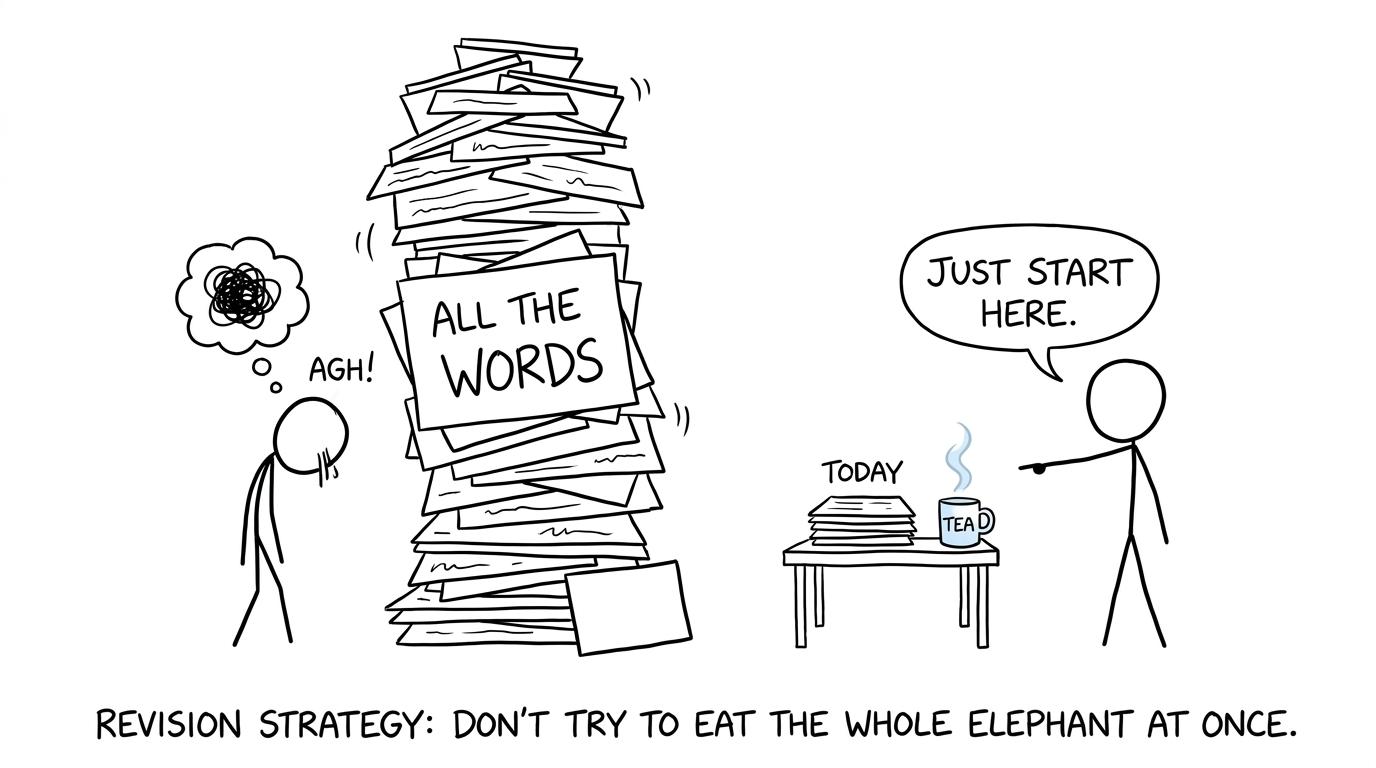 A student choosing a manageable daily flashcard stack instead of an enormous tower
Which GCSE Arabic flashcard decks are worth using?
There is no permanent league table of public Quizlet sets. Community decks can be edited, removed or based on an older course, while available study modes may vary by account, device or subscription. It is therefore better to judge the type and source of a deck than trust its popularity alone.
Your teacher's specification-matched deck
Start with a set supplied or approved by your school. Your teacher knows the vocabulary, structures and speaking material that your class has covered. A class deck may also reflect the order of your scheme of work, making it easier to connect each card to lessons, homework and assessments.
Check that the set is for GCSE Arabic rather than International GCSE, an older specification or a general beginner's Arabic course. Those resources may still contain useful language, but their coverage and assessment priorities are not automatically interchangeable.
A deck imported from Pearson's official vocabulary list
The most dependable foundation is Pearson's published GCSE Arabic vocabulary list. It includes high-frequency language and topic-specific vocabulary for the current specification. The list is organised around five themes:
- identity and culture;
- local area, holiday and travel;
- school;
- future aspirations, study and work;
- international and global dimension.
A Quizlet set claiming to reproduce this list can save preparation time, but compare a sample with the official document before relying on it. Look for missing entries, reversed meanings, broken Arabic characters and confusion between Foundation and Higher vocabulary.
For many students, the strongest solution is to import the official material into private theme-based sets. You then retain the authority of the source while controlling the size and format of each deck.
The public “GCSE Arabic vocabulary” set
A broad public set titled GCSE Arabic vocabulary appears in Quizlet search results and can be useful for quick exposure to common language. Treat it as a starting bank, not proof of complete current-specification coverage. Its general title does not establish which specification version, tier or theme structure it follows.
Test a selection against Pearson's list and your class materials. If the sample is accurate, copy only the relevant entries into your own checked deck. This is safer than revising the entire public set unchanged.
Theme-specific vocabulary decks
Smaller sets labelled with an exact theme or sub-topic are usually more practical than one giant collection. Search for combinations such as Edexcel GCSE Arabic Theme 3 School or GCSE Arabic travel and tourism vocabulary.
The title alone is not enough. Open the set and look for coverage of the specification's actual sub-topics. A school deck, for instance, should go beyond subject names and include school routines, rules, pressures, trips, events and opinions.
Theme decks work especially well when alternated. This prevents you from remembering a word merely because it always appears beside the same neighbouring cards.
Speaking and writing question decks
The public set titled Ali GCSE Arabic: Theme 3: School (Speaking and Writing Sample Q&As) contains a substantial group of prompts and responses. Its format can be useful for practising extended recall and preparing ideas for speaking or writing.
However, model-answer decks should supplement vocabulary learning rather than replace it. Memorising a complete response word for word can make knowledge fragile: one unfamiliar question may disrupt the whole script. Use such decks to notice reusable structures, then adapt the language to your own truthful ideas and your teacher's guidance.
How to choose a reliable Quizlet set
The biggest deck is rarely the best deck. Quality comes from alignment, accuracy and how easily the material can be retrieved.
Check the specification first
Pearson's current GCSE Arabic course assesses listening, speaking, reading and writing at Foundation and Higher tier. Questions draw language from across the themes, and vocabulary listed under one heading may also be useful elsewhere.
A worthwhile deck should therefore identify its theme without suggesting that every word belongs exclusively to that context. It should also avoid claiming that vocabulary recall alone provides complete examination preparation.
Inspect the Arabic carefully
Review a sample with a teacher, textbook or official vocabulary document. Watch for:
- letters that have become separated during copying;
- spelling errors or missing characters;
- inconsistent diacritics;
- English definitions that are too narrow or misleading;
- verbs recorded without enough information to use them correctly;
- several unrelated meanings crowded onto one card.
Audio can support pronunciation, but automated audio should not be treated as a substitute for teacher feedback or authentic listening practice.
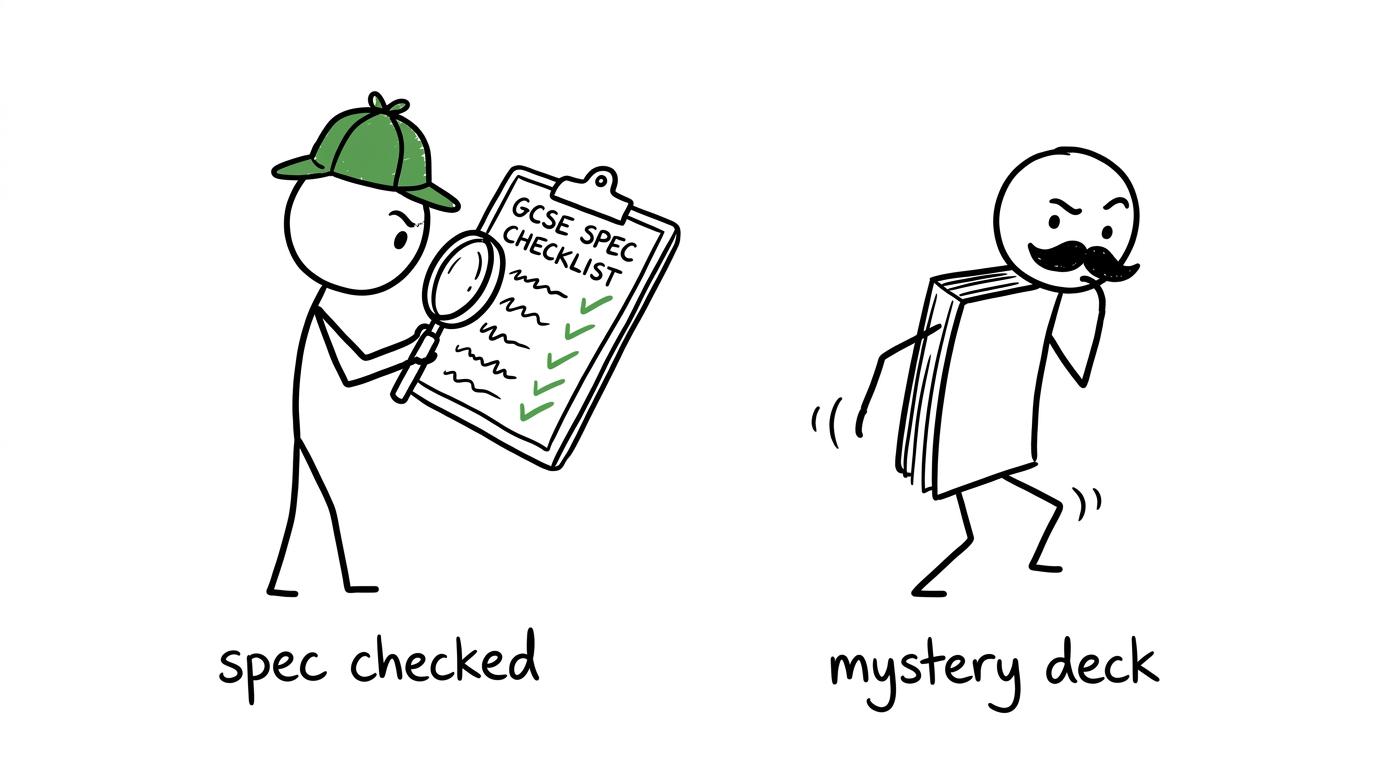 A specification-checked deck investigates a suspicious mystery deck
Prefer recall over recognition
Seeing four possible answers and spotting the familiar one can feel fluent. Producing the Arabic before revealing the card is harder, and more useful. Research on learning consistently supports retrieval practice and spacing over repeated passive review.
Quizlet's Flashcards, Learn and Test tools can present material in different ways, although exact access can change. Whichever mode you use, pause before revealing an answer. Say it, type it or write it from memory. Then check and correct it immediately.
That principle also sits behind MathsGenie's guide to finding weak GCSE topics: testing is valuable because it reveals what to repair, not because it produces a reassuring score.
How to build your own GCSE Arabic deck fast
Building a useful set does not mean typing the entire specification in one sitting. The aim is to create the smallest accurate deck that supports your next piece of learning.
Choose one narrow source
Use one teacher-approved vocabulary sheet, one specification sub-topic or errors from one recent assessment. Avoid mixing unverified websites, old textbooks and several public decks at once.
Your source should determine the content. Quizlet is the delivery tool, not the authority.
Import in batches
Prepare two clean columns in a spreadsheet or document: Arabic and English. Use Quizlet's import option if it is available in your current interface, then inspect every entry after importing. Right-to-left text, punctuation and separators can create formatting mistakes.
Keep each set small enough to review in a short session. Separate decks by theme, tier or purpose, using precise titles such as “Edexcel GCSE Arabic: Theme 2, Directions”. Clear naming makes later revision much faster.
Use one learning demand per card
A card should ask for one retrievable answer. If it contains a paragraph, several translations and a grammar lecture, it has stopped behaving like a flashcard.
Useful card categories include:
- English prompt to Arabic recall;
- Arabic prompt to English meaning;
- a short phrase or collocation;
- a question word or connective;
- an infinitive linked to a form required by your course;
- a speaking prompt whose reverse contains brief planning cues.
Duplicate important entries when you need to practise both directions. Recognition from Arabic and production into Arabic are related but different demands.
Add mistakes immediately
The most valuable personal deck is often an error deck. Add misspelt words, confused meanings and phrases that you could not retrieve in speaking practice. Include the corrected version, not a copy of the error without explanation.
This mirrors effective maths revision. On the GCSE Maths revision hub, students can move from a weak skill to a focused lesson and practice questions rather than rereading everything. Arabic vocabulary benefits from the same narrow repair loop.
A revision routine that makes flashcards work
Use short, repeated sessions rather than one long vocabulary marathon. A practical cycle is:
- preview a small batch and check meaning and pronunciation;
- retrieve each answer before turning the card;
- separate secure and insecure cards honestly;
- revisit difficult cards on another day;
- finish by using selected vocabulary in speaking or writing;
- return later with the card direction reversed.
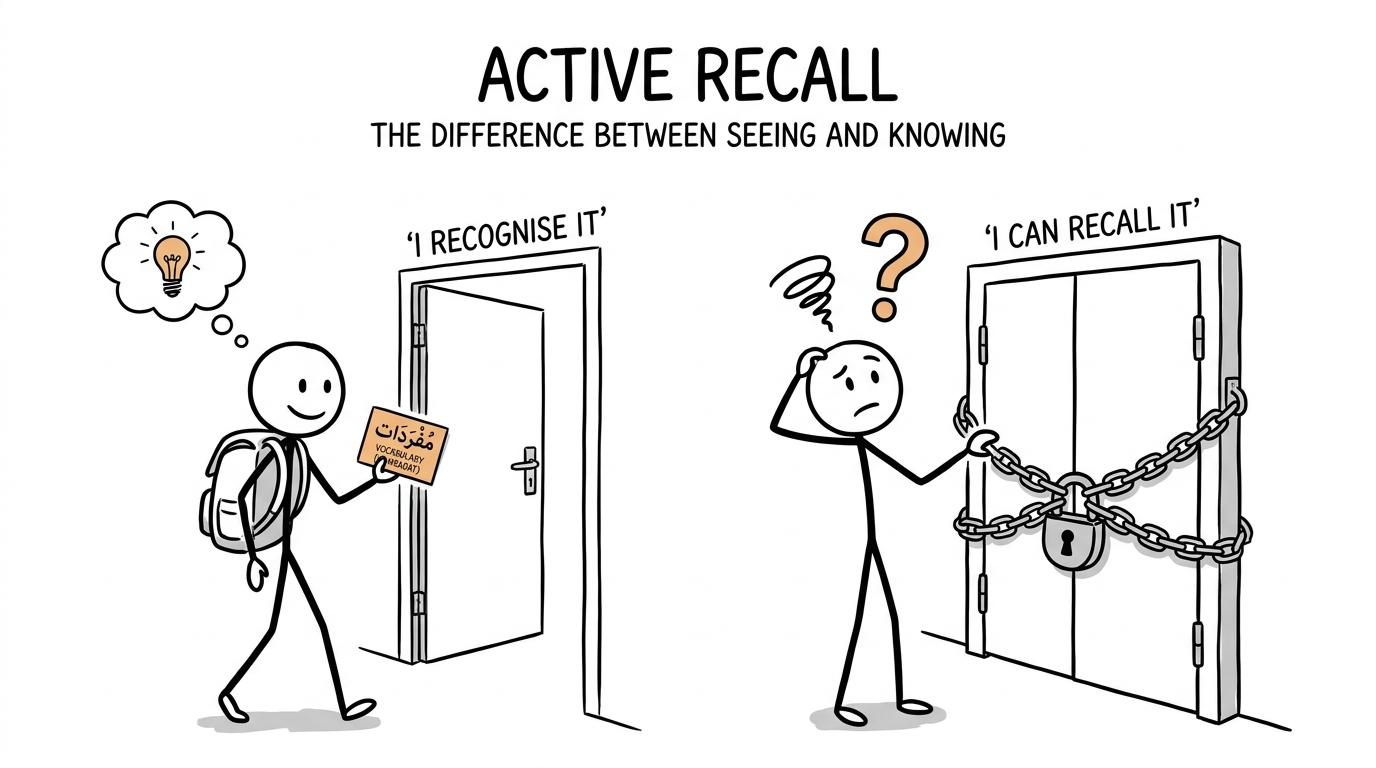 A student discovers that recalling a word is harder than recognising it
If Arabic is one subject among many, place this routine inside a realistic timetable. MathsGenie's GCSE maths revision timetable guide explains how to prioritise weaknesses and revisit them regularly, while the 20-minute GCSE revision routine offers a useful structure for busy days.
Flashcards should not consume all your revision time. GCSE Arabic also requires listening comprehension, reading unfamiliar material, accurate writing and spoken responses. Move regularly from cards to exam-style tasks, just as maths students progress from recall to short GCSE mini tests and complete papers.
Common mistakes with GCSE Arabic Quizlet revision
Trusting popularity instead of accuracy
A set can have many users and still contain outdated, incomplete or incorrectly formatted material. Verify it against the specification and your teacher's resources.
Revising only Arabic to English
This direction is useful for reading, but writing and speaking require production. Reverse the cards and retrieve Arabic without prompts.
Copying model answers unchanged
A memorised paragraph is not flexible language knowledge. Extract adaptable structures and practise responding to varied questions.
Keeping every card in one giant deck
Oversized decks hide priorities and make review feel endless. Divide material by theme and maintain a separate error set.
Clicking through without attempting recall
Turning a card immediately measures recognition, not memory. Commit to an answer before checking it.
Replacing exam practice with flashcards
Vocabulary is necessary, but it must be applied. In maths, past-paper practice reveals whether a method survives exam conditions. Arabic students need the equivalent transition into listening, speaking, reading and writing tasks.
Turn a deck into a dependable revision system
The best GCSE Arabic flashcards are not necessarily the most polished or popular. They are the ones you have checked, divided into useful topics and repeatedly used for genuine retrieval. Begin with a teacher-approved resource or Pearson's vocabulary list, borrow carefully from reliable public sets, and let your own mistakes shape what you revise next.
The same habit can strengthen the rest of your GCSE preparation. Use MathsGenie's free GCSE maths revision resources for revision lessons, worksheets and practice questions, then check progress with mini tests, past papers, mark schemes and video solutions. Nearer the examination, add Edexcel GCSE Maths predicted papers without treating predictions as a replacement for official past papers.
Start small today: check one Arabic deck, keep one accurate theme set and test yourself without looking. Good revision becomes powerful when it is simple enough to repeat.










