

GCSE Arabic 6 to 9: How to Reach the Top Grade
GCSE Arabic 6 to 9: learn the precise changes in vocabulary, grammar, speaking, writing and exam practice that can turn secure marks into top grades.

A grade 6 in GCSE Arabic usually means you can communicate successfully. You understand familiar material, express relevant ideas and use a reasonable range of language. But success is not yet consistent: an unfamiliar recording, an imprecise verb form or an underdeveloped opinion can still expose gaps.
Moving from GCSE Arabic 6 to 9 is therefore less about learning everything again and more about changing the quality of your performance. You need broader vocabulary, greater grammatical control, more detailed answers and reliable understanding when the language is unfamiliar. Most importantly, you must diagnose lost marks instead of simply completing more revision.
The route is demanding, but it is not mysterious. A grade 9 performance is built from small decisions repeated accurately across listening, speaking, reading and writing.
Your grade 6 to grade 9 checklist
Use this as a quick overview of the changes that matter:
- Confirm that you are entered for the tier through which grade 9 is available.
- Treat listening, speaking, reading and writing as equally important.
- Replace isolated vocabulary lists with phrases, structures and word families.
- Control past, present and future timeframes accurately.
- Develop opinions with reasons, detail and contrasting ideas.
- Practise unfamiliar material rather than memorising only predictable responses.
- Use official past papers and mark schemes to identify recurring weaknesses.
- Record every lost mark and retest the underlying skill.
- Complete timed practice before the examination period.
This resembles effective maths revision. The subject changes, but the feedback loop does not: assess, mark, diagnose, repair and retest. MathsGenie's guide to finding your weakest GCSE topics explains how to turn a disappointing score into a precise revision list.
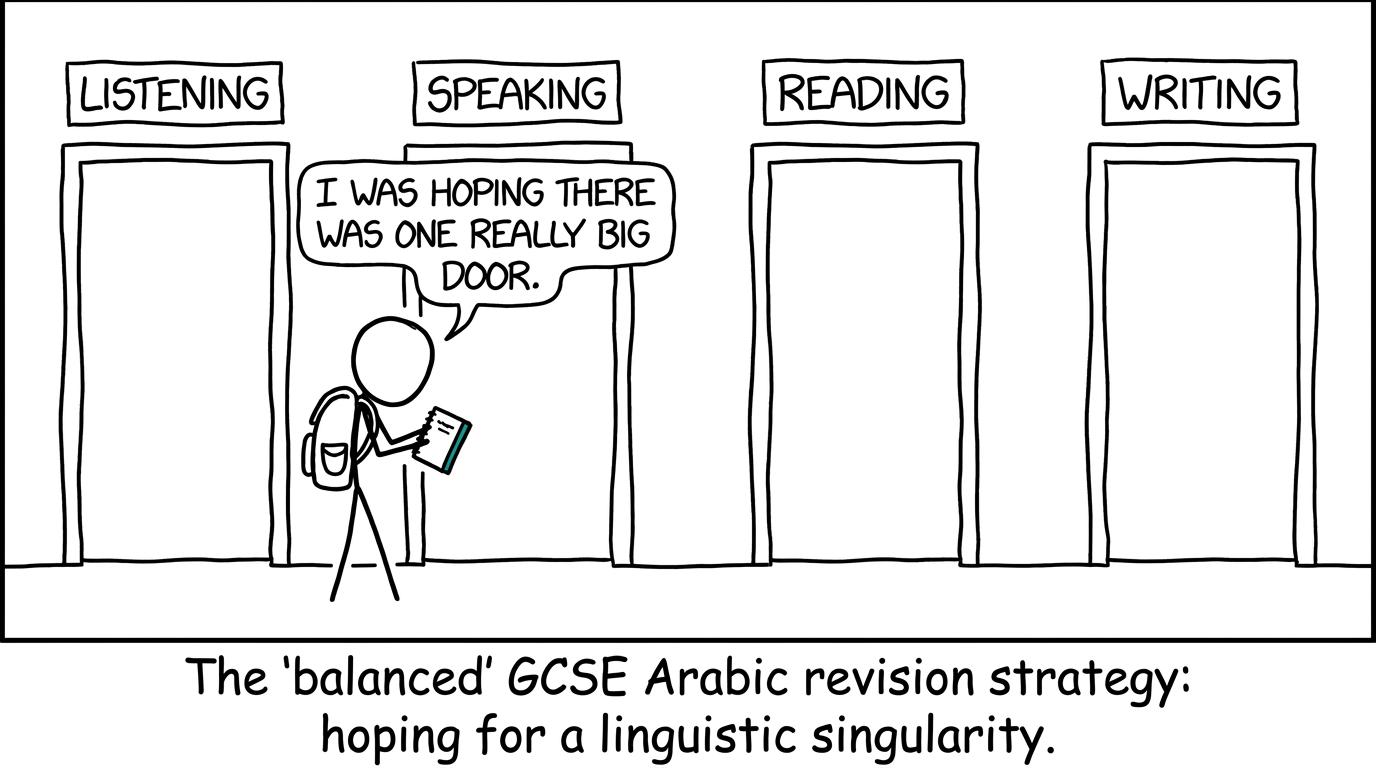 A student discovers that balanced revision has four doors
Understand what the GCSE Arabic examination rewards
For the current Pearson Edexcel GCSE Arabic qualification, the four assessment objectives are listening, speaking, reading and writing. Each contributes 25%25\%25% of the qualification. Students enter Foundation or Higher tier across all four papers rather than mixing tiers. Foundation targets grades 1-5, so a student aiming for grade 9 must be entered for Higher tier.
The Higher speaking assessment contains a role play, a picture-based task and a conversation. The reading paper includes a translation into English, while the writing paper includes extended responses and translation into Arabic. Dictionaries are not permitted, including during speaking preparation.
Check the current specification and arrangements with your teacher because qualifications can change. Do not confuse GCSE Arabic with International GCSE Arabic, which may have a different assessment structure.
The equal weighting matters. A student cannot safely treat fluent conversation as compensation for weak reading, or polished writing as compensation for unreliable listening. A useful diagnostic is:
Skill accuracy=marks earnedmarks available×100%\text{Skill accuracy} = \frac{\text{marks earned}}{\text{marks available}} \times 100\%Skill accuracy=marks availablemarks earned×100%Calculate this separately for each paper. Your overall score may suggest that you are doing well, while the four individual results reveal that one skill is quietly limiting your grade.
What separates a grade 6 from a grade 9 in GCSE Arabic?
Grade boundaries are set after each examination series, so there is no permanent number of marks that guarantees a particular grade. The more useful distinction is qualitative: grade 6 work is generally competent, whereas grade 9 work is consistently precise, flexible and well developed.
Vocabulary becomes usable rather than merely recognisable
A grade 6 student may know many topic words but struggle to retrieve them quickly or adapt them to an unfamiliar question. A top-grade student can select precise vocabulary, recognise paraphrases and use familiar language in new contexts.
Revise words in connected units:
- noun with adjective;
- verb with the preposition it requires;
- opinion with a reason;
- connective with a complete sentence pattern;
- word alongside a synonym, opposite or related form.
This helps across all four papers. In listening and reading, you become less dependent on hearing or seeing the exact word you memorised. In speaking and writing, you gain ready-made building blocks without memorising whole answers.
Grammar becomes controlled
Top-grade responses do not need to be flawless, but errors should not repeatedly disrupt meaning. You need dependable control of features required by your specification, including verb forms, agreement, pronouns, negatives, sentence construction and different timeframes.
The key change is to stop labelling every error as “grammar”. Be exact: incorrect agreement, uncertain past tense, missing pronoun or word order copied from English. A narrow diagnosis creates a narrow fix.
Ofqual's requirements allocate grammar and structural accuracy marks within speaking and writing. Accuracy is therefore not cosmetic. It is part of what is being assessed.
Answers become developed and responsive
At grade 6, a response may answer the question and provide an opinion. To move higher, develop ideas with reasons, consequences, comparisons or contrasting perspectives. That does not mean forcing long sentences into every answer. It means giving the task enough substance while maintaining control.
Learn adaptable functions rather than a script: narrating an event, justifying a preference, comparing alternatives, explaining a problem and proposing a future action. A memorised paragraph is fragile. A flexible structure can survive an unfamiliar question.
Understanding becomes resilient
Higher-tier listening and reading test more than word spotting. The specification expects students to identify messages, details and opinions, deduce meaning and recognise relationships between past, present and future events.
Practise recovering when you miss a word. Use surrounding information, tone, context and word families. In listening, make a second-pass note of what changed or contradicted an earlier idea. In reading, distinguish what the text states from what you assume based on the topic.
Improve each GCSE Arabic skill deliberately
Listening: train prediction and recovery
Before a recording begins, inspect the question and predict the type of information required: an opinion, reason, place, problem or timeframe. During the recording, listen for meaning rather than trying to translate every word.
After marking, classify mistakes. Did you not know the vocabulary? Did you confuse a negative? Did you hear the word but attach it to the wrong speaker? These require different revision. Replay only after committing to an answer, then use the transcript where available to locate the precise failure.
Speaking: sound responsive, not rehearsed
Prepare thoroughly, but avoid answers that collapse when the teacher changes one detail. Practise responding aloud to random questions across all five Edexcel themes. Record yourself and check relevance, clarity, pronunciation, grammatical control and development.
For each answer, ask whether you gave information, expressed a view and supported it. In conversation practice, train yourself to extend naturally without speaking so long that accuracy disappears.
Reading: look for paraphrase and viewpoint
Read short authentic or exam-style texts regularly. Identify who holds each view, whether it is positive or negative and which words establish the timeframe. Build a paraphrase bank so that one idea can be recognised when expressed in different language.
Translation into English should preserve meaning, tense and relationships between ideas. Natural English matters, but never add information that is absent from the source.
Writing: prioritise coverage, range and accuracy
Plan against every bullet point before writing. Choose structures you can control and include varied timeframes where the task requires them. Leave time to check agreements, verb forms, spelling, repeated vocabulary and whether every idea actually answers the prompt.
When reviewing a response, use the official assessment criteria rather than judging it by length. More words do not automatically mean more marks. Controlled detail is more valuable than ambitious language that repeatedly breaks down.
 A grammar gremlin finds the weakness in a giant vocabulary stack
Use a marks-leak system to move up a grade band
The largest change between passive revision and grade 9 revision is what happens after a mistake.
Create an error log with these fields:
- paper, task and question;
- skill being tested;
- marks lost;
- exact reason;
- correction needed;
- date for retesting.
Use five categories: knowledge, grammar, comprehension, communication and exam technique. If the same category appears repeatedly, it becomes a priority regardless of which theme produced it.
MathsGenie's advice on using past papers properly provides a useful paper-to-retest cycle. The guide to using mark schemes as a revision coach also shows why a mark scheme should change your next attempt, not merely confirm a score.
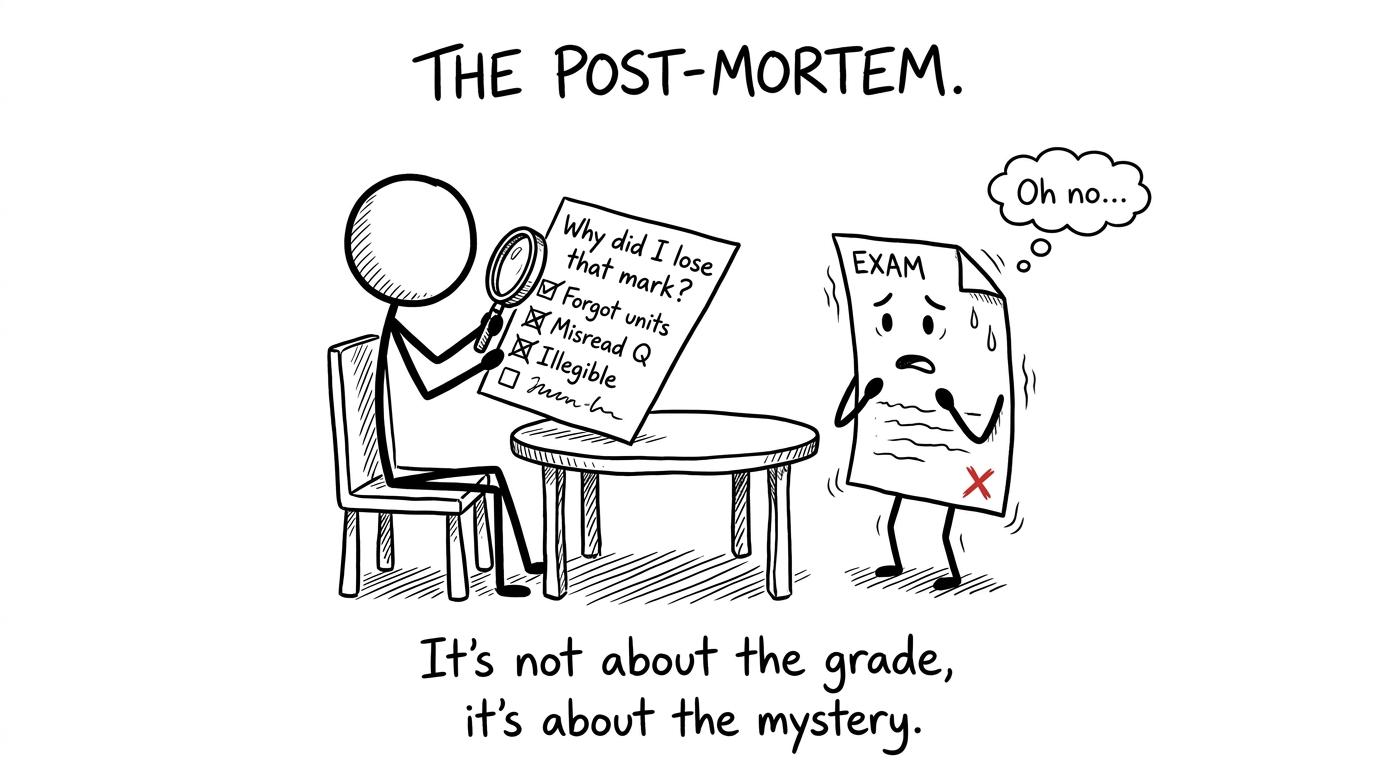 A student interrogates an exam paper to discover why a mark disappeared
Build a weekly revision routine that raises performance
A balanced week could contain four focused Arabic sessions:
- vocabulary retrieval and grammar correction;
- timed listening or reading followed by analysis;
- recorded speaking practice;
- timed writing or translation followed by redrafting.
Add a mixed paper section at the weekend. The point is not to complete the largest possible quantity. It is to discover whether this week's corrections survive under examination conditions.
Space revision across several days rather than cramming one theme. Retrieve before checking notes, revisit errors and mix old content with new material. MathsGenie's article on stopping GCSE content from being forgotten explains this learn, retrieve and retest rhythm. You can organise the sessions with a realistic GCSE revision timetable.
Closer to the examinations, use full official Arabic papers under the correct conditions. Review each paper for at least as long as it took to complete. If a full paper feels too large, use shorter timed sections first, following the same principle described in MathsGenie's guide to how many past papers you should do.
Common mistakes that keep students at grade 6
Memorising essays word for word. This can produce polished but irrelevant answers when the task changes. Memorise flexible structures and vocabulary instead.
Revising only favourite themes. The examination draws language from across the specification. Weakness avoidance feels comfortable but preserves the weakness.
Treating fluency as accuracy. Speaking quickly is not the same as communicating precisely. Slow down enough to control endings, agreements and verb forms.
Ignoring listening until late. Listening develops through repeated exposure and careful error analysis. It is difficult to cram.
Writing beyond your control. Ambition is valuable only when meaning remains clear. Secure a reliable core, then add selected higher-level structures.
Counting papers instead of corrections. A completed paper produces evidence. Improvement happens when you repair and retest what it exposed.
Chasing last year's grade boundary. Boundaries vary by series. Concentrate on maximising marks across every skill rather than treating an old threshold as a target.
From secure performance to consistent excellence
The jump from grade 6 to grade 9 is not one heroic leap. It is a collection of smaller upgrades: vocabulary that can be adapted, grammar that remains controlled, answers that are developed and comprehension that survives unfamiliar language.
Begin with one Higher-tier paper or representative set of tasks. Mark it strictly. Identify the weakest skill and the most common reason for lost marks. Repair that small area, then test it again.
MathsGenie does not provide GCSE Arabic teaching materials, but its free GCSE Maths revision hub, self-assessment resources and past-paper revision system model the same disciplined process you can apply to Arabic. For maths, use the revision lessons, practice questions, mini tests, past papers, predicted papers, mark schemes and video solutions. For Arabic, take that same habit into your official specification and examination materials: practise, diagnose, correct and return stronger.










