Gamify Revision GCSE Sociology: Does It Help?
Gamify revision GCSE sociology with purpose: discover when streaks, points and rewards strengthen recall, and when they distract from real exam practice.
Revision often begins with good intentions and ends with an impressive collection of coloured badges. The difficult question is whether anything has actually been learnt.
If you want to gamify revision GCSE sociology, the short answer is yes: game elements can make useful practice easier to begin and repeat. But points, streaks and rewards do not create learning by themselves. They help only when they encourage retrieval, application, feedback and improvement. If the game rewards logging in, decorating profiles or answering questions that are too easy, it may become a pleasant distraction from exam preparation.
That distinction matters for students balancing Sociology with GCSE Maths. Time is limited. A revision system should turn effort into knowledge and exam skill, not merely activity.
The quick verdict
A useful gamified revision system should:
- reward answering questions from memory rather than rereading notes;
- include immediate checking and corrective feedback;
- give more credit for difficult, exam-relevant tasks;
- revisit content after a delay;
- include extended responses as well as quick quizzes;
- track weak areas, not just total points;
- make missed days recoverable rather than punishing;
- lead gradually towards timed exam practice.
If your system does those things, gamification can support revision. If it mainly creates streak anxiety or encourages you to collect easy wins, simplify it.
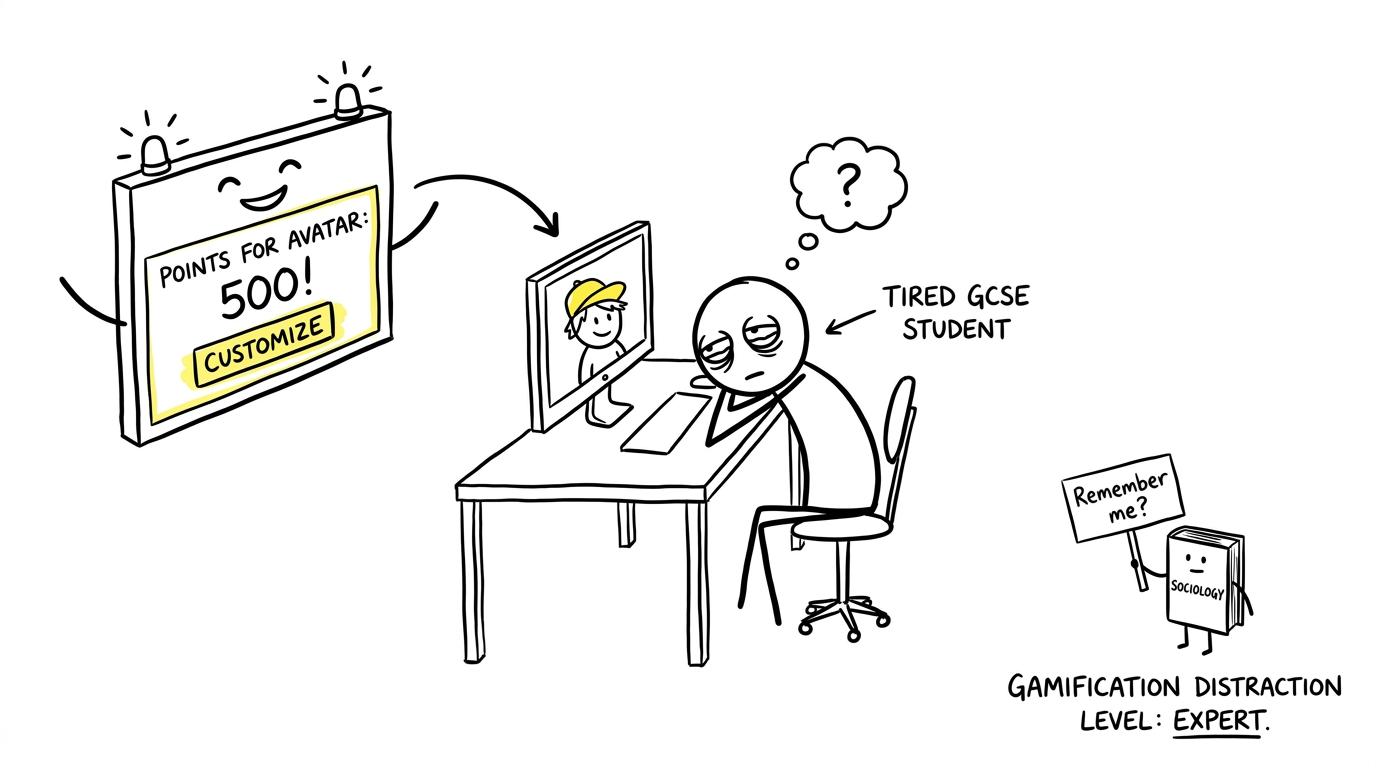 A student earns points for choosing an avatar while the neglected sociology textbook asks to be remembered
What gamifying revision actually means
Gamification means adding selected game features to a non-game activity. In revision, these might include points, levels, progress bars, challenges, badges, streaks or small rewards.
The important phrase is selected game features. Turning revision into a game does not require an elaborate app. A paper checklist containing topic missions and progress milestones can work perfectly well. The purpose is to make the next useful action clear and satisfying.
There are two layers to separate:
- The learning task: recalling a definition, applying a theory, planning an argument or evaluating evidence.
- The game layer: earning points, completing a mission or maintaining visible progress.
The learning task is what prepares you for the examination. The game layer should persuade you to do that task consistently. It is the wrapper, not the medicine.
This principle also applies to maths revision. MathsGenie's GCSE Maths revision hub organises free lessons, exam questions, worksheets, flashcards, mini tests, past papers and predicted papers by exam board. A progress score may help you return tomorrow, but completing and correcting the questions is what develops understanding.
What the evidence suggests about points and rewards
Research on educational gamification does not justify a simple claim that games automatically improve grades. Findings vary because gamification can describe very different systems, learners and tasks. Some research reports improved engagement or motivation, while effects on retained knowledge are less consistent.
That makes intuitive sense. A progress bar can make effort visible. It cannot evaluate a sociological theory for you.
Evidence for retrieval practice is firmer. Actively trying to recall information can strengthen later access to it, particularly when retrieval is repeated after a delay. Feedback is also essential because an unchecked mistake may become more familiar rather than less wrong.
A sensible conclusion is therefore:
Gamify the evidence-informed revision behaviour, not the appearance of revision.
Give credit for a genuine attempt made without notes. Award progress when an answer has been checked and corrected. Make revisiting a weak topic worth more than repeating something already secure.
This is similar to the paper-mark-repair-retest cycle described in MathsGenie's guide to starting GCSE past papers at the right time. The score is useful only when it points towards the next improvement.
Build the game around GCSE Sociology assessment
A Sociology examination requires more than remembering isolated definitions. For example, the current AQA GCSE Sociology assessment objectives cover:
- AO1: knowledge and understanding of theories, concepts, evidence and methods;
- AO2: applying that knowledge and understanding;
- AO3: analysing and evaluating ideas to construct arguments, reach judgements and draw conclusions.
For AQA, AO1 and AO2 each account for approximately 40%40\%40% of the qualification, while AO3 accounts for approximately 20%20\%20%. Always use the current specification and guidance for your own course when planning revision.
A game containing only multiple-choice recall may support part of AO1, but it cannot fully prepare you to apply material or construct a reasoned evaluation. Your missions need to reflect the range of thinking required by the paper.
Create missions with different purposes
Use several categories rather than one endless points total:
- Recall missions: retrieve concepts, studies, researchers and methods without notes.
- Connection missions: link a theory to an issue, topic or contrasting perspective.
- Application missions: use relevant knowledge in the context supplied by a question.
- Evaluation missions: identify limitations, alternative explanations and justified judgements.
- Exam missions: plan or complete responses under realistic time conditions.
- Repair missions: correct an answer after using a mark scheme or teacher feedback.
This prevents the common problem of becoming excellent at quick quizzes while avoiding extended writing. The most demanding missions should carry the greatest status because they resemble the work that tends to be postponed.
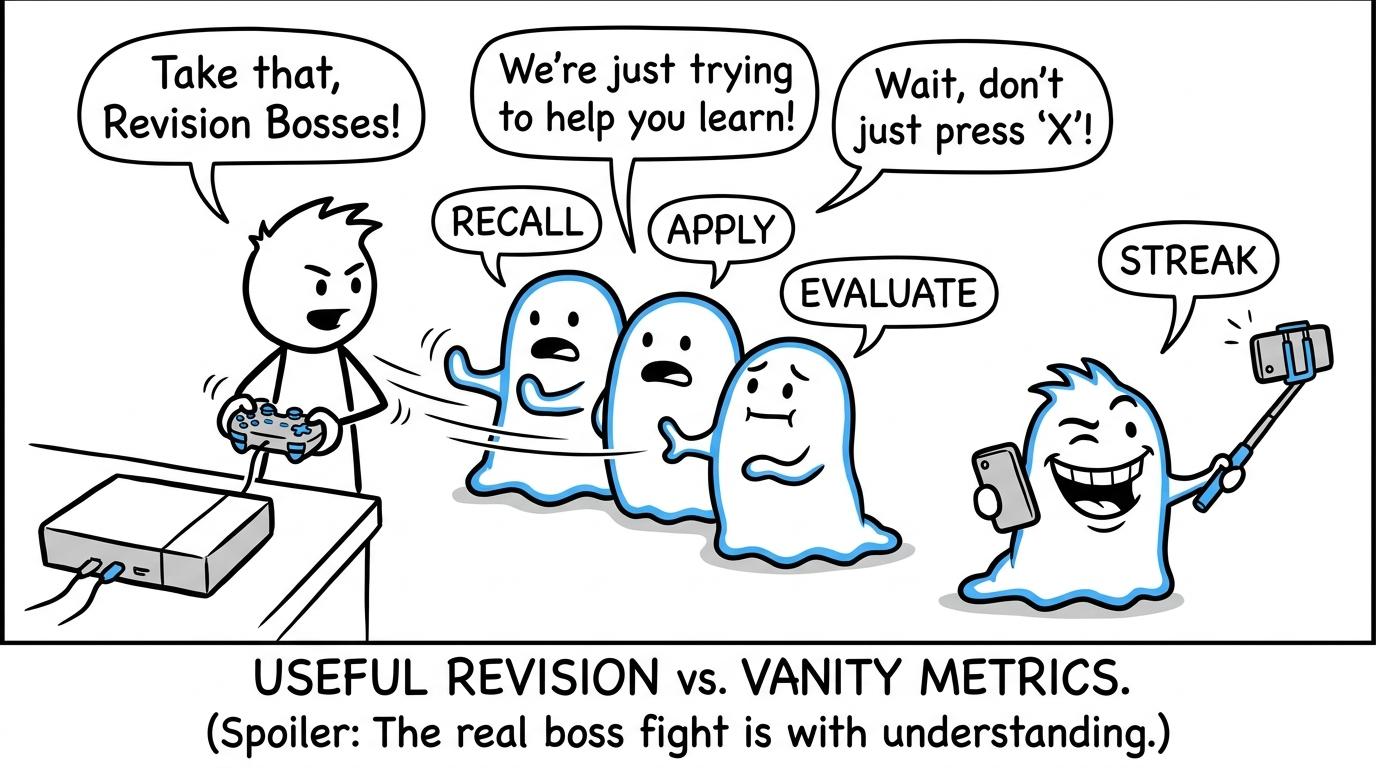 A student battles useful revision monsters while the streak monster takes a selfie
Reward evidence, not confidence
Confidence is useful, but it is not proof of learning. A topic can feel familiar because you have reread it several times. Familiarity disappears quickly when the notes close and a precise question appears.
A stronger points system awards progress only after visible evidence:
- an answer attempted without support;
- a response checked against reliable guidance;
- an error explained and corrected;
- a difficult topic revisited later;
- an extended answer planned or completed;
- teacher feedback acted upon.
Do not remove points for mistakes. Errors are diagnostic information. Rewarding honest correction encourages you to uncover weaknesses instead of protecting a perfect score.
Maths students can use the same logic. The routine in MathsGenie's guide to revising GCSE Maths efficiently moves from learning a method to practising, marking, fixing and retesting it. Sociology content is different, but the useful behaviour is strikingly similar.
Are streaks helpful or harmful?
A streak answers one narrow question: did you complete an activity on consecutive days? It does not tell you whether the activity was challenging, accurately marked or remembered later.
Streaks can still help when starting is the main obstacle. A small daily mission reduces the negotiation involved in revision. Opening the materials and recalling one topic may lead naturally to further work.
The problem begins when preserving the streak replaces the learning goal. Students may choose an effortless activity late at night simply to keep the counter alive. Missing one day can then make the whole system feel broken.
Use a flexible rule instead:
- measure consistency across a week rather than perfection every day;
- allow rest days and recovery days;
- count only meaningful tasks;
- track repaired weaknesses alongside attendance;
- reset the plan without resetting your sense of progress.
Revision should survive ordinary life. A robust system bends without collapsing.
Rewards that support rather than replace motivation
External rewards can help you begin a task you are avoiding, but they should remain small and proportionate. Finishing a planned session might unlock a break, an episode of a programme or time on a favourite activity.
Avoid rewards that make the organisation more exciting than the revision. If you spend twenty minutes designing badges for a ten-minute quiz, the proportions are backwards.
A useful reward closes a completed cycle. It should not arrive merely because a timer ran while your attention was elsewhere. Over time, the more durable reward becomes clearer knowledge: being able to retrieve a study, build an argument and see why a response earned or lost marks.
Combine gamification with a realistic revision cycle
A balanced session can follow this sequence:
- choose one defined Sociology topic or skill;
- retrieve key content without notes;
- check accuracy and correct omissions;
- answer an application or evaluation question;
- review the response using suitable guidance;
- record one weakness to revisit;
- schedule the retest after a delay.
Gamification can sit around this cycle. A completed cycle earns progress; an unmarked page does not.
As examinations approach, shift the balance from short missions towards mixed and timed work. The same progression is useful when preparing for maths exams: topic practice first, then mini tests, paper sections and complete papers. MathsGenie's GCSE resit revision plan explains how diagnostic papers can identify weak topics before targeted repair and retesting.
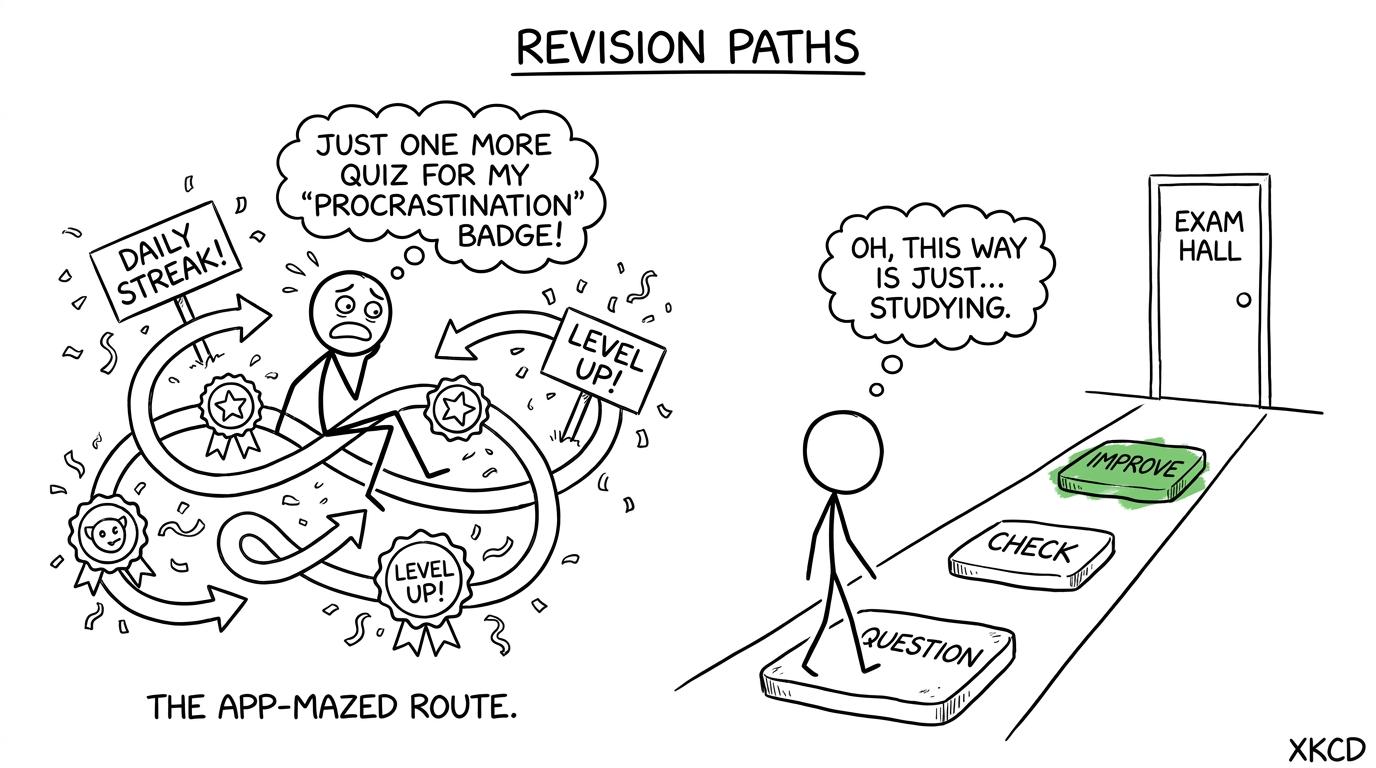 One path loops through badges and streaks while question, check and improve lead towards the exam hall
How to tell whether your revision game is working
Do not judge the system by how satisfying it looks. Test what you can do.
After a week, ask:
- Can I retrieve more accurate content without prompts?
- Can I apply ideas to unfamiliar wording?
- Are my evaluations becoming more specific?
- Am I correcting the same error repeatedly?
- Have I attempted the extended questions I normally avoid?
- Does my score reflect difficult work or easy activity?
If the answers are weak, redesign the tasks before adding more rewards. A game should make progress measurable, but your answers remain the real measurement.
Near an exam, novelty matters less than calm prioritisation. MathsGenie's night-before GCSE Maths plan follows the same principle: choose a small amount of relevant practice, review mistakes and stop at a sensible time. No streak is worth sacrificing sleep or arriving mentally exhausted.
Common mistakes when gamifying GCSE revision
Awarding points for time alone
Time at a desk does not guarantee attention or learning. Reward completed retrieval, application, checking and correction instead.
Making every question easy
Easy quizzes feel fluent and preserve a high score, but they can hide fragile understanding. Include delayed recall, unfamiliar contexts and extended responses.
Ignoring feedback
A tick or cross is not enough. Find the missing knowledge, weak application or unsupported judgement, then improve it.
Letting a broken streak end the plan
One missed day is not erased knowledge. Restart with the next useful task and review consistency over a longer period.
Avoiding exam conditions
Fast quizzes cannot replace writing developed responses. Build towards timed questions and full papers where appropriate.
Using one system for every subject
Sociology demands knowledge, application, analysis and evaluation. Maths demands accurate methods, reasoning and problem solving. Keep the motivational structure if it helps, but adapt the missions to the subject.
Make the game serve the goal
Gamification can help GCSE Sociology revision, but mainly by making worthwhile behaviours easier to start and repeat. Streaks can encourage consistency. Points can show progress. Rewards can lower the barrier to beginning. None of them substitutes for retrieval, feedback, application, evaluation or exam practice.
Keep the system light. Reward difficult evidence. Repair mistakes. Revisit content after a delay. Then gradually remove the game layer as the examination becomes the focus.
For the maths part of your revision timetable, start with MathsGenie's free GCSE Maths revision resources. Choose your exam board and tier, use revision lessons and practice questions to strengthen topics, then move into mini tests, past papers and predicted papers. Mark schemes and video solutions help turn every lost mark into a clear next mission, which is gamification at its most useful: not decoration, but direction.