Foundation vs Higher Maths Resit: Which Tier?
Foundation vs higher maths resit guidance for students targeting grades 4, 5 or 6. Compare grade limits, paper difficulty and boundary risk.
A maths resit comes with an awkward decision before the revision has properly begun: should you enter foundation or higher tier? The choice can feel like a judgement about your ability. It is not. It is a decision about which paper gives your current knowledge the best chance of becoming the grade you need.
For most students weighing up a foundation vs higher maths resit, the practical answer is this: foundation is usually the safer route to grade 444, either tier can lead to grade 555, and higher is essential if you need grade 666 or above. Your recent performance on complete, timed papers should decide the tier, not pride, fear or the tier you took last time.
Your tier decision at a glance
| Target grade | Usually the more suitable tier | Main consideration |
|---|---|---|
| Grade 444 | Foundation | More accessible questions and no need to learn higher-only content |
| Grade 555 | Foundation or higher | Choose using consistent timed-paper evidence |
| Grade 666 | Higher | Grade 666 is not available on foundation tier |
Before agreeing an entry with your school, college or exam centre:
- confirm the minimum grade required by your course, apprenticeship or employer;
- complete recent papers from both tiers under timed conditions;
- mark them carefully using official mark schemes;
- compare consistency across several papers, not one unusually good result;
- ask your teacher or centre to consider your working, topic gaps and exam confidence;
- check the final tier and exam-board entry before the centre's deadline.
MathsGenie's GCSE Maths revision hub lets you choose your exam board and find relevant revision materials, past papers, mark schemes and grade boundaries.
How GCSE maths tiers work
GCSE mathematics is tiered. Foundation tier makes grades 111 to 555 available, while higher tier makes grades 444 to 999 available. This means the tiers overlap at grades 444 and 555, but they do not offer identical routes to those grades.
Foundation papers focus more heavily on foundational and intermediate content. Higher papers assess that knowledge too, but also contain higher-tier topics and more demanding problem solving. All of your GCSE maths papers must be taken at the same tier for a particular entry.
A higher paper is not automatically the ambitious choice. Ambition is choosing the route most likely to achieve your actual objective. If a course asks for grade 444, a secure foundation performance can be more useful than struggling through a higher paper because it appears more impressive.
The opposite is equally important. Foundation tier has a hard ceiling at grade 555. If your next step requires grade 666, foundation cannot deliver it, however well you perform.
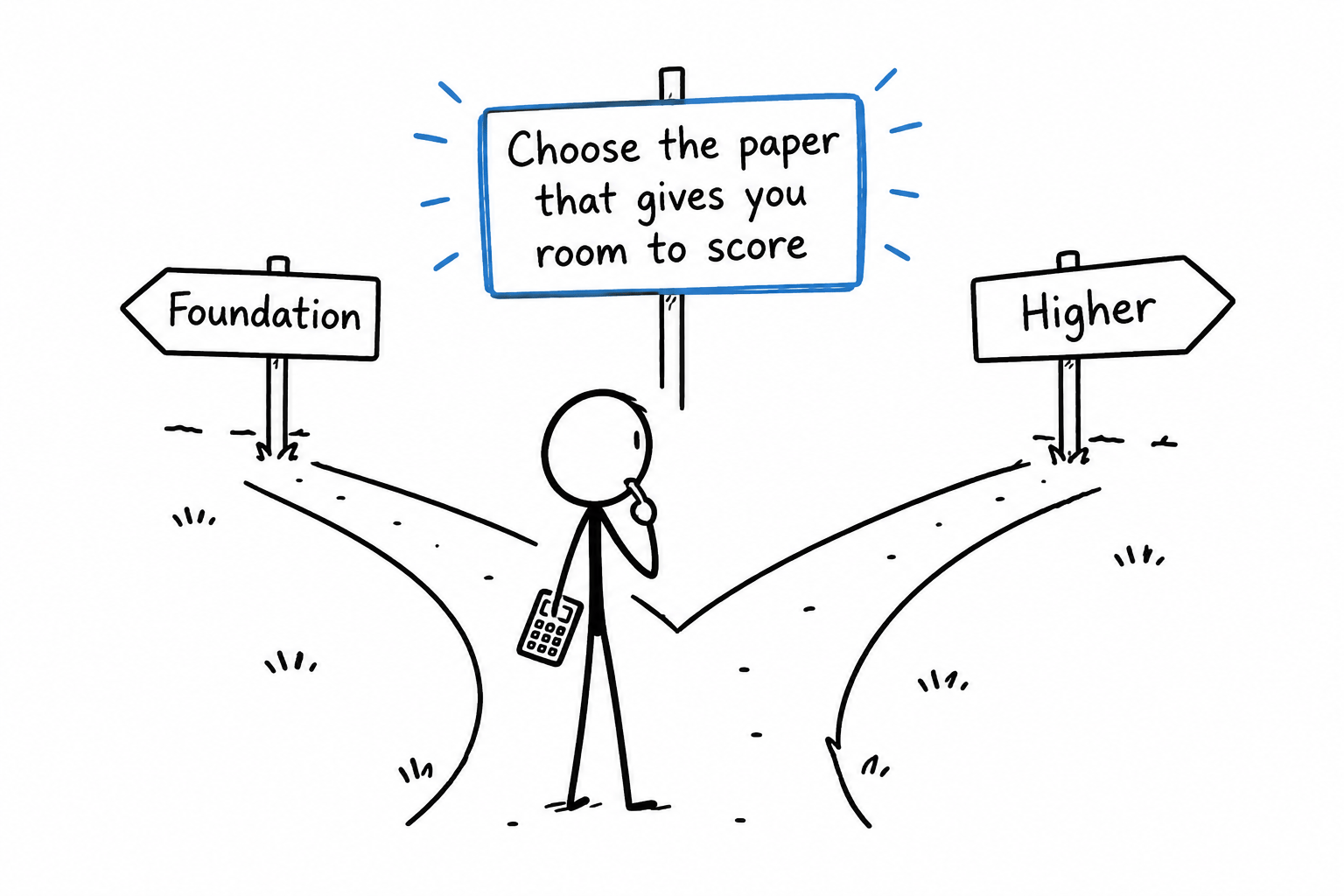 A GCSE resit student choosing thoughtfully between foundation and higher revision paths
Foundation vs higher maths resit difficulty
The difference is not simply that every higher-tier question is harder. Higher papers normally begin with accessible material, then move into questions involving deeper reasoning and higher-only content. Foundation papers also become challenging, particularly near the end, but the overall range of assessed content is narrower.
This creates two different revision burdens.
On foundation tier, a student targeting grade 444 can devote more time to becoming reliable with number, ratio, percentages, basic algebra, measures, geometry, probability and statistics. Reliability matters. Marks are often lost through incomplete methods, calculator errors and weak interpretation rather than unfamiliar advanced mathematics.
On higher tier, those foundations still matter. A student must then add enough higher content and multi-step problem solving to reach the required mark total. Moving to higher does not remove the need to master grade 333 and 444 skills.
A useful test is whether higher questions are difficult but workable, or simply unfamiliar. If you can begin many questions, select relevant methods and collect method marks, higher may be realistic. If large parts of each paper are untouched, the theoretical grade range offers little practical benefit.
Use MathsGenie's grade-organised GCSE resources to identify the point at which your understanding becomes uncertain. Short topic practice can then distinguish a small knowledge gap from a wider tier mismatch.
Understanding grade-boundary risk
Grade boundaries are not fixed in advance. They are set after the exams have been taken and can vary between exam series and exam boards according to the demand of the papers. Last year's boundary can help you interpret a past paper, but it is not a promise about your resit.
This is where GCSE maths tiers create different kinds of risk.
The risk on foundation tier
Foundation offers access to grade 555, but that grade sits at the very top of the tier. A student targeting a 555 generally needs a strong, accurate performance across much of the paper. Small errors can matter when there is little unused grade range above the target.
However, a student targeting grade 444 may benefit from seeing a larger proportion of questions that match the content they have revised. That can make marks more available and improve confidence under time pressure.
The risk on higher tier
Higher provides room to reach grades 666 to 999, and a grade 555 does not sit at the ceiling. Yet the papers contain more demanding material. If too many questions are inaccessible, the student becomes dependent on extracting enough marks from the easier parts.
There is also a limited grade 333 outcome available on higher tier for candidates who narrowly miss grade 444. It is intended as a safety outcome near the grade 444 boundary, not a broad higher-tier route to grade 333. A performance below that range can be ungraded.
The sensible response is not to guess future boundaries. Build a safety margin. If past evidence suggests you need roughly a particular mark total, aim to perform comfortably beyond it in practice rather than repeatedly landing on the edge.
Which tier for a resit targeting grade 4?
For a student whose firm objective is grade 444, foundation will often be the more efficient choice. It gives access to the required grade without adding higher-only content to the revision plan.
This is especially persuasive when previous higher-tier papers contain many blank answers, the earlier result was below grade 444, or revision time is limited. Foundation lets the student concentrate on methods that are more likely to appear throughout the paper.
Higher can still be reasonable if recent timed results show a secure grade 444 or better, the student handles algebra and multi-step problems confidently, or grade 555 may soon become important. One old higher-tier entry is not enough evidence by itself.
Students rebuilding towards a pass may also find the guidance in GCSE maths revision when stuck at a pass grade useful for turning broad revision into targeted practice.
Which tier for a resit targeting grade 5?
Grade 555 is the genuine decision point because both tiers offer it.
Foundation may suit a student who is highly accurate on foundation content, regularly earns strong grade 555 results on complete papers and does not need grade 666. The danger is the ceiling: there is no grade above 555, and reaching the top grade usually demands a consistently strong paper.
Higher may suit a student who has secure core skills, gains marks on higher problem-solving questions and wants a route beyond grade 555. A higher paper may provide more flexibility for someone whose strengths include algebra and reasoning, but only if enough of the paper is accessible.
Do not compare raw marks between tiers as though the papers were interchangeable. Mark each paper against the boundary information for its own board, series and tier. Then repeat the test. Three representative performances say far more than one favourite paper.
MathsGenie's GCSE mini tests can help Edexcel students investigate specific weaknesses before returning to full papers. They include focused practice and mark schemes, making it easier to see whether lost marks come from knowledge or exam execution.
Which tier for a resit targeting grade 6?
If you need grade 666, you must take higher tier. Foundation tier cannot award it.
The more useful question is whether grade 666 is necessary and realistic within your available preparation time. Check course entry requirements directly, then measure your starting point with a complete higher paper. If the gap is manageable, prioritise secure grade 444 and 555 content before adding the higher topics most likely to move your total upwards.
Revision should become a feedback loop:
- Complete a timed section or paper.
- Mark it without being generous to yourself.
- Sort lost marks into knowledge, method, accuracy and time management.
- Relearn the weakest high-value topics.
- Answer fresh questions without notes.
- Retest under timed conditions.
MathsGenie supports that loop with topic lessons, practice questions, video solutions and past-paper resources. The one-month GCSE maths revision plan can provide structure, while the 20-minute maths revision routine is useful when work or college limits your time.
Common mistakes when choosing a resit tier
Choosing higher because it sounds better
The certificate grade matters more than the label on the paper. Choose higher for access to the grades or content you need, not for status.
Choosing foundation because the previous exam felt frightening
A difficult experience can distort judgement. Use new timed evidence. If your knowledge has improved and grade 666 matters, higher may now be appropriate.
Looking only at the grade ceiling
An available grade is not necessarily an attainable grade. Consider how many questions you can meaningfully attempt and how consistently you convert knowledge into marks.
Trusting one past paper
Topic mix, tiredness and familiarity can produce an unusual result. Use several papers and recent specification-matched material. MathsGenie's past-paper marking tools can support careful review rather than leaving a completed paper forgotten in a folder.
Revising only difficult topics
A grade is built from accumulated marks. Securing routine percentage, fraction, ratio and algebra marks is often more valuable than spending an entire evening on one rare challenge.
Ignoring advice from the entry centre
Your school, college or private exam centre makes the entry and knows its procedures. Discuss the decision early, confirm your exam board, and make sure the selected tier has actually been entered.
Make the decision from evidence
A resit is not a replay of the first attempt. You know more now, including where pressure changes your performance and which mistakes keep returning.
For grade 444, foundation is often the clearest path. For grade 555, compare sustained performance on both tiers. For grade 666, choose higher and prepare for the full demand that comes with it. In every case, leave room above the boundary rather than planning to scrape across it.
Start with the MathsGenie GCSE Maths revision hub, select your exam board and turn your next paper into evidence. Use the lessons, practice questions, mini tests, mark schemes and video solutions to repair each gap. The right tier opens the door, but calm, repeated practice is what carries you through it.